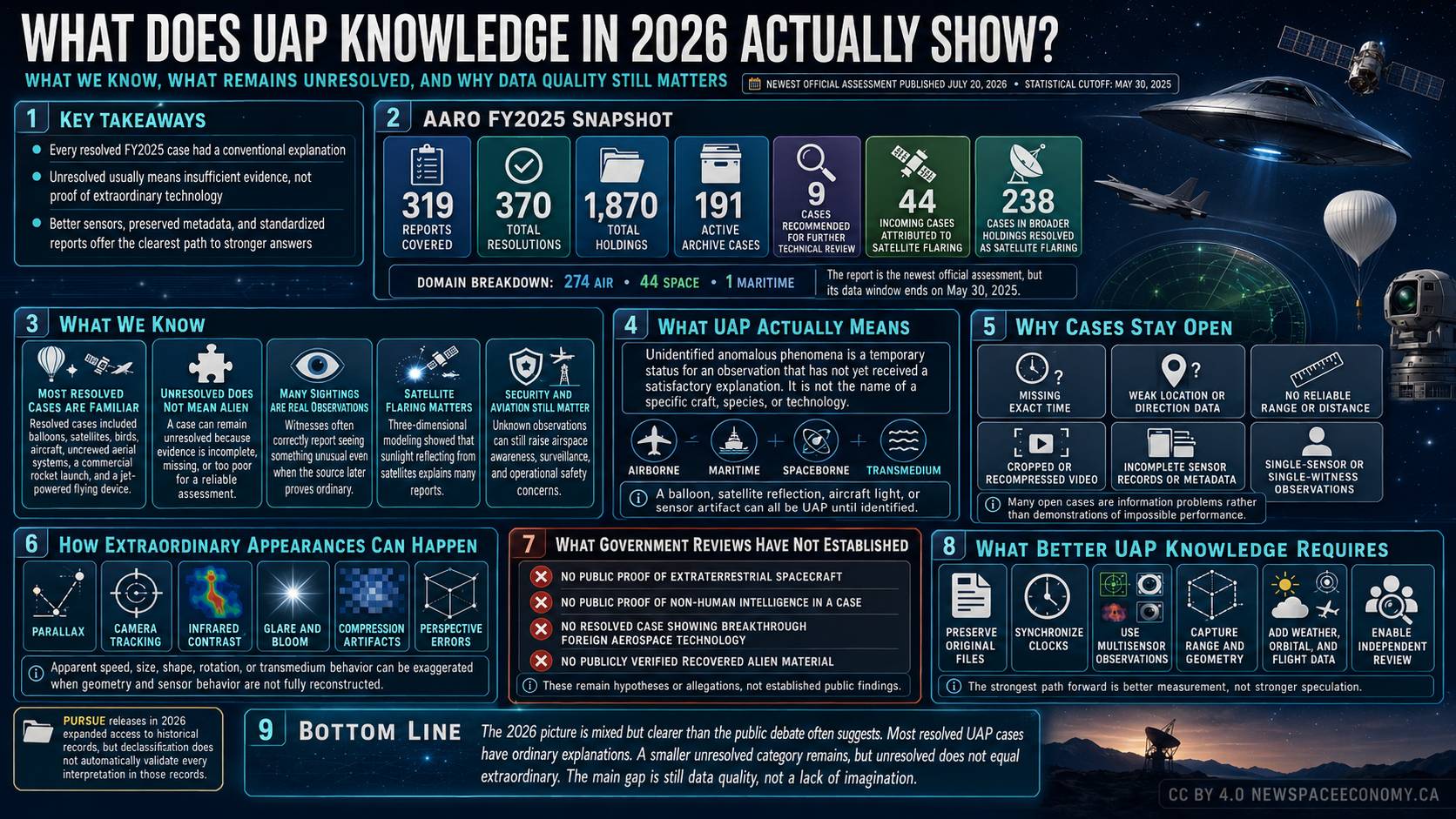
- Key Takeaways
- UAP Knowledge in 2026 After the FY2025 Report
- What the UAP Label Actually Means
- What Public Evidence Supports
- Why Unresolved Cases Stay Open
- How Sensors and Geometry Produce Extraordinary Appearances
- What Government Reviews Have Not Established
- How Scientific Programs Are Improving the Evidence
- Why Secrecy and Culture Keep the Debate Intense
- What Better UAP Knowledge Requires
- Summary
- Appendix: Useful Books Available on Amazon
- Appendix: Top Questions Answered in This Article
- Appendix: Glossary of Key Terms
Key Takeaways
- The FY2025 UAP report found that every resolved case had a conventional explanation.
- Unresolved usually means insufficient evidence, not confirmation of extraordinary technology.
- Better sensors, preserved metadata, and standardized reports offer the clearest path to stronger answers.
UAP Knowledge in 2026 After the FY2025 Report
On July 20, 2026, the All-domain Anomaly Resolution Office (AARO) published its Fiscal Year 2025 Consolidated Annual Report on Unidentified Anomalous Phenomena. It is the newest official statistical assessment available for evaluating UAP knowledge as of July 21, 2026. The publication date requires an immediate qualification: the report’s information cutoff was May 30, 2025. It provides the freshest consolidated government assessment, but it does not cover every event or investigative development between June 2025 and July 2026.
AARO received 319 reports covered by the FY2025 assessment. Of these, 284 concerned events occurring between June 2, 2024, and May 30, 2025, and 35 concerned older events that had not appeared in prior annual reports. The office resolved 114 of the 319 incoming reports and closed another 256 cases from earlier reporting periods. That produced 370 resolutions during the period covered by the assessment.
Every resolved case received a conventional explanation. Identified objects and events included balloons, satellites, birds, aircraft, and uncrewed aerial systems. One case involved a commercial rocket launch, and another involved a person operating a jet-powered flying device. None of the resolved cases indicated a foreign breakthrough aerospace capability.
These findings extend the pattern documented in the FY2024 UAP assessment. Better analysis tends to move cases out of the unidentified category rather than reveal a growing set of objects with demonstrably extraordinary performance. The public record still contains unresolved cases, but unresolved and extraordinary are separate classifications.
AARO’s total holdings reached 1,870 reports as of May 30, 2025. Among the 319 incoming cases, 274 concerned the air domain, 44 concerned the space domain, and one concerned the maritime domain. None of the space-domain assessments originated from space-based sensors. A report classified by apparent location may still come from an observer on an aircraft or the ground, with all the uncertainty created by distance and viewing geometry.
The report placed 191 incoming cases in an active archive because the available information could not support a reliable assessment. Nine reports received a recommendation for further examination by intelligence, scientific, or technical specialists. Those categories should not be combined. An archived case lacks sufficient evidence for classification. A case selected for further work contains enough information or potential relevance to justify added analysis. Neither status confirms unusual technology.
Satellite flaring became one of the most consequential findings. AARO introduced three-dimensional modeling that enabled analysts to resolve 238 reports from its broader holdings as sunlight reflecting from satellites. Among the 319 incoming reports, 44 were attributed to satellite flaring during the covered period. The difference between those figures reflects the office’s continued work on older cases as well as newly submitted reports.
The statistical record supports a restrained assessment. Many UAP reports describe real observations, and many witnesses accurately perceive that they have seen something they cannot identify. Subsequent analysis often shows that the observed source was familiar. A smaller group cannot be resolved because investigators lack distance measurements, original sensor files, synchronized observations, environmental data, or enough time-linked information to reconstruct the event.
The resulting picture differs from the two extremes that dominate public discussion. The evidence does not support dismissing every report as fabrication or incompetence. It also does not support presenting every unresolved case as a vehicle controlled by non-human intelligence. The broader status of UAP research is best described as an identification and measurement problem operating within aviation safety, intelligence, atmospheric science, astronomy, human perception, and sensor engineering.
AARO’s newest report also illustrates why publication dates and data dates must be separated. The report became public in July 2026, but its statistical picture ends in May 2025. Later releases through the Presidential Unsealing and Reporting System for UAP Encounters added historical records and previously classified material, yet those releases do not alter the FY2025 report’s numerical cutoff or automatically resolve the cases contained in the released files.
Four PURSUE tranches had been published by July 21, 2026. The initial release appeared on May 8, followed by releases on May 22, June 12, and July 10. The archive contains documents, imagery, and unresolved case material from different agencies and historical periods. Its value lies in improving access to the government record. The presence of a document in the archive proves that an agency possessed, produced, or reviewed that record. It does not by itself validate every interpretation or allegation contained within it.
What the UAP Label Actually Means
Unidentified anomalous phenomena is a status assigned to an observation that has not yet received a satisfactory explanation. It is not the name of a particular vehicle, species, technology, or physical process. A balloon can be a UAP for several minutes, hours, or years if the evidence needed to identify it remains unavailable.
The older term unidentified flying object encouraged people to imagine a solid machine moving through the atmosphere. That assumption can be misleading. A report may involve a light, an image artifact, a distant aircraft, a satellite reflection, an astronomical source, or an event whose apparent movement came from the observer’s own platform. The word “phenomena” leaves room for observations that do not correspond to one discrete object.
The word “anomalous” also requires care. In scientific work, an anomaly is a result that differs from expectations or cannot be reconciled with the available information. It does not automatically indicate a new law of physics. An anomalous radar return may reveal a calibration problem. An unusual infrared image may result from image processing, glare, or the sensor’s response to temperature differences.
AARO’s official definition of UAP includes anomalous detections associated with airborne, maritime, spaceborne, or transmedium domains. The broader terminology recognizes that military and civilian sensors monitor connected operational regions rather than an isolated sky. A luminous source above the horizon might be interpreted as an atmospheric object even though it is an orbiting satellite. An apparent object near the ocean surface might be an airborne target viewed against water.
That scope improves administrative coordination, yet it makes the category more diverse. Reports may involve different instruments, witness types, environmental conditions, and security implications. Combining every UAP report into a single population can create false patterns because the cases may have no shared cause.
Morphology provides a useful example. AARO reported that spheroidal forms and lights were common descriptions in its FY2025 holdings. A bright point source recorded beyond the resolving power of a camera frequently appears round regardless of the source’s actual shape. A distant aircraft light, satellite reflection, balloon, or star can all produce a small circular image. Shape descriptions alone seldom establish the physical structure of an observed source.
A guide to UAP shapes and classifications can organize testimony, but morphology must remain subordinate to measurement. Investigators need angular size, distance, direction, duration, motion, spectral characteristics, weather conditions, and sensor settings. A witness saying that an object looked triangular is useful testimony. It does not establish that a triangular craft occupied the reported location.
The label also carries no built-in judgment about a witness. Pilots, radar operators, police officers, astronomers, and members of the public can make sincere reports that later receive ordinary explanations. Expertise improves recognition within familiar conditions, but no person has complete knowledge of every atmospheric event, satellite configuration, aircraft lighting system, or sensor artifact.
An aviation specialist may recognize a conventional aircraft faster than a member of the public. That same specialist may lack orbital data needed to identify a satellite flare. An astronomer may identify Venus immediately but have limited experience interpreting a military infrared display. Reliable investigation respects expertise without treating professional status as a substitute for supporting data.
The administrative meaning of UAP can be summarized through three stages. At the time of observation, the source is unidentified. During investigation, analysts compare the evidence with known objects and effects. After investigation, the case may be identified, probably identified, unresolved because of missing data, or retained for further work.
That approach resembles the system used by France’s Group for Studies and Information on Unidentified Aerospace Phenomena, commonly known as GEIPAN. The organization separates cases that are identified, probably identified, unidentified because information is missing, and unidentified after investigation. Its method demonstrates why one unresolved percentage cannot describe the quality of every unresolved case.
A case that lacks the exact time and viewing direction may be impossible to evaluate. Another may contain calibrated imagery from several sensors but still resist identification. Both can appear under an unresolved heading, although their evidentiary value differs considerably.
GEIPAN’s published methodology also distinguishes consistency from residual strangeness. Consistency concerns the amount and quality of available information. Strangeness concerns how difficult the event remains to explain after investigation. A poorly documented case can look mysterious but possess little analytical value. A well-documented case with persistent unexplained characteristics deserves more attention because investigators can test competing explanations against a stronger factual record.
This distinction is central to UAP knowledge in 2026. The category tells investigators where uncertainty remains. It does not tell them what physical explanation will eventually replace that uncertainty.
What Public Evidence Supports
The strongest public finding is that familiar objects and effects explain a substantial share of cases once investigators obtain enough information. This does not mean that one explanation covers every report. It means that the identified population is dominated by known phenomena rather than verified machines displaying impossible performance.
Balloons remain common because they come in many sizes, materials, and configurations. Small reflective balloons can produce intense flashes. Research balloons may operate at altitudes that make their size and motion difficult to judge. Clusters can change shape as individual balloons move relative to one another.
AARO’s Al Taqaddum case resolution illustrates the problem. Infrared footage recorded over an Iraqi air base in 2017 showed an object that appeared unusual against the background. AARO assessed with high confidence that it matched a cluster of fully and partly inflated balloons and displayed no anomalous capability.
Birds also create misleading imagery. A distant bird may occupy only a few pixels and appear as a featureless object. Thermal contrast can make an animal visible even when wings and body details remain below the sensor’s spatial resolution. Camera stabilization can keep the source centered and remove visual clues that would otherwise reveal its motion.
Aircraft create another large class of reports. Landing lights viewed nearly head-on may appear stationary before seeming to move abruptly as the aircraft turns. Atmospheric haze can obscure navigation lights or the aircraft body. Flight-tracking records help with identification, but military activity, incomplete transponder coverage, time errors, and data-retention limits can complicate reconstruction.
Satellites have become more prominent as the orbital population has grown. Sunlight can reflect from a spacecraft’s solar arrays, antennas, or body surfaces and create a bright point that appears, fades, or repeats as several spacecraft cross similar geometries. AARO’s technical paper on satellite flaring and UAP observations explains how such reflections can be misinterpreted as formations or luminous objects at extreme altitude.
Commercial launch activity can produce unfamiliar effects far from a launch site. Rocket exhaust expanding in the upper atmosphere may form broad luminous clouds. Fuel venting, stage separation, and reentry can generate moving shapes that look unlike ordinary aircraft. One report in the FY2025 assessment was identified as a commercial rocket launch, demonstrating how space activity now enters UAP casework directly.
Atmospheric effects remain another source. Ice crystals, temperature layers, clouds, and electrical activity can alter the apparent position or brightness of distant lights. No single atmospheric mechanism explains all cases, and invoking weather without analysis would be inadequate. Weather records still form an important part of responsible case reconstruction.
Public evidence also supports the existence of perception errors that do not imply poor judgment. Human vision estimates speed and distance by combining size, background, contrast, and motion cues. A small nearby object and a large distant object can create the same angular image. With no reliable distance, calculated speed may be wrong by orders of magnitude.
The same principle applies to cameras. A sensor records angular movement across an image, not physical speed by itself. Investigators must know the target’s range and account for the observing platform’s motion. Without those values, a fast-moving image does not prove a fast-moving object.
AARO’s Puerto Rico case reconstruction provides a documented example. Infrared footage from 2013 seemed to show one object moving rapidly, dividing into two, and entering the ocean. Reconstruction of the aircraft’s path and viewing direction supported a different interpretation: two objects traveled close together in a straight line at approximately wind speed and did not enter the water.
This case does not establish that every apparent transmedium event has the same explanation. It shows that camera perspective and incomplete spatial cues can create a compelling but inaccurate narrative. Similar issues affect interpretations of the GoFast footage and other sensor recordings in which background motion makes an object appear faster than a geometric reconstruction supports.
The conventional explanations for UAP reports do not require every witness to have seen the same thing. A responsible explanatory model accepts a mixed population: balloons in some cases, satellites in others, and insufficient evidence in another group.
Public evidence also supports treating UAP as an airspace-awareness concern. An unidentified observation near a training area may indicate an unauthorized drone, a balloon, sensor interference, or an aircraft operating without expected identification. Each possibility can matter operationally even when it has no connection to extraterrestrial life.
The FY2025 report described two accounts involving alleged electronic or avionics interference near operational aircraft. AARO had not determined whether the observed phenomena caused those effects as of the report’s May 30, 2025 cutoff. Temporal proximity alone does not establish causation.
AARO also received 50 reports concerning uncrewed aircraft near U.S. nuclear facilities, weapons locations, and launch sites. None were submitted as UAP. That distinction prevents the UAP category from absorbing known drone incidents and obscuring a more direct security problem.
UAP knowledge in 2026 consequently supports several firm propositions. People observe events they cannot identify. Known objects account for many cases. Sensors and perception can produce misleading impressions. Some reports retain too little information for resolution. No publicly verified case has established an extraterrestrial vehicle.
Why Unresolved Cases Stay Open
An unresolved case is frequently an information failure rather than a mystery with a stable set of extraordinary properties. Investigators may know what a witness perceived but lack the records needed to determine what produced that perception.
Time is often the most basic missing element. A difference of several minutes can change which satellites, aircraft, planets, or rocket stages occupied the viewing area. Approximate time statements may be adequate for recounting an experience, but they can prevent precise correlation with external databases.
Location creates a similar problem. Knowing the witness’s city may be insufficient if the investigation requires an exact observation point, elevation, viewing direction, and horizon profile. A light seen above a building may align with a satellite from one street but not from another.
Direction and elevation are commonly described with broad terms such as north or high in the sky. Those descriptions introduce large uncertainties. A compass bearing and measured angular elevation greatly reduce the search area for possible astronomical or orbital sources.
Sensor files can lose information as they move through communication channels. A video posted online may have been cropped, recompressed, stabilized, or stripped of metadata. Display symbology may not preserve all original instrument settings. A short excerpt can omit the moments before and after the event that reveal how the source entered or left the field of view.
AARO states that a lack of timely, usable sensor data remains the principal constraint on its ability to resolve cases. Its active archive contained 191 of the 319 reports assessed in the FY2025 cycle because analysts lacked enough information to determine whether the reported behavior matched known natural or technological causes. These files remain eligible for renewed examination if added evidence or better analytical methods emerge.
The archive should not be treated as a collection of 191 confirmed craft. It includes cases that cannot support either an ordinary explanation or an extraordinary one. A missing answer is logically different from evidence favoring one particular answer.
Nine reports received recommendations for more technical examination. This smaller category deserves attention because AARO judged that further specialist work could be productive. The public report does not provide enough detail to characterize each event or predict its eventual resolution.
The distinction between evidentiary absence and positive anomaly is frequently lost in public discussion. A report may claim rapid acceleration yet contain no calibrated distance measurement. The acceleration exists in the narrative, but it has not been established as a physical measurement.
A stronger case would require independent observations that agree on time, location, direction, and movement. Radar range combined with calibrated imagery would permit a physical speed estimate. Spectral data could help identify reflected sunlight, thermal emission, or a propulsion-related source.
The number of witnesses does not automatically solve the problem. Several people standing together can share the same viewing geometry and make the same mistaken distance assumption. Independent observers at separated locations provide more information because their sight lines can support triangulation.
Witness testimony still matters. It helps investigators reconstruct sequence, apparent form, duration, behavior, and context. Testimony becomes more powerful when paired with original files and independent records rather than treated as a complete measurement system.
An objective analysis of UAP characteristics requires separating reported characteristics from measured characteristics. “No visible wings” is a visual description. “No aerodynamic lifting surface” is a physical conclusion that usually requires much stronger imagery or recovered material.
The same separation applies to transmedium claims. A point of contrast appearing near a waterline does not establish that a solid object entered the water. Investigators need continuous tracking, stable geometry, and evidence that rules out occlusion, perspective, and two separate sources.
Classification can compound uncertainty. Military sensors may reveal their capabilities through resolution, frame rate, tracking performance, or geographic placement. Agencies may release degraded imagery to protect those capabilities. The public then receives less information than government analysts possess, which can make an ordinary resolution difficult to verify independently.
The opposite problem also occurs. A classified source may have detected something but still lack the range, context, or data quality needed for identification. Classification protects information. It does not guarantee that the protected information provides an answer.
Report volume can be misleading as well. More reports may reflect easier submission, reduced stigma, new sensor coverage, heightened attention, or a burst of satellites visible under favorable lighting. A rising count does not by itself demonstrate that an unknown physical population has increased.
AARO acknowledged collection bias toward the continental United States, nearby waters, and locations where U.S. military operations place more sensors and personnel. Maps of reports consequently show where collection occurs as much as where phenomena occur.
Cases remain open because investigation has limits. Older sensor records disappear, witnesses remember events imperfectly, databases contain gaps, and orbital elements become less reliable when reconstructed long after an event. Some cases may never receive an answer, even when the original cause was ordinary.
That outcome is scientifically acceptable. A valid method must permit insufficient evidence as a conclusion. Forcing every report into either a dismissed case or an alien case replaces investigation with advocacy.
How Sensors and Geometry Produce Extraordinary Appearances
Many celebrated UAP images are difficult to interpret because cameras and human eyes do not record the world as direct physical measurements. They record light entering an instrument from a particular direction, under particular settings, from a moving or stationary platform.
Angular size is one source of confusion. A camera may show an object occupying 10 pixels, but those pixels do not reveal whether the source is a small object nearby or a large object far away. Physical size cannot be calculated without distance.
Speed creates the same difficulty. An object can cross the field of view rapidly because it is moving quickly, because it is close, because the camera is rotating, or because the observing aircraft is moving. More than one cause can contribute at the same time.
Parallax occurs when the observer’s movement makes a nearby source appear to move against a distant background. Looking sideways from a fast aircraft can make a slow object seem to race over the ocean or ground. AARO’s paper on forced perspective and parallax explains why these effects can produce inaccurate estimates of size, speed, and direction.
Camera tracking can intensify the impression. A gimbal or software tracker attempts to hold a source near the center of the image. The stabilized display removes some evidence of the camera’s rotation, encouraging the viewer to attribute all background movement to the object.
Infrared imagery adds another layer. Infrared systems display temperature contrast rather than visible color. A hot engine, reflected radiation, a cloud edge, or a cooler object against a warm background can produce unfamiliar shapes. Automatic gain control changes the displayed contrast as the scene changes.
Glare may enlarge bright sources beyond their true angular dimensions. A small light can bloom into a rounded or elongated form. The displayed outline may represent the sensor’s response rather than the source’s physical boundary.
Compression adds blocks, halos, and apparent edge movement. Online copies may have passed through editing software and social platforms before analysis. Each step can remove detail and create artifacts that were absent from the original recording.
A distant source often appears smooth because the camera lacks enough resolution to show structure. Describing such an image as a featureless sphere can overstate what the pixels establish. The defensible statement is that the available image does not resolve identifying details.
Satellite flares demonstrate how geometry can produce behavior that looks controlled. A spacecraft becomes bright when the Sun, reflective surface, and observer align. It fades when that geometry changes. Several satellites in similar orbits can brighten in sequence, creating the appearance of lights appearing at a fixed point and departing in formation.
AARO reported that its three-dimensional modeling capability resolved 238 reports as satellite flaring. The method combines observer location, time, viewing direction, orbital data, and illumination geometry. Its success shows that stronger analysis can identify recurring causes that once left many cases open.
The scientific analysis of UAP reports becomes more reliable when hypotheses produce testable predictions. A satellite hypothesis predicts a track, timing, brightness pattern, and illumination condition. A balloon hypothesis predicts movement related to winds at a particular altitude.
An extraterrestrial-vehicle hypothesis can be tested only if it produces equally specific predictions. Explaining every missing detail by invoking superior technology makes the claim difficult to falsify. Scientific value comes from evidence that distinguishes one hypothesis from competing explanations.
Apparent rotation provides another example. A sensor housing may rotate to maintain tracking, causing glare patterns to rotate within the display. Image-processing steps can alter orientation. Investigators must separate movement in the optical system from movement of the observed source.
A sudden disappearance may result from loss of contrast, movement outside the sensor’s field, entry into cloud, or tracking failure. It does not establish instantaneous acceleration unless positional data show that physical movement occurred.
Apparent entry into water can result from perspective, background blending, or an obscured flight path. AARO’s Puerto Rico reconstruction showed how two objects moving at wind speed could produce a video interpreted as one object dividing and entering the ocean.
Radar offers valuable distance and speed information, yet radar returns also require interpretation. Propagation effects, interference, clutter rejection, track association, and software filtering can affect a displayed target. Radar confirmation becomes stronger when analysts preserve raw data and correlate it with independent optical or infrared observations.
Several sensor types observing the same event offer the most productive path. Optical cameras can show visible form. Infrared systems record thermal contrast, and radar can provide range or velocity. Triangulated stations can estimate distance without relying on assumptions about size.
The scientific lesson is not that every extraordinary appearance is an artifact. It is that an appearance cannot establish extraordinary performance until investigators reconstruct the full observation system. UAP knowledge in 2026 depends as much on understanding cameras and geometry as on studying the sources that those cameras record.
What Government Reviews Have Not Established
No publicly released evidence has established that a UAP is an extraterrestrial spacecraft. NASA’s UAP questions and answers state that the agency has found no credible evidence connecting UAP with extraterrestrial technology and that the limited supply of high-quality observations prevents firm scientific conclusions about the phenomenon.
That position does not claim that life exists only on Earth. NASA conducts extensive astrobiology, exoplanet, biosignature, and technosignature research. The possibility of life elsewhere is a legitimate scientific subject, but the evidence supporting that possibility is separate from evidence about objects reported in Earth’s atmosphere.
The distinction prevents two questions from being merged. One concerns whether life or intelligence exists beyond Earth. Another concerns whether a particular light, radar track, image, or witness account represents technology created by that intelligence.
AARO’s FY2025 assessment found no resolved cases indicating advanced foreign breakthrough technology. It also reported no evidence that the U.S. government or a private organization had captured or exploited materials derived from UAP.
AARO arranged testing by Oak Ridge National Laboratory of metallic specimens publicly alleged to have extraordinary properties. A January 2026 materials assessment described one specimen as consistent with an ordinary aluminum alloy used in common applications. Laboratory analysis found manufacturing features associated with conventional casting rather than a component designed for an advanced aerospace purpose.
This approach illustrates the proper standard for physical evidence: documented custody, material characterization, reproducible measurements, and comparison with known manufacturing methods. A remarkable history attached to a specimen does not substitute for evidence contained within the specimen itself.
Claims of hidden retrieval and reverse-engineering programs have appeared in testimony, interviews, books, and congressional discussion. The fact that named individuals made such statements is part of the historical record. It does not independently verify the alleged programs, materials, or vehicles.
Public testimony can provide investigative leads. Verification requires documents whose authenticity and meaning can be established, witnesses with direct and corroborated access, physical evidence with traceable custody, or measurements that independent laboratories can reproduce.
AARO’s Historical Record Report concluded in 2024 that U.S. government investigations had not confirmed extraterrestrial technology and that several alleged programs were nonexistent, misidentified, or misunderstood. Critics have disputed the scope and completeness of that review. The public remains unable to resolve the dispute through assertion alone because much of the contested information is said to be classified or compartmented.
The history of official UAP investigation, from Project Sign through AARO, is documented in earlier government inquiries. Those programs operated under different mandates and evidence standards. Their changing names do not establish one uninterrupted secret research effort.
Secrecy is real within defense and intelligence work. Sensor capabilities, collection locations, intelligence methods, and foreign platforms can all justify classification. A classified UAP file may conceal how information was collected rather than conceal an exotic explanation.
This creates an enduring public problem. A government may provide a conclusion without releasing enough data for independent replication. Members of the public who distrust the institution can interpret every withheld detail as evidence of a more extraordinary explanation.
The logical boundary remains straightforward. A lack of public proof cannot settle every possibility involving classified records. It does set the limit on what can responsibly be presented as established public knowledge.
No public dataset has demonstrated repeated vehicles accelerating beyond known physical limits under controlled measurement. No publicly authenticated material has displayed properties requiring a non-human origin. No peer-reviewed case has produced a chain of evidence connecting an observed UAP to an extraterrestrial manufacturer.
Claims about non-human intelligence consequently remain hypotheses or allegations. They may motivate investigation, but they should not appear in the same factual category as identified satellite flares, documented balloon cases, or reconstructed sensor geometry.
The same restraint applies to foreign technology. An unidentified observation near a sensitive facility may justify security attention even when evidence does not support an exotic craft. Small drones, surveillance balloons, spoofing, electronic interference, or classified domestic testing can create operational concerns.
The FY2025 report described narrative accounts near sensitive locations that appeared to allege capabilities beyond known systems. Those accounts lacked accompanying technical data. AARO treated the possibility as a potential threat requiring data and analysis, not as proof that such performance occurred.
Reports of health effects also require careful treatment. AARO stated that it had not received a UAP report in which a reporter described adverse health effects associated with the experience through the FY2025 information cutoff. That finding does not adjudicate every claim made outside AARO’s system, but it defines the evidence in the office’s holdings.
Government reviews have established uncertainty, reporting gaps, conventional resolutions, and reasons for continued collection. They have not established alien visitation, recovered extraterrestrial machines, verified non-human bodies, or operational technology that violates known physics.
How Scientific Programs Are Improving the Evidence
NASA’s 2023 Independent Study Team Report moved the discussion toward measurement design rather than retrospective argument. The study examined how scientific tools, public data, aviation systems, and standardized observations could improve future UAP analysis. It was not commissioned to reopen every famous historical case.
NASA’s public position in July 2026 remained cautious. The agency did not operate a dedicated UAP search program, and it stated that the available high-quality observations were too limited to support scientific conclusions about the nature of the phenomenon. NASA’s Earth-observation data can still assist researchers when atmospheric conditions, clouds, lightning, fires, or related environmental information are relevant.
The government and private organizations studying UAP do not share one mandate. Defense organizations focus on domain awareness and security. Scientific groups emphasize measurement, public data, or hypothesis testing. Civil reporting bodies may concentrate on collecting witness accounts.
The Galileo Project at Harvard University has proposed ground-based observatories using several instruments to record unusual aerial objects. Its published observatory methodology combines optical cameras with infrared equipment, radar receivers, acoustic instruments, and environmental sensors. Observations from more than one location could permit triangulation and physical estimates that isolated videos cannot provide.
The Galileo Project’s UAP research represents an attempt to gather new data under known conditions. Controlled observatories can document calibration, sensor settings, weather, location, and time from the outset. That design avoids depending entirely on recordings made for another purpose and discovered after an event.
A scientific observatory still faces difficulties. Most UAP reports are unpredictable and brief. A fixed station observes only a limited volume of sky, and automated systems must distinguish aircraft, birds, balloons, insects, satellites, meteors, and image artifacts before isolating events that warrant examination.
False positives are expected in any detection program. A system sensitive enough to capture rare events will also record large numbers of ordinary events. Success should be measured by classification accuracy and data quality rather than by the quantity of unexplained detections.
Research published on the Galileo Project’s all-sky infrared camera array described approximately 500,000 reconstructed aerial trajectories recorded during five months of commissioning. After automated screening and manual review, 144 trajectories remained ambiguous. The research team considered them likely to be ordinary objects but reported that distance, kinematic information, or added sensor modalities would be needed for stronger identification.
That result demonstrates the difference between an unexplained detection and evidence of exceptional performance. A trajectory can remain ambiguous because the instrument lacks enough information to classify it, even when the researchers consider a familiar source probable.
AARO’s UAP records and information papers include a July 2026 special issue from the Naval Postgraduate School addressing UAP science and analysis. The publication reflects increased institutional attention to sensor systems, data standards, operational reporting, atmospheric effects, and analytical methods. Academic publication does not confirm any particular UAP explanation, but it can improve the questions and methods applied to the subject.
Canada’s Sky Canada Project approached the subject through public administration and science advice. The project did not seek to determine the physical nature of every UAP or investigate alleged extraterrestrial vehicles. It examined how Canadian institutions receive, manage, and communicate public reports.
The final Sky Canada assessment found that reports were scattered among government and non-government organizations. Few departments investigated them unless they intersected with transportation safety, security, or another defined mandate. The project identified a lack of coordinated reporting and standardized data collection.
A 2024 survey commissioned for the project found that 27% of 1,008 respondents said they had observed an object or phenomenon in the sky that they could not identify. Only 10% said they had reported the observation, and 40% did not know where a report should be submitted. The figures describe survey responses rather than a verified rate of unexplained physical events.
The Sky Canada Project demonstrates that reporting design is itself a research issue. A national system could collect standardized times, locations, directions, media files, witness information, and consent for follow-up. Without that structure, many potentially useful observations lose value before scientific analysis begins.
France provides a longer-running model. GEIPAN, a unit of the French space agency CNES, has collected, investigated, archived, and published reports since 1977. It uses a multidisciplinary method that considers physical evidence and human factors, then classifies cases according to evidentiary consistency and remaining strangeness.
GEIPAN explicitly states that it is not an extraterrestrial-life research organization and does not provide a national security alert service. Its method preserves an unidentified category without turning that category into a claim about origin.
International comparison reveals a shared lesson. AARO, NASA, Sky Canada, GEIPAN, and independent academic projects differ in mission, yet each encounters the same constraint: weak initial data cannot be repaired completely by later analysis.
Scientific progress depends on converting spontaneous sightings into instrumented observations. That requires calibrated sensors, preserved originals, common metadata, independent review, and publication of both identified and unresolved results. The process may produce fewer dramatic claims, but it can produce stronger knowledge.
Why Secrecy and Culture Keep the Debate Intense
UAP discussion does not occur within science alone. It carries more than 75 years of military secrecy, Cold War history, popular entertainment, disputed documents, official denials, witness stigma, and changing government terminology.
Secrecy began for reasons broader than UAP. Governments protect aircraft performance, radar capabilities, surveillance locations, intelligence sources, and military exercises. A witness can observe a classified aircraft without knowing its identity, and officials may decline to explain it publicly.
This creates an asymmetric information problem. The observer possesses an experience but lacks institutional data. The government may possess relevant data but cannot release it. Neither side can fully demonstrate its interpretation to the other.
Historical cases involving classified aircraft contributed to UFO reports. Programs testing high-altitude reconnaissance aircraft or stealth technology operated beyond public knowledge. That history makes suspicion understandable, but it does not establish that every current classification dispute conceals similar technology or non-human hardware.
Stigma produced another information loss. Pilots and military personnel sometimes feared that reporting an unusual observation could damage their professional standing. Formal reporting channels and official recognition have reduced that pressure, increasing the number of reports available for examination.
A higher reporting rate can then be interpreted in conflicting ways. One group sees evidence of more objects. Another sees the result of better reporting. Distinguishing those explanations requires consistent collection over time and adjustments for sensor coverage, public attention, and reporting rules.
Popular culture supplies ready-made narratives. Saucer-shaped craft, hidden hangars, government retrieval teams, and alien occupants became familiar story elements long before current AARO procedures existed. New observations are frequently interpreted through those cultural templates.
Social media accelerates the process. A short video can reach millions of viewers before the original file, date, location, or witness account becomes available. Repeated reposting separates imagery from context and rewards the most dramatic interpretation.
Institutional communication can worsen distrust when releases arrive late or offer conclusions without enough supporting material. Government agencies may have valid security reasons for withholding sensor details. Public confidence still suffers when independent analysts cannot reproduce the result.
The history of UAP secrecy and speculation shows how real classification can become joined to claims that exceed available evidence. Authentic secrecy proves that information has been withheld. It does not identify the content of every withheld record.
The United States expanded public disclosure in 2026 through PURSUE. By July 21, four releases had appeared, beginning on May 8 and continuing through July 10. The collection included declassified imagery, agency documents, witness narratives, and historical records.
Declassification increases access but does not convert every document into validated evidence. Intelligence files often preserve raw reports, correspondence, sketches, or unresolved observations. A document proves that an agency received or discussed a claim. It does not automatically prove the claim’s physical interpretation.
The distinction is essential when reading declassified records. Investigators must ask who created a record, when it was created, what evidence accompanied it, whether later analysis resolved it, and what institutional purpose the record served.
The National Archives UAP collection places records received from federal agencies into Record Group 615. Archival access can improve historical scholarship by showing how agencies recorded and circulated reports. It seldom supplies the calibrated scientific measurements required to determine the source of an old observation.
Congressional hearings have given witnesses a formal setting to describe concerns and allegations. Public testimony can expose administrative failures or encourage investigation. Evidentiary weight still depends on whether testimony rests on direct observation, documentary access, hearsay, or interpretation.
Disputes over terminology add friction. UFO often implies alien craft in public conversation. UAP was adopted partly to reduce that assumption and include observations beyond traditional flying objects. Skeptics may view the new term as rebranding, and advocates may view it as official validation.
Neither interpretation captures its administrative function. The terminology permits agencies to collect reports without deciding their cause in advance. Its value depends on whether that collection produces analyzable data and transparent resolutions.
Trust cannot be restored by disclosure volume alone. Agencies need to explain methodology, release supporting calculations when security permits, correct errors, and distinguish unresolved cases from cases undergoing substantive technical review. Researchers outside government need to apply comparable standards to favored and unfavored explanations.
The debate persists because evidence, secrecy, identity, and worldview have become connected. For some people, UAP represent proof that authorities conceal a discovery that would alter humanity’s understanding of itself. For others, the subject represents poor reasoning and media sensationalism. Both positions can become resistant to new information.
UAP knowledge in 2026 is strongest where those identities matter least. A case should become more or less persuasive based on data quality, reproducibility, and successful elimination of alternatives. The social meaning of a conclusion cannot determine whether the conclusion is true.
What Better UAP Knowledge Requires
A useful UAP report begins with precise observation details. Exact time, location, viewing direction, elevation angle, duration, weather, witness movement, and device information provide the basis for later reconstruction.
Original files should be preserved. Investigators need the earliest available version of every photograph or recording, including metadata. Cropped or recompressed copies may still have public value, but they should not replace the source material.
Military and aviation systems need synchronized clocks. Radar, infrared video, aircraft navigation, voice communications, and mission records become far more informative when analysts can align them accurately. Small timing differences can alter the apparent relationship between tracks.
Range information is necessary for claims about size or speed. Radar, laser ranging, stereoscopic imaging, or triangulation from separated sites can provide distance. Without range, a physical performance calculation rests on an assumption.
Sensor calibration should be documented. Analysts need to know field of view, optical zoom, frame rate, stabilization behavior, gain settings, tracking mode, and known artifacts. A display symbol should never substitute for the underlying instrument record.
Environmental data belong in the same case package. Weather radar, atmospheric profiles, wind direction, cloud layers, astronomical positions, satellite ephemerides, flight records, and launch notices can eliminate candidate explanations or support them.
Automated correlation can reduce investigative workload. Software can compare incoming reports against satellite passes, aircraft tracks, astronomical objects, rocket launches, weather events, and known sensor effects. Automation should produce reviewable results rather than an unexplained classification.
AARO’s satellite-flare modeling shows the benefit. The office used geometry and orbital information to resolve hundreds of reports that might otherwise have remained in its holdings. Such tools can be published as methods so outside researchers can test similar observations.
Independent replication should become routine for high-interest cases. Outside specialists may identify assumptions or errors that an internal team missed. Government analysts may possess context unavailable to public researchers, so productive review requires enough declassified data to compare methods.
Case categories need clearer public definitions. Resolved, probably resolved, active investigation, insufficient data, and unresolved after technical analysis describe different evidentiary conditions. Publishing those categories separately would reduce inflation of the unresolved total.
Statistical releases should disclose changes in collection practices. Added pilot reporting, new sensors, public campaigns, or altered submission criteria can increase counts without a change in underlying events. Analysts need denominators such as flight hours, sensor coverage, and reporting population where those figures are available.
Civilian reporting systems can improve geographic coverage. Canada’s Sky Canada findings show how fragmented channels discourage reporting and produce inconsistent information. A standard national form could guide witnesses through measurements that have investigative value.
Witness protection and respectful treatment also matter. People are less likely to provide prompt, detailed information when they expect ridicule. Respect does not require accepting every interpretation. It requires separating the credibility of a person from the accuracy of an identification.
Scientific programs should publish identified cases as well as anomalies. Conventional resolutions create training data for automated classification and teach observers which conditions generate confusion. A database containing only unexplained events cannot provide an accurate comparison population.
Null results deserve publication. A sensor network that records thousands of aircraft, birds, balloons, and satellites but no event with verified extraordinary performance still produces useful knowledge. Its findings constrain hypotheses and improve estimates of occurrence rates.
International cooperation could expand coverage and methodological comparison. GEIPAN’s classification system, Canada’s administrative review, NASA’s data recommendations, and AARO’s operational casework address different parts of the problem. Shared minimum data standards would make cases easier to compare without requiring identical institutional mandates.
Researchers should define evidence thresholds before examining headline cases. A claim of unusual acceleration requires calibrated position and time. A claim of transmedium travel requires continuous tracking across the boundary. A claim of manufactured material requires custody records and reproducible laboratory analysis.
Claims of non-human origin require an even higher standard because ordinary and human-made alternatives are numerous. Persuasive evidence could include a recoverable device with demonstrably non-terrestrial manufacture, repeated instrumented observations under controlled conditions, or communicative behavior that independent teams can verify.
No public case met that standard by July 21, 2026. That finding should not stop observation or inquiry. It should determine the wording used to describe the results.
The most productive UAP program would be designed to identify ordinary causes efficiently and preserve exceptional data carefully. It would treat a balloon resolution as successful work rather than a disappointment. It would also retain well-documented anomalies without assigning them an origin that the evidence cannot support.
Progress will come from fewer assumptions and better measurements. More cameras alone will not solve the problem if their files lack metadata or distance information. Better-designed collection can turn future incidents from ambiguous stories into testable events.
Summary
The newest official UAP assessment presents a mixed but increasingly measurable field of inquiry. AARO resolved hundreds of cases through conventional explanations, with satellite flaring accounting for a substantial share. It retained other reports because the available evidence could not support a conclusion and referred a smaller group for further technical work.
NASA, AARO, Canada’s Sky Canada Project, France’s GEIPAN, and academic initiatives converge on one methodological point: data quality determines how much can be learned. They do not share every mission or interpretation, but none has publicly established extraterrestrial technology as the source of a UAP.
What remains unknown cannot be compressed into one explanation. Some cases may concern ordinary objects whose identifying evidence was lost. Others may involve drones, classified systems, unusual atmospheric conditions, or sensor behavior. A limited group may retain characteristics deserving deeper investigation.
The unresolved category should be protected from two opposite errors. Automatic dismissal can discard information relevant to aviation, security, or science. Automatic promotion to non-human technology replaces missing evidence with a preferred answer.
The deeper change in UAP knowledge in 2026 is procedural. Governments and researchers are building reporting channels, publishing case reconstructions, applying orbital models, testing alleged materials, and designing multimodal observatories. Those activities do not promise a dramatic revelation. They offer a method for separating what was observed from what was inferred.
Appendix: Useful Books Available on Amazon
- UFOs: Generals, Pilots, and Government Officials Go on the Record
- American Cosmic
- UFOs and Government
- After the Flying Saucers Came
- Passport to Magonia
Appendix: Top Questions Answered in This Article
What Does UAP Mean?
UAP means unidentified anomalous phenomena. It is a temporary classification for observations in air, space, maritime, or related domains that investigators cannot immediately attribute to a known source. The term does not identify a particular kind of craft or imply extraterrestrial origin.
Does Unresolved Mean That a UAP Is Extraordinary?
No. An unresolved classification commonly means that investigators lack enough reliable information to select an explanation. A case may have no precise time, distance measurement, original sensor file, or independent observation, making both ordinary and extraordinary conclusions unsupported.
Have Government Investigators Confirmed Alien Spacecraft?
No publicly released U.S. government assessment has confirmed that a UAP is an alien spacecraft. AARO reports that resolved cases have conventional explanations, and NASA states that available data do not support linking UAP to alien technology.
How Many Reports Did AARO Receive in Its FY2025 Assessment?
AARO received 319 reports covered by the FY2025 assessment. It resolved 114 of those incoming reports and another 256 older cases, producing 370 resolutions during the reporting period. Its total holdings reached 1,870 reports by May 30, 2025.
Why Did AARO Archive 191 Reports?
AARO placed 191 incoming cases in an active archive because the evidence was insufficient to determine whether the reported event matched natural phenomena or known technology. The cases can be reopened if added information or improved analytical methods become available.
Why Are Satellites Mistaken for UAP?
Sunlight can reflect from satellite surfaces and create bright points that appear suddenly, fade, or repeat in patterns. Orbital formations can make several reflections appear in sequence, resembling coordinated objects. Accurate time, position, direction, and orbital modeling can identify many such events.
Can Trained Pilots Misidentify Objects?
Yes. Training improves recognition of familiar aviation conditions but does not eliminate uncertainty about distance, orbital objects, atmospheric optics, or sensor behavior. A professional report may be reliable as a description of what appeared on a display without providing a correct identification of the source.
Why Is UAP Information Sometimes Classified?
Classification may protect radar performance, sensor resolution, military locations, intelligence methods, or details about foreign systems. Withholding those details does not establish that the underlying object was exotic. It can prevent independent researchers from verifying an official conclusion.
What Would Count as Strong Evidence of Non-Human Technology?
Strong evidence would need to be independently testable and resistant to ordinary explanations. Examples could include recoverable material with a documented chain of custody and properties incompatible with human manufacture, or repeated calibrated observations showing behavior that independent teams can reproduce and verify.
What Is Most Likely to Improve UAP Research?
Standardized reporting, calibrated multisensor observations, original file preservation, precise timing, and reliable distance measurements would improve UAP research. Independent review and publication of identified cases would also help researchers distinguish uncommon events from familiar sources recorded under confusing conditions.
Appendix: Glossary of Key Terms
Unidentified Anomalous Phenomena
Observations associated with air, space, maritime, or related domains that cannot initially be attributed to a known source. The term identifies an unresolved observation status and does not establish the source’s physical nature or origin.
All-Domain Anomaly Resolution Office
A U.S. government office responsible for receiving and analyzing UAP reports connected with national security operations. AARO publishes annual assessments, selected imagery, technical papers, and case-resolution materials when information can be released publicly.
Active Archive
An AARO category for reports that lack enough information to support a reliable analytical conclusion. The files remain available for renewed examination if investigators later obtain corroborating records or improved analytical tools.
Satellite Flaring
An optical effect produced when sunlight reflects from a satellite toward an observer. The reflection may appear as an intense moving or stationary light that brightens and fades as the viewing geometry changes.
Parallax
An apparent shift in an object’s position caused by movement of the observer relative to the object and background. From a fast aircraft, parallax can make a slow nearby source appear to move rapidly across distant terrain or water.
Triangulation
A method of estimating an object’s position and distance by comparing sight lines from separated observation points. Accurate triangulation can convert angular movement into physical measurements of altitude, size, speed, and direction.
Infrared Sensor
An instrument that detects infrared radiation and displays differences associated with temperature or emitted energy. Infrared images may look unfamiliar because their shapes and brightness do not correspond directly to visible-light appearance.
Sensor Artifact
A feature created or altered by an instrument, its software, or image processing rather than by the observed source. Glare, compression, stabilization, noise, and automatic contrast adjustment can all produce artifacts.
Transmedium
A term applied to a reported event that appears to move between operational domains, such as air and water. Establishing transmedium movement requires continuous tracking and evidence that excludes perspective, obscuration, and separate objects.
Morphology
The reported shape or visual form of a phenomenon. Morphology can help organize observations, but a distant unresolved image may reflect glare or limited resolution rather than the source’s physical outline.
Chain of Custody
A documented record showing who collected, stored, transferred, and tested a physical specimen. Reliable custody records help establish that laboratory findings apply to the material associated with the original claim.
Technosignature
Observable evidence that could indicate technology created by an intelligent civilization. Technosignature research usually examines measurable phenomena such as artificial radio emissions, optical pulses, atmospheric pollutants, or large engineered structures.