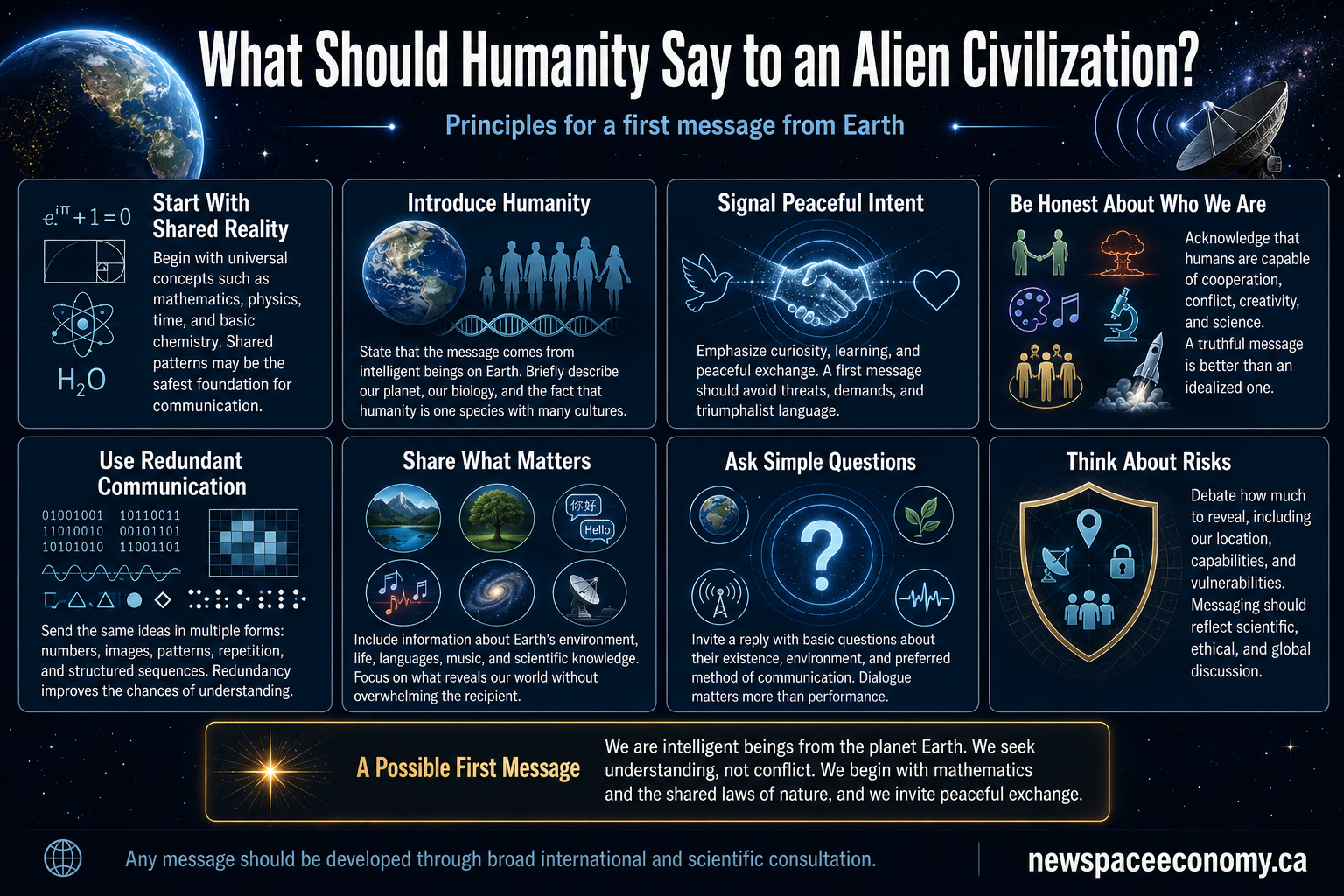
- Key Takeaways
- Alien Civilization Message Content Begins With Governance
- Technical Design Is Not Message Content
- Message Types Carry Different Commitments
- Humanity Has No Single Voice
- Disclosure Choices Shape Risk
- Past Human Messages Reveal Editorial Bias
- Scientific Content Should Be Modest and Shared
- Governance and Consent Determine Legitimacy
- A Responsible Initial Message for an Alien Civilization
- Cultural Representation Should Favor Process Over Perfection
- Summary
- Appendix: Useful Books Available on Amazon
- Appendix: Top Questions Answered in This Article
- Appendix: Glossary of Key Terms
Key Takeaways
- Message content requires political judgment, not technical design alone.
- A responsible message should disclose less than humanity is able to disclose.
- No single institution can claim to speak for Earth without broad consent.
Alien Civilization Message Content Begins With Governance
On November 16, 1974, the Arecibo Observatory broadcast a brief binary-coded message toward Messier 13, a globular cluster thousands of light-years away. The transmission included information about numbers, chemical elements, deoxyribonucleic acid, human form, Earth’s place in the Solar System, and the telescope that sent it. That event still frames the alien civilization message debate because it showed that humanity could send structured information into interstellar space, yet it did not settle what humanity should say, who should decide, or how much should be disclosed.
The content question differs from the engineering question. A technical team may decide whether a message uses binary encoding, repetition, narrowband radio, optical pulses, prime numbers, or image-like grids. Those choices answer how a message might be recognized and decoded. Content answers a harder question: what moral, political, scientific, and cultural statement should humanity attach to its technological ability to speak across interstellar distance.
The Search for Extraterrestrial Intelligence (SETI) has usually focused on listening for evidence of technology beyond Earth. Messaging Extraterrestrial Intelligence (METI), often called Active SETI by critics, reverses that posture by sending deliberate messages. New Space Economy’s explainer on Messaging Extraterrestrial Intelligence captures the split: listening can be treated as observation, but intentional transmission raises questions of consent, risk, representation, and authority.
A message to another civilization would speak for a species that has no single government, religion, language, scientific academy, artistic canon, legal authority, or moral consensus. It would represent present humanity to beings that may receive it long after the senders have died. It might also represent Earth’s other life forms without their consent. The act would mix astronomy, diplomacy, anthropology, communication theory, planetary security, ethics, and public trust.
The most defensible starting point is restraint. Humanity should not assume that technical capability creates moral permission. A responsible message would avoid claiming unity that does not exist, avoid disclosing unnecessary vulnerability, avoid triumphal language, and avoid presenting one culture as civilization itself. It would say that Earth contains life, that humans are one technological species among many Earth species, that communication is sought peacefully, and that any reply should proceed through slow, transparent, scientifically verified exchange.
That restrained position does not require fear. It treats interstellar messaging as a high-consequence public act, not a private experiment. It also recognizes that any alien civilization capable of receiving and interpreting a deliberate interstellar message may be older, more advanced, more alien, or less interested than humans imagine. The content should be clear enough to invite understanding, modest enough to avoid arrogance, and limited enough to respect uncertainty.
Technical Design Is Not Message Content
A technically elegant message can still say the wrong thing. It can be clear in structure and careless in politics. It can teach arithmetic, chemistry, and astronomy, then embed assumptions about gender, power, nationhood, religion, or superiority that reveal more about the senders than the senders intended. The difference between design and content matters because decoding a message is not the same as trusting it.
Technical design concerns detectability, interpretation, and sequence. Designers may repeat a pattern, start with simple counting, introduce prime numbers, define units through atomic transitions, and build from mathematics toward physics, chemistry, biology, and culture. A technical message may use redundant data so errors can be detected. It may explain its own format so the receiver can tell where one section ends and another begins. It may rely on universal references, such as hydrogen, star positions, or geometry, because culture-specific references would be fragile.
Content concerns identity, motive, disclosure, and invitation. A greeting says one thing. A scientific encyclopedia says another. A cultural archive says another. A warning says another. A request for knowledge says another. A beacon that only says “technology exists here” carries less content than a message giving Earth’s biology, maps, conflicts, and aspirations. The same binary grammar could carry a cautious greeting or a reckless data dump.
Past attempts show the distinction. The Voyager Golden Record carried images, natural sounds, music, greetings, and formal messages selected to portray life and culture on Earth. The Pioneer plaques used pictorial and astronomical information to identify human origin and form. The Arecibo message compressed a technical self-portrait into 1,679 bits. Each case mixed engineering with editorial judgment.
A content-first approach would begin by stating what the message is meant to do. If the purpose is a beacon, the content can be minimal. If the purpose is a greeting, the tone should be peaceful and modest. If the purpose is a scientific exchange, the message should emphasize shared observations rather than human self-display. If the purpose is a cultural archive, the designers must confront representation, selection, and omission. If the purpose is a request for dialogue, the message must include a reply path, timing expectations, and a method for continuing exchange.
Many public debates about alien contact skip this distinction. They ask whether humans should send messages without asking which messages, from whom, under what process, and with what limits. A harmless classroom exercise, an artistic transmission, a one-time radio broadcast, and a sustained high-power beacon do not carry the same content risk. A message to a star system 12 light-years away differs from a symbolic message attached to a spacecraft that may drift for millions of years.
The content question should be treated as a governance problem before it becomes a communications problem. Technical experts can explain what is possible. They should not decide alone what humanity is willing to reveal. The message should pass tests of scientific clarity, cross-cultural fairness, political legitimacy, and risk restraint before anyone transmits it with enough power and targeting to make reception plausible.
Message Types Carry Different Commitments
A message to an alien civilization does not have to be a single grand statement. It could be a layered exchange that begins with a minimal beacon and builds toward more complex content only after a reply or repeat contact. That staged approach would reduce the burden placed on a single transmission and would allow humanity to learn from the receiver’s response pattern before disclosing more.
The simplest type is a beacon. It says that an artificial transmitter exists. It may include a mathematical pattern, a timing structure, or a narrow set of physical references. A beacon does not need to describe human bodies, governments, or geography. Its strength is restraint. Its weakness is that it may be too empty to start a meaningful exchange.
A peaceful greeting adds intent. It could say, in structured form, that the sender seeks no harm, recognizes uncertainty, and wishes to communicate slowly. Such a greeting may be valuable because it frames contact as cautious dialogue rather than conquest, worship, trade, plea, or challenge. It should avoid emotional overclaiming, since an alien receiver may not share human ideas of friendliness, sincerity, or ceremony.
A scientific introduction could describe mathematics, physics, chemistry, astronomy, and biology. It might include atoms, molecules, DNA structure, planetary measurements, star catalogs, and timekeeping. It would present humanity as a knowledge-producing species. Yet even science carries cultural choices. Which facts are selected, how life is classified, and how human cognition is represented all carry assumptions.
A cultural archive expands the risk. The Voyager Golden Record model is inspiring because it treats human culture as worthy of sharing, but a cultural archive also raises selection disputes. Music, images, speech, art, stories, and symbolic objects can represent some communities and exclude others. A receiver may also misread art as literal evidence, ceremony as instruction, or conflict imagery as threat.
A warning message would require the most care. Humanity might warn a receiver about self-destruction, ecological harm, artificial intelligence risk, nuclear war, or the dangers of contacting unknown civilizations. Yet a warning can sound arrogant, fearful, manipulative, or incomprehensible. A species that has already survived hazards unknown to humans may not find human warnings useful.
The following table organizes common message types by intent and content risk.
| Message Type | Main Content | Content Risk |
|---|---|---|
| Beacon | Artificial pattern, time marker, basic mathematics | Too little content to guide exchange |
| Greeting | Peaceful intent, identity, request for dialogue | Human intent may be misunderstood |
| Science Primer | Mathematics, physics, chemistry, astronomy | Assumes shared reasoning and measurement |
| Planetary Profile | Earth, Solar System, life, environmental facts | Discloses location and vulnerability |
| Cultural Archive | Art, languages, images, music, stories | Selection may exclude many communities |
| Knowledge Request | Questions about science, life, time, survival | May reveal ignorance or dependence |
No type solves the problem alone. A responsible design would likely combine a restrained beacon, a scientific primer, a modest greeting, and an invitation to structured dialogue. It would avoid sending a complete cultural archive or operational map at the start. It would also avoid asking for salvation, advanced technology, weapons knowledge, or political intervention. A message asking for help may seem humble, but it could reveal need, division, and lack of control.
The content should also make room for silence. An alien civilization may receive a message and choose not to answer. It may answer after decades, centuries, or millennia. It may send content humans cannot identify. A responsible human message would not demand response or imply entitlement to knowledge. It would frame communication as voluntary, staged, and reversible.
Humanity Has No Single Voice
Any message that says “we” creates a political problem. Humans can speak as scientists, artists, citizens, governments, companies, religious communities, Indigenous peoples, language groups, children, future generations, and members of a biosphere. None of those categories can fully represent the others. A message claiming to speak for humanity may erase internal disagreement before it even leaves Earth.
The problem is older than METI. Diplomatic notes, treaties, religious texts, national constitutions, and international declarations all face questions of representation. Interstellar messaging intensifies those questions because the receiver may have no way to tell whether a message came from one laboratory, one state, one company, one cultural coalition, or a legitimate planetary process. A private message may be mistaken for a species statement.
A scientifically designed message could still overrepresent science. Scientists have strong claims to authority on encoding, astronomy, and verification. They do not have automatic authority over moral content. Artists have claims over cultural expression, but not over planetary risk. Governments have legal authority over transmitters and territory, but no government speaks for all humans. International organizations can convene debate, yet they remain shaped by states and politics. Religious and philosophical traditions carry deep ideas about meaning, dignity, and other beings, but no tradition can stand in for all humans.
Indigenous representation raises a distinct concern. Many human messages have relied on universalizing language, as if modern scientific culture can translate humanity into a neutral code. Yet Indigenous knowledge systems often carry long-term thinking about land, relation, stewardship, ancestry, non-human life, and responsibility across generations. Excluding those perspectives would make the message poorer and less legitimate. Including them as symbolic decoration would also be wrong. Representation must involve decision power, not token presence.
Non-human life adds another layer. Earth is not only a human planet. The biosphere includes animals, plants, fungi, microbes, and planetary systems that made human intelligence possible. A message that describes Earth as a human possession misrepresents the planet. New Space Economy’s article on the animal communication analogy shows how human difficulty communicating with other Earth species should caution against overconfidence in communicating with distant minds.
Future generations matter because interstellar communication unfolds across long time spans. A message sent today may arrive after current institutions, borders, and languages have changed. A reply may return to descendants who never consented to the original exchange. That does not make messaging impossible, but it strengthens the case for restraint and public legitimacy.
A fair message should admit plurality. It should not say, “Humanity believes,” when humanity does not agree. It should say that Earth contains many human societies, many languages, many knowledge systems, and many unresolved disputes. It should state that the message was authorized by a transparent process, if such a process exists. If the process is limited, the message should say so.
This honesty may reduce the elegance of the message, but it would improve its truthfulness. A receiver advanced enough to decode the message may notice contradiction between claims of unity and evidence of conflict. False unity could look deceptive. Honest plurality could look immature, but it would also be accurate. A developing civilization that knows it is divided may be more trustworthy than a divided civilization pretending to be one voice.
Disclosure Choices Shape Risk
The most contested content decision is how much to reveal. A message can disclose Earth’s location, biological chemistry, population, technology level, cultural output, political structure, ecological stress, military capacity, and internal conflict. Each disclosure has value for interpretation, but each may also create risk.
Location is the central dispute. Some argue that Earth’s atmospheric chemistry, radio leakage, space probes, planetary radar, city lights, and industrial activity may already make concealment unrealistic for a sufficiently advanced observer. Others answer that unintentional detectability is not the same as deliberately sending a clear, repeated, information-rich message to a selected target. The Berkeley SETI statement on METI argued for broad scientific, political, and humanitarian discussion before powerful intentional transmissions. That position treats deliberate messaging as a separate act, not a trivial extension of existing leakage.
Biology creates a different risk. Describing DNA, proteins, human anatomy, reproduction, disease, and ecology may support scientific exchange. It may also expose vulnerabilities. Even without hostile intent, a receiver might misinterpret biological descriptions or respond with information unsafe for humans to test. A responsible message could describe that Earth life is carbon-based and water-dependent without transmitting detailed medical weakness, pathogen data, or genetic instructions.
Technology level is equally delicate. Humanity might want to present competence through mathematics, astronomy, and radio engineering. Disclosing industrial capacity, energy systems, defense systems, computing infrastructure, or space assets would be harder to justify. The receiver does not need a technical inventory to know that humanity can transmit. A modest statement of general scientific knowledge would be enough for an initial exchange.
Conflict and environmental harm raise the hardest moral choice. Concealing war, inequality, ecological damage, and social division would create a polished self-portrait. Disclosing every weakness would create a bleak and possibly unsafe message. The more defensible path is controlled honesty: humanity can state that it is a developing technological civilization facing internal conflict and environmental stress without giving tactical details, blame narratives, or requests for rescue.
The disclosure issue can be grouped into four content categories.
| Disclosure Area | Reason to Include | Reason to Limit |
|---|---|---|
| Location | Allows targeting of a reply | May expose Earth to unknown intent |
| Biology | Shows what Earth life is | Could reveal medical or genetic weakness |
| Technology | Proves organized intelligence and method | May disclose capacity and dependence |
| Culture | Shows meaning beyond measurement | May distort or exclude human communities |
| Conflict | Avoids false self-presentation | Could invite misreading of threat or instability |
| Environment | Shows planetary conditions and responsibility | May make humanity appear unable to self-manage |
Risk management does not mean secrecy about everything. A message with no location, no biology, and no reply path may be safe but useless. A message with full location, genetic detail, political admissions, and technological inventory may be rich but reckless. The safer middle path is progressive disclosure. Begin with mathematics, physics, general planetary context, general biology, and peaceful intent. Reserve more detailed knowledge for later exchange, after verification, public debate, and evidence that communication is stable.
The strongest argument for limited disclosure is not fear of invasion. It is humility under uncertainty. Humans do not know how alien civilizations interpret messages, how they assess motives, or whether their reply would be helpful, harmful, indifferent, automated, delayed, or incomprehensible. Uncertainty favors minimizing irreversible disclosure at the start.
Past Human Messages Reveal Editorial Bias
Past interstellar messages are often remembered as heroic gestures. They were also editorial products of their time. Each chose what counted as humanity, what counted as Earth, and what counted as worth preserving. Those choices still deserve admiration, but they should not be copied uncritically.
The Pioneer plaques placed human anatomy beside astronomical markers. They used the hyperfine transition of neutral hydrogen as a reference, a diagram of the Solar System, and a pulsar map. Their strength was compression. Their weakness was cultural assumption. The human figures reflected choices about gender, posture, body representation, and normality. A receiver would need to interpret a two-dimensional diagram, infer scale, and recognize that the figures were symbolic rather than exact instructions.
The Voyager Golden Records took a broader approach. NASA says the records include images, natural sounds, music, greetings in 55 languages, and formal messages from political leaders. This archive has lasting cultural power because it presents Earth as more than data. It includes whales, surf, thunder, music, speech, and human activity. Yet selection remains a problem. No committee can fit Earth into a phonograph record without exclusion.
The Arecibo message showed the appeal of compact scientific self-description. Its structure favored mathematics, chemistry, biology, astronomy, and instrument identity. It did not try to represent every culture. It did not establish a continuing dialogue. It was sent once during a ceremony connected to the telescope’s upgrade. The event remains famous because it showed how a civilization might compress self-knowledge into a format that could be rendered as an image.
Later efforts, including Sónar Calling GJ 273b, mixed science, art, and music. Such projects expand the content debate beyond state agencies and Cold War science. They also sharpen the legitimacy problem. A message created by a small group may be creative and sincere, but it cannot settle whether others consent to being represented.
The strongest lesson from past messages is not that they were wrong. It is that every interstellar message reflects the sender’s cultural moment. The 1970s messages reflected a space-age confidence in science, universal diagrams, and expert committees. Later messages reflect greater interest in participation, cultural plurality, and ethics. Current debate reflects concern about misinformation, private actors, space security, and planetary governance.
New Space Economy’s article on communication with alien species emphasizes that communication may fail because sender and receiver do not share senses, environment, symbols, bodies, or social experience. That warning applies to content as much as code. A picture of a human body may be less universal than humans assume. Music may be meaningful to humans but unreadable as culture to another mind. A map may be interpreted as invitation, threat, coordinate system, or artifact.
A responsible message should treat past efforts as prototypes, not templates. It can borrow their use of mathematics, astronomy, physics, and layered information. It should improve their representation process, avoid unnecessary bodily or strategic disclosure, and explain more clearly what kind of exchange is being requested. It should also test content with many human communities before transmission. If humans cannot interpret the message across languages and cultures, there is little reason to assume a distant receiver will do better.
Scientific Content Should Be Modest and Shared
Science is the safest starting content because it offers references that may exist beyond human culture. Counting, geometry, atomic structure, spectral lines, orbital motion, stellar properties, chemistry, and planetary measurement provide possible bridges between minds that do not share history. Yet science should be presented as a shared starting point, not as a boast.
A scientific introduction should begin with the simplest concepts needed to define the message. It can introduce counting, zero, sequence, ratio, and prime numbers. It can define units through physical constants, such as hydrogen’s spectral properties, instead of Earth-specific conventions. It can show shapes, periodicity, and chemical relationships. It can build toward carbon chemistry, water, biological polymers, cell structure, and planetary environment.
The content should avoid pretending that mathematics guarantees understanding. Humans often call mathematics universal, but a receiver may use different notation, perception, computation, or conceptual grouping. Even if arithmetic is shared, the representation of a grid, image, molecule, or body may fail. Mathematical content should be redundant, slow, and tested through blind decoding by human groups unfamiliar with the design.
Biology should be handled in layers. A basic layer could state that Earth life uses carbon chemistry, water, energy gradients, cells, heredity, and many forms. A second layer could describe ecosystems and interdependence. A later exchange might discuss genetics in greater detail. An initial message should not transmit large genetic datasets, pathogen details, or human medical vulnerabilities.
Planetary content should also be layered. A basic message could describe Earth as a rocky planet orbiting a star, with oceans, atmosphere, land, and life. It could describe the Solar System at a general level. A detailed location map should require stronger consensus because it changes the risk profile. A reply path may require location, but location can be provided with less precision at the start, or by using a return method tied to the transmitter rather than a full planetary dossier.
Cultural content should not be absent. A message made only of mathematics and chemistry may fail to convey motive. It may look like an instrument calibration, not a greeting. Culture can show that humans make music, images, stories, tools, rituals, and moral claims. The safest cultural content would be curated as plural evidence of meaning-making, not as a canon of greatness. It should include explanation that samples are partial and selected through a public process.
New Space Economy’s discussion of technosignature searches points toward another content issue. A civilization might detect technology before it decodes any intentional message. If that happens, humanity’s content choices may arrive after the receiver has inferred industrial activity, energy use, or planetary modification. A message could help contextualize those observations by saying that humans are aware of their technological footprint and are trying to manage it.
The scientific content should show humility. Instead of saying humanity has mastered nature, it should say humanity studies nature and often revises its understanding. Instead of presenting technology as maturity, it should present technology as capacity mixed with responsibility. Instead of claiming superiority over other Earth life, it should state that humans are one life form within a larger biosphere.
A modest scientific message would also avoid sending instructions for dangerous technologies. It should not include weapons design, methods for manipulating biology in harmful ways, or operational details about planetary infrastructure. The point of an initial message is to open communication, not to exchange power.
Governance and Consent Determine Legitimacy
The authority question may matter as much as the content. A message from one university, one artist collective, one company, one billionaire, one defense agency, or one national government may be technically real but politically weak. A message that claims to represent humanity should emerge from a process broad enough to make that claim credible.
The International Academy of Astronautics has worked on post-detection principles for handling possible evidence of extraterrestrial intelligence. Recent work has focused on verification, transparency, international consultation, and public communication. Those ideas are directly relevant to outbound messaging. If humanity should not answer a received message without international consultation, it should not initiate a high-power message without comparable care.
A legitimate process would need scientific review, public debate, international participation, ethical assessment, legal review, and risk analysis. It would need mechanisms for dissent because universal agreement is unlikely. It would also need transparency about who funds, controls, and authorizes transmission infrastructure. Private funding may support research, but private wealth should not decide planetary speech.
Governance should distinguish symbolic messages from powerful, repeated, targeted transmissions. A plaque on a spacecraft is different from a radio broadcast aimed at a nearby star system. A student message archive is different from a beacon designed for detection over interstellar distance. Regulation and consultation should scale with power, target selection, repetition, and content sensitivity.
International law has no detailed treaty regime governing the content of messages to extraterrestrial civilizations. Space law focuses on state responsibility, harmful contamination, registration, liability, and peaceful use, not alien diplomacy. That gap does not give actors a free hand. It means states, international organizations, scientists, and civil society would need to build norms before a high-consequence transmission.
Representation mechanisms could include citizen assemblies, scientific academies, Indigenous councils, youth participation, ethics boards, public comment periods, intergovernmental review, and open message testing. New Space Economy’s article on post-detection policy offers useful context for how detection procedures already raise questions about disclosure, verification, and public trust. Outbound content needs a similar level of care.
A consent process cannot include every person on Earth in a direct vote with full knowledge of the technical details. Yet it can still be more legitimate than a private decision. Public reason-giving matters. So does record-keeping. Future generations should be able to know who authorized the message, what alternatives were considered, what objections were raised, and why the final content was selected.
The message itself should disclose its authorization status. If it comes from a global process, it can say that. If it comes from a limited coalition, it should say that too. A message from a limited group can still be valuable, but it should not falsely claim to be the voice of Earth.
Consent also applies to content testing. Before sending a message across interstellar space, humans should test it across human language communities, age groups, cultural traditions, and educational backgrounds. If only its designers can decode it, it has failed a basic test. If many human communities find its representation offensive, exclusionary, or misleading, the content needs revision before any transmission.
A Responsible Initial Message for an Alien Civilization
A responsible initial message should be limited, layered, and candid. It should not try to contain the whole human story. It should not attempt to impress. It should not ask for rescue. It should not transmit strategic vulnerability. It should not use one nation’s symbols as Earth’s symbols. It should not hide that humanity is divided, yet it should not dwell on conflict as the defining fact of Earth.
The opening layer should establish artificial origin. That layer could use repeated mathematical structure, timing, and basic physical constants. It should make clear that the message is intentional and that the sender understands measurement, sequence, and error correction. It should teach the receiver how to parse later layers.
The next layer should state peaceful intent in the most restrained way possible. Human concepts of peace and non-hostility may not map neatly onto alien concepts, but the message can still avoid threat, command, demand, or superiority. It can say that the sender seeks information exchange and does not intend harm. It can also say that the sender understands that the receiver may choose silence.
A scientific layer should introduce Earth in general terms. It can describe the Sun, the Solar System, Earth’s atmosphere, oceans, geology, and biosphere. It can identify humans as one technological species from Earth, not as owners of Earth. It can describe life broadly before describing humans narrowly. It can use time markers and physical units that the receiver can test.
A cultural layer should be small and clearly labeled. It can include samples of human language, music, visual pattern, and symbolic expression, with an explanation that these are partial examples. It should avoid presenting art as universal truth or selecting cultural material through narrow institutional channels. A receiver should understand that samples are evidence of diversity, not an official canon.
A governance layer should explain the message’s origin. It should state whether the message was authorized by an international process, a scientific body, or a limited group. It should include a record of the decision method in compressed form. That may seem strange, but legitimacy is part of content. A receiver capable of understanding social information may care whether the message reflects authority or private initiative.
A reply layer should be cautious. It can provide a method for response without disclosing more than needed. It can request slow repetition, shared mathematical framing, and non-harmful scientific exchange. It should not ask for advanced technology, medicine, energy systems, military protection, or intervention in human affairs. Such requests could create dependence, mistrust, or dangerous temptation.
A restraint layer should identify prohibited content. The message should avoid operational details about defense, infrastructure, pathogens, genetic vulnerabilities, detailed resource maps, political targets, or social weaknesses. It should avoid religious claims that speak for all humans. It should avoid claims that humanity is peaceful in any simple sense. It should avoid claims that Earth is unified under one authority.
New Space Economy’s coverage of Breakthrough Listen reminds readers that, as of June 2026, scientific SETI remains a search without a confirmed extraterrestrial technology detection. That absence should shape content. Humanity should not write as if contact is routine or as if assumptions about alien motive have evidence behind them.
The most responsible initial message would be less like a national anthem and more like a carefully labeled scientific greeting. It would say: this is Earth, a living planet; humans are a technological species within that life; the message was sent through a documented process; the sender seeks peaceful, slow, verifiable exchange; the receiver is free not to answer; more detailed exchange should proceed only after mutual structure is established.
Such a message would disappoint anyone seeking grandeur. It would also disappoint anyone who wants total silence. Its value lies in disciplined restraint. It recognizes that speech can be meaningful without being reckless, and that humility may be the most accurate self-description humanity can offer.
Cultural Representation Should Favor Process Over Perfection
No message can represent every human culture, language, memory, art form, belief, grief, hope, joke, ceremony, and scientific idea. The attempt to make a perfect human archive would fail before transmission. The better goal is to represent the process by which humanity selected content, then provide a small set of content samples that make their incompleteness clear.
The Voyager model remains moving because it treated sound, image, and greeting as worthy companions to science. Yet a modern process would face more demanding expectations. It would need to address colonial history, linguistic survival, Indigenous knowledge, disability, gender, migration, faith, nonbelief, digital culture, environmental harm, and future generations. A committee drawn only from elite scientific institutions could not credibly decide that alone.
Representation should include living languages and endangered languages, but it should not reduce language communities to token greetings. It should include art, but it should not treat museum art as the whole of culture. It should include music, but it should explain that human music depends on bodies, hearing, rhythm, and cultural training. It should include images, but it should explain that images are two-dimensional representations constructed for human vision.
Religious and philosophical content requires care. Religion is central to many human civilizations, but no religious message can speak for all humanity. A responsible message may state that humans hold many beliefs about origin, meaning, duty, death, consciousness, and the sacred. It should avoid presenting doctrine as planetary fact. It should also avoid pretending that humans are purely scientific beings with no metaphysical life.
Political content should be limited. The message should not include national flags as the main visual vocabulary of Earth. It should not rank states, celebrate alliances, or name adversaries. It can state that humans organize themselves into many polities and institutions. It can say that cooperation and conflict both exist. That is enough for an initial exchange.
A cultural archive should include non-human Earth life through sound, image, biological description, and ecological relationship. The sender should say that humans do not fully understand other Earth minds. That admission matters. If humans struggle to interpret whales, elephants, corvids, cephalopods, and primates, then claims about alien understanding should remain modest.
The Fermi paradox adds another caution. The absence of confirmed contact could reflect rarity, distance, timing, self-destruction, non-detection, deliberate quiet, or assumptions that do not fit the universe. A cultural message should not presume that civilizations naturally want to announce themselves. It should allow for the possibility that silence is an ethical choice.
Process can be represented inside the message. A section could show that humans selected content through international deliberation, scientific review, public participation, and recorded dissent. That may be more informative than any single song or image. It tells the receiver that humanity knows representation is hard and tried to handle it openly.
A content strategy that favors process over perfection would also age better. Future generations may reject specific selections, but they may respect a transparent method. An alien receiver may not understand every cultural sample, but it may infer that the sender recognizes plurality and limitation. That inference may be one of the most valuable messages humanity can send.
Summary
The question of what humanity should say to an alien civilization cannot be answered by engineering alone. Message design can help a receiver detect, parse, and decode a transmission. Message content decides what humanity reveals, what it asks, who it represents, and how much risk it accepts.
A responsible message should begin with modesty. It should establish artificial origin, define its format, introduce shared scientific references, and state peaceful intent without grand claims. It should describe Earth as a living planet rather than a human possession. It should identify humans as a developing technological species with knowledge, culture, conflict, and responsibility. It should disclose enough to support dialogue but not enough to expose unnecessary vulnerability.
The strongest content would be staged. A minimal beacon could lead to a scientific greeting. A scientific greeting could lead to limited cultural exchange. Deeper disclosure should wait for verification, public debate, and evidence that communication is stable. The message should not ask for rescue, advanced technology, medical secrets, military aid, or intervention in human affairs. It should not claim unity where none exists.
Humanity’s initial message would be judged by what it says and by how it was authorized. A message from a small group may be creative, but it should not claim to represent Earth. A message sent after transparent international consultation would carry more legitimacy, even without universal agreement. The content should include a record of that process.
The best initial statement may be simple: Earth contains life; humans are one technological species within that life; the sender seeks peaceful, voluntary, slow, verifiable exchange; the receiver may answer or remain silent; further communication should proceed with care. That message would not be the grandest statement humanity could make. It may be the most responsible one.
Appendix: Useful Books Available on Amazon
- Extraterrestrial Languages
- The Contact Paradox
- Communication with Extraterrestrial Intelligence
- Xenolinguistics
- The Impact of Discovering Life beyond Earth
Appendix: Top Questions Answered in This Article
What Should Humanity Say to an Alien Civilization?
Humanity should send a restrained scientific greeting rather than a complete self-portrait. The message should identify Earth as a living planet, introduce humans as one technological species within that biosphere, express peaceful intent, and invite slow dialogue. It should avoid unnecessary disclosure of location detail, biology, technology, conflict, and vulnerability.
Who Should Decide the Content of an Interstellar Message?
No single scientist, company, state, or cultural institution should decide alone. A legitimate process would need international consultation, scientific review, ethical assessment, Indigenous participation, public debate, and transparent records of dissent. The more powerful and targeted the transmission, the stronger the need for broad authorization.
Should Humanity Disclose Earth’s Location?
Earth’s location is useful for a reply, but detailed disclosure carries risk. A responsible message could use a staged approach that gives enough context for interpretation without immediately transmitting a full planetary dossier. More precise location data should require stronger public consent and a clear reason tied to safe dialogue.
Should Humanity Mention War and Environmental Problems?
Humanity should not pretend to be perfectly unified or peaceful, but it should avoid sending detailed accounts of conflict or weakness. A careful message could state that humans are a developing technological species facing internal conflict and environmental stress. That level of honesty avoids false self-presentation without creating a vulnerability catalog.
Should a Message Include Human Art and Music?
Art and music can show that humans create meaning beyond measurement, but they require context. A receiver may not understand sound, rhythm, image, or symbolism as humans do. Cultural samples should be partial, clearly labeled, and selected through an open process rather than treated as a complete archive of human civilization.
Should Humanity Ask Aliens for Knowledge?
A cautious message may invite exchange, but it should not ask for rescue, advanced technology, military aid, or intervention. Requests for powerful knowledge could create dangerous incentives or reveal dependence. A safer approach asks for slow, verifiable exchange about shared science, timekeeping, astronomy, and non-harmful knowledge.
Can Mathematics Serve as a Universal Language?
Mathematics may offer shared structure, but it does not guarantee understanding. A receiver may use different notation, sensory systems, or conceptual categories. Mathematical content should be repetitive, layered, and tested through blind decoding by human communities before anyone assumes that distant minds would interpret it correctly.
Why Is a Simple Beacon Different From a Cultural Archive?
A beacon mainly announces artificial origin, often through pattern and repetition. A cultural archive reveals far more about the sender’s values, biology, art, environment, and social choices. The archive may be richer, but it creates greater risk of misrepresentation, exclusion, and disclosure of information that does not need to be shared early.
Should Humanity Present Itself as Unified?
Humanity should not claim unity that does not exist. A truthful message can say that humans share a planet and some scientific knowledge, yet differ across languages, cultures, beliefs, and political systems. Honest plurality is more defensible than a polished but inaccurate claim that Earth speaks with one voice.
What Should a Responsible Initial Message Avoid?
A responsible initial message should avoid threats, demands, arrogance, national propaganda, detailed vulnerabilities, operational technology, pathogen information, genetic datasets, and requests for intervention. It should also avoid claiming to represent all humanity unless a credible international process authorized it. Restraint should guide content from the start.
Appendix: Glossary of Key Terms
Arecibo Message
The Arecibo Message was a 1974 binary-coded radio transmission sent from the Arecibo Observatory toward Messier 13. It included compact information about mathematics, chemistry, DNA, human form, Earth’s place in the Solar System, and the telescope that sent it.
Beacon
A beacon is a minimal message designed mainly to announce artificial origin. It may use repeated patterns, timing, mathematics, or physical constants. A beacon can reduce disclosure risk, but it may provide too little content to support dialogue.
Cultural Archive
A cultural archive is a message collection containing items such as language samples, music, images, art, stories, or symbolic material. Its value lies in showing meaning beyond science, but its weakness is that selection can exclude many communities.
Messaging Extraterrestrial Intelligence
Messaging Extraterrestrial Intelligence is the deliberate attempt to send messages to possible extraterrestrial civilizations. It differs from listening-based SETI because it initiates contact and raises added questions about authority, consent, disclosure, and risk.
Pioneer Plaques
The Pioneer plaques are engraved messages attached to Pioneer 10 and Pioneer 11. They used human figures, a hydrogen reference, a Solar System diagram, and a pulsar map to identify the spacecraft’s origin and the beings that built it.
Progressive Disclosure
Progressive disclosure means releasing information in stages rather than transmitting everything at once. In interstellar messaging, it would begin with limited scientific and peaceful content, then reserve more sensitive information for later exchange after verification and public debate.
Search for Extraterrestrial Intelligence
The Search for Extraterrestrial Intelligence is the scientific effort to detect evidence of technology beyond Earth. It has often focused on radio astronomy, optical searches, data analysis, technosignatures, and follow-up checks on unusual observations.
Technosignature
A technosignature is observable evidence that may indicate technology beyond Earth. Examples may include unusual radio emissions, optical pulses, atmospheric pollutants, waste heat, orbital structures, or artifacts, provided natural explanations and human interference are ruled out.
Voyager Golden Record
The Voyager Golden Record is a phonograph record carried by the Voyager spacecraft. It contains images, natural sounds, music, greetings in many languages, and formal messages selected to portray Earth’s life and culture to any distant finder.