Key Takeaways
- Six defense, space, and satellite-related SPAC mergers were announced during 2026.
- Government demand can strengthen order books without producing predictable revenue or profit.
- Investors must separate funded contracts from backlogs, proposals, and projected opportunities.
Public Markets Are Reopening to Space Companies
Six defense, space, or satellite-related companies announced mergers with special-purpose acquisition companies during 2026, twice the number recorded during all of 2025. At least seven additional companies in the sector completed conventional initial public offerings, according to a Reuters examination of the renewed listing cycle.
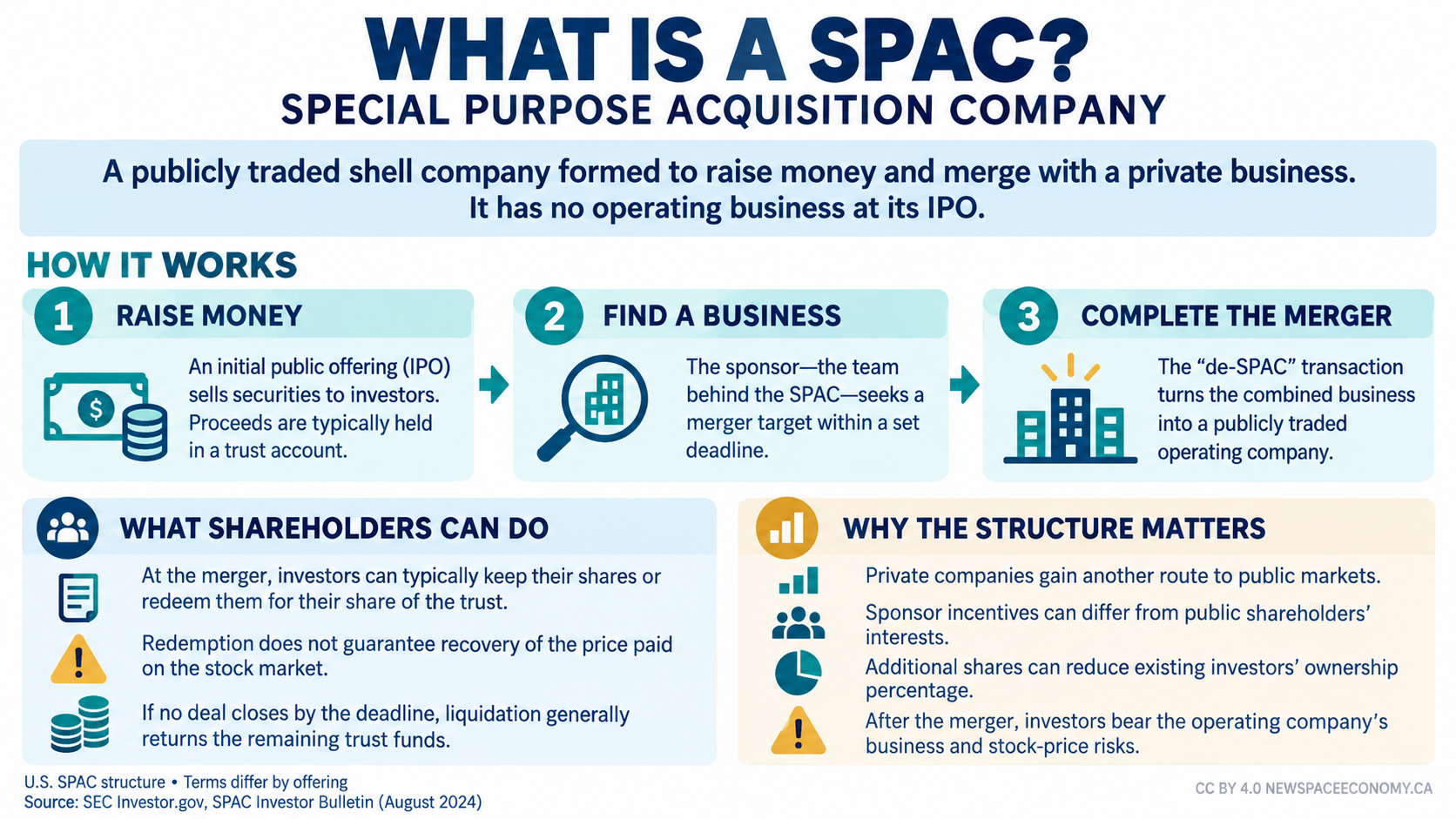
A special-purpose acquisition company, commonly called a SPAC, raises money through an initial public offering before identifying an operating company to acquire. The resulting merger provides the target company with a stock-market listing without following the standard initial public offering process.
The structure appeals to space and defense businesses because their financing needs rarely align neatly with public-market conditions. A propulsion manufacturer may need to expand production before expected contracts convert into deliveries. A satellite-services company may require years of capital spending before its constellation produces meaningful revenue.
A negotiated SPAC transaction can provide greater control over valuation, timing, and financing. It can also permit a company to raise a private investment in public equity, or PIPE, alongside the merger. These features become attractive when management believes that customer demand is arriving faster than private financing can support new factories, equipment, testing facilities, and staff.
The renewed interest does not mean that the weaknesses of the previous SPAC cycle have disappeared. It means investors are again willing to finance companies whose value depends heavily on future execution.
National-Security Spending Has Changed the Financing Environment
Government demand has become a larger part of the investment argument for many space businesses. Military agencies are buying missile propulsion, satellite communications, space-domain awareness, remote sensing, orbital mobility, and resilient navigation services. The same procurement cycle is drawing capital toward drones, hypersonic systems, counter-drone technologies, and autonomous aircraft.
Reuters reported that nine SPACs were seeking defense or space targets in September 2026, with approximately $2.35 billion held in trust. That pool of capital gives early-stage companies another route to fund production, although it does not remove the operational risks associated with government contracting.
Defense contracts can appear more dependable than purely commercial demand because national governments have large budgets and long-term security requirements. Contract revenue may still arrive unevenly. Programs can be delayed, appropriations can change, customer testing can reveal technical problems, and a contractor can spend heavily preparing for an award it never receives.
A company that relies on a small number of agencies faces concentration risk even when those customers have strong credit. A delayed milestone payment or procurement decision may affect revenue far more than it would at a diversified industrial business.
This distinction matters when evaluating claims about backlog. A funded contract, an indefinite-delivery vehicle, a customer option, and a projected market opportunity are economically different. Combining them into one large figure can give an exaggerated impression of demand.
Ursa Major Illustrates the Industrial-Capacity Argument
Ursa Major announced a SPAC transaction in August 2026 that assigned the propulsion company a post-transaction equity valuation of approximately $2.3 billion. The company develops rocket engines and propulsion systems used in space launch and defense applications.
The transaction’s industrial argument rests on capacity. Chief Executive Chris Spagnoletti told Reuters that customer demand was exceeding available supply and that public capital would help the company increase domestic production. This is a more concrete use of proceeds than a generalized promise to pursue growth, but investors still need to examine the assumptions beneath it.
Expanding manufacturing requires more than constructing floor space. The company must secure specialized materials, qualify suppliers, recruit experienced personnel, maintain production quality, and deliver systems at acceptable margins. Propulsion products also face extensive testing requirements because a single failure can destroy a vehicle or compromise a military mission.
A capacity investment creates value when customers order enough units, on sufficiently favorable terms, to cover fixed costs and generate returns. It can weaken the business if management builds for demand that arrives late or at lower margins than expected.
Ursa Major’s transaction may indicate that investors see propulsion shortages as an investable constraint. The stronger test will come from production throughput, revenue conversion, operating margins, and repeat orders after the merger closes.
Orbital Infrastructure Companies Face a Different Test
Quantum Space, which is developing spacecraft for orbital mobility, logistics, servicing, and refueling, also announced a SPAC transaction during 2026. Reuters reported that the company had secured more than $88 million in government contracts.
Government contracts provide external validation, but they do not establish that a large commercial market already exists. Orbital servicing companies must demonstrate that satellite operators will pay enough for inspection, repositioning, refueling, or life-extension services to justify the cost and complexity of deploying servicing spacecraft.
Technical success represents only one stage of that process. Customers must compare the price of servicing with the cost of replacing a satellite, accepting reduced performance, or allowing the asset to retire. Insurance terms, licensing requirements, rendezvous standards, and liability allocation also affect purchasing decisions.
Public investors should distinguish between technology development funded by government agencies and repeatable service revenue paid by operating customers. Government-funded demonstrations can help create a market, but they cannot guarantee that the resulting service will achieve sustainable margins.
SPAC Financing Transfers Risk Rather Than Eliminating It
The US Securities and Exchange Commission’s SPAC rules require enhanced disclosures concerning conflicts of interest, sponsor compensation, dilution, and business combinations. These requirements respond to structural risks that became apparent during the earlier SPAC boom.
Sponsors generally receive financial benefits for completing a transaction. That structure can create pressure to close a deal before the SPAC’s deadline, even if returning funds to shareholders would produce a better result.
Redemptions create another complication. Investors who purchased shares in the SPAC can redeem them before the merger, removing cash that the operating company expected to receive. A transaction promoted using the headline value of the SPAC trust may deliver substantially less cash after redemptions and expenses.
PIPE financing can replace some of the missing funds, but it may introduce different pricing, warrants, or preferential terms. Existing shareholders can face dilution from sponsor shares, warrants, employee equity, and new capital.
The operating company also inherits the reporting costs and market scrutiny associated with being publicly traded. Management teams accustomed to private financing must produce audited results, explain missed targets, maintain internal controls, and communicate with shareholders every quarter.
Valuation Must Be Tied to Measurable Performance
Space companies often present large total addressable markets. These figures may include every government program or commercial service that could use the company’s technology, regardless of whether the business can reach those customers profitably.
A more useful valuation analysis begins with production capacity, contracted revenue, gross margin, cash requirements, and customer concentration. It also examines how much capital the company must spend before reaching positive free cash flow.
For manufacturers, unit economics should include materials, labor, testing, warranty exposure, factory utilization, and supply-chain costs. Service companies require evidence concerning customer acquisition, renewal rates, operating expenses, constellation replacement, and infrastructure spending.
Government contracting adds another layer. Award ceilings should not be treated as committed revenue, and backlog should be separated into funded and unfunded portions. Prototype awards may validate technology without establishing production demand.
Projected revenue deserves close attention because SPAC transactions have historically relied more heavily on forward estimates than conventional initial public offerings. Investors need to compare each forecast with existing capacity, customer commitments, program schedules, and the capital required to deliver it.
The Cycle May Contain Better Companies and Familiar Hazards
The 2026 market differs from the speculative period that brought numerous pre-revenue space companies to public markets earlier in the decade. Government demand is stronger in several defense-related segments, commercial satellite services have matured, and public investors have more operating history against which to judge space businesses.
Yet improved market conditions do not make every transaction sound. A company can operate in a growing sector and still have a weak balance sheet, unrealistic valuation, poor unit economics, or insufficient production discipline.
The strongest candidates will show that new capital is connected to identifiable customer demand and measurable capacity expansion. They will separate signed, funded orders from broader market estimates and explain how revenue converts into gross profit and cash flow.
A successful space SPAC cycle would finance companies capable of turning technical capability into repeatable production and service delivery. An unsuccessful cycle would once again transfer speculative forecasts from private investors to public shareholders before the underlying businesses are ready.
Summary
The renewed use of SPAC mergers shows that public capital is again available to smaller space and defense companies. National-security spending, production shortages, and investor interest provide a stronger commercial basis than existed for many earlier transactions.
The central question is not whether the space economy is growing. It is whether each company can convert contracts, technology, and manufacturing capacity into dependable revenue at sustainable margins. That standard separates an industrial-financing cycle from another speculative one.