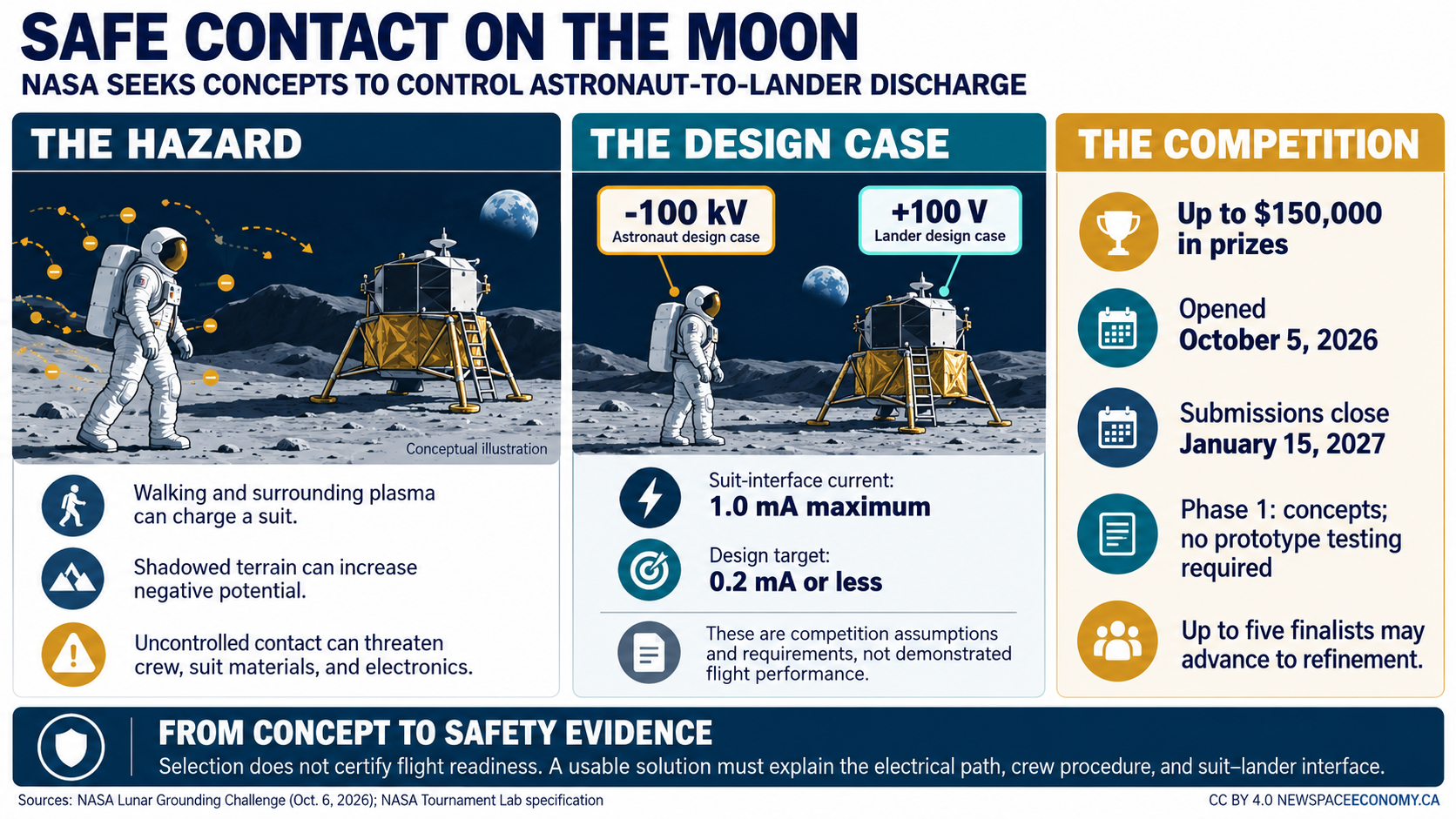
NASA opened its Lunar Grounding Challenge on October 5, 2026, seeking ways to discharge electrically charged astronauts safely before they interact with a lunar lander. The agency’s October 6 announcement offers up to $150,000 in prizes and sets January 15, 2027, as the submission deadline. The problem concerns a potentially dangerous transition between two systems that must work together: a spacesuit exposed to the lunar environment and the vehicle an astronaut returns to after surface work.
The challenge asks for concepts, rather than announcing a flight-ready protection system. That distinction defines its practical significance. NASA has described a hazard and invited engineering responses, but the competition does not demonstrate that a particular device can control it on the Moon. The immediate opportunity is to develop an approach whose electrical behavior, operation, and integration can be assessed.
According to NASA’s challenge announcement, walking can generate charge through contact between materials, a process called tribocharging. Surrounding plasma, a gas containing charged particles, can also influence a suit’s electrical state. In shadow, reduced sunlight and the local particle environment can allow a substantial negative potential to develop. A sunlit lander can have a different electrical potential, creating the conditions for a discharge during contact.
Voltage describes an electrical potential difference. A large difference can drive charge rapidly between objects when a path becomes available. NASA identifies possible consequences involving suit materials, electronics, the oxygen-rich interior, and the astronaut. The proposed protection must manage the transfer before routine contact creates an uncontrolled path. The familiar experience of a static spark illustrates the general mechanism, but it cannot establish the severity of a lunar event.
The detailed competition specification uses a design case of approximately −100 kilovolts on the astronaut and +100 volts on the lander. It limits current at the suit interface to 1.0 milliampere and sets a target of 0.2 milliampere or less. These values are requirements and modeling assumptions for submitted concepts. They should not be read as measurements from a completed polar astronaut mission or performance achieved by an existing mitigation device.
The specification also sets a mass limit below 20 kilograms, a worst-case discharge duration of 30 seconds, and support for up to four surface excursions over 10 days. It assumes available attachment points and a suited-astronaut capacitance model of 200 picofarads. Phase one requires no fabrication or physical prototype testing. Up to five finalists may advance to concept refinement, where reviewer feedback informs revised submissions.
Those requirements illustrate why a solution must address more than the amount of charge removed. A current-limiting approach needs a controlled connection, an operating sequence, and an explanation of what happens if the connection is incomplete. A device can appear adequate in an ideal circuit and still leave important questions about its use. The relevant evidence must connect the electrical model to the physical arrangement an astronaut would encounter.
The time limit creates an operational consideration. A system intended for use before lander contact must fit into the return procedure without relying on an ambiguous indication that discharge has finished. A proposed design should explain how completion is recognized and what prevents contact too early. These are engineering implications of the stated objective, rather than additional requirements announced by NASA in the short public notice.
Dust adds another layer to the interface problem. NASA’s Apollo spacesuit examination studied flown suit components for contamination, abrasion, wear, and loss of function. That historical work supplies evidence that lunar particles affect real hardware. It does not validate the challenge’s high-voltage case, but it explains why a clean laboratory arrangement alone would provide an incomplete basis for assessing a device intended for repeated surface use.
New Space Economy’s discussion of moon dust hazards places electrical behavior alongside abrasion and contamination. For a grounding concept, the practical implication is that an interface must remain understandable and usable after exposure. Deposited particles could change how components meet or how crews handle them. Any proposed tolerance to contamination needs supporting analysis and, at a later development stage, suitable testing rather than an assumption that dust can be ignored.
The word grounding can also obscure the design task. The competition’s objective is to bring the astronaut and vehicle toward a safe electrical relationship. It should not be assumed that a familiar terrestrial grounding arrangement will work unchanged in a lunar environment. A proposal must identify where charge moves, how that path is controlled, and which components experience the resulting current. Naming a device does not substitute for explaining its circuit.
Crew interaction is part of that explanation. A concept that requires precise placement or several manual actions introduces questions about visibility, access, and confirmation. A protective feature must be compatible with the suit and the lander it connects. The underlying design question is whether the complete procedure can prevent the hazardous contact, including when a step fails or a component behaves differently from the model.
The prize format permits comparison of approaches before committing to a single hardware design. That can be useful for a problem combining electrical engineering, materials, and human operation. The stated concept stage also limits what a winning entry would establish. Selection would recognize the quality of a submission under the competition criteria; it would not, by itself, certify a device for astronaut use or establish a commercial procurement commitment.
For companies and research teams, the challenge offers a defined problem with measurable constraints, rather than a general invitation to propose lunar products. Its broader significance is the need to manage safety at the boundary between independently complex systems. A successful path from concept to use would require evidence that charge can be transferred safely under representative conditions and through a procedure crews can execute reliably. Until that evidence exists, the challenge remains a structured search for a solution.
Useful Books Available on Amazon