Key Takeaways
- The new executive connects space research and commercial technology with acquisition leadership.
- An organizational announcement does not establish a new funding program or an available contract.
- Progress depends on tested capabilities reaching funded programs and operational users.
The Space Technology Portfolio Executive Receives a Transition Mandate
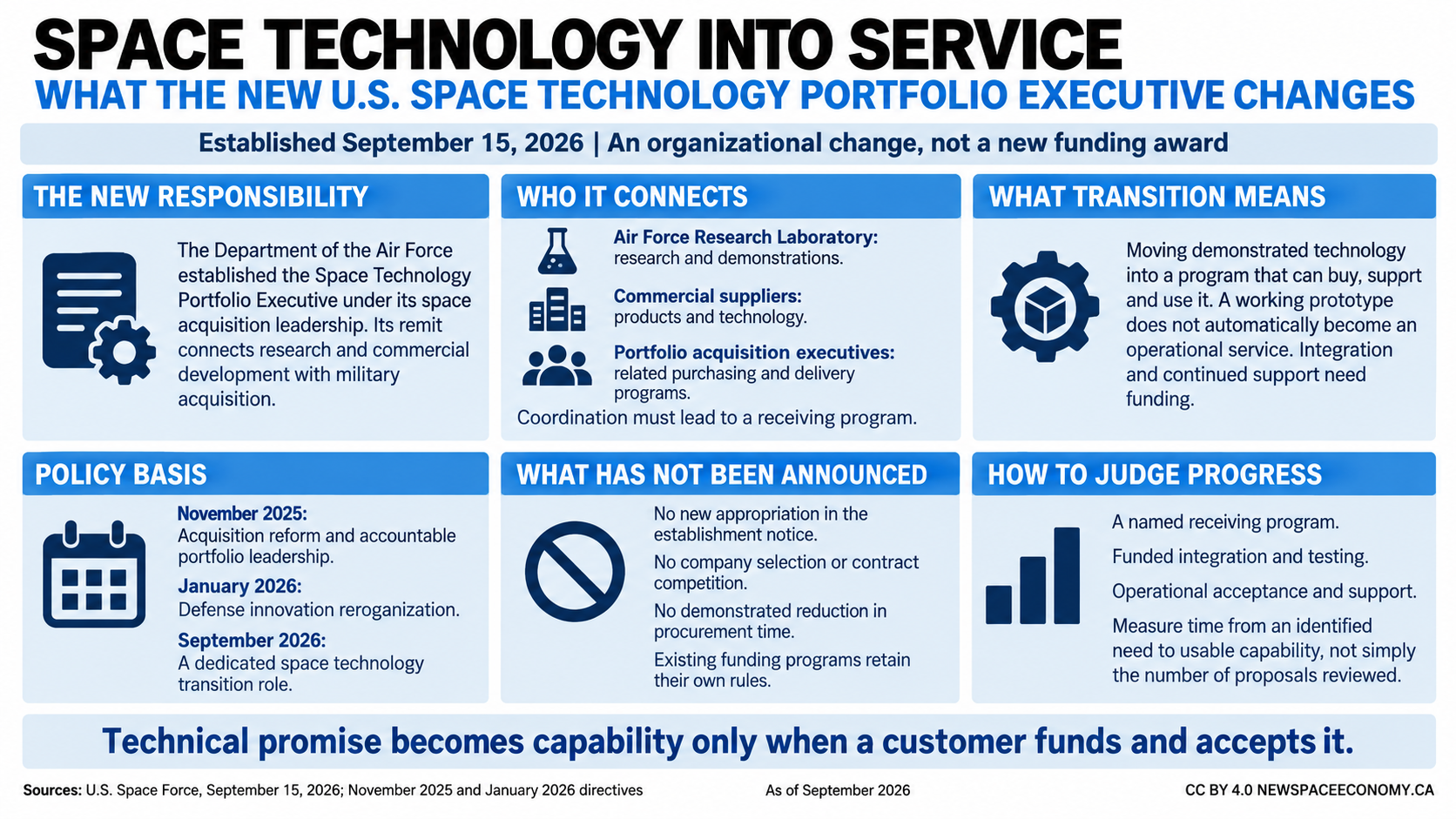
The Department of the Air Force announced the establishment of the Space Technology Portfolio Executive on September 15, 2026. The official establishment notice places the role under the Assistant Secretary of the Air Force for Space Acquisition and Integration. Its responsibilities connect research and commercial technology with the organizations that acquire military space capabilities.
Technology transition means moving an invention or demonstrated product into a program that can purchase, support, and use it. The new executive is intended to coordinate that process between the Air Force Research Laboratory and portfolio acquisition executives, alongside commercial suppliers. The announced remit includes rapid prototyping and alignment of technology investments.
The immediate change is organizational. The notice does not announce a new appropriation, identify a competition, or demonstrate a reduction in procurement time. It establishes a responsibility for improving the path into operational programs, with the results still to be shown.
For companies, that distinction affects how the announcement should be interpreted. A potential government sponsor is different from a paying customer. A supplier can receive interest in its technology without obtaining the contract needed to finance production or continuing support.
The commercial significance is the possibility of clearer coordination. Research organizations can establish whether something works, but an acquisition organization must determine whether it fits a funded requirement. When those judgments connect earlier, companies may receive more useful information about the work necessary for adoption.
The role’s title alone cannot establish that outcome. Its influence will depend on practical relationships with the offices responsible for requirements and purchasing. Evidence of progress would include identifiable technologies moving into funded use, with the receiving organization accepting responsibility for their operation and support.
Earlier Directives Explain the Organizational Change
The September announcement implements broader changes to defense acquisition. A November 2025 acquisition directive calls for organizing related capabilities under accountable portfolio leadership. It also seeks performance measures based on the time needed to move from an identified requirement to operational capability.
Portfolio management groups related purchases and development activities so they can be considered together. That approach can expose dependencies between programs that would be less visible if each were managed entirely separately. It also creates decisions about which improvements deserve resources when several proposals compete for the same operational need.
A January 12, 2026 directive separately announced a reorganization of defense innovation leadership. Its stated purpose was faster decisions and more focused technology delivery. The September space appointment applies that policy direction to a defined area of acquisition.
These directives establish intended changes in management, not proof that every purchasing organization has already changed its procedures. Their significance for an individual supplier depends on implementation. The relevant office still needs a requirement that the company can meet and a purchasing mechanism that can fund the work.
The distinction between responsibility and authority also matters. Assigning someone to coordinate research does not establish unlimited discretion over budgets or contracts. Published instructions and individual solicitations provide more specific evidence about what an organization can buy.
For military users, consolidation has potential value if it reduces unresolved handoffs. It can also create another coordination step if responsibilities remain unclear. Assessing the new role requires observing whether decisions become more direct and whether acquisition teams receive technologies with an identified purpose, rather than counting meetings or proposals.
Existing Transition Programs Show What Adoption Requires
The Department of the Air Force already uses funding mechanisms intended to move small-business technology toward operational adoption. Its 2026 Tactical Funding Increase notice describes supplemental support for eligible development efforts. The notice includes both Air Force activity through AFWERX and Space Force activity through SpaceWERX.
The Tactical Funding Increase program, commonly called TACFI, supports eligible Small Business Innovation Research and Small Business Technology Transfer projects. The notice specifies awards from US$375,000 to US$2 million, with performance periods of up to 24 months. Those are program terms in a published opportunity, not funding automatically available to every company with a space product.
The structure makes the transition problem concrete. An earlier development contract can produce a useful result without financing the next stage. Continuing work needs an interested user and an acquisition organization prepared to support adoption. Private investment may help a company expand, but it does not substitute for a government purchasing commitment.
The program comparison published by AFWERX distinguishes TACFI from Strategic Funding Increase support for larger efforts. The mechanisms have different funding scales and matching arrangements. Their existence shows that technology adoption already involves several routes, each with eligibility conditions.
The new executive’s potential contribution is coordination across such routes, rather than the creation of every route from scratch. A company needs to know whether a prototype belongs in another development phase or is sufficiently mature for a customer-funded purchase. Directing every proposal toward more research would not solve that decision.
The September notice does not state that these existing programs have transferred to the new executive or that their eligibility rules have changed. Any such claim would require a separate published decision. Suppliers should distinguish the new leadership function from the established terms of individual funding opportunities.
Commercial Readiness and Military Readiness Differ
A commercial product can function successfully and still require additional work before military adoption. The issue may concern integration with government systems or the operating conditions of a particular mission. A customer’s requirement determines which evidence is relevant, rather than the label attached to the product.
New Space Economy’s treatment of the satellite manufacturing supply chain provides context for the organizations involved between component production and a delivered spacecraft. A supplier’s product often becomes part of a larger system, so its performance cannot always be evaluated independently of the equipment surrounding it.
This creates several separate commercial decisions. A buyer may accept the design but need more evidence about repeatable production. An operator may accept the hardware but require changes to the software used to control it. Each decision can add work without invalidating the original invention.
The Ursa Major company profile illustrates why propulsion businesses are assessed through development and testing as well as contract announcements. That broader industrial context is relevant to technology transition, although it does not establish any connection between Ursa Major and the newly announced executive. The office’s public notice does not name a portfolio of selected companies.
A useful transition process would make the remaining work explicit. Companies need to distinguish required modifications from optional improvements, because both consume engineering time. Government buyers also need to identify which organization will pay for integration and continuing support.
The wider space economy includes services and operational infrastructure as well as flight hardware. For the new executive, successful adoption could involve a component entering a larger program or a service becoming part of routine operations. The relevant result is a supported capability meeting a defined need.
Procurement Outcomes Will Provide the Strongest Evidence
The most informative evidence will be the movement of specific technologies into use. An announcement that an office has reviewed proposals establishes activity. A contract establishes an obligation for defined work, and operational acceptance establishes something different again. Treating those events separately prevents organizational progress from being confused with delivered capability.
The November directive’s emphasis on measuring time from validated need to operational capability offers one assessment framework. Applied carefully, that measure would cover the full period relevant to military users. Measuring only the time taken to sign a contract could miss delays in testing or integration after the award.
Speed also needs a clear starting point. A short procurement completed after years of research differs from a capability developed and delivered over the same short period. Public statements about accelerated acquisition become more useful when they identify which portion of the process became faster.
For businesses, predictability can matter alongside speed. A company that understands the next decision and its evidence requirements can plan staffing more precisely. Repeated requests for demonstrations without a purchasing decision can consume resources even when each individual request appears modest.
A centralized executive could help identify a receiving program earlier and resolve disagreements about transition responsibility. That remains a potential benefit, not an established result. The September announcement supplies no completed case study attributable to the new role.
Additional evidence would include published engagement procedures and program-specific solicitations. Named leadership would clarify who holds the responsibility, but authority must still be understood through the relevant instructions. A useful assessment would follow whether funded programs adopt suitable technologies and whether operators receive continuing support after the development team finishes its work.
Summary
The Space Technology Portfolio Executive creates a defined leadership function for connecting research and commercial development with military acquisition. Its significance will depend on decisions that follow the announcement, including the identification of receiving programs and the funding of work needed for operational use.
Accountability also requires recognizing unsuccessful transitions. A decision to stop work can be appropriate when testing shows that a technology does not meet the need. The stronger measure is whether the process produces timely, evidence-based decisions about adoption, modification, or closure, rather than assuming that every funded prototype should enter production.