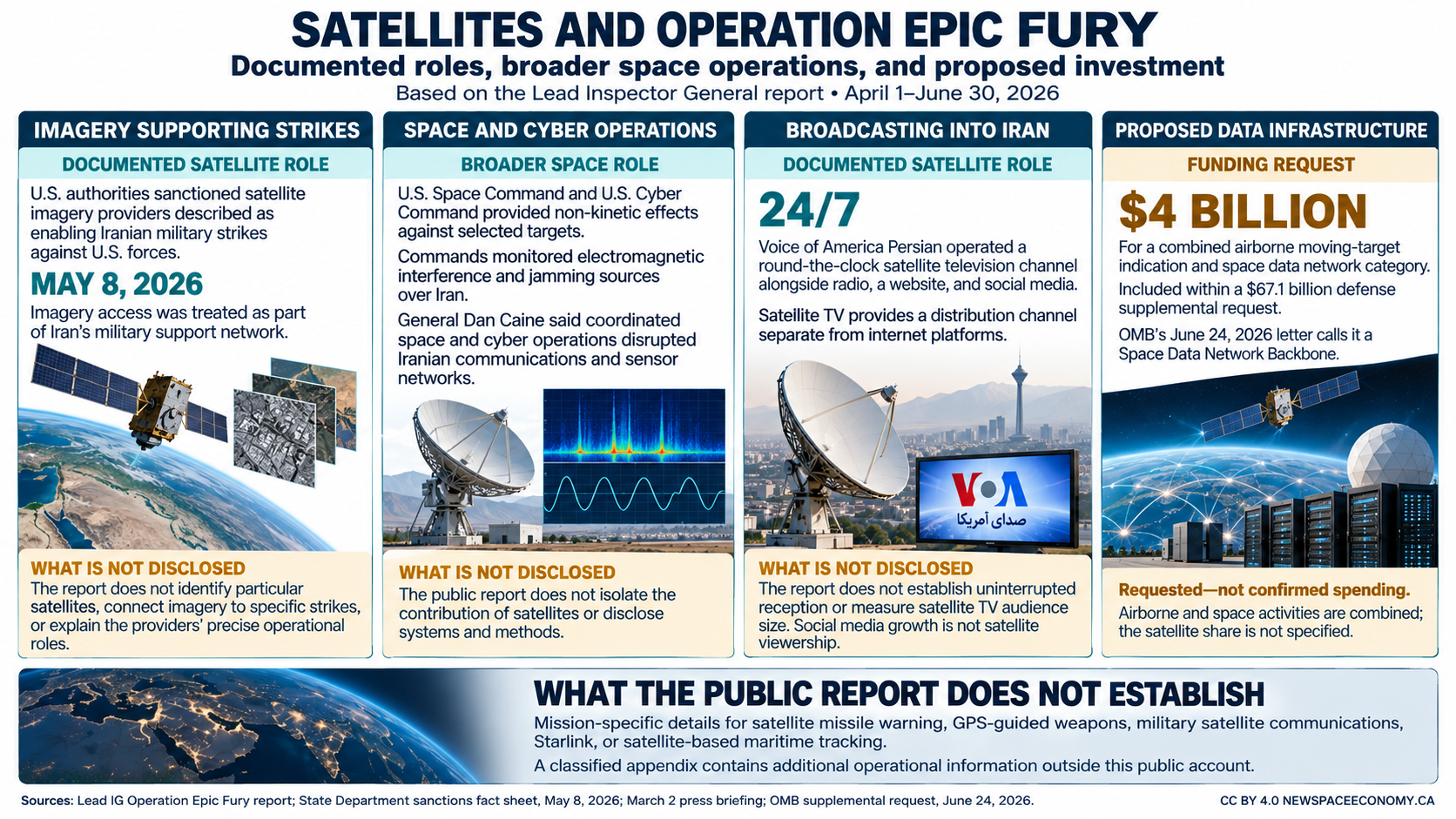
The Lead Inspector General Report to the United States Congress on Operation Epic Fury, covering April 1–June 30, 2026, shows satellite services and broader space capabilities contributing to military operations, imagery supporting Iranian strikes, and broadcasting into Iran. It also identifies proposed investment in a space data network. However, the public report provides limited technical detail and does not offer a complete inventory of the satellites involved.
Satellite imagery is supporting military strikes. The report states that U.S. economic measures targeted satellite imagery providers described as enabling Iran’s military strikes against U.S. forces. Its sanctions chronology records action against these providers on May 8, 2026, referencing the State Department’s fact sheet, Disrupting Iran’s Overseas Military Procurement Networks.
This is the report’s clearest explicit connection between satellite-derived information and combat operations. Imagery can help identify facilities, observe deployments, and assess changes at potential targets. However, the report does not explain which of these functions the sanctioned providers performed, identify particular satellites, or connect their imagery to specific strikes. The documented finding is that U.S. authorities treated access to satellite imagery as part of Iran’s military support network.
Space operations are helping disrupt Iranian communications and sensors. According to the report, U.S. Space Command and U.S. Cyber Command provided non-kinetic effects against selected targets and monitored electromagnetic interference and jamming sources over Iran. It also recounts General Dan Caine’s statement during the March 2, 2026, press briefing that coordinated space and cyber operations disrupted Iranian communications and sensor networks during the opening days of combat.
These activities demonstrate the operational importance of controlling access to information and limiting an opponent’s ability to coordinate. An important distinction is that the report describes combined space and cyber operations, rather than identifying particular satellite actions. It does not disclose the systems, methods, or individual contribution of satellites to those effects.
Satellite television is providing a channel for broadcasting into Iran. The report identifies Voice of America Persian’s round-the-clock satellite television channel as part of U.S. broadcasting directed toward Iranian audiences, alongside radio, a website, and social media.
Here, the satellite role is information distribution to civilians. Satellite television provides a delivery channel separate from internet-based platforms, which is relevant in a setting where the report also discusses internet-service suspension. Nevertheless, it does not measure satellite television reception, establish uninterrupted availability, or quantify its influence. The audience-growth figures presented for VOA Persian concern social media and should not be interpreted as satellite television viewing figures.
A proposed space data network appears in the funding request. The report lists $4 billion for “Airborne Moving Target Indication and Space Data Network” within a $67.1 billion defense supplemental request, mostly intended to support Operation Epic Fury needs. The underlying June 24, 2026, Office of Management and Budget letter to House Speaker Mike Johnson describes the category as “Airborne Moving Target Indication and Space Data Network Backbone.”
The funding category places moving-target detection and space data infrastructure among the capabilities proposed for additional investment. However, the $4 billion combines airborne and space-related activities. The report does not specify how much would go to satellites, ground infrastructure, or other components. It is a funding request, not evidence that the full amount was appropriated, spent, or used to deploy an operational network.
The broader picture is that space capabilities are integrated into the campaign, but their precise contribution remains partly undisclosed. The report explicitly describes an operation integrating air, land, sea, cyber, and space components. Its public account supports three distinct satellite-related functions: supplying imagery, distributing television programming, and forming part of proposed data infrastructure. It separately documents space-command involvement in disruption and interference-monitoring activities.
The document does not establish mission-specific details for satellite missile warning, GPS-guided weapons, military satellite communications, Starlink, or satellite-based maritime tracking. Those roles should not be presented as findings from this report. A classified appendix contains additional operational information, but that material is outside the public document.