
Key Takeaways
- A 66-satellite emulation replaced repeated ground transmissions with one initial uplink.
- Distributed state sharing could support more autonomous and resilient satellite groups.
- Flight testing remains necessary before the concept can support operational constellations.
Satellite Swarms Create a Control Problem
A satellite constellation with dozens of spacecraft cannot operate efficiently if every routine update requires separate ground commands. The communication burden grows with the number of satellites, ground-station access remains limited, and delayed instructions can reduce the value of time-sensitive observations.
A September 16, 2026 research paper on distributed satellite computing proposes treating a satellite swarm as a distributed computer. Instead of making the ground segment the central coordinator for every action, spacecraft would share information and coordinate tasks through intersatellite links.
The researchers, affiliated in part with France’s National Centre for Space Studies, organize the idea around three functions: shared state, command and control, and scientific mission processing. Shared state means that satellites maintain compatible information about conditions such as orbital objects, assignments, or network status. Command and control governs how the swarm makes and carries out decisions. Scientific processing distributes work such as filtering observations or identifying events.
This model does not eliminate ground control. Human operators and ground systems still define goals, authorize actions, and monitor safety. The change lies in reducing the number of routine exchanges needed to keep a large constellation synchronized.
One Uplink Can Feed an Entire Constellation
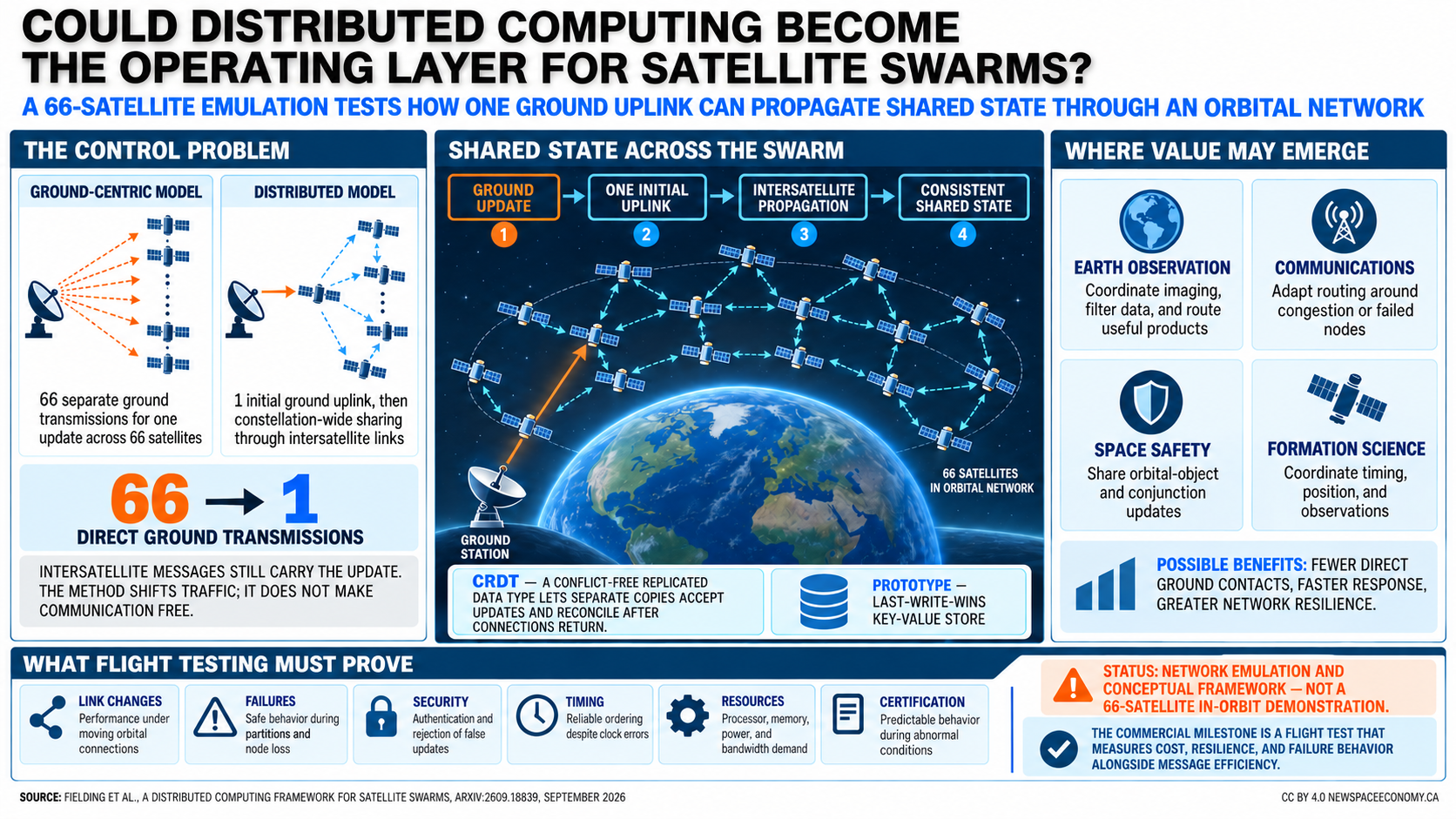
The paper evaluates a state-sharing service through an emulated constellation of 66 satellites. Its example involves distributing a space situational awareness catalog, which contains information about satellites and debris that may affect orbital safety.
Under a direct ground-to-satellite approach, an updated catalog must be transmitted separately to every spacecraft. The 66-satellite case requires 66 ground transmissions for each update.
The distributed approach sends the update to one satellite. That spacecraft shares it through the constellation’s intersatellite network until the other satellites receive the new state. The method reduces the ground segment’s direct burden from 66 transmissions to one initial uplink.
This does not mean the information moves without cost. Satellites still exchange messages with one another. The paper reports that a tree-based dissemination pattern can produce a total message count comparable to sending the update directly to every satellite. Its advantage lies in shifting most transmissions away from scarce ground contacts and into the orbital network.
That distinction matters commercially. Ground stations require antennas, spectrum, scheduling, staff, and geographic coverage. A constellation that can distribute routine information internally may use its ground network more efficiently and respond sooner when only one spacecraft has contact with a station.
Conflict-Resistant Data Sharing Supports Autonomy
A distributed system needs a method for handling updates created in different places. Two satellites may change the same record before either receives the other’s version. Communication links may disappear temporarily, creating separate groups with different information.
The framework uses a conflict-free replicated data type, or CRDT. This is a data structure designed so separate copies can accept updates and later reconcile them without requiring a central database to resolve every conflict.
The prototype uses a last-write-wins key-value store. Information is organized as named records with associated values. When two versions conflict, the system retains the update recognized as newer under its ordering rules.
Such an approach offers practical benefits. Satellites can continue operating during intermittent connectivity, exchange changes when links return, and converge toward a common state. The researchers report sublinear growth in intersatellite messages during concurrent updates because nodes discard versions that have already become outdated.
Last-write-wins logic also has limitations. The newest update is not automatically the most accurate or safest one. Clock errors, delayed messages, corrupted data, or incorrect commands can cause a valid record to be replaced. Mission designers need rules that reflect the meaning of the data rather than applying one conflict policy to every situation.
A science observation may tolerate delayed reconciliation. A collision-avoidance command requires stricter timing, authority, and confirmation.
Autonomy Could Improve Several Space Services
Earth-observation satellites often collect more data than they can immediately transmit. A coordinated swarm could identify cloud-free scenes, divide imaging assignments, and send selected products toward the satellite with the best ground contact. Onboard processing would reduce the volume of raw data sent to Earth.
Communications constellations could use shared state to distribute traffic around congested or failed nodes. Satellites might update routing decisions locally as network conditions change, reducing reliance on continuous ground intervention.
Space situational awareness provides another application. Satellites could exchange information about nearby objects, suspected maneuvers, or changes in conjunction risk. Faster distribution would be useful when a spacecraft receives an update outside the contact window of another member of the constellation.
Scientific formations present a more demanding case. Several satellites may need to coordinate their positions and observation times so their measurements can be combined. Distributed computing could help manage these tasks, though precision missions would require stronger timing and synchronization than the paper’s catalog-distribution example demonstrates.
The economic value depends on the service. Fewer ground transmissions could lower operating costs, but autonomous software adds development, validation, and cybersecurity expenses. Operators must compare the savings from reduced contact demand with the cost of proving that distributed decisions remain safe.
Resilience Comes With New Security Risks
A constellation that shares updates internally can keep operating when one ground station or satellite link becomes unavailable. It may also route information around a failed spacecraft. This can improve resilience because the system has no single communication path for every update.
The same connectivity can spread harmful information. A compromised satellite could attempt to inject false records, replay old commands, or overwhelm neighboring nodes. An error that once affected one spacecraft might propagate through the swarm.
Distributed systems require authentication, authorization, and records of where each update originated. Satellites need a way to reject commands from unauthorized nodes and isolate members that behave unexpectedly. Sensitive operations may require several independent approvals before the swarm acts.
Software updates create another risk. A common operating layer makes coordination easier, but a defect shared across the fleet can cause failures at constellation scale. Operators may need staged deployments that update a small group before extending new software to every spacecraft.
Recovery plans must work without reliable ground contact. Safe modes, local operating limits, and protected command channels remain necessary even in a highly autonomous architecture.
Emulation Is an Early Step
The paper presents a conceptual framework supported by network emulation. It does not report an operational demonstration aboard 66 satellites. Real spacecraft introduce constraints that software emulators cannot fully reproduce.
Radiation can alter memory and processing behavior. Antenna geometry affects which satellites can communicate. Orbital motion changes network connections continuously. Power budgets may limit the time available for computation and crosslink transmission. Hardware from different manufacturers may use incompatible software and security controls.
A flight demonstration would need to test network partitions, failed nodes, delayed messages, inaccurate clocks, and corrupted updates. It should also measure processor use, memory consumption, energy demand, link capacity, and recovery time.
Certification may prove harder than raw performance. Conventional mission control keeps important authority on the ground, where decisions can be reviewed. Distributed autonomy transfers some decisions to software operating across several spacecraft. Regulators, customers, and insurers will need evidence that the swarm behaves predictably during failures as well as normal operations.
Summary
The 66-satellite experiment shows how one ground uplink can distribute an update through a constellation rather than requiring a separate transmission to every spacecraft. Conflict-resistant data structures allow satellites to accept local changes and reconcile their records after disrupted communications.
These techniques could support Earth observation, communications, space situational awareness, and formation-based science. They could also reduce dependence on constant ground access and make large constellations more responsive.
The result remains an emulated proof of concept. Flight hardware, dynamic link conditions, security threats, and certification requirements can change system performance. The next commercial milestone is an orbital demonstration that measures operating cost and failure behavior alongside message efficiency.
If flight tests confirm the approach, distributed computing may become a shared operating layer beneath future satellite services. The most valuable product may be neither a spacecraft nor a ground station, but the software that allows an entire constellation to behave as one coordinated system.
