
Key Takeaways
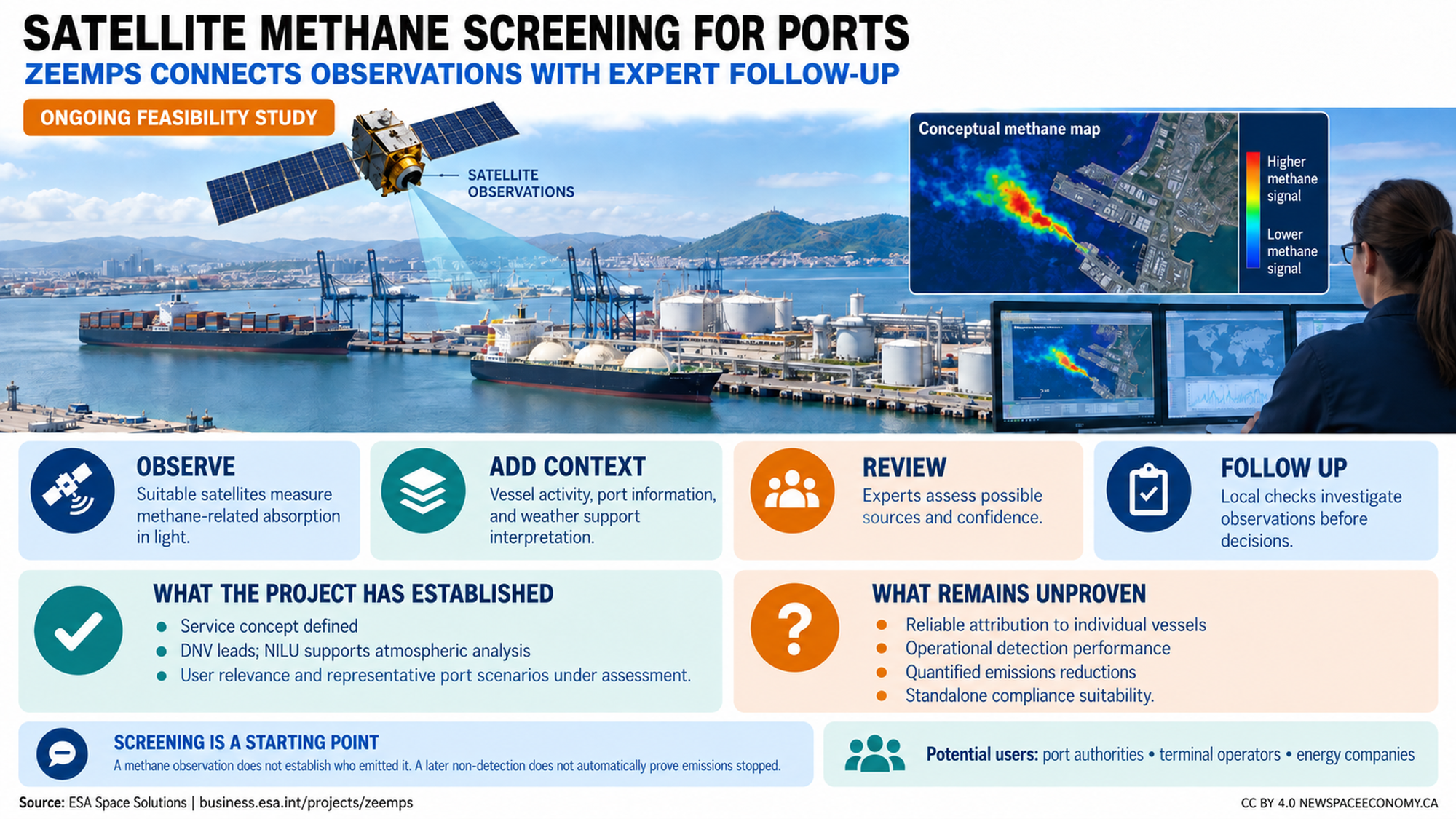
- ZeEMPS is assessing satellite methane screening for ports through an ongoing feasibility study.
- Vessel activity and weather can support interpretation, but they do not establish an emission source alone.
- Local confirmation and documented follow-up remain necessary to turn observations into useful decisions.
Satellite Methane Screening Enters a Port Feasibility Study
DNV is leading an ongoing European Space Agency (ESA) feasibility study called ZeEMPS, with atmospheric-analysis support from NILU. The project update dated September 18 describes satellite methane screening combined with vessel activity and environmental information. Its intended purpose is to direct attention toward observations that merit expert review or local confirmation.
The service concept has been defined, but its usefulness in representative port situations remains under assessment. That places the project at an earlier stage than an operational monitoring service with a published performance record. The update does not establish verified attribution to individual ships or quantified emission reductions.
Ports create a demanding setting for interpreting observations because the management question extends beyond locating a feature on a map. A decision may depend on whether that feature relates to port infrastructure or a vessel. The information must support an investigation without presenting an uncertain association as a settled finding.
The feasibility study can examine whether bringing different datasets together makes that investigation more focused. A useful result would specify what users can conclude from an observation and which additional checks remain necessary. It should also identify situations in which the available evidence cannot support a meaningful interpretation.
That is a narrower promise than continuously measuring every source in a port. It may still have commercial value if the service helps organizations allocate review effort more effectively. Establishing that value would require evidence from the intended users, together with a clear account of the observations available under the conditions being assessed. A defined concept is a starting point for those tests, rather than a substitute for them.
Measuring Methane Requires More Than a Conventional Photograph
Methane absorbs light at particular wavelengths, allowing suitable instruments to identify its presence from changes in the measured spectrum. A spectrum separates light into wavelength components. The resulting analysis differs from looking for a visible cloud in an ordinary photograph.
The National Aeronautics and Space Administration describes this principle in its trace-gas mapping work. Its Earth Surface Mineral Dust Source Investigation instrument can use methane’s shortwave-infrared absorption features to map suitable emission plumes. This establishes a physical basis for the observation method, but it does not establish the performance of ZeEMPS or identify which instrument the project will use for every application.
ZeEMPS proposes assessing information from different suitable sensors. That approach raises an evaluation question: how to compare observations whose characteristics may differ. An integrated display should preserve the information needed to understand each observation rather than implying that all incoming measurements have identical sensitivity or coverage.
For a potential customer, the useful specification would describe where the data are suitable and when no dependable assessment can be made. A blank area on a display should not automatically be interpreted as evidence of no emissions. It could instead represent an absence of suitable observations, a distinction the service should communicate explicitly.
New Space Economy’s discussion of government and commercial observation assets provides context for purchasing information from different sources. Data access and service obligations can vary with the provider. For an emissions application, the purchasing assessment should include whether users can retain sufficient supporting information to understand a result after it has been delivered, including the observation date and the qualifications attached to its interpretation.
A Plume Location Does Not Settle Source Attribution
A vessel’s presence near a methane observation is an association to investigate. It does not, by itself, establish that the vessel produced the observed gas. The distinction becomes more important when a screening product may influence how an organization prioritizes follow-up.
ZeEMPS proposes combining methane observations with maritime activity and weather information. That combination can provide context for expert interpretation. The public description retains local confirmation as part of the intended process, rather than claiming that a map can independently resolve every possible source.
Timing deserves particular attention in that process. A comparison should use vessel information relevant to the observation time, with any gap made visible. Matching an observation to a ship’s later position would answer a different question from identifying which vessels were present when the measurement was taken.
The analytical output should also distinguish the observed area from a proposed source area. Those are different products, even if they appear on the same display. An inferred source needs a stated method and an account of the assumptions that shaped the inference.
For the ZeEMPS feasibility work, a useful assessment would ask whether a reviewer can reconstruct that reasoning from the delivered information. If a conclusion depends on a particular weather input or an uncertain operational record, the reviewer should be able to identify that dependency. A confidence label alone would provide too little explanation if its meaning remained unclear.
This suggests a practical boundary for early deployment: use the output to organize investigations before using it to make consequential assertions about a named operator. That is an interpretation of how the proposed screening service could be used responsibly, not a reported operating policy or a legal conclusion. The available update supplies no basis for treating vessel-level attribution as an already demonstrated capability.
An Observation and an Emissions Inventory Answer Different Questions
An observation concerns conditions during a particular measurement. An emissions inventory concerns releases over a defined period and within a defined boundary. Moving from one to the other requires assumptions that should remain visible, rather than disappearing inside a single total.
For ZeEMPS, that distinction limits what should be inferred from a promising detection. The public update does not present a validated method for turning its port screening outputs into a complete annual inventory. It also does not establish that all relevant sources would be observed with sufficient frequency to support such a calculation.
A suitable evaluation should distinguish evidence of an event from evidence about its duration. A measured condition cannot establish how long it existed before the observation or whether it persisted afterward without additional information. Repeated observations can strengthen the record, but their timing and suitability still need to be considered.
The same caution applies to an apparent improvement. A later observation with no detected plume would need interpretation in relation to the available measurement conditions. A claim that emissions decreased should explain what evidence supports that conclusion and what alternative explanations were considered.
These distinctions matter for communication with customers as much as for analysis. A port manager should be able to tell whether an output is an alert for review, an interpreted event assessment, or a broader estimate. Presenting each as an equivalent emissions measurement would make the product easier to misunderstand.
A practical demonstration could test whether users classify those outputs correctly without specialist help. It could also examine how they handle missing information. That would evaluate a proposed service requirement directly: whether confidence and limitations remain understandable when analytical results pass from atmospheric specialists to people responsible for operational follow-up.
Follow-Up Determines Whether Detection Produces an Environmental Benefit
The United Nations Environment Programme (UNEP) has documented the gap between detecting methane and obtaining a response. In a November 2024 assessment, it reported 1,200 notifications from its Methane Alert and Response System, with responses to approximately 1% of them. Those are historical program figures, not a current response rate or a measure of ZeEMPS performance.
The same assessment described cases in Algeria and Nigeria where engagement following alerts led to action on leaks. Their relevance is the complete process linking observation with investigation and corrective work. They do not demonstrate that the same results will follow from screening a port.
For ZeEMPS, a useful service trial should identify who receives an observation and what happens next. The recipient needs enough information to decide whether further review is warranted. A named responsibility for follow-up would make it possible to distinguish a completed assessment from an alert that simply remained in a dashboard.
The evaluation should record the outcome of that review even when it does not confirm an emission source. An unresolved case and a confirmed finding have different meanings. Combining them under a count of alerts would obscure the amount of useful evidence the service actually produced.
New Space Economy’s coverage of workforce training for satellite data addresses the human capability needed to interpret such products. Technical access does not guarantee that an organization has the skills to assess uncertainty or arrange an appropriate investigation.
A future ZeEMPS pilot could examine that handoff explicitly, including the time required to obtain clarification from specialists. Those results would help establish whether the proposed service reduces investigative effort or adds another stream of information that users must reconcile manually.
Commercial Value Depends on the Quality of the Decision Support
ZeEMPS identifies potential users among port authorities and terminal operators, with energy companies also included. These are prospective customer groups. Their presence in a project description does not establish signed commercial contracts or a predictable market size.
The service’s economic case would need to connect its price with a specific improvement in work. For a screening product, that could involve reducing the effort required to identify cases worth investigating. It would need measurement before being presented as a demonstrated saving.
A trial could compare the review process with and without the proposed service, documenting the time spent reaching an assessment. The comparison should include cases that remain unresolved, as well as useful findings. Excluding difficult cases would make the product appear more effective than the ordinary user experience supports.
Costs should include access to observations and the specialist work needed to interpret them. Customer effort also belongs in the assessment. A low subscription price would not necessarily imply a low total cost if staff had to spend substantial time resolving ambiguous outputs or transferring information between systems.
This sits within the space economy value chain, where downstream businesses combine satellite inputs with expertise and software. The commercial product can be an interpreted service rather than ownership of a satellite. Its value depends on the information provided to a customer and the conditions under which that information can be used.
For procurement, a clear specification should state what the provider undertakes to deliver and what remains the customer’s responsibility. Access to supporting records and the handling of revised interpretations deserve explicit treatment. These are proposed criteria for assessing a future offer, not terms disclosed by the feasibility study. A successful concept assessment would provide a firmer basis for defining those obligations before customers depend on them.
A Useful Pilot Would Test Uncertainty as Carefully as Detection
The next development step should be judged by the questions a pilot can resolve. More observations would be useful only if they support a defensible assessment of the intended service. ZeEMPS has not yet published the operational validation needed to determine that performance.
A proposed evaluation should specify what constitutes a correct screening result before reviewing outcomes. It should retain cases where the evidence is insufficient, rather than forcing every observation into a confirmed or rejected category. An explicit unresolved category would preserve information about the limits of the method.
Independent review could examine whether another qualified analyst reaches a similar interpretation using the same supporting material. Agreement would provide evidence of reproducibility. Disagreement could reveal whether the problem lies in incomplete data or unclear decision rules, with different implications for improving the service.
User testing should examine the presentation as well. Confidence information needs to influence understanding, rather than function as a small-print qualification that recipients overlook. A display that makes an uncertain source association appear definitive could create problems even when the underlying analysis includes appropriate caveats.
The study can also examine how corrections propagate. If an interpretation changes after local confirmation, the service should make the revised assessment distinguishable from the earlier one. Retaining that history would allow users to understand why a follow-up decision changed.
Such tests would produce evidence about the proposed product without implying uninterrupted monitoring or automatic enforcement capability. They would also help define which customers and situations are suitable for an initial service. Restricting an early offer to conditions supported by validation would provide a more defensible basis for expansion than presenting every port environment as equally well understood.
Summary
ZeEMPS is examining whether satellite observations can help port and maritime organizations identify methane-related cases worth investigating. Its present contribution is a defined service concept undergoing feasibility assessment. Reliable vessel attribution and verified emissions reductions remain outside the results established by the public update.
An additional benefit of a well-designed service could be a better record of unresolved questions. Port organizations could retain why a case was selected for review and what information was missing. That record would make later observations more useful because analysts could compare them with an existing investigation rather than starting again from an isolated map.
This would require careful management of revisions and access to supporting evidence. It would also require a clear separation between an observed feature, an analyst’s interpretation, and an operator’s subsequent response. Those distinctions can make the information usable without pretending it is more certain than the measurement permits.
The strongest future evidence would connect screening to a documented investigation and a verified outcome. Until that evidence is available, the project is best understood as work toward an additional tool for port methane management, with its practical value still to be demonstrated under the conditions in which customers would use it.
