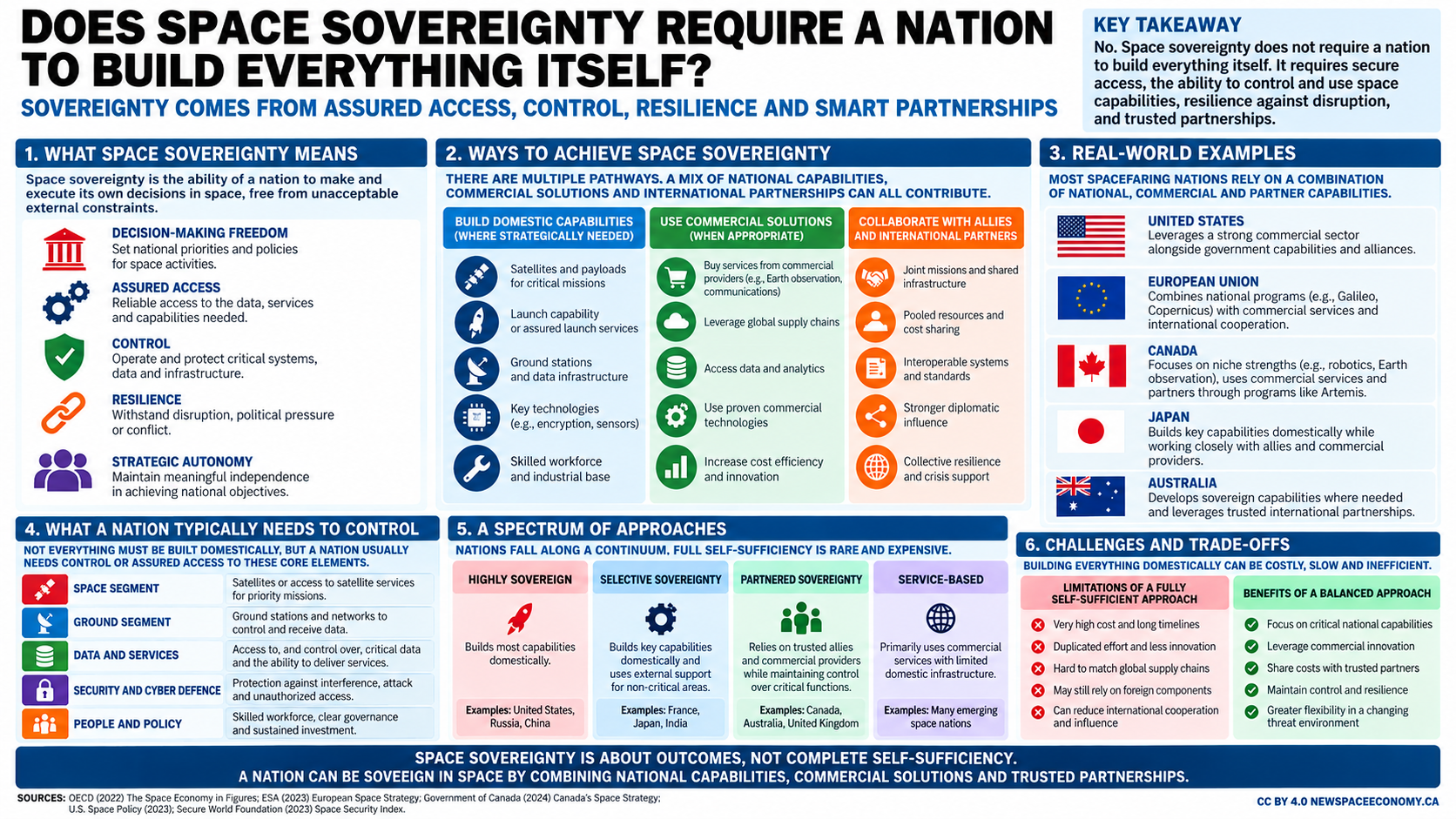
- Key Takeaways
- Space Sovereignty Is About Control Rather Than Autarky
- Sovereign Control Must Follow Mission Consequences
- Foreign Procurement Can Support Space Sovereignty
- Stockpiles Buy Time but Do Not Create Permanent Independence
- Selective Sovereignty with Assured Access Offers a More Practical Model
- Mixed National Models Show How Sovereignty Works in Practice
- A Sovereign Endurance Period Makes the Stockpile Idea Measurable
- Governments Should Build the Chokepoints and Buy the Rest Carefully
- Summary
Key Takeaways
- Space sovereignty depends on assured national control, not complete domestic production.
- Foreign systems can support sovereignty when access, use, sustainment, and data remain controlled.
- A stockpile can create temporary autonomy, but only for a defined and tested endurance period.
Space Sovereignty Is About Control Rather Than Autarky
On February 17, 2026, Canada launched its Defence Industrial Strategy and placed space among 10 national sovereign capability areas, including space-based intelligence, surveillance and reconnaissance, space domain awareness, satellite communications, and space launch. The same strategy adopted a Build-Partner-Buy procurement model. Canada intends to build at home where national strengths or sovereignty requirements justify it, partner with trusted allies where joint development offers advantages, and buy from allies when domestic or joint production is not feasible. That combination gives a direct answer to the policy question behind space sovereignty: a state can treat a capability as sovereign without insisting that every component, factory, launch vehicle, software module, or service provider be nationally owned.
The term needs legal care. The Outer Space Treaty does not grant states territorial sovereignty over outer space. Article II states that outer space, including the Moon and other celestial bodies, is not subject to national appropriation by a claim of sovereignty, use, occupation, or other means. In national policy, “space sovereignty” is more usefully understood as the ability of a state to make decisions and carry out essential space-enabled functions without an unacceptable external veto. That meaning is closer to strategic autonomy, assured access, freedom of action, and sovereign control than to territorial ownership.
This distinction matters because complete domestic self-sufficiency is economically unrealistic for most states and unnecessary for many missions. Space systems depend on semiconductors, radiation-tolerant electronics, propulsion equipment, optical components, ground networks, launch services, software, cloud infrastructure, radio-frequency equipment, insurance, test facilities, data processing, cybersecurity, and specialist labor. Reproducing every element inside national borders can consume more money and personnel than the mission warrants. It can also create a new single point of failure if a country replaces several trusted foreign suppliers with one protected domestic supplier.
A more useful definition treats space sovereignty as control over outcomes. The state needs authority to task a system, receive and protect its data, operate it under national authority, maintain it during disruption, replace lost capacity within an acceptable period, and change suppliers when necessary. Ownership can help achieve those conditions, but ownership is one instrument rather than the definition.
New Space Economy has described this approach as selective autonomy: direct control is retained where loss of control would create unacceptable national risk, and commercial or allied supply is used where comparable mission outcomes can be secured at lower cost. That framing fits the direction visible in several national policies as of August 25, 2026. The policy target is credible national choice, not an attempt to reproduce the entire international space industry inside one border.
Sovereign Control Must Follow Mission Consequences
A government deciding what must be sovereign should start with the consequences of denial rather than with the nationality of the manufacturer. The useful question is whether loss of an outside supplier, service, authorization, software update, cryptographic key, launch slot, ground station, or data feed would stop an essential national function before the country could restore it by another route. If the answer is yes, the dependency deserves stronger national control or a more resilient allied arrangement.
Different missions produce different answers. A scientific instrument that can wait 18 months for replacement may tolerate deep foreign dependence. A protected military communications function may require immediate national tasking authority, national control of encryption, several ground paths, and a replacement plan that works during conflict. Earth observation for disaster response can occupy an intermediate position. The state may buy commercial imagery during normal operations yet retain government-owned sensors or guaranteed tasking rights for emergencies.
Canada’s June 30, 2026, RADARSAT replenishment decision shows how this can work. The Canadian Space Agency awarded MDA Space a CAD $688 million contract to build, test, and launch a replenishment satellite. The spacecraft will rely on a commercial satellite design derived from MDA CHORUS synthetic aperture radar technology and Canada’s RADARSAT heritage. The Canadian Space Agency states that the replenishment spacecraft is intended to maintain uninterrupted access to RADARSAT Constellation Mission data used by more than 10 federal departments and is targeted for launch in the early 2030s.
Sovereignty in that case comes from the combination of national mission requirements, Canadian industrial capacity, controlled access to data, compatible ground infrastructure, operational knowledge, and the ability to sustain a government service. It does not depend on a rule that every item inside the satellite must originate in Canada.
An analytic model can separate sovereign control into several dimensions. These are planning categories rather than terms of international law, and a state can set different thresholds for each mission.
| Control Dimension | Sovereignty Test | Likely National Requirement |
|---|---|---|
| Decision Authority | Can government task the capability independently? | National command authority and protected procedures |
| Mission Operations | Can national operators run the mission during supplier denial? | Trained personnel and controlled operating systems |
| Data and Cryptographic Control | Can data and keys remain under national authority? | National custody, access rules, and security authority |
| Sustainment | Can equipment be repaired without one foreign vendor? | Spares, documentation, tools, rights, and trained maintainers |
| Reconstitution | Can lost capacity be replaced within the required time? | Replacement hardware, integration capacity, and launch access |
| Supply Diversity | Can another source replace a denied supplier? | Qualified alternatives and interoperable interfaces |
This approach prevents domestic-content percentages from becoming a substitute for operational analysis. A spacecraft can contain 90% domestic content and still depend on one foreign encryption module that cannot be replaced. Another system can contain substantial imported hardware yet remain highly sovereign if the state owns the software baseline, controls mission operations, possesses spare units, has several suppliers, and can continue functioning through a geopolitical disruption.
For policy purposes, the strongest sovereignty claims should attach to capabilities that preserve independent national decisions under stress. That may require domestic production in some areas. Elsewhere, contractual rights, allied agreements, technical interoperability, protected data custody, stockpiles, alternate suppliers, or reserved production capacity can provide comparable protection.
Foreign Procurement Can Support Space Sovereignty
Buying a spacecraft, launch service, terminal, sensor, or component from another country does not automatically surrender space sovereignty. The result depends on the terms of control after purchase. A government that acquires foreign equipment can still possess sovereign operational authority if it can use the equipment without foreign permission, maintain it without continuing access to a single external contractor, protect national data, modify authorized software, integrate the system into national networks, and obtain replacement parts through more than one dependable path.
Canada’s 2026 procurement policy makes this principle explicit. Under the Defence Investment Agency’s Build-Partner-Buy framework, Canada may buy equipment from allies when it cannot reasonably build the capability at home or through partnership. The government states that foreign purchases should include conditions requiring reinvestment in Canadian industry and ensuring Canadian sovereign control over operation and sustainment. That is a stronger sovereignty test than country of origin alone because it focuses on authority after delivery.
The United States Space Force uses similar reasoning at a much larger scale. Its Commercial Space Strategy states that the service will integrate organic, allied, and commercial space solutions into hybrid architectures. The strategy also emphasizes avoiding overreliance on a single provider or solution, interoperability, and resilience through supplier and supply-chain diversity. A state with extensive domestic space capacity still sees operational value in external commercial supply because complete government duplication can cost more, take longer, and provide less flexibility than a mixed architecture.
The United States Space Force International Partnership Strategy extends the same model to allies. It calls for allied and partner integration into force design, force development, and operations and describes international integration as complementary to the Space Force’s government-commercial hybrid architecture.
The United Kingdom uses another form of selective control. Its Space Industrial Plan identifies national capability goals and a set of Highly Assured Technical Areas where the Ministry of Defence wants access to assured national capacity. The plan states that these areas preserve an option to procure onshore for national security and assurance reasons. It does not state that every space technology must be produced in the United Kingdom.
The European Union’s IRIS² secure connectivity program provides a multinational case. On August 7, 2026, the European Commission and SpaceRISE concluded negotiations and signed an implementation agreement that increased the main constellation to 348 satellites. The European Space Agency states that the constellation will comprise 330 satellites in low Earth orbit and 18 in medium Earth orbit, with initial launches planned from 2029. IRIS² is intended to provide sovereign and secure connectivity through a public-private structure involving European institutions, participating governments, SpaceRISE, and a distributed European industrial base.
These models do not eliminate dependency. They manage it. A foreign purchase can strengthen sovereignty when it removes a more dangerous dependency, creates redundancy, or gives the state a capability it could not field in time. It can weaken sovereignty when the supplier retains an external disable function, exclusive maintenance rights, proprietary interfaces, export-controlled replacement parts, operational data access, or legal power to withhold service when the capability is needed.
Stockpiles Buy Time but Do Not Create Permanent Independence
A stockpile purchased from another country can provide a defined period of sovereign operation. It should be described as time-bounded strategic autonomy rather than permanent industrial independence. The distinction matters because stockpiles work best for items that can be stored, tested, replaced, and used without continuous foreign intervention. They work less well for services and systems whose continued operation depends on remote software support, external networks, vendor authorization, licensed cryptographic material, cloud infrastructure, spectrum coordination, or specialized maintenance.
The stockpile concept can work well for spare components, replacement terminals, selected electronics, propulsion hardware with suitable storage characteristics, deployable ground equipment, and complete replacement spacecraft if storage and recertification requirements are manageable. It can also support launch readiness when a state possesses stored hardware, trained personnel, approved facilities, and the legal and technical authority to operate the system. A warehouse full of imported equipment has little sovereign value if national personnel cannot inspect, repair, integrate, or activate it without a foreign contractor.
Time is the governing variable. Governments should define an endurance requirement before procurement. A 30-day interruption tolerance creates a different supply policy from a five-year requirement. Stored equipment can cover a short disruption, but long periods expose degradation, obsolescence, battery life, propellant limits, software incompatibility, disappearing test equipment, expiring certifications, and workforce attrition. Space hardware can also become unusable because the surrounding architecture changes even when the stored unit remains physically intact.
A stockpile does not solve reconstitution by itself. If satellites are lost, a government needs replacement spacecraft, launch access, payload integration, ground updates, frequency coordination, trained operators, and command authority. If the inventory contains satellites but no compatible launch option is available, the mission still fails. If launch hardware is stored but an imported flight computer requires unavailable vendor support, launch autonomy remains incomplete.
Supply-chain resilience deserves equal attention with platform ownership. New Space Economy’s examination of space supply-chain resilience addresses long-lead components, electronics, specialist suppliers, and the industrial capacity needed to sustain space programs under disruption. The same principle applies to a national stockpile. Inventory is useful only when it sits inside a tested sustainment system.
The most defensible policy claim is that a foreign-sourced stockpile can create a sovereign operating window. That window should have a declared duration, a tested consumption model, inspection schedules, replacement rules, trained national personnel, and a path to replenishment. If the state cannot explain what happens after the stored inventory is depleted, it has purchased a period of resilience rather than permanent industrial autonomy.
Selective Sovereignty with Assured Access Offers a More Practical Model
Selective sovereignty begins by identifying which mission effects cannot be allowed to fail. It then assigns the lowest-cost control mechanism that keeps the probability and duration of denial within national tolerance. That mechanism may be national ownership, domestic production, allied co-production, a commercial service contract, a stockpile, reserved manufacturing capacity, multi-vendor procurement, or a combination of those tools.
This approach avoids assuming that foreign supply is always unsafe. Trusted allies can offer geographic diversity, larger production runs, mature technology, and substitute capacity that a smaller national industry may be unable to reproduce economically. Canada’s March 14, 2026, space cooperation agreement with Norway illustrates the policy logic. The countries signed a Letter of Intent covering policy, intelligence, research and development, capabilities, and industry, with an emphasis on Arctic security and sovereign defence capabilities. Cooperation is being used to strengthen sovereign capacity rather than treated as its opposite.
Domestic production also does not automatically guarantee control. A nationally owned prime contractor can remain dependent on imported microelectronics, foreign machine tools, overseas cloud services, one launch range, a single propulsion supplier, or intellectual property that cannot legally be modified. A domestic monopoly can reduce resilience if it eliminates alternate sources.
New Space Economy’s analysis of who controls the space supply chain makes this point in industrial terms. Space programs depend on government procurement, upstream suppliers, qualification systems, materials, electronics, testing, propulsion, and production capacity. The flag attached to the prime contractor does not by itself describe the degree of national control.
Assured access is the useful bridge between sovereignty and interdependence. A country may accept a foreign supplier if access is protected by treaty, alliance commitments, long-term contracts, stored inventory, production reservations, technical data rights, national maintenance capability, interoperable alternatives, or several providers in different jurisdictions. The required combination depends on mission sensitivity and recovery time.
A government can also preserve sovereignty through reversibility. If a commercial provider becomes politically unreliable, technologically obsolete, financially unstable, or operationally unsuitable, the state should be able to migrate data, terminals, software, mission planning, and procurement to another provider. Open interfaces and government-controlled integration layers can matter more than owning every physical element.
For this reason, “buy versus build” is too narrow a policy framework. The choice is better framed through control, assurance, substitution, and reconstitution. A state can buy foreign hardware and still control it. It can use allied services and assure access through binding arrangements. It can substitute another supplier if interfaces are interoperable. It can reconstitute lost capability if production, integration, and launch plans exist.
Space sovereignty becomes measurable once those functions are assigned to real institutions and tested against defined disruption periods.
Mixed National Models Show How Sovereignty Works in Practice
Current policy across Canada, Europe, the United Kingdom, and the United States rejects the proposition that sovereign space capability requires one state to own an entire vertically integrated space program. The degree of domestic control differs, but the shared pattern is selective national ownership combined with trusted external capacity.
Canada’s Defence Industrial Strategy places space in the sovereign capability category and states that the government intends to maximize strategic autonomy and reduce supply-chain vulnerabilities in designated sovereign capability areas. The strategy gives domestic production priority, yet its Build-Partner-Buy structure expressly permits trusted allied partnerships and foreign acquisition when building domestically is not feasible. Foreign purchases are expected to preserve Canadian control over operation and sustainment.
Canada is also investing directly in domestic launch capacity. National Defence documentation states that CAD $182.6 million over three years has been committed toward establishing a sovereign Canadian space-launch capability. This illustrates how selective sovereignty can vary by function. A government may decide that national launch access deserves direct investment even though many spacecraft components or services remain internationally sourced.
Europe’s approach operates at regional scale. The August 7, 2026, IRIS² implementation agreement moved the secure-connectivity system toward full-scale deployment with 348 satellites in the main constellation. European institutions describe the system in terms of secure connectivity and strategic autonomy, but its implementation depends on shared governance, public financing, commercial operators, European manufacturers, launch procurement, ground infrastructure, and member-state contributions. No single European Union state needs to duplicate the entire architecture independently.
The United Kingdom reserves stronger domestic assurance for selected technical areas rather than declaring the whole space supply chain nationally exclusive. Its Highly Assured Technical Areas include capabilities associated with satellite communications, tracking telemetry and control, software, sensors, alternative navigation, space domain awareness, and timing. The policy directs attention toward the technologies where assured national supply or trusted national analysis has the greatest security value.
The United States illustrates the same principle from the opposite direction. Even with extensive domestic manufacturing, launch infrastructure, military satellite programs, and public investment, the Space Force plans to integrate commercial and allied capabilities into hybrid architectures. Large domestic industrial capacity does not remove the operational value of trusted external capacity.
The table below compares the main models available to a government. Most national programs combine several rather than selecting one for every mission.
| Model | Control Pattern | Main Benefit | Main Exposure |
|---|---|---|---|
| Domestic Build | National design, production, and support | High operational and industrial control | Cost, scale, and domestic bottlenecks |
| Allied Partnership | Shared production, technology, or operations | Scale, interoperability, and shared investment | Joint decisions and partner availability |
| Foreign Purchase | National ownership after external manufacture | Fast access to mature capability | Export controls and sustainment dependence |
| Strategic Stockpile | Stored foreign or domestic capacity | Defined operating time after disruption | Depletion, obsolescence, and recertification |
| Commercial Service | Government buys an operating service | Scale and fast technology refresh | Provider policy and continuity risk |
| Hybrid Architecture | Government, allied, and commercial mix | Redundancy and supplier choice | Integration and governance complexity |
New Space Economy’s discussion of sovereign space capability reaches a similar policy result from a market perspective. Governments gain more freedom when they control mission-essential functions, maintain alternatives, and avoid dependencies that can become an external veto. Industrial depth matters, but complete duplication is not the standard against which every sovereign program should be judged.
A Sovereign Endurance Period Makes the Stockpile Idea Measurable
The idea of purchasing foreign equipment to support sovereignty for a designated period becomes more useful when the period is made explicit. A practical planning metric is a “sovereign endurance period,” meaning the number of days, months, or years that an essential national space function can continue after foreign supply, support, or service is interrupted. This is an analytic planning term, not an established treaty definition or universal government standard.
The endurance period should be calculated for the mission, not for the inventory. A country might possess two years of spare terminals but only 90 days of software support. It might have replacement satellites in storage but no compatible launch availability for 18 months. It might own ground stations but depend on an external provider for encryption management. The shortest indispensable dependency sets the practical endurance period because that is where the mission stops.
Several variables should be tested. Inventory consumption rates need to include failures and conflict-related loss assumptions rather than peacetime averages alone. Stored hardware needs scheduled inspection and recertification. Software and firmware need a national maintenance path. Cryptographic systems need domestic authority over keys and updates. Ground networks need alternate communications paths. Launch plans need compatible interfaces, reserved capacity where justified, regulatory authority, and trained integration teams. Supply contracts need provisions for surge demand and geographic disruption.
The concept also exposes a difference between possession sovereignty and production sovereignty. A state can possess enough imported equipment to operate independently for three years, which may meet the policy requirement for a low-probability disruption. It does not possess permanent production sovereignty if it cannot replenish that inventory after three years. That may still be acceptable. A nation does not need permanent industrial independence in every category if the cost exceeds the public benefit and trusted alternatives remain dependable.
For missions tied to defence, national command, strategic warning, secure government communications, or independent intelligence collection, the required endurance period may be long and the control threshold high. For research missions, commercial Earth observation, or replaceable communications services, a country may accept shorter endurance and greater market reliance. Sovereignty should be proportional to the consequence of denial.
This framework turns a vague debate into a procurement specification. Instead of asking whether a foreign purchase “counts” as sovereignty, planners can state the required operating period under supplier denial, identify the shortest dependency, fund the measures needed to extend that period, and decide whether domestic production is economically justified.
Governments Should Build the Chokepoints and Buy the Rest Carefully
National programs should concentrate domestic investment where foreign denial would have the greatest operational effect and where local control materially changes the outcome. That can include command-and-control software, protected data environments, cryptographic authority, mission operations, secure ground infrastructure, system integration, selected sensors, national intelligence processing, and enough engineering knowledge to maintain and modify essential systems. Launch can also belong in the domestic category when replacement speed or foreign scheduling risk creates unacceptable exposure.
Other elements can be bought or shared. Commercial imagery, routine launch capacity, standardized satellite buses, ground services, cloud processing, user terminals, and many commodity components may be sourced internationally when the market offers several suppliers and the state can switch without losing mission continuity. These purchases still need supply-chain screening, cybersecurity requirements, export-control analysis, and contractual rights that survive political disagreement or corporate failure.
The Canadian Build-Partner-Buy framework gives governments a useful sequence. Build where sovereignty and national industrial strength justify domestic capacity. Partner when the capability benefits from allied scale or shared technology. Buy when building would waste time or money, but preserve control over operation and sustainment. A stockpile belongs inside the buy or partner path as a resilience measure, not as a complete sovereignty doctrine.
Procurement contracts can strengthen control by requiring technical data packages, maintenance manuals, diagnostic tools, software rights, local training, spare parts, security accreditation, and documented interfaces. Multi-vendor qualification reduces dependence on one supplier. Government-controlled mission software can make spacecraft and service providers more replaceable. Domestic ground systems can protect data even when spacecraft are foreign-built. Reserved launch capacity can reduce the risk that a provider prioritizes another customer during a disruption.
New Space Economy’s analysis of launch cost asymmetries adds an economic dimension. Governments can preserve domestic launch options for sensitive missions and still use lower-cost allied or commercial launch services when conditions permit. Maintaining credible choice can provide more operational freedom than forcing every payload onto a protected national launcher regardless of cost, capacity, or schedule.
The strongest national architecture is one that can absorb the loss of a supplier without losing the state’s ability to decide and act. Domestic industry is one path to that result. Trusted allies, stockpiles, commercial competition, interoperable interfaces, national operating knowledge, and reserved capacity are other paths. The appropriate mix depends on how long the country must operate under denial, how quickly alternatives can be activated, and how severe the consequences of interruption would be.
Summary
Space sovereignty does not require a nation to build, own, and support every element of a national space program. International law does not recognize territorial sovereignty over outer space, and national policy uses sovereignty in a more operational sense: freedom of decision, assured access to essential services, control of sensitive data and operations, and the ability to sustain or restore capability without an unacceptable external veto.
Foreign procurement can be compatible with that objective. Canada’s Build-Partner-Buy policy, the United States Space Force’s hybrid architecture strategy, the United Kingdom’s selective assurance model, and Europe’s multinational IRIS² program demonstrate that governments can combine domestic, allied, and commercial capacity without abandoning sovereign outcomes. The important question is what the state controls after the purchase and what happens if the supplier becomes unavailable.
A foreign-sourced stockpile can provide space sovereignty for a designated period if the country can operate, maintain, secure, and deploy the stored capability without continuing foreign permission or support. That period must be defined and tested. Stored hardware alone is insufficient when the mission still depends on foreign software, cryptographic keys, launch services, ground infrastructure, replacement parts, or specialist personnel.
Selective sovereignty offers a practical policy model. Government retains direct control over functions whose loss would create unacceptable national consequences and uses trusted external supply where dependency can be managed. A sovereign endurance period can make that judgment measurable by defining how long each mission must continue after outside support is interrupted.
The decisive distinction is between origin and control. A component can be foreign-made and still sit inside a sovereign national system. A domestically built system can remain strategically dependent if an external actor controls one indispensable input. Space sovereignty is strongest when a country preserves the authority, knowledge, inventory, interfaces, alternatives, industrial capacity, and replenishment options needed to keep essential space-enabled functions operating for as long as national policy requires.