Key Takeaways
- ESA advanced ECO, Keystone and CryoRad toward an Earth Explorer 12 decision.
- ECO ranked highest scientifically, but each candidate addresses a different observation gap.
- Strategic return includes scientific value, industrial capability and operational heritage.
ESA Has Narrowed the Competition to Three Missions
On September 25, 2026, the European Space Agency announced that ECO, Keystone and CryoRad would proceed to the next preparatory phase for Earth Explorer 12. Hydroterra+, the fourth concept assessed since 2024, did not advance.
The Advisory Committee for Earth Observation ranked the candidates in the order ECO, Keystone, CryoRad and Hydroterra+. ESA’s Programme Board for Earth Observation considered that scientific advice alongside program factors. One of the three remaining concepts is expected to be selected before the next ESA Council at Ministerial level, with launch anticipated around 2036.
Earth Explorer missions test observation methods that address defined scientific gaps. Their value can extend beyond the original research mission. Previous explorers have supplied technical heritage for operational Copernicus satellites and other long-running services.
That record connects the selection to the wider European Earth observation market. A mission can produce open scientific data, develop instruments, train specialists and create later demand for processing or calibration services. Strategic return must account for all those channels.
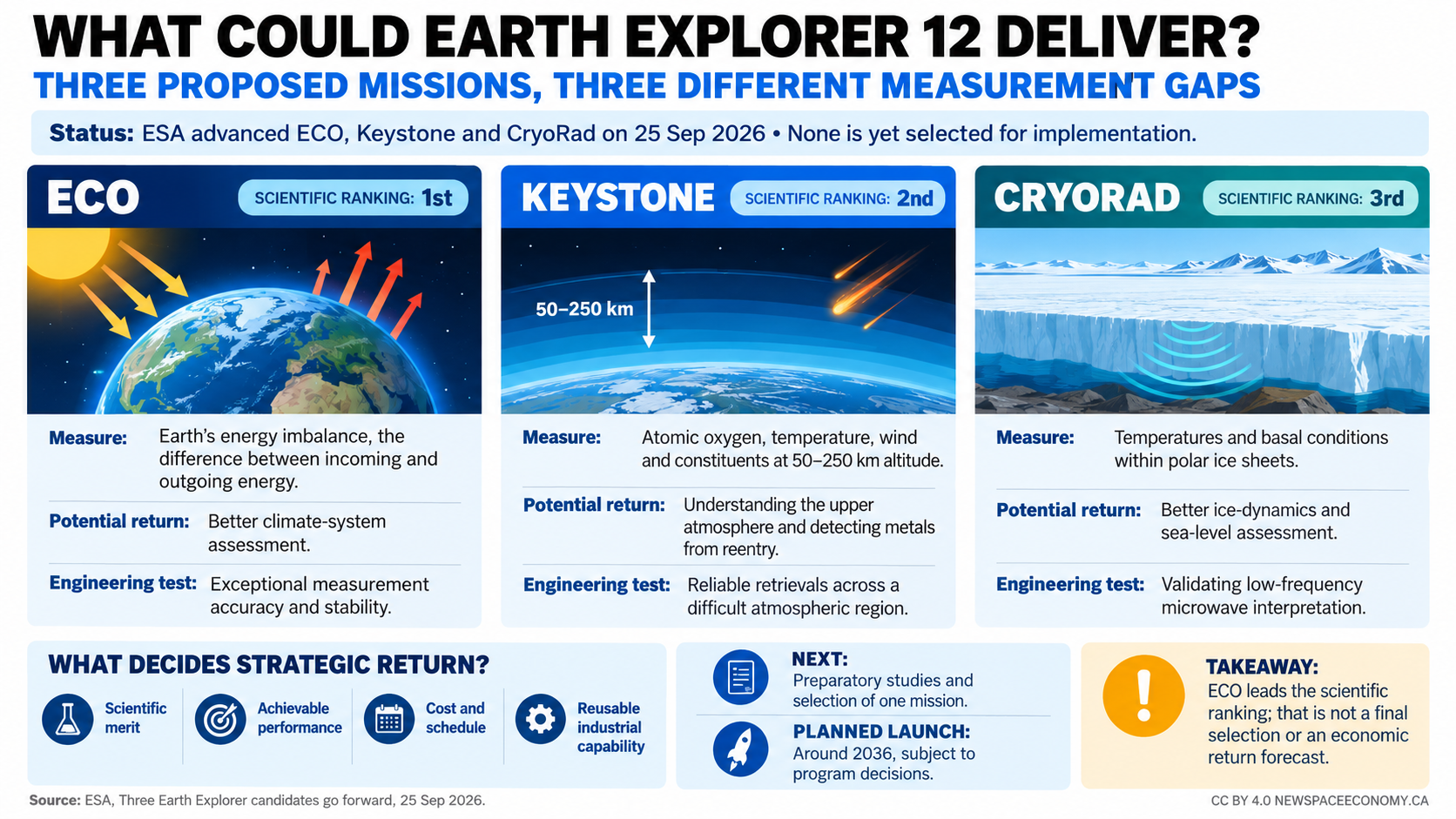
The decision is not a direct comparison of three versions of the same satellite. ECO studies Earth’s energy imbalance, Keystone examines the upper atmosphere and CryoRad probes polar ice. ESA must compare dissimilar scientific benefits under common budget and schedule constraints.
ECO Targets a Central Climate Measurement
ECO would measure the difference between incoming solar radiation and outgoing energy. That difference, called Earth energy imbalance, governs whether the planet gains or loses heat. ESA proposes a constellation carrying wide-field radiometers to measure the imbalance directly with high accuracy and stability.
The scientific attraction is clear. Temperature and sea-level records show the effects of heat accumulation, but a direct global energy measurement would examine the governing quantity itself. Better measurements could help scientists test climate models and assess changes over shorter periods.
ECO also carries demanding engineering risk. Measuring a small global imbalance requires exceptional calibration and long-term stability. A measurement error that appears minor beside the total incoming and outgoing radiation could be large relative to the imbalance being studied.
If ESA can solve those problems, the industrial return could extend to precision radiometry, calibration methods and formation operations. Europe could apply parts of that knowledge to weather, climate and later operational missions.
The economic value of Earth observation often develops after a mission creates a consistent measurement record. ECO’s direct commercial market may be narrow at launch, yet its data could strengthen climate services, financial risk products and public adaptation planning.
Keystone Reaches an Underobserved Atmospheric Region
Keystone would observe atomic oxygen, temperature, wind and atmospheric constituents between roughly 50 and 250 kilometers above Earth. This region links the lower atmosphere with the ionosphere and near-Earth space, but it remains difficult to measure globally.
Atomic oxygen affects atmospheric chemistry, satellite drag and energy transfer. Keystone would also detect metals produced when space debris reenters the atmosphere. That capability would connect Earth science with a growing operational concern about launch activity and spacecraft disposal.
The mission’s strategic value lies partly in linking atmospheric research to space operations. Better upper-atmosphere models can support orbit prediction, reentry analysis and space-weather studies. Those applications matter to civil agencies, defense organizations and commercial operators.
Keystone could also strengthen European instruments and processing methods for limb sounding, which observes the atmosphere across the edge of Earth. The scientific data would require specialized retrieval algorithms and validation networks.
The space data economy values observations that improve operational decisions. Keystone may create fewer mass-market applications than optical imaging, but it could serve high-value needs involving orbit safety, atmospheric modeling and sovereign monitoring.
CryoRad Would Look Inside Polar Ice
CryoRad would use a broadband low-frequency microwave radiometer to measure temperatures and basal conditions within polar ice sheets. ESA also associates the concept with sea-ice thickness and cold-water salinity measurements.
Ice-sheet behavior is one of the largest sources of uncertainty in long-term sea-level assessment. Surface elevation and ice motion reveal important changes, but conditions within and beneath the ice affect how quickly an ice sheet can flow toward the ocean.
CryoRad would complement planned Copernicus missions including CRISTAL, CIMR and ROSE-L. Those missions measure ice elevation, microwave properties and radar characteristics. Combining their observations could give scientists a more complete account of polar change.
Commercial demand for subsurface ice measurements would be limited compared with agriculture or infrastructure mapping. Public value could be high because governments, ports and insurers need better sea-level information. The global Earth observation industry includes public scientific missions whose economic contribution appears through avoided loss and planning rather than data sales.
The engineering return could include low-frequency radiometry and calibration in difficult polar environments. Europe already holds strong capabilities in microwave Earth observation, and CryoRad could deepen that specialization.
Strategic Return Extends Beyond Scientific Ranking
A scientific ranking answers one part of ESA’s decision. Strategic return also includes cost, schedule, technical readiness, supplier capacity and the likelihood that a research instrument can support later operational missions.
ECO offers the broadest direct connection to global climate policy. Keystone links atmospheric science with orbital operations and reentry. CryoRad addresses sea-level uncertainty and complements an established European polar-observation program.
Industrial distribution matters because ESA programs spread work among member states under agreed procurement policies. A mission that depends on scarce components or overloaded suppliers may carry schedule risk. A concept that creates reusable technology across several programs can produce wider industrial benefits.
Data usability should also affect the choice. ESA’s open-data model helps universities and companies build services, but each candidate will require calibration, archives and specialist software. The satellite data analytics market captures value when measurements become validated products that other systems can use.
No candidate maximizes every dimension. ECO appears strongest on scientific ranking and climate-policy reach. Keystone offers a rare connection between Earth science and space operations. CryoRad fits a coherent European polar-monitoring portfolio.
ECO Currently Holds the Strongest Overall Case
Based on public information available on September 28, 2026, ECO offers the strongest overall strategic return. ESA’s scientific advisers ranked it highest, and Earth energy imbalance addresses a central question in climate measurement. Successful execution would also advance demanding radiometric calibration and constellation methods.
That judgment remains conditional. ECO’s measurement requirement may carry greater technical difficulty than its competitors. A mission that cannot achieve the required accuracy would yield less value than a narrower concept with a better chance of success.
Keystone presents a strong alternative if ESA gives more weight to upper-atmosphere knowledge, satellite drag and reentry monitoring. Growing orbital activity could make those capabilities more valuable by the 2030s. CryoRad becomes more attractive if sea-level uncertainty and complementarity with Copernicus polar missions dominate the decision.
ESA’s scientific mission documents provide assessment reports for all candidates. The next phase should refine costs, risks and achievable accuracy before selection.
Strategic return should be judged against the question each mission can answer and the capability Europe retains after launch. ECO leads the public case today, but technical evidence from the preparatory phase can still alter that order.
Summary
Earth Explorer 12 is a choice among different scientific priorities rather than competing versions of one service. ECO measures Earth’s energy balance, Keystone studies the upper atmosphere and CryoRad probes polar ice.
ECO presently offers the strongest combined scientific and policy case. Keystone and CryoRad retain credible strategic claims tied to orbital operations and sea-level knowledge. ESA’s final decision should reward achievable measurement quality, reusable industrial capability and a clear path from research data to long-term public benefit.
Appendix: Useful Books Available on Amazon
- Remote Sensing and Image Interpretation
- Fundamentals of Satellite Remote Sensing
- Deep Learning for the Earth Sciences
- GIS Fundamentals
- Space 2.0
Appendix: Top Questions Answered in This Article
What Is Earth Explorer 12?
Earth Explorer 12 will be the twelfth research mission selected through ESA’s Earth Explorer program. It is expected to test a new method for observing a defined Earth-system process.
Which Candidates Remain?
ECO, Keystone and CryoRad advanced in September 2026. Hydroterra+ did not proceed to the next preparatory phase.
Which Candidate Ranked Highest?
ESA’s Advisory Committee for Earth Observation ranked ECO highest, followed by Keystone, CryoRad and Hydroterra+. The ranking addressed scientific merit, and ESA also considers program factors.
What Would ECO Measure?
ECO would directly measure Earth’s energy imbalance, the difference between incoming solar energy and outgoing radiation. The measurement would help assess planetary heat accumulation.
What Would Keystone Measure?
Keystone would observe atomic oxygen, temperature, wind and other atmospheric constituents between about 50 and 250 kilometers. It would also detect metals associated with reentering debris.
What Would CryoRad Measure?
CryoRad would use low-frequency microwave radiometry to study temperatures and basal conditions within polar ice. It would also support sea-ice and cold-water measurements.
When Could Earth Explorer 12 Launch?
ESA states that the selected mission is expected to launch in the 2036 timeframe. That date remains a planning expectation rather than a completed commitment.
Why Do Research Missions Matter Commercially?
Research missions develop instruments, software and data records that can support later operational services. Companies may also gain contracts and expertise during design, manufacturing and processing.
Does Scientific Ranking Decide the Winner?
No. Scientific merit carries substantial weight, but cost, risk, readiness and program compatibility can affect the final choice.
Which Candidate Offers the Best Strategic Return?
ECO currently presents the strongest combined scientific and policy case. Keystone or CryoRad could become preferable if later studies reveal lower risk or stronger program compatibility.
Appendix: Glossary of Key Terms
Earth Explorer
An Earth Explorer is an ESA research satellite designed to answer a defined Earth-science question using an advanced observation method. Successful techniques may later support operational missions.
Earth Energy Imbalance
Earth energy imbalance is the difference between solar energy absorbed by Earth and energy radiated back to space. A positive imbalance means the planet is accumulating heat.
Radiometer
A radiometer measures electromagnetic radiation within selected wavelength or frequency ranges. Satellite radiometers can infer physical conditions from energy emitted or reflected by Earth.
Limb Sounding
Limb sounding observes the atmosphere across Earth’s edge rather than looking directly downward. The long viewing path can reveal vertical information about atmospheric composition and temperature.
Basal Conditions
Basal conditions describe temperature, water and material properties where an ice sheet meets the land beneath it. These conditions influence how quickly the ice can move.