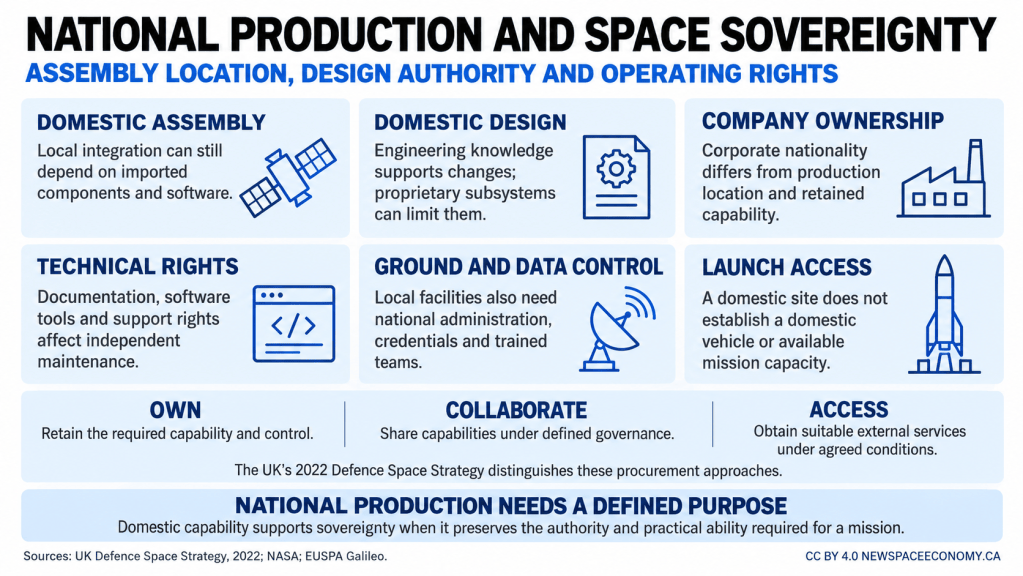
The United Kingdom’s 2022 Defence Space Strategy distinguishes capabilities the country should own, capabilities it should develop with partners, and capabilities it can access from external sources. Its ownership and access framework provides a documented example of selecting the level of control required for particular missions. It does not impose domestic production as the answer to every space requirement.
The national-production question begins with the capability that authorities intend to protect. Building a satellite domestically can support employment, engineering expertise, and access to production facilities. Those benefits need separate evaluation from the ability to control its mission or sustain its operation. Space sovereignty depends on the combination of production, technical rights, operational authority, and available alternatives, rather than a single manufacturing label.
Domestic assembly is one category. It means that workers bring equipment together within the country, but it does not establish where the equipment was designed or produced. An assembly organization may import computers, sensors, propulsion equipment, and software. This arrangement can still create useful national capability, particularly in integration and testing. Its limitations depend on which imported items remain necessary and how difficult they would be to replace.
Domestic design is another category. Engineers who define a spacecraft’s architecture, interfaces, and operating requirements possess knowledge that supports future changes. National design authority concerns responsibility for approving and controlling the design. Its practical value depends on both competence and legal access to necessary information. An organization may understand the overall architecture but remain unable to modify a proprietary subsystem supplied by another company.
Company ownership adds a separate question. A nationally owned firm can manufacture abroad or depend on foreign technology. A foreign-owned company can employ domestic engineers and operate local facilities. Neither arrangement establishes the available level of national control without examining contracts, technical responsibilities, applicable restrictions, and access to staff and equipment. Corporate nationality, production location, and retained capability need to be reported separately.
Intellectual property affects what can be changed or reproduced. Governments purchasing equipment do not necessarily receive unrestricted rights to all associated designs or software. Procurement terms can specify access to documentation, maintenance information, interface definitions, and other support material. The useful question concerns which rights are needed for the intended national function. Acquiring more rights than necessary also has costs and may affect suppliers’ willingness to participate.
Software deserves particular attention because it can determine how hardware operates. A spacecraft may depend on software for command handling, communications, fault detection, or payload management. Source-code access can help domestic engineers investigate problems, but the code alone may be insufficient. Build tools, technical documentation, test equipment, dependencies, and experienced personnel can also be needed to produce and verify a working update.
Technical changes require evidence that the modified system still meets its requirements. NASA’s product verification guidance describes testing, analysis, inspection, and demonstration as verification methods. This establishes an important qualification to claims about independent modification. Possessing permission to change a subsystem is different from possessing the engineering and facilities needed to verify the consequences for the complete spacecraft.
National priorities can justify selective production. A government may place particular value on secure communications equipment, specialized observation instruments, or mission software. Local capability in these areas can preserve control over sensitive functions. Other equipment may be available from several dependable external suppliers. The assessment needs to identify the consequence of supply loss and compare domestic production with substitution, inventory, and partnership arrangements.
Ground infrastructure can offer another form of national capability. Domestic control centers, data-processing facilities, network gateways, and user terminals can support national tasking and information handling even when spacecraft are procured internationally. However, location alone is insufficient. Authorities need to establish who administers the systems, who controls credentials and encryption keys, and whether local teams can maintain operations when external support becomes unavailable.
Launch requires a distinction between the site, vehicle, and service. A domestic spaceport provides infrastructure within national territory. A rocket using that site may still depend on a foreign manufacturer, imported engines, external software, or overseas technical support. A domestic vehicle may require externally supplied components. Launch sovereignty must be assessed against the actual ability to deploy the required payload, including available capacity and operational readiness.
A country can also obtain launch access through several external providers. That approach depends on spacecraft compatibility, integration requirements, scheduling, and any relevant restrictions. It may reduce concentration without creating a domestic rocket industry. The alternatives cannot be compared only by nationality: a national vehicle that cannot reach the required orbit does not replace a suitable overseas service for that mission.
Regional programs illustrate a different scale of control. The Galileo program is owned by the European Union, with operational service responsibilities assigned within its institutional framework. This arrangement supports European capability through shared institutions. It should not be described as unilateral ownership by each member state. National, regional, and commercial control arrangements can coexist, but their decision-making rights differ.
Procurement specifications need to make the intended meaning of national production explicit. Requirements can identify where assembly occurs, which engineering responsibilities remain local, what documentation is delivered, and how support continues through corporate changes. Acceptance evidence should demonstrate those requirements individually. A broad sovereignty claim can otherwise combine several distinct benefits without showing whether any particular continuity objective has been met.
New Space Economy’s discussion of sovereign control provides related background on ownership and access arrangements. The underlying policy choice still requires mission-specific evidence. A secure government link, a research instrument, and a commercial imagery subscription can justify different procurement conditions because the consequences of interruption, disclosure, or restricted access differ.
The strongest case for national production arises when losing external access would cause unacceptable operational consequences and substitutes could not be introduced in time. The decision must also account for continuing engineering, testing, staffing, and production costs. A nationally built system supports space sovereignty when domestic organizations retain the authority and practical capability required for its intended function throughout its life.
Useful Books Available on Amazon