- Key Takeaways
- Technosignatures as Evidence of Technology
- Radio and Microwave Technosignatures
- Optical and Laser Technosignatures
- Infrared and Thermal Technosignatures
- Atmospheric and Industrial Technosignatures
- Planetary Surface and Orbital Technosignatures
- Spacecraft Probe and Solar System Technosignatures
- Computational and Data-Center Technosignatures
- Waste Pollution and Environmental Technosignatures
- Speculative Physics-Based Technosignatures
- How Scientific Maturity Shapes the Dictionary
- How Technosignatures Broaden SETI
- Summary
- Appendix: Useful Books Available on Amazon
- Appendix: Top Questions Answered in This Article
- Appendix: Glossary of Key Terms
Key Takeaways
- Technosignatures expand SETI beyond messages into the search for technology itself.
- Each candidate must be tested against natural sources and human interference.
- The strongest search strategy combines radio, optical, infrared, atmospheric, and artifact evidence.
Technosignatures as Evidence of Technology
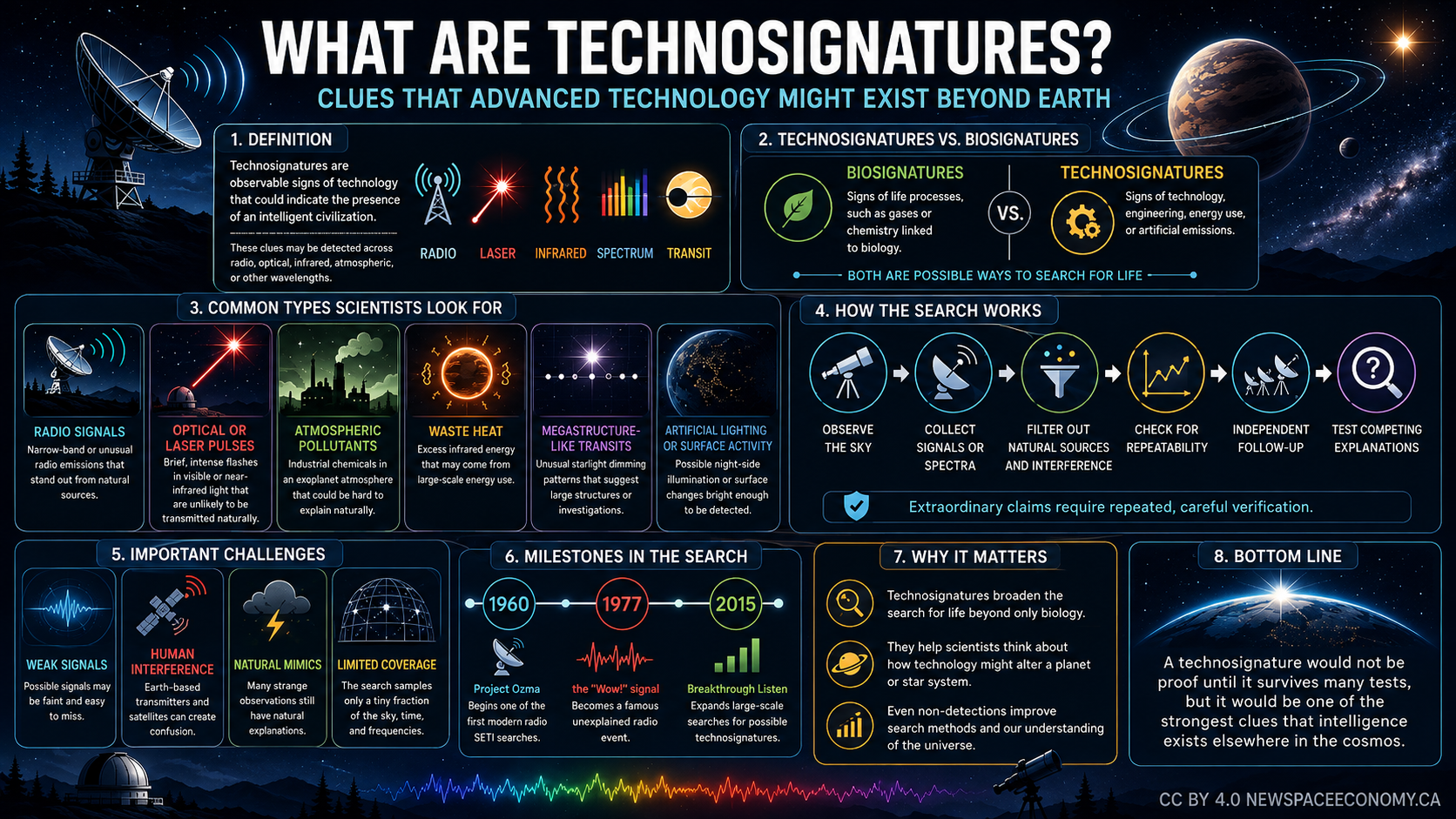
Jill Tarter helped popularize the term technosignature as a way to describe measurable traces of technology beyond Earth. Technosignatures are observable properties that could indicate the presence, activity, waste, infrastructure, communication, computation, or engineering of an extraterrestrial technological civilization. The term now covers far more than deliberate radio messages. It includes unintended leakage, industrial byproducts, planetary modification, unusual orbital structures, waste heat, interstellar probes, and physical artifacts that might survive long after their builders have changed or disappeared.
A technosignature differs from a biosignature. A biosignature is possible evidence of life, such as oxygen, methane, seasonal vegetation patterns, or chemical disequilibrium in an atmosphere. A technosignature is possible evidence of technology. A planet could have life without technology, as Earth did for most of its history. A planet could also display traces of technology that survive after the biological civilization that created them has vanished. For that reason, technosignature research sits within astrobiology but asks a narrower question: not whether life exists, but whether technology exists or once existed.
A message is a special type of technosignature. It contains information intended for a receiver. A narrowband radio beacon, a laser pulse sequence, or a deliberately encoded mathematical transmission could be both a technosignature and a message. Many technosignatures would not be messages. Waste heat from energy use, nitrogen dioxide from combustion, or orbital debris would be traces of activity without any intention to communicate.
An artifact is a physical object. It could be an interstellar probe, a lander on a moon, a dormant machine in an asteroid belt, or debris from an ancient spacecraft. Artifacts differ from remote technosignatures because they have form, position, and material properties. A radio emission can vanish when the transmitter stops. A durable artifact could remain detectable for millions of years if it survives erosion, impacts, radiation, and orbital instability.
An anomaly is broader and weaker. It is something that does not fit current expectations. Most anomalies are natural, instrumental, statistical, or human-made. A technosignature candidate usually begins as an anomaly, but an anomaly does not become evidence of technology until natural causes, instrumental artifacts, and terrestrial contamination have been tested.
The terms can be separated in a compact way.
| Term | Definition |
|---|---|
| Technosignature | A measurable property that could indicate extraterrestrial technology. |
| Biosignature | A measurable property that could indicate life, with or without technology. |
| Message | A transmitted pattern designed to convey information to a receiver. |
| Artifact | A physical object that could have been made, placed, or modified by technology. |
| Anomaly | An observation that does not yet fit known natural, instrumental, or human-made causes. |
Technosignature science changes the framing of the search for extraterrestrial intelligence. Classic SETI searched mainly for intentional communication, often in the radio spectrum. A broader technosignature program searches for technology whether or not anyone is trying to talk. That shift matters because a civilization might be silent, extinct, uninterested in contact, too distant for practical exchange, or active in ways that produce detectable side effects rather than messages.
The scientific maturity of these ideas differs sharply. Narrowband radio searches and optical laser searches have decades of observational methods behind them. Waste heat, atmospheric pollution, and artificial illumination are active research topics tied to exoplanet astronomy, but detection usually requires instruments more powerful than those available for most targets. Megastructures and speculative physics-based signatures remain possible search categories, yet they demand unusually strong false-positive control because nature produces many strange, bright, cold, hot, periodic, dimming, or asymmetric phenomena.
Radio and Microwave Technosignatures
Radio technosignatures remain the classic SETI target because radio waves can cross interstellar distances, penetrate dust better than visible light, and carry information using technology that humans already understand. The SETI Institute and Breakthrough Listen have used radio telescopes to search for emissions that appear too narrow, structured, persistent, or frequency-stable to match common natural astrophysical sources.
Narrowband Radio Emissions
A narrowband radio technosignature is energy concentrated into a very small frequency range. Nature produces broadband radio emission through processes such as synchrotron radiation, stellar flares, lightning, and plasma activity. A very narrow carrier tone, by contrast, looks more like engineered transmission because transmitters can concentrate power at a chosen frequency.
Detection uses large radio telescopes and signal-processing pipelines. Researchers search across many frequencies, compare target observations with nearby control observations, and look for Doppler drift caused by the relative motion of Earth and the source. A extraterrestrial transmitter would usually appear to shift slightly in frequency over time because planets rotate, planets orbit stars, and Earth itself moves during the observation.
The main natural explanations include stellar radio bursts, pulsars, masers, and plasma emission. The main non-natural false positives come from Earth technology: aircraft, satellites, ground transmitters, radar, electronics, and instrument effects. The BLC1 Proxima Centauri candidate became a useful example. It had several properties expected from a candidate technosignature, yet detailed analysis traced it to local radio-frequency interference. That result did not weaken SETI; it improved the verification framework.
Scientific maturity is high for narrowband searches. The method is well defined, instrumentation exists, and false-positive procedures are increasingly formal. The weakness is coverage. Only a tiny fraction of sky positions, frequencies, times, polarizations, repetition rates, and transmitter powers have been searched.
Broadband Radio Leakage
Broadband leakage would be accidental radio emission from radar, communications, power systems, or industrial activity. Earth leaks radio energy into space, but most leakage weakens rapidly with distance. Detecting an Earth-level civilization through ordinary leakage would be very hard at interstellar distances unless the civilization is nearby or the leakage is unusually powerful.
Detection would require sensitive radio arrays and long integration times. Researchers would need to distinguish leakage from natural broadband sources and from human radio-frequency interference. A leakage technosignature might appear as a moving or repeating spectral pattern associated with a star or planet rather than a steady narrow carrier.
The technological interpretation is plausible because complex societies often generate electromagnetic emissions. Yet leakage is also inefficient from a detection standpoint. Civilizations may reduce leakage as their systems become fiber-based, encrypted, highly directional, or less wasteful. Earth’s own radio profile has changed over time.
Scientific maturity is moderate. Radio astronomy has the tools, but the expected detectability of leakage is far lower than the detectability of powerful beacons.
Radar Bursts and Planetary Defense Systems
Powerful radar emissions could reveal a civilization that maps asteroids, tracks spacecraft, probes planetary surfaces, or operates defense and traffic-control systems. Earth’s former Arecibo planetary radar and other radar systems illustrate the concept. A radar beam is not usually directed toward another star for communication, yet a distant observer in the right line of sight could detect it as a strong, structured radio emission.
Detection would require catching the beam at the right time. Radar is directional, intermittent, and tied to operational needs. A candidate might show high power, short duration, frequency structure, and Doppler behavior linked to a planet or object. Natural explanations include radio bursts, masers, and transient astrophysical events. Human interference remains the harder problem for Earth-based observers.
Scientific maturity is moderate. The physics is clear because humans already produce such emissions. The probability of being in the beam at the right time is low.
Optical and Laser Technosignatures
Optical technosignatures search for artificial light in visible or near-infrared wavelengths. Some ideas involve communication, such as laser pulses. Others involve illumination, propulsion, industrial activity, or large optical engineering. Optical search gained attention because lasers can produce intense, short bursts that briefly outshine a star in a narrow beam.
Laser Pulses
A laser pulse technosignature would be a short flash of coherent light. Optical SETI searches often look for nanosecond-scale pulses because natural astrophysical events rarely concentrate so much energy into such a short interval and narrow direction. A civilization could use lasers for interstellar communication, power beaming, spacecraft propulsion, or ranging.
Detection uses fast photometers, optical telescopes, and repeated observations of target stars. A pulse becomes more interesting if it repeats, comes from a fixed stellar position, appears in multiple detectors, and has timing or spectral properties inconsistent with known natural sources.
Natural explanations include cosmic rays hitting detectors, stellar flares, satellite glints, meteors, and instrument noise. The best verification requires multiple telescopes or multiple detectors at the same telescope seeing the same event at the same time. A single flash is rarely enough.
Scientific maturity is high for the search method and moderate for the expected occurrence rate. Instruments exist, searches have been conducted, and the physical idea is strong. The main limitation is timing. A pulse may be extremely easy to detect during the tiny interval when it arrives and invisible at all other times.
Continuous Laser Beacons
A continuous optical beacon would emit a stable laser line toward another star or across a repeated sweep pattern. It might be detected as an unusually narrow spectral feature in visible or near-infrared light. Unlike a pulse, a continuous beacon could be easier to confirm if it persists.
Detection would use high-resolution spectroscopy. Researchers would search for narrow emission lines that do not match stellar atmospheres, interstellar gas, or known molecular features. A strong candidate would remain tied to a star or planet and would show motion consistent with that system.
Natural explanations include stellar activity, gas emission, instrument artifacts, and line confusion. Human satellites and aircraft can also produce optical contamination. A continuous laser that is too weak compared with its star would be difficult to detect.
Scientific maturity is moderate. The tools exist, but surveys need large volumes of high-quality spectra.
Artificial Night-Side Illumination
City lights on an exoplanet would represent a planetary-surface technosignature visible as artificial illumination on the dark side of a rotating world. Earth’s night-side lights are bright locally, but faint compared with reflected sunlight and thermal emission. Detecting similar illumination around another star would require extraordinary contrast performance.
Detection would involve monitoring brightness changes as a planet orbits its star and rotates. Artificial lighting could produce spectral features from narrow-band lamps or unusual night-side brightness patterns. Future observatories designed for direct imaging of exoplanets could, in principle, test such ideas for nearby worlds.
Natural explanations include auroras, lightning, airglow, volcanic activity, reflected light from moons or rings, and data artifacts. A technological interpretation would require repeated patterns, spectral evidence, and consistency with geography or rotation.
Scientific maturity is low to moderate. The idea is physically reasonable, but current instruments cannot detect Earth-like city lights across interstellar distances.
Infrared and Thermal Technosignatures
Energy use leaves heat. That simple physical fact makes infrared technosignatures one of the most general categories. A civilization can hide a radio transmitter, encrypt a message, or choose not to communicate. It cannot use large amounts of energy without producing waste heat somewhere.
Waste Heat
Waste heat is thermal radiation produced by energy consumption. A technological civilization that uses energy on planetary, orbital, or stellar scales could emit more infrared radiation than expected from natural heat balance. The concept links SETI to thermodynamics rather than communication.
Detection uses infrared surveys and spectral energy distributions, which compare how bright an object appears at multiple wavelengths. An unusual infrared excess could suggest warm material absorbing visible starlight and re-radiating energy as heat. The Wide-field Infrared Survey Explorer helped make large-scale infrared searches possible by surveying the sky in infrared wavelengths.
Natural explanations are abundant. Dust disks, young stars, background galaxies, planetary nebulae, red giants, and star-forming regions can all produce infrared excess. That makes waste-heat searches powerful but difficult. A candidate must survive filtering against known astrophysical sources.
Scientific maturity is moderate to high. Infrared astronomy is mature, and the thermodynamic logic is strong. The weakness is ambiguity. Heat alone rarely proves technology.
Dyson-Like Structures
Freeman Dyson proposed that an advanced civilization might build structures to capture a large fraction of a star’s energy. Popular discussion often imagines a solid shell, but physically plausible versions usually involve swarms of collectors, habitats, mirrors, or power stations. A Dyson-like structure would dim visible starlight and increase infrared emission.
Detection uses optical catalogs, infrared catalogs, and follow-up observations. Studies such as the Project Hephaistos search compare data from Gaia, 2MASS, and WISE to look for stars with unusual infrared excess consistent with partial Dyson-like structures.
Natural explanations include circumstellar dust, debris disks, background contamination, evolved stars, and interstellar extinction. A credible candidate would need repeated observations, better spatial resolution, and tests for ordinary dusty astrophysics.
Scientific maturity is moderate. The concept has a long history and search pipelines exist, but no confirmed Dyson-like structure has been found.
Stellar Dimming and Megastructure Claims
Unusual stellar dimming can attract technosignature interest because large artificial structures could block starlight in patterns unlike planets. The most famous modern example is Tabby’s Star, which showed unusual dips in brightness. Follow-up research favored natural explanations involving dust rather than alien engineering.
Detection uses photometry from transit surveys, spectroscopy, infrared follow-up, and long-term monitoring. A technological interpretation would require dimming patterns that cannot be explained by planets, dust, starspots, binary companions, debris, or instrumental effects.
Scientific maturity is moderate for detecting dimming and low for confirming technology from dimming alone. Strange light curves are common enough that astronomy needs caution before invoking engineering.
Atmospheric and Industrial Technosignatures
Atmospheric technosignatures search for gases or aerosols that may indicate industrial activity. The logic resembles biosignature science, but the target is technology rather than metabolism. A telescope cannot see factories on a distant exoplanet. It can sometimes measure how molecules absorb starlight passing through an atmosphere or how a planet’s own infrared emission carries spectral fingerprints.
Artificial Pollutants
Industrial pollutants include chemicals that would be unlikely in large quantities without manufacturing. Chlorofluorocarbons, nitrogen dioxide, sulfur hexafluoride, tetrafluoromethane, and related molecules have been discussed as candidate atmospheric technosignatures. Some are long-lived and have strong infrared absorption features.
Detection would use transmission spectroscopy during planetary transits or direct imaging spectroscopy for nearby exoplanets. The James Webb Space Telescope can study some exoplanet atmospheres, though Earth-like industrial pollution around Sun-like stars remains beyond routine detection. Future large space telescopes or extremely large ground telescopes could improve the search.
Technology becomes plausible when a gas appears in abundance, has no strong natural production pathway in that environment, and is accompanied by a planetary context compatible with industrial activity. Natural explanations include volcanism, photochemistry, lightning, geology, and unknown atmospheric chemistry. Some compounds that look artificial on Earth may arise naturally under different planetary conditions.
Scientific maturity is moderate. The chemistry is active research, and artificial greenhouse gas studies have modeled detectability. Actual detection remains difficult.
Nitrogen Dioxide and Combustion Products
Nitrogen dioxide can arise from combustion, lightning, volcanism, and atmospheric chemistry. On Earth, much nitrogen dioxide comes from industrial activity and combustion engines. On an exoplanet, excess nitrogen dioxide could hint at energy-intensive technology if natural sources are too weak to explain the observation.
Detection would require atmospheric spectroscopy with enough sensitivity to separate nitrogen dioxide from overlapping molecular features. A candidate would be stronger if it varied with surface regions, season, or day-night cycles in a way consistent with industrial geography.
Natural explanations are a major barrier. Lightning on a stormy world could produce nitrogen oxides. Volcanic activity and photochemistry could complicate interpretation. A single molecule cannot carry the whole case.
Scientific maturity is moderate. The idea is plausible, but it depends heavily on future instrumentation and better models of alien atmospheric chemistry.
Deliberate Climate Engineering
A civilization might alter its atmosphere intentionally, for warming, cooling, radiation shielding, agriculture, or planetary habitability. Artificial greenhouse gases could warm a cold planet. Reflective aerosols or orbital shades could cool a warm planet. These interventions might create spectral features or brightness patterns that look odd compared with natural planets.
Detection would search for unusual gases, suspiciously stable climate states, reflective particles, or atmospheric compositions that appear engineered for temperature control. A cold planet with strong artificial greenhouse gases could be more suggestive than the same gases on a geologically active planet with natural explanations.
Natural explanations include geology, impacts, photochemistry, runaway greenhouse processes, and unusual starting conditions. Scientific maturity is low to moderate. The concept is becoming more formal because human climate engineering discussions provide a baseline, but exoplanet detection remains hard.
Planetary Surface and Orbital Technosignatures
Some technosignatures would come from surfaces, moons, rings, or orbital space. They do not require a civilization to transmit a message. They require technology to change how a planet reflects, emits, blocks, or organizes light.
Planetary Surface Modification
Large-scale surface modification could include agriculture, mining, reservoirs, artificial materials, reflective panels, roads, or engineered terrain. On a distant exoplanet, the evidence might appear as unusual reflectance, unnatural spectral edges, geometric patterns, or time-variable surface signatures.
Detection would require direct imaging and repeated observations across a planet’s rotation. Researchers would compare brightness and color changes to plausible maps of continents, oceans, clouds, vegetation, ice, and minerals. Artificial materials could have spectral reflectance unlike common rocks, water, ice, or biological pigments.
Natural explanations include minerals, snow, clouds, deserts, vegetation, oceans, seasonal cycles, and volcanic deposits. Geometry is also difficult to prove at low resolution. A distant planet may be only a point of light, so mapping is indirect.
Scientific maturity is low. The physics is understandable, but the required observations are beyond routine capability for Earth-like exoplanets.
Orbital Satellites
Artificial satellites around an exoplanet could produce transits, glints, thermal emission, or spectral anomalies. A dense satellite population might create small, repeating brightness dips, unusual scattering, or infrared emission linked to orbital infrastructure.
Detection would be difficult because satellites are small compared with planets and stars. Large orbital structures could be easier to detect. A planet with many reflective objects might show unusual phase curves or brief glints.
Natural explanations include rings, moons, dust, debris, comet fragments, and instrument artifacts. A satellite interpretation would require repeated orbital timing and patterns inconsistent with ordinary rings or moons.
Scientific maturity is low to moderate. Human satellite growth shows the category is realistic in principle, but remote detection around other stars remains beyond current survey capability for Earth-scale activity. Related discussions of space infrastructure connect this idea to wider questions about what technology leaves behind.
Megastructures in Orbit
Megastructures include large collectors, mirrors, shades, habitats, starshades, or industrial platforms. They could orbit planets, stars, or compact objects. Compared with small satellites, megastructures might block, reflect, or emit enough energy to be detected.
Detection would look for transit shapes unlike planets, infrared excess, changing reflection patterns, or spectral features from artificial materials. A stellar shade or mirror might create brightness changes too large or too structured for natural debris.
Natural explanations include dust clouds, rings, debris disks, binary companions, starspots, and background objects. Scientific maturity varies. Searches for infrared excess are active; claims based on unusual shapes or dips alone remain weak.
Spacecraft Probe and Solar System Technosignatures
Spacecraft and probes shift technosignature research from distant astronomy to local search. Instead of asking whether a planet or star system shows remote traces of technology, this category asks whether physical objects from another civilization could be passing through, parked in orbit, hidden among asteroids, or resting on planetary surfaces.
Interstellar Probes
An interstellar probe could be active, dormant, derelict, or self-replicating. It might enter another star system to observe planets, relay data, seed instruments, or wait for technology to appear. Ronald Bracewell proposed the idea of interstellar messenger probes in the 1960s, and the concept remains a recurring part of technosignature thought.
Detection could use optical surveys, radar, infrared searches, radio listening, and trajectory analysis. A probe might reveal itself through non-gravitational acceleration, unusual reflectance, artificial radio emission, thermal behavior, or an orbit that looks engineered.
Natural explanations include comets, asteroids, tumbling interstellar objects, outgassing, fragmentation, and observational uncertainty. The discovery of interstellar objects such as 1I/‘Oumuamua, 2I/Borisov, and 3I/ATLAS gave this topic more practical relevance. In June 2026, the SETI Institute reported a radio technosignature search of 3I/ATLAS using the Allen Telescope Array, with no evidence of extraterrestrial technology.
Scientific maturity is moderate for searching known objects and low for claiming artificiality. The category is valuable because it can set upper limits even when it finds nothing.
Bracewell Probes
A Bracewell probe is a hypothetical autonomous probe designed to wait in or near another star system and communicate when it detects a technological civilization. Unlike a one-way radio message, a probe could observe, choose timing, adapt its response, and send information at close range.
Detection strategies include scanning stable orbital locations, Earth-Moon regions, Sun-Earth Lagrange points, near-Earth objects, and unusual asteroid orbits. A probe might be radio quiet until triggered, so artifact searches matter as much as radio searches.
Natural explanations include ordinary asteroids, old human hardware, meteoroids, and survey artifacts. Scientific maturity is low, but the idea is testable in limited ways. Searches can improve catalogs of small bodies and identify objects with unusual spectra or motion.
Lunar and Asteroid Artifacts
Artifacts on the Moon, Mars, asteroids, or outer Solar System bodies could survive for long periods. The Moon has little atmosphere and slow erosion, making it an attractive place to search in theory. Asteroids and stable orbital zones could also preserve objects.
Detection would use high-resolution imaging, radar, spectroscopy, thermal inertia measurements, and searches through planetary mission archives. An artifact could appear as a geometric shape, unusual material, anomalous reflectance, unexpected heat retention, or a pattern inconsistent with geology.
Natural explanations include boulders, impact fragments, landslides, shadows, image compression, and unusual minerals. Scientific maturity is low but improving because planetary datasets grow over time. The work resembles archaeology applied to space, with the added burden that most candidate features will be geology.
Computational and Data-Center Technosignatures
Computational technosignatures ask what large-scale information processing might look like from a distance. A civilization dominated by computing may produce less radio leakage than expected, yet more heat, timing structure, power demand, or engineered environments optimized for processors.
Planet-Scale Computation
Planet-scale computation could involve dense data centers, artificial intelligence systems, distributed sensor networks, or computation integrated into infrastructure. The most detectable side effect would be heat. Large computers consume energy and reject waste heat, usually at temperatures that produce infrared radiation.
Detection would search for anomalous thermal emission, day-night heat patterns, and spectra suggesting artificial energy use. A planet with too much night-side heat, or heat concentrated in regions not explained by climate, volcanism, or tidal heating, could become a candidate.
Natural explanations include greenhouse effects, clouds, oceans, atmospheric circulation, volcanism, tidal heating, and young planetary age. Scientific maturity is low to moderate. Waste heat is physically general, but assigning it to computation rather than ordinary energy use would be hard.
Cold Computing and Outer-System Infrastructure
Advanced computation might migrate to cold environments because lower temperatures can improve heat rejection. A civilization could place large computing installations far from a star, on icy moons, in outer-system orbits, or near cold dust-rich regions. Such systems might be faint in visible light but detectable in far-infrared wavelengths.
Detection would require far-infrared observatories and careful background subtraction. Candidate objects could look like cold artificial heat sources, unusual blackbody emitters, or objects with engineered temperature distributions.
Natural explanations include cold dust clouds, debris disks, brown dwarfs, distant planets, and background galaxies. Scientific maturity is low. The idea is speculative but grounded in thermodynamics.
Artificial Data Modulation in Natural Sources
A civilization might modulate an existing bright source rather than build a powerful transmitter from scratch. It could use a star, maser, pulsar-like beacon, or other astrophysical energy source as a carrier. The technosignature would be unnatural timing, coding, or information density imposed on a natural phenomenon.
Detection would involve time-series analysis, periodicity searches, compression tests, and comparisons with known natural variability. Technology becomes plausible only if the pattern carries structure that natural processes do not produce.
Natural explanations include pulsars, magnetars, accretion disks, stellar oscillations, eclipsing binaries, and instrument sampling. Scientific maturity is low. The concept is testable with data, but the interpretation burden is high.
Waste Pollution and Environmental Technosignatures
Technology produces residues. Some residues are chemical, some are thermal, and some are physical. Pollution technosignatures matter because they may be unintentional. A civilization might not want to announce itself, yet its atmosphere, orbit, or local space environment could reveal activity.
Industrial Waste Gases
Industrial waste gases include long-lived molecules, byproducts of manufacturing, and compounds that accumulate faster than natural processes remove them. Their value as technosignatures depends on detectability, lifetime, uniqueness, and context.
Detection uses atmospheric spectra. A gas with strong absorption bands and long atmospheric lifetime has a better chance of detection than a reactive gas that vanishes quickly. Researchers must also understand planetary temperature, pressure, ultraviolet radiation, clouds, and geology.
Natural explanations vary by compound. Some chemicals that appear technological on Earth may arise through volcanic or photochemical pathways elsewhere. For strong confidence, observers would need multiple lines of evidence, not a single gas.
Scientific maturity is moderate. The category has active modeling and direct connection to exoplanet spectroscopy, but few near-term observations can test Earth-like industrial levels.
Orbital Debris
Orbital debris could indicate extensive space activity. Around Earth, rocket bodies, defunct satellites, and fragments form a growing human-made population. Around an exoplanet, a debris-rich orbital environment might affect transit light curves or produce unusual reflection and thermal patterns.
Detection would be easier for large debris belts or large artificial platforms than for small fragments. A dense engineered debris environment could resemble rings or dust. Distinguishing technology from natural rings would be difficult.
Natural explanations include planetary rings, moon collisions, comet dust, and impact debris. Scientific maturity is low. The concept is grounded in human spaceflight experience, but remote detection around other planets needs far better resolution.
Mining and Resource Extraction Residues
Asteroid mining, lunar mining, or planetary excavation could alter surface composition, create dust, expose subsurface materials, or produce artificial shapes. On exoplanets, direct evidence would be hard. Within the Solar System, survey data could detect unusual objects or surface patterns.
Detection might use spectroscopy, high-resolution imaging, or monitoring of dust production. A mined asteroid could have unnatural geometry, reflective materials, waste piles, or thermal properties different from untouched bodies.
Natural explanations include collisions, fragmentation, space weathering, and unusual mineral composition. Scientific maturity is low. This is a future-facing search category, but it ties naturally to the space economy because human activity is beginning to make similar signatures in near-Earth space. New Space Economy’s coverage of space economy markets helps frame why infrastructure can leave traces that outlast individual missions.
Speculative Physics-Based Technosignatures
Some technosignature ideas draw on physics that is known but not yet practical for humans. Others rely on speculative engineering that may never be possible. These concepts can still be useful if they generate testable predictions and avoid unfalsifiable storytelling.
Neutrino Communication
Neutrinos pass through matter with little interaction, which makes them attractive for crossing dense material and unattractive for practical communication. They are extremely hard to generate in directed beams and extremely hard to detect. A civilization with enormous energy resources might use neutrinos for special communication cases, such as transmitting through stars or planets.
Detection would require neutrino observatories looking for unnatural timing, energy, direction, or modulation. Facilities such as IceCube detect high-energy neutrinos, but identifying artificial modulation would be difficult.
Natural explanations include cosmic accelerators, supernovae, active galactic nuclei, and atmospheric neutrinos. Scientific maturity is low. The physics is real, but the technological plausibility and search methods remain speculative.
Gravitational-Wave Engineering
Gravitational waves are ripples in spacetime produced by accelerating massive objects, such as merging black holes or neutron stars. Artificial gravitational-wave communication would require moving enormous masses with extreme precision. No known civilization-level engineering pathway makes this practical.
Detection would use observatories such as LIGO, Virgo, KAGRA, or future space-based detectors. An artificial candidate might show unnatural repetition or coding. Natural explanations dominate the field because compact-object mergers and astrophysical dynamics are expected sources.
Scientific maturity is very low as a technosignature category. It belongs in a dictionary because it shows the boundary between active research and speculative possibility.
Star Lifting and Stellar Engineering
A civilization might alter a star to extract material, extend its lifetime, move it, or control its output. Stellar engineering concepts include star lifting, Shkadov thrusters, and other megascale projects. If possible, they could produce unusual stellar motion, spectral composition, asymmetry, or infrared emission.
Detection would rely on stellar catalogs, astrometry, spectroscopy, and infrared surveys. A candidate might be a star with odd acceleration, unusual chemical depletion, or asymmetric radiation pressure effects. Natural explanations include binary companions, stellar evolution, galactic dynamics, and measurement errors.
Scientific maturity is low. The ideas are physically motivated but far beyond known engineering. They remain useful as search prompts for astronomical anomalies already being cataloged by surveys such as Gaia.
High-Energy Beacons
Gamma-ray, X-ray, or other high-energy beacons have been proposed as extreme technosignatures. A civilization might use high-energy emission for attention-getting, power transfer, propulsion, or physics experiments. Such methods would be energetically expensive and dangerous near inhabited worlds.
Detection would use high-energy observatories and transient surveys. A candidate would need to show patterns, repetition, directionality, or spectral behavior unlike natural high-energy sources.
Natural explanations include gamma-ray bursts, magnetars, accreting black holes, neutron stars, and solar flares. Scientific maturity is low. The search overlaps with ordinary high-energy astrophysics, but technology is rarely the simplest explanation.
How Scientific Maturity Shapes the Dictionary
Technosignature ideas should not be treated as equally likely or equally testable. A narrowband radio emission from a fixed stellar position has a mature detection tradition. A gravitational-wave message from an alien civilization does not. A Dyson-like infrared excess is searchable with existing catalogs, yet dust creates many false positives. Artificial pollutants are chemically plausible, but detecting them on Earth-like exoplanets will require stronger instruments and better atmospheric models.
This maturity ranking helps keep the field scientific. A search category becomes stronger when it has a defined observable, a known instrument path, a clear false-positive list, and a verification method. It becomes weaker when it relies on unknown motives, unbounded engineering, or one-off anomalies that cannot be repeated.
The following table organizes major categories by detection maturity and false-positive burden.
| Category | Main Observable | Maturity | Main False Positive |
|---|---|---|---|
| Narrowband Radio | Tight Frequency Emission | High | Human Interference |
| Laser Pulses | Short Optical Flashes | High | Detector Events |
| Waste Heat | Infrared Excess | Moderate | Dust |
| Artificial Gases | Atmospheric Absorption | Moderate | Photochemistry |
| Surface Modification | Reflectance Patterns | Low | Minerals And Clouds |
| Interstellar Probes | Objects And Emissions | Moderate | Comets And Asteroids |
A mature search also needs null results. The absence of detection can still narrow the possibilities. Breakthrough Listen, the Allen Telescope Array, infrared catalog searches, and exoplanet spectroscopy studies all help define what has not been found under specific assumptions. New Space Economy’s survey of SETI hypotheses and formulas provides useful context for why non-detections still matter: they constrain only the part of the search space actually examined.
How Technosignatures Broaden SETI
Classic SETI often imagined a deliberate message crossing the distance between stars. That remains a valid search target. Yet technosignature research makes the search broader, less dependent on alien intentions, and more connected to mainstream astronomy. A civilization does not need to know Earth exists for its technology to affect light, chemistry, heat, or orbital structure.
This change also changes the verification culture. A radio candidate must be checked against human interference. An atmospheric candidate must be checked against geology and photochemistry. An infrared candidate must be checked against dust. A surface candidate must be checked against clouds, minerals, and viewing geometry. A probe candidate must be checked against ordinary small-body behavior. Each category has its own burden of proof.
Technosignatures also connect SETI to exoplanet science. The same instruments that search for habitability can search for technology. Spectroscopy can test atmospheres for biosignatures and industrial gases. Direct imaging can search for oceans, clouds, surfaces, and artificial illumination. Infrared astronomy can study dust disks and waste heat. Time-domain surveys can catch transients, dimming events, glints, and unusual moving objects.
The field benefits from skepticism because most candidates will be false positives. That does not make the search weak. It makes it scientific. A strong technosignature program should expect null results, ambiguous candidates, and ordinary explanations. The value comes from building better filters, improving instrumentation, defining upper limits, and learning which observations would actually change scientific confidence.
New Space Economy’s articles on technosignature search ideas, technosignature definitions, oxygen and detectability, METI, and first contact show how the topic extends from astronomy into communication, policy, philosophy, and the long-term development of spacefaring societies.
The most important shift is conceptual. SETI no longer needs to wait only for a message. It can search for technology as an astrophysical phenomenon. Alien industry, energy use, probes, orbital construction, environmental modification, and computational activity could all leave traces. Some traces may be intentional. Some may be accidental. Some may be ancient. Some may be mistaken for nature until better data arrives.
Summary
Technosignatures are possible evidence of extraterrestrial technology, not proof by themselves. They include radio emissions, laser pulses, waste heat, atmospheric pollutants, surface modification, orbital structures, probes, artifacts, computational heat, and speculative physics-based effects. Each candidate must survive tests against natural phenomena, human contamination, and instrument behavior.
The strongest technosignature categories have clear observables and practical verification paths. Narrowband radio and optical laser searches are mature because instruments and filtering methods already exist. Infrared waste heat and atmospheric pollutants are scientifically active because they fit into exoplanet and survey astronomy. Surface modification, orbital debris, and computational technosignatures remain harder to detect but still help define what future observatories should measure.
The dictionary of possible technosignatures turns SETI into a broader search for technology. A message would be extraordinary, but technology may reveal itself without saying anything. The long-term search is likely to combine radio astronomy, optical astronomy, infrared surveys, exoplanet spectroscopy, planetary science, Solar System object catalogs, and careful anomaly analysis. That combined approach gives the field more ways to ask whether humanity is seeing nature alone or nature altered by intelligence.
Appendix: Useful Books Available on Amazon
- The Eerie Silence
- Extraterrestrial Languages
- The Contact Paradox
- Alien Oceans
- Astrobiology: A Very Short Introduction
- The Copernicus Complex
Appendix: Top Questions Answered in This Article
What Is a Technosignature?
A technosignature is a measurable trace that could indicate extraterrestrial technology. It may be a deliberate message, an accidental emission, an atmospheric pollutant, a heat source, a probe, an artifact, or an engineered structure. A technosignature is not proof by itself. It becomes scientifically meaningful only after natural causes and human interference have been tested.
How Is a Technosignature Different From a Biosignature?
A biosignature points to possible life, with or without intelligence or technology. A technosignature points to possible technology, which implies some form of technological intelligence or machine activity. Oxygen in an atmosphere can be a biosignature. A narrowband radio emission, artificial pollutant, or engineered orbital structure would be a technosignature candidate.
Why Does SETI Still Search for Radio Emissions?
Radio searches remain useful because radio waves can travel across interstellar distances and can carry information efficiently. Narrowband radio emissions are attractive because nature rarely concentrates radio energy into extremely tight frequency ranges. The problem is that Earth produces enormous radio-frequency interference, so verification must be strict.
Could Alien Technology Be Detected Without a Message?
Yes. Many technosignatures would not be messages. Waste heat, artificial atmospheric gases, city lights, orbital structures, probes, and surface modification could reveal technology without any intention to communicate. This is why technosignature research has expanded SETI beyond the search for deliberate transmissions.
What Makes Waste Heat an Important Technosignature?
Waste heat follows from thermodynamics. Any civilization using large amounts of energy must eventually release heat. That heat could appear as infrared excess around a planet, star, or artificial structure. The challenge is that dust, young stars, and many natural astronomical sources also produce infrared excess.
Are Dyson Spheres Considered Realistic?
Dyson-like structures are speculative, but the search for infrared excess is scientifically testable. Most researchers do not expect a solid shell around a star. More plausible concepts involve swarms of collectors or habitats. Natural dust and background objects create many false positives, so any candidate would need careful follow-up.
Could Pollution Reveal an Alien Civilization?
Pollution could reveal technology if a planet’s atmosphere contains gases that are hard to explain through natural chemistry. Candidate gases include industrial compounds and combustion byproducts. Detection requires sensitive spectroscopy and strong atmospheric models. A single molecule would not be enough to prove technology.
Could Interstellar Objects Be Alien Probes?
Interstellar objects can be searched for technosignatures, but natural explanations come before artificial ones. Objects such as 1I/‘Oumuamua, 2I/Borisov, and 3I/ATLAS show that material from other star systems passes through the Solar System. Searches can test for unusual emissions or motion, yet no confirmed alien probe has been found.
Why Are False Positives Such a Big Problem?
False positives are common because nature produces unusual phenomena and human technology contaminates observations. Stars flare, dust glows, satellites interfere, instruments glitch, and atmospheres produce unexpected chemistry. A strong candidate must survive repeated observation, independent confirmation, and elimination of ordinary explanations.
How Does Technosignature Research Change SETI?
Technosignature research changes SETI from a search mainly for messages into a wider search for technology. It connects radio astronomy, exoplanet science, infrared surveys, atmospheric chemistry, planetary science, and Solar System object searches. That broader approach improves the chance of detecting technology that is silent, accidental, ancient, or not directed at Earth.
Appendix: Glossary of Key Terms
Technosignature
A measurable trace that could indicate technology beyond Earth. Examples include narrowband radio emissions, laser pulses, waste heat, artificial atmospheric gases, orbital structures, probes, or engineered surface patterns.
Biosignature
A measurable trace that could indicate life. Biosignatures include atmospheric gases, surface pigments, chemical disequilibrium, or other features that living systems may produce without requiring technological intelligence.
SETI
The search for extraterrestrial intelligence. SETI began with strong emphasis on radio communication, but the field now includes broader searches for technology through many astronomical and planetary methods.
METI
Messaging extraterrestrial intelligence. METI refers to deliberate attempts to transmit messages from Earth toward possible extraterrestrial receivers, rather than only listening or searching passively.
Narrowband Radio Emission
A radio emission concentrated into a very small frequency range. Such an emission can look technological because engineered transmitters can concentrate power more tightly than most natural astrophysical processes.
Radio-Frequency Interference
Human-made radio contamination from satellites, aircraft, electronics, radar, ground transmitters, and instruments. Radio-frequency interference is one of the hardest problems in radio technosignature searches.
Optical SETI
The search for optical or near-infrared technosignatures, often involving laser pulses or narrow laser lines. Optical SETI uses telescopes and fast detectors to search for brief or structured light patterns.
Waste Heat
Thermal radiation released after energy use. Large-scale technological activity could produce detectable infrared excess, although many natural sources can also emit excess infrared radiation.
Dyson-Like Structure
A hypothetical megastructure or swarm designed to collect a large fraction of a star’s energy. Such structures might be detectable through dimmed visible light and excess infrared emission.
Artificial Pollutant
A molecule or aerosol that may indicate industrial activity if found in an exoplanet atmosphere at levels difficult to explain naturally. Interpretation depends on planetary context and chemistry.
Interstellar Probe
A spacecraft or device traveling between star systems. An interstellar probe could be active, dormant, or derelict, and might be searched for through motion, emissions, reflectance, or thermal behavior.
Bracewell Probe
A hypothetical autonomous interstellar probe designed to wait near another civilization and communicate when conditions are favorable. It represents a physical alternative to long-distance radio messaging.
Megastructure
A very large engineered structure in orbit around a planet, star, or other object. Megastructures could affect brightness, spectra, infrared emission, or transit shapes.
Spectroscopy
The study of light separated by wavelength. Spectroscopy allows astronomers to identify gases, materials, temperatures, and motion, making it central to atmospheric and optical technosignature searches.
Infrared Excess
More infrared radiation than expected from an object. It can suggest dust, warm material, or waste heat, but it requires careful filtering because natural infrared sources are common.