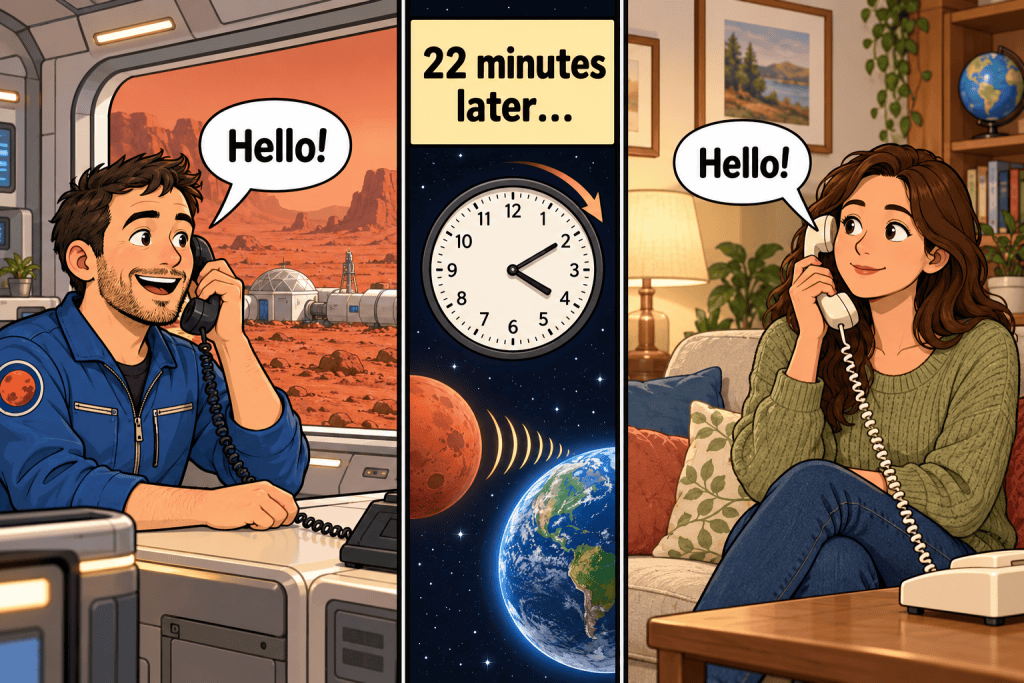
NASA describes Earth-to-Mars communications delays of roughly three to 22 minutes in one direction, depending on the planets’ positions. A reply must make the journey back. Even before someone on Mars considers an answer, a question-and-response exchange can involve about six to 44 minutes of signal travel. A familiar telephone conversation cannot keep its usual rhythm under those conditions.
The problem is distance rather than an inadequate calling application. Radio signals and laser signals travel at the speed of light, which is fast enough to make many terrestrial conversations feel immediate. The separation between Earth and Mars is much larger and changes as both planets orbit the Sun. Improving the communications equipment can carry more information, but cannot make that information cross the same distance faster than light.
NASA’s Mars Relay Network connects surface missions with Earth through spacecraft orbiting Mars. Relays help collect information from landers and rovers and send it onward to receiving stations. They provide useful opportunities for communication without removing the travel delay. A message may also wait for a suitable relay contact, adding a scheduling delay to the unavoidable journey through space.
For a future crew, a call would resemble an exchange of recordings more than a live conversation. A person could speak at natural speed, but the listener would hear the message later. Interruptions and immediate clarification would be difficult. The familiar habits of ordinary conversation, including brief acknowledgments and rapid changes of subject, would need to adapt to a long gap between contributions.
This difference would affect both personal contact and mission operations. Family messages could carry voices and images, preserving a richer connection than text alone. They would still arrive after a delay. A conversation about an urgent technical problem would need enough detail in the first message to reduce repeated exchanges. Good documentation would become a practical part of communication, rather than an optional record created afterward.
The ground team would also receive an incomplete picture of the immediate situation. Information reaching Earth describes a condition that existed on Mars minutes earlier. A decision sent back would address that earlier observation and would arrive later still. In rapidly changing situations, waiting for an Earth-based instruction could be inappropriate. Communications planning must account for the age of information as well as whether the message arrived correctly.
NASA’s research on human Mars communications considers the operational implications of these delays. The general consequence is a need for greater local decision-making capability than missions with nearly immediate ground contact. Astronauts would need procedures, equipment information, and authority appropriate to their circumstances. That requirement follows from the communications environment; it does not establish that a particular crewed mission architecture has already been adopted.
Robotic exploration already demonstrates why local autonomy matters. A rover cannot rely on an operator reacting instantly to every obstacle. Its activities are planned around communication opportunities and its ability to perform selected tasks onboard. A crewed mission would bring human judgment to the surface, but would also create more complex medical, operational, and personal needs. Experience from robotic missions provides useful evidence without reproducing every requirement of a human expedition.
There are periods when communicating with Mars becomes harder for another reason. During solar conjunction, the Sun lies near the line of sight between the planets. Disturbed solar material can interfere with radio communications. NASA has historically restricted commands during these periods to avoid the consequences of corrupted instructions. This is a temporary communications constraint, separate from the travel delay that applies whenever the planets are far apart.
A mission can prepare for predictable interruptions by sending instructions and storing information in advance. Some activities can continue locally, with data held until a suitable connection returns. A missed contact may extend the time before Earth receives results, even if the observations themselves were completed correctly. The operational aim is to make interrupted communication manageable, rather than assume that every activity requires an uninterrupted conversation.
Network capacity remains a second engineering concern. Higher data rates can support more detailed imagery, larger scientific datasets, and richer personal messages. They can reduce how long it takes to transmit a recording once contact begins. They cannot turn that recording into an immediate exchange. Keeping capacity and delay separate prevents a successful high-speed demonstration from being mistaken for a solution to the conversational problem.
The ground infrastructure is also shared. Large antennas and mission operations teams support spacecraft with competing requirements. New Space Economy’s Deep Space Network history explains the receiving infrastructure behind distant missions. For a future Mars crew, scheduled communication would be part of a larger service that includes tracking, mission data, and other spacecraft, rather than an ordinary private telephone circuit.
Software could help people manage these conditions. Messages can include timestamps, clear subject information, and enough context to remain understandable after arrival. Systems can indicate whether information has been transmitted or merely queued. Applications that expect immediate confirmation would need different behavior. These are design implications of long delay, not claims that a complete consumer communications service for Mars already exists.
The human significance is a change in the relationship between a distant team and its supporters on Earth. Expertise could still travel through the network, but it would be consulted with an understanding of timing. Personal contact could remain frequent without being immediate. Preparing for that difference would help people use the connection effectively rather than repeatedly expecting the response pattern of a terrestrial call.
A Mars call would be awkward because the conversation would span distances that ordinary social habits were never designed to accommodate. Better antennas, relays, and networking can make the exchange more informative and reliable. The lasting adjustment is accepting that the people at each end are acting in different communication moments, with decisions and daily life continuing during the space between a message and its reply.
Useful Books Available on Amazon