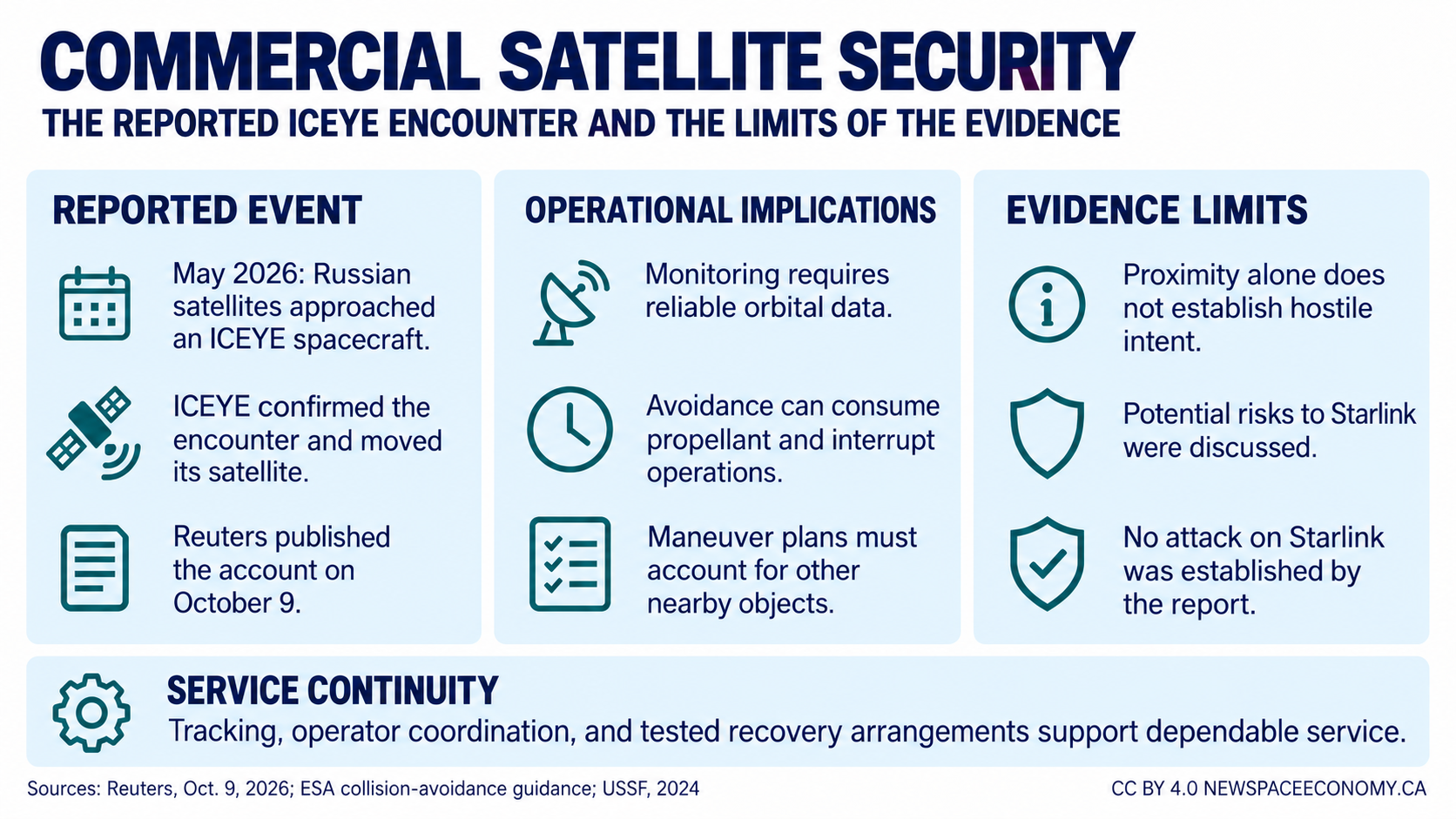
German space commander Michael Traut raised concerns about commercial satellite security in a Reuters report published October 9, 2026. Reuters reported that four Russian military satellites approached an ICEYE spacecraft in May. ICEYE confirmed the encounter and subsequently moved its satellite. Traut warned that similar capabilities could threaten Starlink; the report did not establish an attack on Starlink. Russia’s defense ministry did not respond to Reuters’ questions.
The reported encounter raises an operational question that extends beyond physical damage: how a commercial operator can maintain service when nearby activity requires closer monitoring or changes to its own flight plan. The answer depends on reliable observations, spacecraft capabilities, coordination procedures, and the responsibilities agreed between an operator and its customers.
Commercial satellites can provide military customers with information without becoming government-owned systems. ICEYE’s radar-imaging explanation describes how synthetic aperture radar sends pulses toward Earth and processes returning echoes into images. Unlike an optical camera relying on daylight, radar can collect information in darkness and through clouds. That makes the technology useful when weather or lighting limits optical observations.
Imaging and communications are different services. An imaging satellite collects observations; a broadband constellation carries data between users and networks. Both can support government operations, but a disruption would affect them differently. Missed imaging opportunities can interrupt a collection schedule. A communications interruption can affect access to an ongoing service. The consequences require analysis at the service level, rather than an assumption that all satellites face identical risks.
Proximity alone does not identify intent. An assessment requires observations of how spacecraft move over time, how their behavior relates to other objects, and whether communications or mission performance changes. New Space Economy’s discussion of military dependence on space services emphasizes the distinction between maintaining access to orbit and sustaining useful operations. That distinction is directly relevant to commercial operators supporting government users.
Routine collision avoidance already illustrates some of the costs of responding to orbital activity. ESA’s collision-avoidance explanation describes how maneuvering can consume propellant and interrupt observations or communications. These effects can occur even when a collision is successfully prevented. They explain a general operational mechanism, not a measured loss suffered by ICEYE or Starlink in the reported episode.
Propellant is only part of that cost. Flight-control teams must assess warnings, calculate possible responses, verify commands, and consider effects on the mission schedule. An unnecessary maneuver can impose work and disruption without improving safety. A delayed response can reduce the available options. The quality and timing of the underlying orbital information matter because operators must make decisions before every uncertainty has disappeared.
ESA’s description of close-approach assessment identifies several inputs: predicted miss distance, collision probability, approach geometry, and uncertainty in the estimated orbits. A single distance figure cannot capture all those factors. An object predicted to pass nearby with a well-understood trajectory presents a different decision problem from an encounter whose trajectory is poorly constrained.
The same assessment process must consider whether an avoidance maneuver introduces another risk. ESA screens candidate maneuvers against other objects before recommending a response. This makes collision avoidance a coordinated flight-planning task rather than a simple instruction to increase separation. In a crowded orbital environment, changing one spacecraft’s path can affect subsequent encounters as well as the immediate event.
Security monitoring adds questions that collision calculations cannot answer alone. A flight-safety analysis estimates whether objects may collide. A security assessment also examines patterns, possible intent, and effects on the mission. Accurate orbital information can support both tasks, but an assessment of hostile purpose requires additional evidence. Public descriptions of unusual motion should retain that distinction.
Coordination mechanisms can reduce some of the uncertainty between cooperative operators. ESA’s CREAM automation project addresses encounter assessment, maneuver planning, and communication among operators and tracking providers. Its published description presents automation as a way to reduce workload and improve responses. It does not establish a solution for every security scenario or guarantee cooperation from another spacecraft’s operator.
For commercial customers, this leads to practical questions about service continuity. Contracts can specify notification procedures, availability commitments, and arrangements for restoring service. A government customer and a commercial provider also need a shared understanding of which information can be exchanged during an incident. These are implications of operating a contracted service under risk, not disclosed terms of ICEYE’s customer agreements.
Defense policy already recognizes the need to plan commercial integration before a crisis. An April 2024 Space Force policy explanation describes priorities including availability through contracts, integration during peacetime planning and training, and protection of relevant space capabilities. Its reference to commercial protection is qualified by “where appropriate.” It should not be interpreted as an unconditional security guarantee for every commercial satellite.
That qualification leaves responsibility to be defined for particular arrangements. Operators control their spacecraft and possess detailed information about their systems. Governments may hold additional observations and security assessments. Effective cooperation depends on procedures that connect those capabilities without assuming either party possesses all the necessary information. The existence of a commercial contract alone does not show how that coordination will work.
Fleet size also needs careful interpretation. More satellites can provide alternative capacity, but service continuity depends on whether suitable spacecraft, ground connections, and user equipment can substitute for an affected link or collection opportunity. Redundancy must be evaluated against the service required at a particular place and time. An orbital inventory cannot establish that result on its own.
The reported encounter makes monitoring and continuity planning concrete concerns for commercial satellite operations. A proportionate assessment separates observed spacecraft behavior, an operator’s response, and forecasts of what similar behavior could cause elsewhere. Stronger conclusions about harm or intent require additional evidence; practical preparation can still proceed through better tracking, defined coordination, and tested arrangements for maintaining service.
Useful Books Available on Amazon