
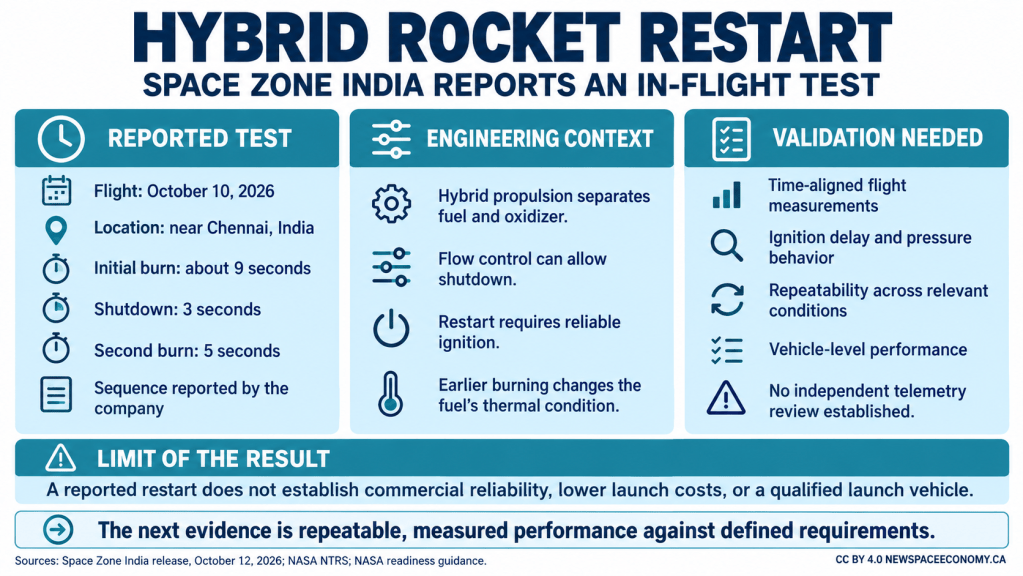
Space Zone India reported on October 12, 2026, that its RRR-1 experimental rocket completed an in-flight hybrid rocket restart during a flight two days earlier near Chennai. The company’s published announcement describes two powered periods separated by an intentional shutdown. The report concerns a propulsion experiment, with the result attributed to the mission team.
A restart can matter because some missions require thrust at separate points rather than in one continuous burn. However, the reported sequence does not establish the reliability, payload capability, or operating cost of a commercial launch system. Its immediate technical significance is narrower: the company says its experimental hardware stopped producing thrust and then resumed powered operation during the same flight.
According to the announcement, the first burn lasted approximately nine seconds, followed by a three-second shutdown and a further five-second burn. That gives 14 seconds of powered operation within a 17-second sequence. The company says onboard instrumentation and tracking supported the flight. Those statements describe its reported test conditions; they do not provide an independently reviewed performance record.
Independent local reporting provides context for the event. DT Next reported that two hybrid rockets launched at Thiruvidanthai on October 10 to test restart technology. Its account supports the occurrence and purpose of the launch event. It does not publish the detailed telemetry needed to verify the timing, thrust, and combustion behavior claimed for the RRR-1 sequence.
Hybrid propulsion uses fuel and oxidizer stored separately, typically with solid fuel and a liquid or gaseous oxidizer. The oxidizer supports combustion when it reaches the fuel. New Space Economy’s introduction to hybrid rocket propulsion explains the basic distinction from motors that contain fuel and oxidizer together in a solid propellant. The separate supply creates an opportunity to control combustion through oxidizer delivery.
That opportunity does not make restart automatic. Stopping the supply and successfully reestablishing combustion are different functions. A working restart arrangement must bring the engine back into a condition that produces the intended thrust. Whether that happens consistently depends on the particular hardware and operating conditions, rather than on the hybrid classification alone.
The underlying engineering problem has a long research history. A 1973 experimental study, recorded in NASA’s Technical Reports Server, investigated hybrid motor restarts after brief extinguishment. Its abstract reports reduced ignition delay on restart because the fuel absorbed less energy before reaching ignition conditions. This is evidence that the thermal state left by an earlier burn can affect a subsequent ignition.
That historical result also limits how the new claim should be framed. Hybrid restart is an established research subject, so an individual demonstration should be assessed against its own configuration and objectives. The available announcement does not establish a global first. It also does not show that behavior observed after a short shutdown will be unchanged after a substantially longer interval.
A useful evaluation would distinguish command timing from engine response. A command to restart at a stated time is different from measured ignition at that time, and both differ from achieving stable thrust. Time-aligned measurements would allow those events to be compared. Without them, a short description of the sequence cannot establish how rapidly or consistently the propulsion system responded.
Engine behavior can also change during a burn. A 2023 hybrid propulsion modeling study by Joel Jean-Philyppe examined a nitrous oxide and paraffin system, including changing tank conditions and transient performance. It compared the developed model with hot-fire test data. That work concerns different hardware and cannot validate RRR-1, but it illustrates why propulsion assessment requires measured behavior rather than a burn duration alone.
For the reported Indian test, a more complete technical account could identify the intended performance and compare it with observations during both burns. Relevant evidence would include the restart delay, pressure behavior, and any deviations from the planned sequence. The objective would be to establish what the hardware actually did, including any limitations, rather than merely whether a second visible plume appeared. Such disclosure would also make comparisons with later tests more meaningful.
Repeatability is another separate issue. One successful sequence can establish that an event occurred under the tested conditions, provided the measurements support it. It cannot by itself estimate how often the same hardware would succeed across a broader operating range. Additional tests would need to address the conditions relevant to the intended application, including differences between initial ignition and subsequent restarts.
NASA’s technology readiness framework distinguishes laboratory work, prototype demonstration, qualification, and successful operational use. The framework provides a useful way to separate a test result from a finished capability. The public information available for RRR-1 is insufficient to assign a defensible readiness level, and a flight experiment should not automatically be described as a qualified commercial propulsion system.
The economic implications require additional evidence as well. The ability to schedule separate burns may provide mission design options, but lower cost or improved propellant efficiency would depend on the complete vehicle and mission. Added hardware, testing, and operational requirements would also enter that assessment. No cost reduction can be calculated from the reported seconds of engine operation.
Commercial development would require connecting the propulsion result to a defined service, customer requirements, and demonstrated delivery capability. Investor discussions or expansion plans would not establish that customers have bought launches or that funding has closed. The appropriate evidence would be specific commitments and test results that address the requirements of the proposed service.
The reported October 10 flight provides a basis for further examination of Space Zone India’s restart system. Its significance will become clearer if the company publishes measurements, explains the conditions under which the sequence worked, and demonstrates repeatable performance. The unresolved issue is whether the reported restart can be reproduced and integrated into a vehicle that meets a defined operational requirement.
Useful Books Available on Amazon
