
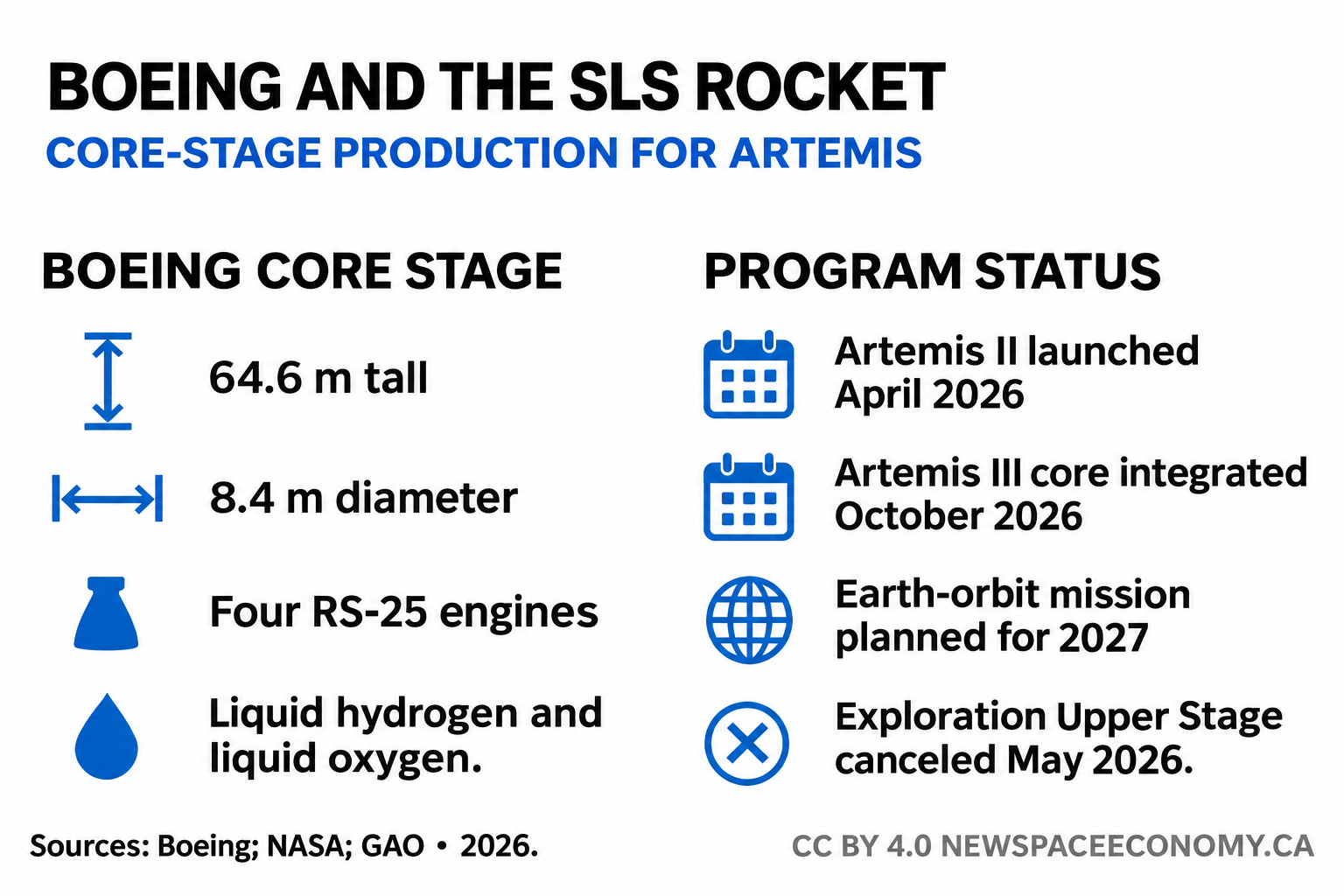
Boeing builds the core stage of NASA’s Space Launch System, the rocket that launched the Artemis II crew toward their lunar flyby in April 2026. Its next flight article, the Artemis III core stage, was integrated beside its boosters at Kennedy Space Center in October. The rocket is being prepared for a crewed Earth-orbit mission in 2027 under NASA’s revised Artemis program.
Boeing’s role is that of a major manufacturing contractor within a NASA-managed launch system. The core stage supplies the propellant tanks, structure, and onboard equipment around four RS-25 engines, and connects to the two solid rocket boosters. The complete Space Launch System, usually abbreviated SLS, combines Boeing’s work with engines, boosters, upper-stage hardware, spacecraft, and ground systems supplied by other organizations.
Boeing and Its Launch Manufacturing Role
Boeing’s corporate organization comprises Commercial Airplanes, Defense, Space & Security, and Global Services. Space systems sit within a much larger aerospace enterprise that also manufactures civil aircraft and military equipment and provides support services. Its company-wide employment count was 181,984 at the end of December 2025, including subsidiary operations.
For the third quarter of 2026, Boeing reported $24.2 billion in revenue. Defense, Space & Security contributed approximately $7.9 billion and reported $492 million in earnings from operations. These are segment-level figures covering the defense and space portfolio. The SLS work is one program within that organization.
NASA identifies Boeing as the lead contractor for core-stage manufacturing, including the flight computers that control the rocket. The principal manufacturing site is NASA’s Michoud Assembly Facility in New Orleans. NASA’s Marshall Space Flight Center manages SLS and develops its avionics software, and Kennedy Space Center supports final integration and launch. This arrangement distributes responsibility among the program office, manufacturing teams, and launch-site organizations.
The Block 1 Launch Vehicle
The flown SLS Block 1 configuration uses four liquid-propellant RS-25 engines and two five-segment solid rocket boosters. Its stated capability exceeds 27 metric tons on a trajectory toward the Moon. The rocket’s initial thrust comes from the combined operation of the engines and boosters; the upper stage performs the subsequent in-space propulsion work.
The Interim Cryogenic Propulsion Stage, or ICPS, derives from the Delta IV upper-stage design. It uses liquid hydrogen and liquid oxygen with one RL10 engine. The stage sits above Boeing’s core and below Orion, connected through structural adapters. Boeing describes the ICPS as hardware built by United Launch Alliance and Boeing for SLS Block 1. Its function is separate from the core stage’s powered ascent.
The Boeing-built core stage is 212 feet tall and 27.6 feet in diameter, approximately 64.6 meters by 8.4 meters. Its liquid-oxygen tank holds approximately 196,000 gallons, and its much larger liquid-hydrogen tank holds approximately 537,000 gallons. Hydrogen occupies more volume because of its low density. Both propellants are stored at cryogenic temperatures and supplied to the engines during ascent.
The stage’s forward skirt houses flight computers and other avionics. The intertank connects the two main tanks and provides a structural attachment for the boosters. The engine section holds the four RS-25 engines and associated equipment. Power distribution, cameras, gyros, and flight computers provide the electronic functions that accompany the propellant and structural systems.
Northrop Grumman supplies the five-segment solid boosters, each approximately 177 feet tall. They operate during the first two minutes of ascent and provide most of the liftoff thrust. The additional propellant segment distinguishes them from the four-segment boosters used by the space shuttle. Their attachment to the core makes the central stage both a liquid-propellant stage and a major load-carrying structure for the assembled rocket.
Work on the RS-25 engines continues alongside stage production. NASA conducted an October 21, 2026 engine test using developmental engine 10001 at Stennis. The 500-second firing included operation at the 111% power level planned for new-production engines. NASA identified acceptance testing of future flight components and validation of nozzle thermal protection among the objectives. The engine itself was a development unit, and the campaign supplied data for the engines that will be integrated into future flight cores.
Building and Testing the Core Stage
NASA’s core-stage description identifies aluminum 2219 as the principal structural material. Panels are joined into barrel and dome assemblies, which form the tanks and other major sections. Orange spray-on foam insulates the cryogenic tanks. The stage also carries loads from the upper rocket and spacecraft and transmits thrust from its engines and attached boosters.
The five major elements are the forward skirt, liquid-oxygen tank, intertank, liquid-hydrogen tank, and engine section. Structural test articles representing the tanks, intertank, and engine section were tested at Marshall to examine their response to flight loads. The first complete flight stage then underwent integrated functional testing at Stennis Space Center in Mississippi. These activities addressed both individual structures and the assembled stage.
The first stage’s Green Run campaign culminated in a full-duration firing on March 18, 2021. All four engines operated for approximately eight minutes and 19 seconds. The firing followed an earlier January test that ended after about one minute. NASA used the longer test to collect integrated-stage data across operating conditions representative of flight.
During the firing, the team moved the engines to exercise thrust steering and varied their power settings. Earlier portions of the eight-part campaign had examined avionics, propulsion, and hydraulic systems. The test arrangement combined the actual flight core with the B-2 stand’s propellant supplies, electrical power, cooling water, and instrumentation. Afterward, the stage was prepared for transport to Kennedy and assembly with the remaining Artemis I hardware.
Flight Experience From Artemis I and II
SLS first flew on November 16, 2022, launching the uncrewed Artemis I mission. NASA’s post-flight assessment found that the rocket met or exceeded its performance expectations. Engineers compared flight measurements with predictions, examining propulsion, structural behavior, separation events, and the operating environment experienced by the rocket.
NASA collected more than four terabytes of data and onboard imagery during the prelaunch and launch phases, plus approximately 31 terabytes of imagery from multiple camera locations. The core contained more than 1,000 sensors and about 45 miles of cabling. The data set recorded the stage’s actual performance under conditions that integrated ground tests could only partly reproduce, including booster separation during ascent.
The ICPS completed two burns for Artemis I, including the maneuver that sent Orion toward the Moon. NASA reported that RS-25 thrust and mixture-ratio control-valve behavior stayed within 0.5% of predicted values. These measurements supported the transition from the uncrewed demonstration to carrying astronauts on the second flight.
Artemis II launched on April 1, 2026, carrying NASA astronauts Reid Wiseman, Victor Glover, and Christina Koch and Canadian Space Agency astronaut Jeremy Hansen. SLS delivered Orion to Earth orbit. After spacecraft checks, Orion’s service-module engine placed the crew on the lunar-flyby trajectory.
The crew returned to the Pacific Ocean on April 10 after a journey lasting nearly 10 days. NASA reported a total distance of 695,081 miles and a maximum distance from Earth of 252,756 miles. For Boeing’s launch-stage program, the mission added crewed flight experience to the initial uncrewed SLS demonstration. The rocket’s role was completed during the early launch and orbital phases, followed by Orion’s independent flight and return.
The Canceled Block 1B and Exploration Upper Stage
Boeing also developed the Exploration Upper Stage, or EUS, for the planned SLS Block 1B upgrade. NASA canceled Block 1B in May 2026. The Government Accountability Office’s 2026 assessment records stop-work orders in February and termination of the EUS portions of Boeing’s contracts in May. NASA was standardizing the rocket configuration and changing its Artemis mission sequence.
The original Block 1B design retained the core, RS-25 engines, and five-segment boosters, but replaced the ICPS with the larger EUS. In its crew configuration, the proposed rocket stood 366 feet tall and was designed to send approximately 38 metric tons toward the Moon. Its payload arrangement would have allowed Orion and a separate cargo element to fly together.
The EUS used four RL10C-3 engines burning liquid hydrogen and liquid oxygen. NASA’s technical description of the stage included larger propellant tanks, a thrust structure, an equipment shelf, and an upper adapter. Flight computers would have moved from the core-stage forward skirt to the upper stage, allowing the same computers to remain with the mission through Orion separation.
The stage was designed for multiple ignitions and extended in-space operation. It also incorporated redundant electrical and guidance equipment and communication links with Orion and ground controllers. These features belonged to the canceled development configuration. They explain the scope of Boeing’s former upper-stage work and the role that EUS would have served in the proposed rocket family.
The Government Accountability Office reported that EUS subassemblies had entered production and the flight engines were complete when work stopped. It also described Block 2, a further SLS evolution involving replacement boosters, as lacking established cost and schedule baselines. Booster development testing remained relevant to possible later use of the standardized SLS configuration. Boeing’s core-stage production continued within the revised program.
Centaur and the Revised Upper-Stage Plan
United Launch Alliance announced an expanded Centaur development effort on October 23, 2026. NASA prioritized a 180K Centaur V version, including qualification and flight hardware intended to support a 2028 Artemis launch. ULA described a longer tank assembly with approximately 50% greater propellant capacity than its existing Centaur V.
The planned changes include alloy 718 tank material, larger hydrazine tanks, and updated avionics and software. The stage would be built at ULA’s Decatur factory and transported to Florida for integration with SLS. For Boeing, the revised upper stage changes the hardware above its core while retaining the company’s central manufacturing role in the lower rocket.
NASA’s October Artemis update identified two upper-stage options for Artemis IV: the existing ICPS and the stretched Centaur V. The agency described Artemis III as a planned 14-day Earth-orbit mission in 2027 to test Orion rendezvous and docking with lander test vehicles. Artemis IV remained the planned lunar-landing mission for 2028.
A New Assembly Process for Artemis III
Boeing changed how it delivers the core stage beginning with Artemis III. In April 2026, the upper four core-stage elements left Michoud aboard NASA’s Pegasus barge without the engine section. The forward skirt, oxygen tank, intertank, and hydrogen tank had already been joined. The engine section would be attached after arrival in Florida.
The Kennedy integration arrangement places the stage vertically and provides access around its circumference. Boeing described an engine-section integration area, a large subassembly clean room, and a support stand among the associated infrastructure improvements. The company projected a reduction in production cycle time of up to six months from the revised process.
By October, the stage had moved to High Bay 3 in the Vehicle Assembly Building and joined the boosters in the short-stack configuration. That configuration supports propellant-loading tests before the complete vehicle is assembled. The Artemis hardware schedule connects this work to the planned 2027 flight, with Boeing’s next core stage entering final processing at the launch site.
As an Amazon Associate we earn from qualifying purchases.
Useful Books Available on Amazon
