
Key Takeaways
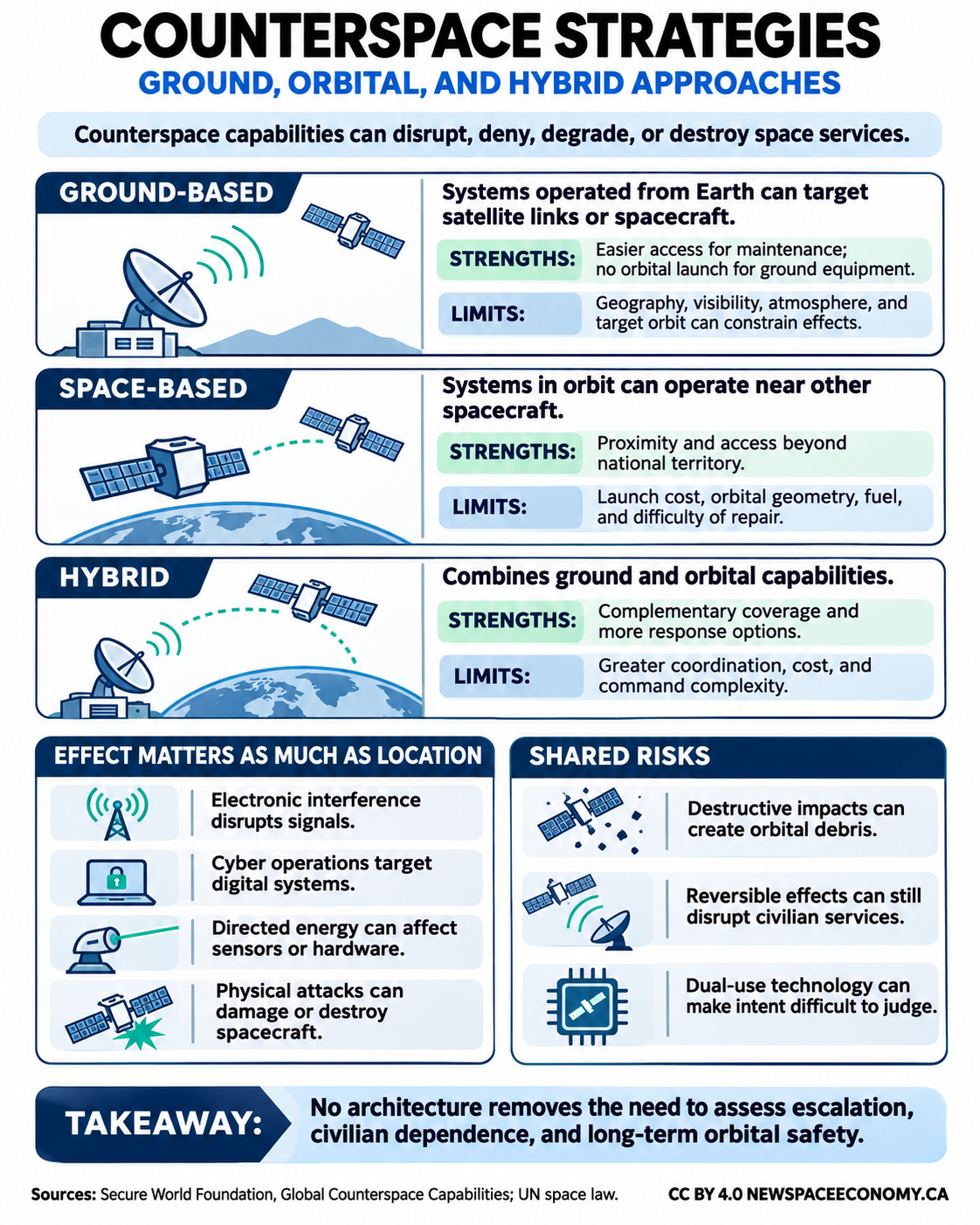
- Ground-based, space-based, and hybrid counterspace postures balance cost, orbital reach, and escalation risk.
- Hybrid counterspace architectures pair terrestrial power and scale with persistent global reach across orbits.
- Disabling adversary imaging fleets from Earth requires layered tracking, lasers, jammers, and missiles.
How Modern Nations Define Counterspace Architecture
Hours before Russian ground forces crossed into Ukraine on February 24, 2022, a coordinated cyberattack knocked tens of thousands of commercial satellite modems offline across Ukraine and Central Europe, demonstrating that space systems have become opening targets in modern conflict. According to the 2026 Global Counterspace Capabilities assessment published by the Secure World Foundation, 13 countries now actively research, test, or field counterspace systems designed to disrupt, deny, degrade, or destroy adversary access to orbit. Designing a national counterspace strategy requires governments to choose where those capabilities live, how they operate, and what level of permanent damage or diplomatic fallout they are willing to accept.
Military planners generally classify counterspace weapons categories into four functional families: kinetic physical, non-kinetic physical, electronic, and cyber. Kinetic weapons rely on direct collision or explosive fragmentation to destroy spacecraft or ground stations. Non-kinetic physical weapons use directed energy, such as high-powered lasers or microwaves, or electromagnetic pulses to damage hardware without physical contact. Electronic warfare (EW) interferes with radio-frequency uplinks and downlinks through jamming or spoofing, and cyber operations target the software, networks, and data streams that command satellites and process their output. Across this spectrum, effects range from temporary and reversible interference to irreversible destruction that leaves hazardous debris in orbit.
When translating these tools into a national force posture, defense planners face a foundational architectural decision: whether to rely exclusively on space-based assets, deploy a ground-based only architecture, or build a hybrid force that integrates both domains. Each model reflects distinct assumptions about national budgets, industrial capacity, geographic footprint, and military doctrine. As documented in reviews of global counterspace capabilities, a small nation seeking regional deterrence faces very different engineering constraints than a superpower trying to project military power across multiple continents and orbital regimes.
The stakes of this architectural choice have grown sharper as commercial and military constellations expand. Legacy space architectures depended on small numbers of expensive, multi-ton satellites operating in predictable paths, making single-target destruction an attractive option. Modern fleets increasingly combine sovereign defense spacecraft with commercial imaging, communications, and navigation networks. Selecting the right counterspace strategy depends on how effectively a posture can adapt to shifting orbital densities, manage escalation thresholds, and sustain operations over weeks or months of crisis.
Space-Based Only Counterspace Posture and Orbital Trade-Offs
A space-based only counterspace strategy places the primary offensive and defensive counterspace tools directly in orbit. Rather than waiting for adversary spacecraft to pass over friendly territory, a nation launches co-orbital satellites, maneuverable inspector vehicles, robotic servicing craft, or reusable spaceplanes capable of operating alongside target constellations. These platforms can conduct rendezvous and proximity operations (RPO), loiter near adversary assets to gather signals intelligence, jam crosslinks at close range, grapple a spacecraft to tug it out of its operational slot, or release kinetic projectiles on command.
Recent orbital activity illustrates the growing sophistication of these platforms. According to the U.S. Space Force Space Threat Fact Sheet updated in July 2026, China demonstrated dual-use orbital maneuvering in 2022 when its SJ-21 satellite grappled a defunct BeiDou navigation spacecraft and towed it into a graveyard orbit above geostationary Earth orbit (GEO). In the second half of 2025, China’s SJ-21 and SJ-25 satellites conducted dockings and undockings linked to potential on-orbit refueling, extending the operational endurance of maneuverable orbital vehicles. Russia has likewise deployed probable co-orbital prototypes into low Earth orbit (LEO) in 2017, 2019, 2022, 2024, and 2025, and in May 2026 maneuvered four military satellites, Cosmos 2610 through 2613, close to a Western commercial radar satellite supporting Ukraine. Meanwhile, France, Germany, India, and Japan have all initiated programs or policies exploring co-orbital bodyguard satellites designed to defend sovereign assets in orbit.
Strategic Advantages of a Space-Based Only Posture
The defining advantage of a space-based only counterspace strategy is global reach independent of terrestrial geography. A co-orbital interceptor or jamming satellite positioned in an adversary’s orbital plane can engage targets over oceans, polar regions, or enemy territory without requiring forward terrestrial bases or diplomatic overflight permissions. This reach becomes particularly valuable against spacecraft in medium Earth orbit (MEO) at roughly 20,000 kilometers (12,400 miles) altitude and GEO at approximately 36,000 kilometers (22,300 miles) altitude, where ground-based missiles require large multistage boosters and ground-based lasers suffer severe beam dispersion over vast distances.
Orbital counterspace platforms also offer persistent proximity and rapid engagement. Because an inspector or bodyguard satellite can be stationed in orbit during peacetime, it eliminates the multi-minute flight warning associated with launching a missile from Earth. Operating outside Earth’s atmosphere removes cloud cover, precipitation, and atmospheric turbulence as barriers to optical lasers or high-frequency radio jamming. In addition, non-destructive counterspace satellites equipped with proximity jammers, robotic arms, or low-power dazzling optics can apply calibrated, reversible pressure during a diplomatic crisis without immediately creating orbital debris.
Operational and Economic Drawbacks of Orbital Exclusivity
Despite these advantages, relying solely on space-based counterspace systems introduces severe technical, financial, and political liabilities. Launching, commanding, and sustaining a fleet of maneuverable counterspace vehicles requires heavy capital investment and reliable space launch infrastructure. Every orbital plane change consumes large quantities of onboard propellant, constraining how many targets a single co-orbital weapon can realistically engage during its service life. Once a space-based system is launched, technicians cannot easily repair, refuel, or upgrade its hardware, leaving it vulnerable to technological obsolescence as adversaries modify their own frequencies, encryption, or defensive tactics.
Visibility and vulnerability further complicate an orbital-only posture. Because satellites follow deterministic laws of orbital mechanics, modern space domain awareness networks operated by governments and commercial tracking firms routinely catalog new launches and flag unusual orbital maneuvers. A pre-positioned co-orbital weapon is itself a fragile target exposed to ground-based direct-ascent missiles, lasers, or adversary co-orbital interceptors. Politically, placing dedicated weapons in orbit carries heavy diplomatic friction. Although the 1967 Outer Space Treaty explicitly prohibits stationing nuclear weapons or other weapons of mass destruction in orbit rather than conventional arms, overtly weaponizing space invites international condemnation and accelerates reciprocal deployments by rival states.
Ground-Based Only Counterspace Posture and Terrestrial Limits
A ground-based only counterspace strategy keeps all weapons, sensors, and command infrastructure on Earth, operating from fixed installations, road-mobile vehicles, naval vessels, or aircraft. This posture encompasses direct-ascent anti-satellite (DA-ASAT) missiles, fixed and mobile high-power laser stations, radio-frequency jammers and spoofers, cyber operations centers, and conventional precision-strike munitions aimed at adversary satellite ground stations. For many nations, a terrestrial approach represents the most accessible entry point into counterspace operations because it builds directly on existing air defense, missile defense, electronic warfare, and cybersecurity institutions.
Real-world deployments highlight the maturity of Earth-based anti-satellite weapons across both kinetic and non-kinetic tiers. In the kinetic domain, China destroyed its defunct Fengyun-1C weather satellite in 2007 with a ground-launched SC-19 missile, India demonstrated a LEO intercept in 2019, and Russia used its road-mobile Nudol DA-ASAT missile in November 2021 to destroy the defunct Cosmos 1408 satellite. In the non-kinetic domain, Russia deployed truck-mounted Peresvet laser dazzlers to five strategic missile divisions starting in 2018 and has constructed a fixed, higher-power adaptive-optics laser complex called Kalina in the northern Caucasus to suppress optical reconnaissance satellites. In the electromagnetic domain, the U.S. Space Force Combat Forces Command operationally accepted its transportable Meadowlands satellite jammer on June 8, 2026, fielding a more compact upgrade to the Counter Communications System designed for rapid movement in austere environments.
Strategic Advantages of a Ground-Based Only Posture
Terrestrial counterspace architectures offer compelling economic and logistical strengths. Ground facilities enjoy access to industrial electrical grids, large cooling systems, and ample physical space, allowing engineers to field high-power lasers and wideband jammers without the strict mass, volume, and solar-power ceilings imposed on spacecraft. Maintenance crews can repair broken components, swap out electronics, update software, and reload missile canisters rapidly at a fraction of orbital replacement costs. Road-mobile jammers and launchers can also disperse across national territory, complicating an adversary’s ability to locate and neutralize them before conflict begins.
A ground-based posture also maximizes sovereign control and escalation flexibility. Because the hardware remains inside national borders or on sovereign naval and air platforms, operators retain direct physical security over their systems. Reversible terrestrial tools, particularly electronic space warfare systems and cyber operations, allow a government to contest specific regions or communication links during gray-zone crises without permanently destroying hardware or generating orbital debris. Indeed, open-source assessments through 2026 show that electronic warfare and cyber operations remain the only counterspace categories actively used in live conflicts.
Geographic and Physical Constraints of Terrestrial Exclusivity
The primary weakness of a ground-based only counterspace strategy is geometry. Because Earth is curved, any ground-based laser, radar, or jammer can engage a satellite only when that spacecraft rises above the local horizon and enters direct line of sight. A satellite in LEO passes over a single ground station for only a few minutes per orbit, and satellites in GEO positioned over the opposite hemisphere remain permanently out of view from domestic territory. Even when a target is overhead, clouds, fog, rain, and atmospheric turbulence degrade or completely block ground-based laser beams, rendering optical directed-energy weapons weather-dependent.
Ground-based kinetic weapons carry distinct strategic liabilities of their own. Launching a DA-ASAT missile produces an unmistakable infrared plume detected almost instantly by adversary missile-warning satellites, making attribution immediate and public. Kinetic intercepts in LEO also generate long-lived debris clouds that threaten satellites of all nations, including the attacker’s own spacecraft. Following Russia’s 2021 test, 155 nations voted in December 2022 to adopt United Nations General Assembly Resolution A/RES/77/41, calling on states to commit not to conduct destructive DA-ASAT missile tests. As of early 2026, 2,773 pieces of trackable debris out of 6,904 fragments catalogued from past anti-satellite tests by the United States, Russia, China, and India remained in orbit, underscoring the enduring environmental and diplomatic cost of terrestrial kinetic strikes.
Hybrid Space-Based and Ground-Based Counterspace Strategies
A hybrid counterspace strategy combines terrestrial systems and orbital assets into an integrated architecture, assigning each domain the missions it performs most efficiently. Rather than treating ground and space platforms as competing alternatives, major space powers use terrestrial sensors, jammers, lasers, and cyber units to handle high-volume, regional, and cost-sensitive tasks, whereas orbital assets provide global reach, close-range inspection, and coverage of high-altitude orbits that ground sites cannot reliably access.
In practice, the United States, China, and Russia all operate variations of a hybrid posture. The United States pairs ground-based electromagnetic warfare systems such as Meadowlands and terrestrial space surveillance radars with space-based surveillance assets like the Geosynchronous Space Situational Awareness Program (GSSAP) satellites, which have conducted close approaches near Chinese spacecraft in GEO. China integrates terrestrial space object surveillance networks, ground-based lasers, regional jammers, and DA-ASAT missiles with on-orbit space situational awareness satellites, reusable spaceplanes, and maneuverable GEO vehicles. Russia similarly blends mobile Peresvet lasers, widespread battlefield EW units, and Nudol interceptors with co-orbital LEO prototypes and GEO signals-intelligence platforms such as Luch.
Strengths and Trade-Offs of the Hybrid Approach
The foremost strength of a hybrid counterspace strategy is operational resilience across multiple orbits and conflict intensities. If cloud cover blocks a ground-based laser or enemy airstrikes neutralize a forward jamming battery, orbital platforms or distributed cyber units can maintain pressure on adversary space services. Conversely, if an opponent disables an orbital bodyguard or inspector satellite, terrestrial systems continue operating from hardened domestic sites. Hybrid integration also improves targeting precision: ground-based radars and optical telescopes can tip and cue orbital inspector satellites to investigate anomalous spacecraft behavior, closing information gaps across both domains.
This flexibility comes at a steep institutional and financial price. Maintaining parallel terrestrial and orbital counterspace pipelines strains defense budgets, specialized engineering workforces, and launch capacity. Coordinating actions across ground electronic warfare units, cyber operators, missile crews, and orbital flight controllers demands sophisticated battle management software and unified command authorities. As analysts of satellite defense and responsive space observe, hybrid postures can also blur defensive and offensive intentions. Dual-use orbital servicing vehicles paired with terrestrial tracking and jamming networks make it harder for rival powers to distinguish routine maintenance from preparations for an attack, elevating the risk of inadvertent escalation during a crisis.
The following table summarizes the primary operational, economic, and strategic trade-offs across the three counterspace deployment models.
| Strategic Dimension | Space-Based Only | Hybrid Architecture | Ground-Based Only |
|---|---|---|---|
| Geographic Reach | Global coverage across multiple orbital planes | Global orbital reach plus dense regional denial | Constrained by horizon and sovereign basing |
| Orbital Altitude Access | Effective in LEO, MEO, and GEO | Full multi-orbit coverage with tailored tools | Strongest in LEO; limited reach in GEO |
| Lifecycle Cost | High launch, design, and replenishment expenses | Highest combined capital and integration cost | Lowest entry cost and easier hardware upgrades |
| Weather Sensitivity | Unaffected by clouds or atmospheric turbulence | Orbital assets offset terrestrial weather limits | Optical lasers blocked by clouds and storms |
| Sustainability and Reloading | Limited by onboard fuel and finite payloads | Terrestrial scale preserves scarce orbital fuel | Grid power and rapid terrestrial resupply |
| Escalation Management | Dual-use ambiguity raises miscalculation risk | Broadest range of reversible and kinetic options | High flexibility via EW; overt kinetic launches |
For middle powers without large launch fleets or deep defense budgets, a pure space-based posture is rarely feasible, and even a full hybrid force may require allied integration, as reflected in discussions of sovereign counterspace and space domain awareness. Consequently, understanding how far a ground-based only system can stretch against a demanding military mission, such as blinding an adversary’s entire Earth observation fleet, has become a central question for modern defense planners.
Why Adversary Earth Observation Constellations Are Hard to Disable
Before designing a ground-based counterspace deployment to disable an adversary’s Earth observation satellites, planners must account for how radically remote sensing architectures have changed. During the Cold War, a superpower operated only a handful of large electro-optical reconnaissance satellites. Disabling three or four spacecraft could blind an opponent’s strategic intelligence apparatus for months. In 2026, an advanced adversary’s Earth observation capability consists of a dense, multi-layered ecosystem spanning government intelligence satellites, civil remote sensing fleets, and commercial imaging constellations.
China illustrates the scale of this transformation. By mid-2026, the People’s Liberation Army benefited from more than 510 intelligence, surveillance, and reconnaissance satellites carrying optical, multispectral, synthetic aperture radar (SAR), and radio-frequency payloads. Commercial providers multiply that density further. Across the global operational Earth observation satellite landscape, companies such as Planet Labs, Maxar, ICEYE, and Chang Guang Satellite Technology operate dozens to hundreds of agile spacecraft in LEO. As demonstrated in the war in Ukraine and analyzed in CSIS research on extending the battlespace to space, even a nation with minimal sovereign spacecraft can tap commercial electro-optical and SAR imagery to track troop convoys, monitor logistics hubs, and guide long-range strikes.
Orbital Mechanics and Sensor Diversity
Most high-resolution Earth observation satellites operate in LEO between 400 and 800 kilometers (250 to 500 miles) above Earth, frequently in sun-synchronous polar orbits that pass over any given latitude at the same local solar time each day. Traveling at roughly 7.5 kilometers per second (about 16,800 miles per hour), each satellite completes an orbit in approximately 90 to 100 minutes. Because Earth rotates beneath the orbital plane, a single spacecraft views a specific ground target for only five to 12 minutes per pass. When an adversary deploys dozens or hundreds of satellites distributed across multiple orbital planes, revisit intervals shrink from days to minutes, ensuring that disabling one satellite leaves neighboring spacecraft ready to capture the next pass.
Sensor diversity compounds this resilience. Electro-optical and infrared imaging satellites rely on passive telescopes that collect reflected sunlight or thermal emissions, making them vulnerable to bright laser light aimed into their apertures. Synthetic aperture radar satellites transmit their own microwave pulses and measure the returning echoes to image terrain through dense clouds, smoke, and nighttime darkness. A ground-based laser dazzler has virtually no effect on a SAR payload, whereas a radar jammer cannot blind a passive optical camera. Furthermore, advances in onboard artificial intelligence and edge processing allow newer imaging satellites to identify military targets in orbit and transmit compact text alerts rather than massive raw image files, reducing their exposure to traditional downlink jamming.
Translating Total Earth Observation Denial Into a Ground-Based Deployment
If a nation commits to disabling all Earth observation satellites of a capable adversary using a ground-based only counterspace strategy, it cannot rely on a single silver-bullet weapon. Because every terrestrial counterspace mechanism has specific physical blind spots, achieving comprehensive denial requires deploying a synchronized, five-layer ground architecture. Planners must also draw a sharp distinction between localized operational denial, which prevents enemy satellites from collecting usable imagery over a specific homeland or battlefield, and permanent global neutralization, which renders the adversary’s entire fleet inoperable everywhere on Earth.
Layer One: Distributed Space Domain Awareness and Fire-Control Network
No ground-based counterspace weapon can engage an Earth observation satellite without knowing its exact position, velocity, orientation, and sensor type seconds in advance. The foundation of a ground-based deployment is an extensive network of phased-array radars, wide-field optical tracking telescopes, and passive radio-frequency listening stations. Because LEO imaging satellites cross the sky rapidly and can execute unexpected thrust maneuvers to evade tracking, a single domestic tracking site is insufficient. The defending nation must place sensors across wide longitudinal and latitudinal baselines, supplemented by mobile tracking units or maritime radar ships, to compute high-precision orbital ephemerides and feed real-time fire-control solutions directly to laser directors, jammers, and missile batteries.
Layer Two: Layered Electro-Optical Laser Dazzling and Blinding Sites
To neutralize optical and infrared Earth observation satellites, the nation must deploy a two-tier directed-energy network consisting of fixed high-power facilities and road-mobile tactical batteries. Fixed complexes built at high-altitude, dry mountain locations, similar in concept to Russia’s Kalina installation, use large telescopes and adaptive optics to compensate for atmospheric distortion and keep a narrow beam locked onto an overhead sensor. Technical assessments of satellite-blinding laser technology indicate that a single high-power ground telescope can continuously track and dazzle an imaging satellite across hundreds of miles of its orbital pass, effectively shielding an area of roughly 100,000 square kilometers (about 40,000 square miles) from optical collection.
Because a single site cannot see past the horizon or shoot through storm systems, a nation seeking comprehensive optical denial must scatter multiple fixed complexes across different weather zones and pair them with road-mobile laser dazzlers, analogous to Russia’s Peresvet batteries, positioned directly beside mobile missile units, airfields, and staging areas. To move beyond temporary dazzling and permanently disable an adversary’s optical fleet, these ground lasers must deliver enough continuous or pulsed energy into the satellite’s telescope aperture to burn out focal-plane detector arrays as each spacecraft passes overhead. Because polar-orbiting LEO satellites eventually overfly almost every mid-latitude country twice per day during ascending and descending passes, a network of high-power blinding lasers operating over several clear-sky days could theoretically damage optical sensors on a large portion of an adversary’s fleet without firing a missile.
Layer Three: Synthetic Aperture Radar and Downlink Electronic Warfare Grid
Because lasers cannot stop radar imaging spacecraft, a ground-based deployment must add a dedicated electromagnetic warfare tier targeting SAR satellites and data links. High-power mobile radar jammers, conceptually similar to Russia’s Krasukha-4 and Divnomorye systems, must be deployed around priority military sites to transmit noise or deceptive radar echoes in the X-band, C-band, or L-band frequencies used by imaging radars. By flooding the satellite’s receiver with competing microwave energy during its brief imaging window, these jammers smear or erase the resulting radar image over the defended area.
To degrade an adversary’s broader collection cycle beyond protected sites, the terrestrial EW grid must also deploy uplink and downlink jammers similar to the U.S. Space Force’s Meadowlands system. Downlink jammers placed near enemy ground stations or tactical receiving terminals block imagery from reaching battlefield commanders. Uplink jammers positioned within the field of view of an adversary’s satellite command antennas can interfere with tasking orders, preventing operators from telling a satellite where to point its camera or when to download stored data. However, because ground-based jammers require line-of-sight proximity to either the satellite’s command footprint or the adversary’s receiving antennas, this layer struggles to stop an opponent from downlinking imagery to distant ground stations on the opposite side of the globe or routing data through optical inter-satellite links to commercial relay constellations.
Layer Four: Ground-Segment Cyber Operations and Conventional Strikes
The geographic limits of line-of-sight lasers and jammers mean that disabling an adversary’s entire Earth observation enterprise from Earth depends heavily on attacking the terrestrial ground segment. Every satellite constellation relies on mission control centers, telemetry and command antennas, cloud processing pipelines, and customer distribution portals. A ground-based counterspace campaign would deploy dedicated cyber units to penetrate those terrestrial networks, corrupt calibration files, hijack command uplinks, or wipe mission-planning databases. As the 2022 Viasat attack and 161 space-sector cyber operations documented between February 2022 and March 2025 during the Russia-Ukraine war demonstrate, cyber tools bypass orbital geometry entirely and can affect dozens of spacecraft simultaneously from thousands of miles away.
In a high-intensity war, planners can reinforce cyber operations with conventional kinetic strikes, using cruise missiles, ballistic missiles, drones, or special operations forces to destroy adversary satellite ground stations, power grids, and fiber-optic backbones. Ground-station attacks are irreversible in the short term and generate zero orbital debris, yet they require deep strike reach into enemy territory and may still fail to achieve total blackout if the adversary relies on redundant commercial ground-station networks hosted in third-party countries.
Layer Five: Direct-Ascent Kinetic Interceptors for Permanent Attrition
If the nation’s objective is not merely temporary regional blinding but the permanent, verifiable destruction of every adversary Earth observation satellite, including radar spacecraft immune to lasers and hardened military satellites resistant to cyber intrusion, the deployment must include a ground-launched kinetic layer. Road-mobile and sea-based DA-ASAT interceptors provide the only ground-based mechanism capable of physically destroying any LEO satellite regardless of its sensor modality or onboard encryption.
Translating that requirement to a real-world force exposes a daunting logistics problem. Because LEO satellites pass over a given launch corridor only during specific orbital windows, intercepting a fleet of 100 to 500 adversary Earth observation satellites requires dispersing dozens of mobile launcher batteries across wide national territory and maritime patrol zones so multiple interceptors can fire in coordinated salvos during narrow engagement windows. Even if each interceptor achieves a high single-shot probability of kill, maintaining the missile magazine depth, solid-rocket motor manufacturing base, and real-time kill-assessment radar network needed to attrit a proliferated constellation would demand tens of billions of dollars and years of peacetime stockpiling.
The table below maps how these five terrestrial layers work together to address different segments of an adversary’s Earth observation architecture.
| Deployment Layer | Primary Target | Operational Limitation |
|---|---|---|
| SDA Tracking Grid | All LEO optical, infrared, and SAR spacecraft | Needs wide geographic baselines to track maneuvering satellites continuously |
| Fixed and Mobile Lasers | Electro-optical and infrared imaging sensors | Blocked by clouds and ineffective against synthetic aperture radar |
| EW Jamming Grid | SAR receivers, command uplinks, and local downlinks | Line-of-sight range limits; emitters expose location to counter-strikes |
| Cyber and Ground Strikes | Mission control centers, antennas, and data pipelines | Redundant commercial and overseas ground networks reduce single-point failure |
| DA-ASAT Interceptors | High-value or hardened LEO reconnaissance satellites | Severe debris blowback, high missile cost, and immediate attribution |
Strategic, Economic, and Escalation Limits of Ground-Based Denial
Even a well-funded nation that builds all five terrestrial layers confronts hard economic, physical, and geopolitical ceilings when attempting to disable every adversary Earth observation satellite from the ground. The most immediate obstacle is cost asymmetry against proliferated constellations. When an adversary replaces a handful of billion-dollar spy satellites with hundreds of mass-produced small imaging spacecraft launched on reusable rockets, firing multimillion-dollar DA-ASAT missiles to shoot them down one by one becomes financially unsustainable. Non-kinetic ground systems such as laser dazzlers, radar jammers, and cyber operations reverse that cost curve in the attacker’s favor for localized, temporary denial, yet they rarely deliver guaranteed, permanent kills across an entire global constellation.
Orbital debris creates an equally severe self-deterrence barrier. Destroying dozens of LEO Earth observation satellites at typical imaging altitudes between 500 and 800 kilometers would inject tens of thousands of high-velocity fragments into the exact orbital shells used by the attacker’s own reconnaissance, communications, and weather satellites. Analysts examining space warfare and orbital debris note that fragments generated near 800 kilometers can remain in orbit for decades, turning a short-term tactical victory into a long-term hazard for civil, commercial, and military spaceflight worldwide. A nation that relies heavily on its own LEO infrastructure faces strong incentives to restrict kinetic DA-ASAT strikes to only the most irreplaceable adversary spacecraft, if it uses them at all.
Commercial and allied entanglement further complicates total denial. Modern conflicts rarely involve a closed contest between two sovereign satellite fleets. If a nation disables an adversary’s military reconnaissance satellites, that opponent can purchase imagery from foreign commercial providers or receive intelligence from allied constellations operating under neutral flags. Attacking commercial satellites owned by third-party nations through blinding lasers, cyberattacks, or missiles risks pulling neutral countries into the conflict, triggering economic sanctions, and inviting legal retaliation. Moreover, active ground-based jammers and high-power lasers emit strong electromagnetic or optical signatures that adversary signals-intelligence satellites and drones can geolocate, turning exposed terrestrial counterspace batteries into high-priority targets for conventional airstrikes and artillery.
Summary
Choosing among space-based only, ground-based only, and hybrid counterspace strategies forces every spacefaring nation to weigh orbital reach against cost, sustainability, and escalation risk. Space-based postures deliver unmatched global access and high-altitude coverage at the expense of steep launch costs, finite fuel, and heightened diplomatic friction. Ground-based architectures offer affordability, rapid upgrades, and strong sovereign control, yet remain bound by Earth’s curvature, weather, and debris blowback when kinetic weapons are fired. Hybrid strategies combine the strengths of both domains and have become the default choice of major powers, even though they impose the heaviest financial and command burdens.
Attempting to disable an adversary’s entire Earth observation fleet purely from the ground exposes these trade-offs in sharp relief. Achieving localized, temporary blindness over specific military assets is operationally realistic through a layered terrestrial mix of space tracking radars, adaptive-optics laser dazzlers, radar jammers, and cyber operations. Achieving permanent, global neutralization of a modern proliferated imaging fleet from Earth alone pushes ground-based systems against severe geographic, economic, commercial, and orbital-debris limits, demonstrating why terrestrial counterspace is far more effective as a tool of selective denial than total orbital eradication.
