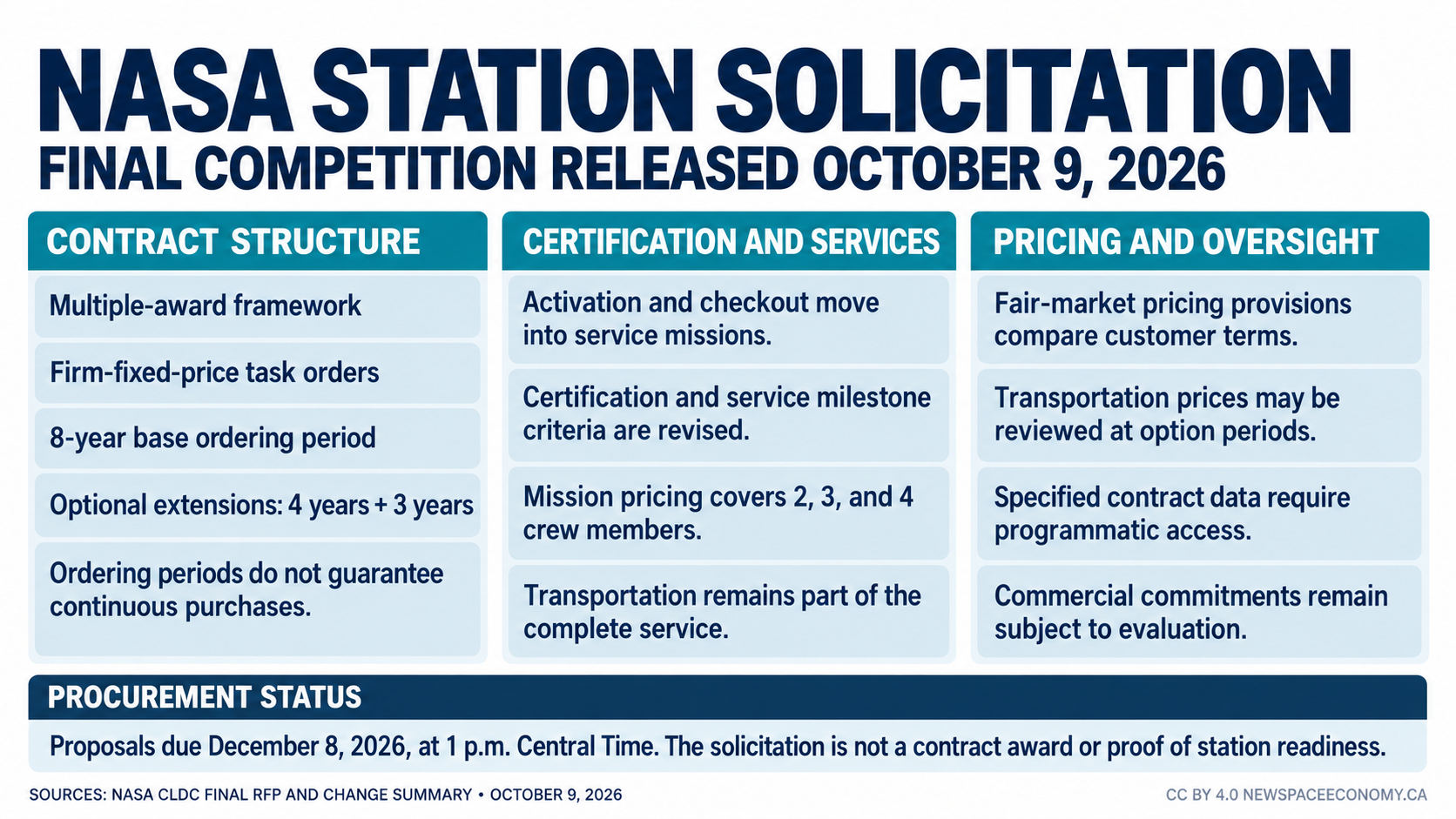
NASA released its final commercial space station solicitation on October 9, 2026, defining how the agency intends to buy development, certification, and operational services from privately owned destinations in low Earth orbit. The Commercial Low Earth Orbit Destination Contract competition covers the complete service needed to support NASA missions, including transportation and research activities. Its significance lies in the purchasing requirements that prospective providers must now address, rather than in any confirmation that replacement stations are ready.
The final solicitation, numbered 80JSC027R0004, follows an earlier draft and incorporates changes to mission activities, pricing, certification, and government access to information. Proposals are due December 8, 2026, at 1 p.m. Central Time. The package creates a competition; it does not award contracts, authorize bidders to begin paid work, or establish that NASA will purchase every service described.
NASA’s cover letter describes a multiple-award indefinite-delivery, indefinite-quantity arrangement. That structure establishes a contractual framework under which the government can place subsequent orders. NASA plans to use firm-fixed-price task orders, with an eight-year base ordering period and optional extensions of four years and three years. The maximum potential ordering period is 15 years, but exercising those options is separate from establishing the initial contract.
The cover letter also encourages contractors to use NASA personnel and expertise through collaboration arrangements. This gives prospective providers a route to request specialized government support. Such collaboration remains distinct from NASA assuming ownership or responsibility for operating the destination.
The distinction matters for companies evaluating government demand. An ordering period describes when NASA may purchase work under the agreement; it is not a promise of continuous station occupancy or a fixed annual volume of research. Bidders must consider the services actually ordered, the conditions governing payments, and their own commercial customers. Long contract duration can support planning without establishing the revenue that a particular station will receive.
One substantive change concerns the relationship between certification and initial operations. NASA’s summary of changes removes the separately described crewed demonstration from the second contract line item. Activation and checkout activities instead fall within the third line item, which covers service missions. A contract line item identifies a defined category of work and its associated contractual treatment.
This change should not be interpreted as removing the need to demonstrate safe operation. It changes where NASA places those activities within the procurement structure. The final package also revises the entrance and success criteria for certification and mission-service milestones used for performance-based payments. For prospective providers, the relevant issue is which evidence must be accepted before payment and how that evidence relates to a mission’s readiness.
Transportation remains part of the service rather than an incidental station expense. The package distinguishes proposals offering complete transportation arrangements from proposals requesting government-furnished transportation and support. Pricing tables require entries for missions carrying two, three, and four crew members. Those configurations allow NASA to compare service quantities more explicitly, but they do not establish the crew complement of every future mission.
The final contract also includes a transportation price reopener associated with option periods. This provides a defined process for addressing material changes in transportation pricing over a long agreement. Its inclusion recognizes that crew transport, cargo transport, and launch services affect the cost of station access. It does not mean prices can change without the contractual notification, review, and adjustment procedures.
NASA revised its taxpayer-protection language from most-favored pricing to fair-market pricing. The operative clause still requires equitable treatment relative to other customers, including foreign and domestic purchasers. Objectively supported differences, such as mission risk, duration, or unique payload integration, require the treatment specified in the contract. The wording change should not be reduced to a claim that NASA has abandoned price comparisons.
These terms make commercial transactions relevant to government oversight. A provider’s arrangements with other customers can affect the assessment of whether NASA receives equitable terms for comparable services. At the same time, the solicitation seeks evidence of commercialization through private capital and credible customer commitments. Contracts, deposits, purchase commitments, and letters of intent provide different kinds of evidence; none should automatically be treated as completed revenue.
Information access is another substantive requirement. The final package adds a clause requiring programmatic access to specified contract data, alongside machine-readable metadata and version tracking. Metadata describes a dataset or document so that its identity and meaning can be understood. Version tracking allows NASA to distinguish an updated delivery from the information previously supplied.
For a commercially operated destination, such access supports government review without requiring NASA to own every system. The contractor remains responsible for providing the agreed evidence, and applicable data-rights provisions continue to matter. A commercial ownership model does not eliminate the agency’s need to understand configuration, performance, and the basis for accepting mission services.
The procurement also has consequences for scientific users. New Space Economy’s discussion of commercial station research access explains why laboratory space alone is insufficient: experiments also need power, thermal control, communications, crew assistance, and transportation. The final solicitation’s inclusion of utilization and payload-related services makes the purchased capability more specific than simply placing astronauts aboard an orbital facility.
NASA identifies April 15, 2027, as the anticipated award date in its cover letter. That remains a procurement schedule, not a completed decision. The same letter states that the solicitation does not obligate NASA to procure the services or pay proposal-preparation costs. Those qualifications matter when comparing the final competition with company announcements, investment plans, or proposed station deployment dates.
The final package gives bidders a more defined basis for allocating responsibilities, pricing services, and demonstrating readiness. Whether it produces usable replacement capacity will depend on later awards, accepted certification evidence, funded orders, and successful operations. The practical test is whether NASA can purchase a complete mission service under those terms, with the transportation, information access, and research support needed to use the destination.
Useful Books Available on Amazon