- Key Takeaways
- Existential Threats to a Mars Colony Begin With the Planet Itself
- Habitat, Power, and Life Support Make Survival a Systems Problem
- Human Health, Biology, and Reproduction Can Erode the Human Base
- Dust, Fire, Contamination, and Planetary Protection Can Turn Small Faults Into Colony Loss
- Transport, Supply Chains, and ISRU Decide Whether Mars Remains a Base or Becomes a Settlement
- Governance, Security, and Social Cohesion Become Life Support
- Economic and Political Abandonment Can Be as Dangerous as Hardware Failure
- Designing Against Cascades Is the Real Survival Strategy
- Mars Colony Survival Depends on Redundancy, Local Production, and Political Patience
- Summary
- Appendix: Useful Books Available on Amazon
- Appendix: Top Questions Answered in This Article
- Appendix: Glossary of Key Terms
Key Takeaways
- Mars colony survival depends on redundancy, repair capacity, and local production.
- The greatest danger is cascading failure, not a single dramatic disaster.
- Governance, health, supply chains, and funding matter as much as engineering.
Existential Threats to a Mars Colony Begin With the Planet Itself
Mars gives a settlement almost no margin for error. NASA’s Mars facts describe a planet with a thin carbon dioxide atmosphere, severe cold, and surface conditions far outside normal human tolerance. The existential threats to a Mars colony begin with that physical reality: there is no breathable air outside the habitat, no open water biosphere, no quick rescue force, and no naturally forgiving environment waiting beyond an airlock.
A colony on Mars would survive inside machines. Every person would depend on pressure vessels, oxygen systems, carbon dioxide removal, thermal control, radiation shielding, water recycling, food systems, medical support, communications, power distribution, and transport links. That dependence makes Mars different from remote Earth settlements. A broken furnace, failed well, or blocked road on Earth can be dangerous. On Mars, the equivalent failure can remove breathable air, freeze a habitat, poison a closed atmosphere, or strand a crew in a suit with limited consumables.
The planet’s thin atmosphere creates two related hazards. It cannot support human breathing, and it provides little shielding from radiation or incoming small debris. A pressure leak inside a habitat, greenhouse, rover, tunnel, suit, or airlock would not behave like a drafty building. It would be a direct loss of the artificial atmosphere that the colony has manufactured, stored, and protected. The design problem is not simply to prevent leaks. The deeper survival problem is to isolate, seal, bypass, and repair damage before one failed pressure volume becomes a colony-wide emergency.
Temperature compounds the pressure problem. Mars can be far colder than most inhabited places on Earth, and the thin atmosphere does little to hold daytime heat after sunset. Batteries lose performance in the cold. Seals stiffen. Valves, pumps, bearings, and hinges can become less reliable. Heat rejection can become as important as heat generation inside tightly packed habitats, since a greenhouse, data center, workshop, and crew cabin may each need a different thermal regime.
Radiation adds a slower threat. NASA’s Human Research Program identifies space radiation, isolation and confinement, distance from Earth, altered gravity, and hostile closed environments as the five hazards for deep space missions. A Mars colony would face all five at once. Galactic cosmic rays would arrive continuously. Solar particle events could create acute radiation emergencies for exposed crews, surface vehicles, and lightly shielded structures. Long-duration exposure could raise cancer, cataract, central nervous system, cardiovascular, and reproductive risks.
Mars dust is another system-level hazard. Safe on Mars, a National Academies study, identified airborne dust as a potentially significant hazard for human surface operations. Dust can abrade seals, clog filters, reduce solar-panel output, contaminate habitats, interfere with optics, and complicate surface maintenance. Perchlorate-bearing soil raises toxicology questions for agriculture, crew exposure, and waste handling. A colony that cannot keep dust out of lungs, pumps, bearings, airlocks, and greenhouses would lose reliability from thousands of tiny intrusions rather than from a single spectacular accident.
Habitat, Power, and Life Support Make Survival a Systems Problem
A Mars settlement is best understood as a nested stack of life support systems. The outer layer is the site itself. The next layer includes landing pads, roads, berms, cable runs, power fields, communications towers, storage tanks, spare-parts depots, and radiation-shielded shelters. Inside that layer sit pressure vessels, tunnels, greenhouses, workshops, medical rooms, sleeping quarters, and command spaces. Inside those spaces sit air, water, food, heat, and waste loops. None can be treated as optional.
The most dangerous hardware failures are the ones that remove time. A slow decline in crop yield gives a colony time to ration, replant, diagnose disease, and request supplies. A major habitat breach, uncontrolled fire, or total power loss can give crews minutes or hours. For that reason, every survival system must be judged by how much recovery time it preserves. A design that operates efficiently during normal conditions but offers no degraded mode can become a trap.
Power sits near the top of the risk chain. Solar arrays can lose output during dust storms and from long-term dust accumulation. Nuclear power can reduce dependence on sunlight, yet it brings its own demands for shielding, heat rejection, maintenance, security, spare parts, and trained operators. Batteries, fuel cells, backup generators, and power electronics can fail through fire, temperature stress, manufacturing defects, software faults, or dust intrusion. A colony with one main electrical bus may look efficient, but it could turn one electrical fault into a settlement-wide shutdown.
Mars has already shown the operational risk of dust and sunlight. NASA’s Mars dust storm discussion notes that continent-sized storms can last for weeks. A JPL Mars Report from 2018 described how a global dust storm reduced sunlight enough to force the solar-powered Opportunity rover into sleep mode. A crewed settlement would have more redundancy than a rover, but a dust-darkened power system would still place heating, communications, food production, and repair work under stress at the same time.
Environmental control and life support systems, often called ECLSS, become the lungs, kidneys, and climate-control organs of the settlement. Oxygen production, oxygen storage, nitrogen or buffer gas management, carbon dioxide removal, humidity control, trace contaminant cleanup, water recovery, waste processing, and microbial monitoring must keep working under load. A single failed fan can produce local carbon dioxide buildup. A failed water purifier can turn hygiene, agriculture, and medical care into competing demands. A bad sensor can cause operators to trust a false reading until symptoms reveal the failure.
Fire deserves special attention because a habitat is a sealed volume filled with life-support hardware, plastics, filters, wires, fabrics, batteries, chemicals, and oxygen-bearing gas. Smoke cannot simply drift away. Toxic products can enter filters, ducts, suits, and sleeping spaces. Fire suppression can damage equipment needed for recovery. A fire that would be survivable on Earth can become a colony-ending event if it poisons air loops, shuts down power cabinets, or forces too many people into too few refuge spaces.
The main threat classes can be grouped by how they remove survival margin.
| Threat Class | Colony-Ending Mechanism | Best Defense |
|---|---|---|
| Hostile Environment | Vacuum, cold, radiation, dust, and impacts overwhelm exposed systems | Buried shelters, shielding, dust control, and hardened structures |
| Infrastructure Failure | Power, air, water, heat, or data systems fail faster than crews can restore them | Independent backups, spare parts, and manual recovery modes |
| Human Health | Low gravity, radiation, infection, and isolation reduce survival capacity | Medical autonomy, exercise systems, shielding, and crew support |
| Transport Failure | Cargo, landers, return vehicles, or launch windows fail at the wrong time | Inventory buffers, local production, and multiple vehicles |
| Governance Failure | Conflict, poor procedure, or weak authority blocks rapid survival decisions | Clear command rules, training, and dispute resolution |
A good Mars colony would not define success as normal operation. It would define success as survivable degradation. If a greenhouse fails, stored food carries the crew. If a main habitat loses pressure, a separated refuge holds. If a power plant trips offline, emergency circuits protect air, heat, medical systems, communications, and data. If software misbehaves, manual procedures still work. Survival depends on designs that keep bad events local.
Human Health, Biology, and Reproduction Can Erode the Human Base
The colony’s human population would be part of the life support system. A settlement of 20 people cannot lose the only surgeon, greenhouse specialist, reactor technician, power engineer, dentist, or software operator without reducing its survival margin. A settlement of 200 people has more depth, but it still depends on cross-training, medical autonomy, and work routines that account for fatigue, grief, isolation, and conflict.
Low gravity creates a long-term biological unknown. Mars gravity is about 38% of Earth gravity. That is more than lunar gravity, yet no human population has lived for years in Mars gravity, and no pregnancy, birth, childhood, puberty, or aging process has been studied there. The Human Body in Space material from NASA describes how altered gravity affects muscle, bone, fluid distribution, balance, vision, and cardiovascular function. Exercise systems, nutrition, medication, and artificial-gravity research may reduce the risk, but a permanent colony cannot assume that adult countermeasures solve reproduction and development.
Radiation health risk also changes once the goal shifts from a mission to a settlement. A short expedition can accept exposures within mission limits and return to Earth for long-term medical care. A colony accumulates exposure over decades. It must protect workers who repair solar fields, move cargo, inspect landing pads, mine ice, clean dust, and handle emergencies outdoors. Covered habitats, regolith shielding, storm shelters, and radiation monitoring would need to become routine infrastructure, not special equipment.
Medical autonomy may become a survival divider. Appendicitis, fractures, eye injuries, infections, dental abscesses, burns, pregnancy complications, kidney stones, stroke, cancer, and severe allergic reactions do not pause because Earth is months away. Time delay limits real-time telemedicine. Cargo windows limit resupply. A colony hospital would need imaging, surgery, sterilization, blood management, pharmacy production or storage, rehabilitation, infection control, quarantine capacity, and trained backup personnel. The loss of health care can create a chain reaction: injured personnel cannot repair systems, overworked personnel make mistakes, and untreated infection can spread inside closed spaces.
Closed habitats amplify microbial risk. Air, water, surfaces, clothing, food systems, waste streams, and medical spaces form connected pathways. Microbes can adapt to closed environments, form biofilms, clog filters, contaminate crops, and complicate wound care. A pathogen does not need to be exotic to threaten a settlement. A familiar respiratory virus or gastrointestinal infection could become dangerous if it hits the crew during a dust storm, power failure, or landing accident.
Psychological strain needs equal attention. Distance from Earth, limited privacy, monotony, confinement, delayed communication, social friction, and grief would shape decision quality. A Mars crew cannot quit, commute home, or rotate out on demand. Command decisions made under stress can place everyone at risk. The strongest technical system can still fail if crews stop reporting problems, hide errors, split into factions, or lose confidence in leadership.
Nutrition links health to agriculture and supply chains. Stored food can degrade. Greenhouses can suffer disease, low pollination, nutrient imbalance, water contamination, equipment failure, or lighting loss. A colony that grows food also grows dependence on controlled biology. Agriculture must be treated as a medical, power, water, and biosecurity system at once.
Dust, Fire, Contamination, and Planetary Protection Can Turn Small Faults Into Colony Loss
Dust is easy to underestimate because it looks mundane. On Mars, dust touches almost every hazard category. It reduces sunlight, hides terrain, abrades suit joints, invades airlock seals, contaminates filters, interferes with radiators, settles on optics, and may carry chemicals harmful to humans or crops. Dust also affects behavior. If every outside task requires long cleaning cycles, crew time shifts away from maintenance and inspection. Delayed maintenance then creates more failures.
The National Academies finding that dust intrusion and accumulation require continuous monitoring points toward a design rule: dust control must be built into architecture from the start. Airlocks need separation between dirty and clean zones. Suits may need to remain outside the main living volume. Rovers and cargo vehicles need cleaning systems. Filters need inspection and replacement access. Greenhouses need biosecure entry procedures. Power fields and radiators need ways to maintain performance without exhausting crew time.
Fire combines with dust, oxygen, plastics, batteries, and human error. A smoldering electrical cabinet can produce toxic gases. Dust on hot surfaces can create ignition or insulation problems. Battery failures can release heat and smoke. Cleaning solvents, lubricants, pressure vessels, and stored chemicals can add complexity. Fire planning cannot stop at extinguishers. It must include atmospheric isolation, smoke cleanup, toxic-gas sensing, evacuation routes, independent breathing supply, post-fire inspection, and rapid restoration of life support.
Contamination has two meanings on Mars. One meaning is ordinary colony contamination: sewage in water loops, mold in greenhouses, chemical leaks in cabins, or fuel residue near habitat entrances. The other meaning is planetary protection. NASA planetary protection distinguishes forward contamination, in which Earth organisms could be transferred to another world, from backward contamination, in which extraterrestrial material could be transferred to Earth’s biosphere. Human Mars settlement would make forward contamination much harder to control, since people bring air, water, food, waste, microbes, and equipment at scale.
Planetary protection is sometimes treated as a science issue, but for a colony it is also an operational and political risk. If crews contaminate sites where past or present Mars life might be studied, they may compromise science and trigger disputes over mission rules, protected regions, or resource access. If a sample-handling incident raises concerns about returned material or biological uncertainty, the settlement could face restrictions from Earth-based authorities. A colony that depends on Earth for cargo, finance, and legitimacy cannot ignore those rules.
Recent Mars science keeps the biological question active. NASA’s Perseverance rover has continued to examine Jezero crater materials relevant to ancient habitability, and public discussion of possible biosignatures has kept attention on sample return, contamination control, and laboratory analysis. A settlement would operate in that scientific setting. It would need strict separation between living zones, industrial zones, mining zones, sample-handling zones, and protected science areas.
The survival lesson is direct: cleanliness is not housekeeping. It is an engineering function. Dust, microbes, chemicals, smoke, and biological samples must each have controlled pathways. A colony that loses track of what entered which loop may spend precious hours diagnosing an illness, crop failure, sensor fault, or filter blockage that began as a preventable contamination event.
Transport, Supply Chains, and ISRU Decide Whether Mars Remains a Base or Becomes a Settlement
A Mars colony that cannot replace what it consumes remains an expeditionary outpost. A settlement begins to exist only when it can make, repair, recycle, and store enough essentials to survive missed shipments. Transport risk shapes every other decision because launch windows between Earth and Mars are limited, cargo flights can fail, landing accuracy matters, and rescue is slow even under favorable orbital geometry.
Landing on Mars is difficult because the atmosphere is thick enough to heat incoming vehicles and thin enough to limit aerodynamic braking. Large payloads for habitat modules, power systems, construction equipment, propellant plants, medical equipment, greenhouses, and spare parts would need highly reliable entry, descent, and landing. One failed cargo lander could remove a power unit, excavator, reactor component, medical package, or food shipment. Several failures in a transfer window could freeze colony growth or reduce survival margin.
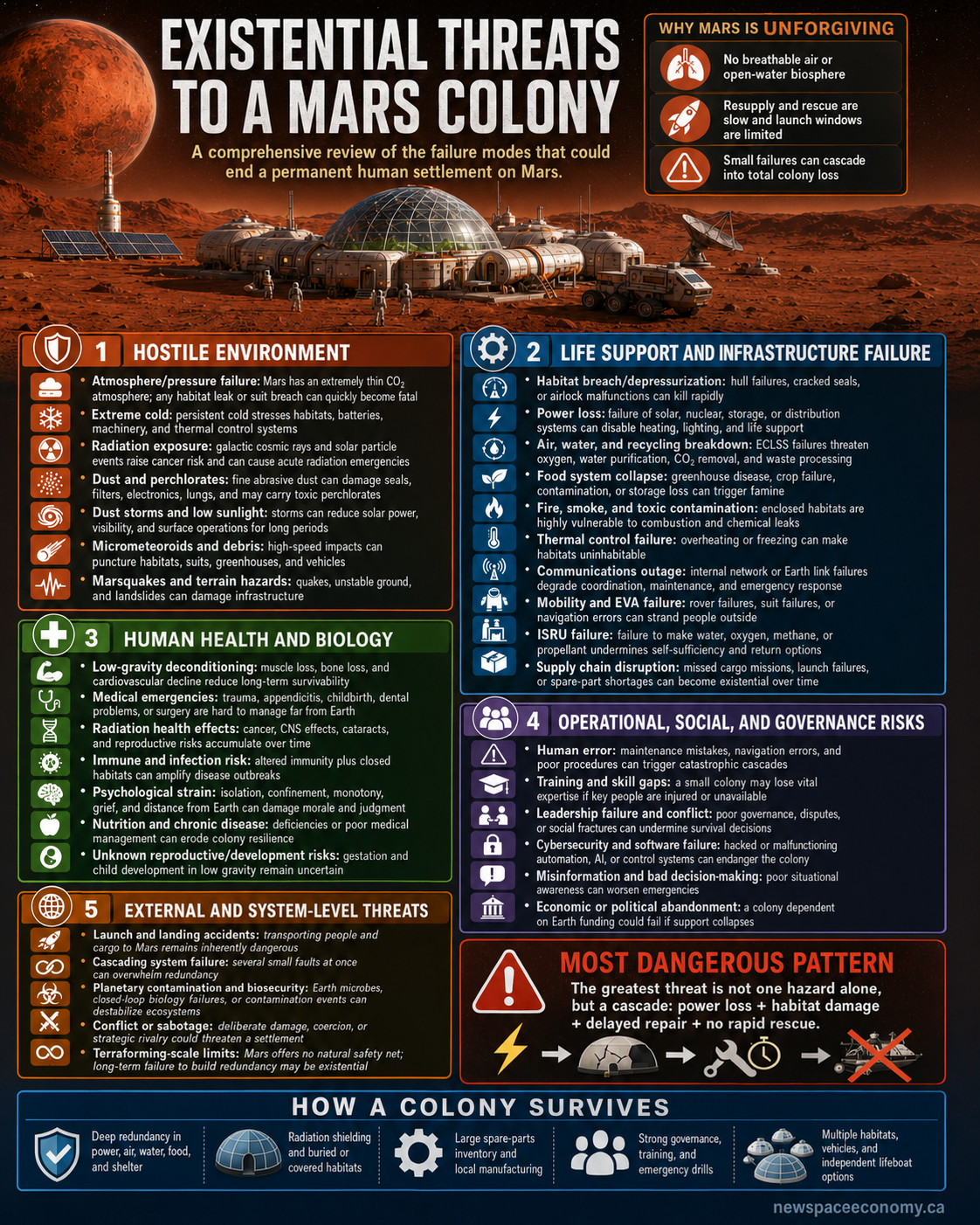
The infographic’s reference to supply-chain disruption deserves a central place. Earth-based supply chains would include launch vehicles, spacecraft, propellant, ground systems, mission control, insurance, communications, manufacturing, testing, software, suppliers, regulators, financiers, and public funding. A factory delay on Earth can become a food delay on Mars. A launch-vehicle grounding can become a medical shortage. A budget fight can become a spare-parts crisis. Space settlement is a logistics business before it is a frontier story.
In-situ resource utilization, or ISRU, is the proposed answer to that dependence. ISRU means making useful supplies from local materials. Living Off the Land explains why oxygen, water, propellant, and building materials matter for long-duration exploration. For Mars, local water ice, carbon dioxide atmosphere, regolith, and possibly accessible minerals could support oxygen production, methane production, radiation shielding, construction feedstock, agriculture inputs, and industrial processes.
NASA’s MOXIE experiment demonstrated oxygen production from the Martian atmosphere aboard the Perseverance rover. It produced 122 grams of oxygen over its Mars mission and reached 12 grams per hour at peak performance. That was a technology demonstration, not a settlement-scale plant. A colony would need industrial output, continuous operations, dust-tolerant equipment, heat management, storage systems, repairable components, and enough power to run the process during harsh seasons.
Mars settlement architectures tied to methane propulsion make ISRU more important. New Space Economy’s discussion of methane engines explains the link between methane, oxygen, and return capability. A Mars settlement that relies on vehicles using methane and oxygen would need to manufacture, liquefy, store, and transfer propellants safely. Failure of that chain could remove emergency return options and strand surface assets.
Starship discussions often place Mars transport at the center of the settlement story, but transport does not solve survival by itself. Low-cost mass to Mars helps only if the colony turns delivered mass into redundancy, production capacity, shelters, mobility, and repair depth. A warehouse of imported parts buys time. A factory that can diagnose, machine, print, test, and certify replacement parts changes the survival equation.
Governance, Security, and Social Cohesion Become Life Support
Mars colony survival would depend on rules as much as machinery. A settlement needs decision authority, emergency command, maintenance discipline, medical consent processes, labor expectations, dispute resolution, privacy norms, inspection routines, criminal procedure, property rules, data governance, and safety enforcement. None of those questions can wait until the colony is large. Small groups under stress can develop conflict faster than institutions can form.
A breakdown in governance can become a physical hazard. If operators ignore maintenance logs, air filters fail. If a commander hides a power problem to preserve morale, crews lose time. If factions dispute who controls food, transport, or communications, emergency response slows. If technicians fear blame, they may delay reporting errors. A culture that punishes bad news can be as dangerous as a cracked pressure seal.
Security risks should be handled without cinematic assumptions. The grave risks are sabotage, coercion, insider threats, data tampering, theft of scarce resources, mission-control conflict, and denial of access to life-support assets. A settlement cannot allow one person or one small group to control oxygen, power, water, medical supplies, communications, food stores, or exit vehicles without oversight. Strong access control, transparent logs, independent monitoring, and clear emergency authority would matter from the start.
Cybersecurity deserves its own place because automation would run through the colony. Air pumps, valves, thermal systems, agriculture lighting, navigation, medical devices, power converters, excavation equipment, rovers, inventory systems, docking procedures, communications relays, and production plants would all depend on software. Malfunctioning software does not have to be malicious to endanger a colony. Bad updates, corrupted data, sensor drift, conflicting automation, and poorly tested control logic can all cause harmful decisions.
Artificial intelligence systems may assist diagnosis, planning, inventory control, crop monitoring, medical triage, robotic repair, and scientific operations. That assistance can save crew time, but it can also create overreliance. If an automated system recommends the wrong pressure response, misidentifies crop disease, misroutes power, or hides uncertainty behind confident language, crews need enough training to challenge the output. Automation must be auditable, reversible, and subordinate to tested safety rules.
Social cohesion is not a soft topic in a sealed settlement. Fatigue, isolation, unequal status, family separation, uneven risk exposure, cultural divisions, privacy loss, and grief can affect judgment. Crew selection alone cannot solve the problem. Rotations, counseling, recreation, conflict mediation, work-rest rules, transparent rationing, and meaningful participation in decisions all help protect survival. A Mars colony that treats morale as a luxury may lose the trust required for fast collective action.
Preconditions for a Self-Sustainable Mars Colony correctly places social structure beside technology. Survival depends on whether people can keep acting as a competent institution after months of discomfort and years of uncertainty.
Economic and Political Abandonment Can Be as Dangerous as Hardware Failure
A Mars colony cannot be assessed only by asking whether it can survive the next dust storm. It also has to survive sponsor fatigue, budget cycles, launch-market shocks, legal disputes, insurance constraints, supply-chain inflation, geopolitical conflict, public backlash, and changing priorities on Earth. A settlement that depends on external support can die slowly through underfunding before any habitat fails.
The space economy dimension matters because Mars settlement would require many markets and institutions to mature at once. Launch providers would need reliable heavy-lift. Spacecraft manufacturers would need interplanetary transport systems. Ground networks would need deep-space communications capacity. Suppliers would need pressure vessels, suits, robotics, power systems, radiation shielding, medical equipment, recycling hardware, and construction machines. Insurers, regulators, investors, public agencies, and defense organizations may each affect cost and permission.
A permanent settlement would likely begin with government support, private capital, philanthropy, or some combination of all three. That creates a dependency problem. If Earth-based sponsors withdraw after the colony becomes occupied but before it becomes self-supporting, the settlement may face a moral and political crisis. The colony could be too large to abandon safely and too dependent to survive alone.
New Space Economy’s broader treatment of space colonization frames the promise and problems of off-world settlement in economic, social, and ethical terms. That wider frame matters for Mars because a colony will be judged by more than engineering milestones. It will face questions about scientific value, public cost, private profit, labor rights, planetary protection, resource claims, and whether settlement should proceed before safety and governance are mature.
The case against human Mars settlement also deserves attention. The Case Against Human Spaceflight Exploration argues that robotic missions can deliver science at far lower risk and cost. A neutral review does not need to accept that position fully to recognize its policy impact. If voters, governments, or investors conclude that a Mars colony is too expensive, unsafe, or ethically weak, continued funding could weaken.
Economic abandonment can interact with technical risk. Deferred maintenance increases breakdowns. Smaller cargo shipments reduce spare parts. Fewer training programs reduce skill depth. Lower launch cadence reduces evacuation and resupply options. Budget pressure can encourage optimistic reporting, rushed repairs, and reduced testing. A colony can survive harsh nature only if its Earth-side institutions continue to provide time, money, accountability, and industrial depth until local production can carry more of the burden.
Designing Against Cascades Is the Real Survival Strategy
The most dangerous pattern for a Mars colony is not a single hazard. It is a cascade: power loss plus habitat damage plus delayed repair plus no rapid rescue. Cascades turn manageable failures into colony-ending events because each failure removes the capacity needed to handle the next one. A dust storm reduces solar power. Low power reduces heating and communications. A cold-stressed seal leaks. Repair crews work outside in poor visibility. A rover fault strands them. Medical staff treat injuries as air reserves fall. None of those steps has to be impossible by itself. The combination becomes the threat.
Engineering against cascades begins with separation. Habitats should not share one unprotected atmosphere. Power systems should not depend on one control room. Food should not depend on one greenhouse. Water should not depend on one purifier. Communications should not depend on one antenna. Vehicles should not depend on one maintenance bay. Crew expertise should not depend on one person. Separation turns a total failure into a local failure.
The next layer is graceful degradation. A system should fail into a safer state when possible. Valves should isolate damaged loops. Fire doors should contain smoke. Power circuits should protect life support ahead of comfort loads. Greenhouses should shed nonessential lighting before losing temperature control. Rovers should preserve navigation and communications ahead of secondary tools. Software should reveal uncertainty and allow manual control.
Repairability then becomes a settlement design rule. A colony needs tools, diagnostic equipment, spare parts, documentation, test rigs, training, machine shops, additive manufacturing where suitable, welding or bonding capacity, electronics repair, and clean rooms. It also needs the dull habits of maintenance: logs, inspections, checklists, drills, and failure reviews. New Space Economy’s treatment of grand challenges places human health, radiation, propulsion, life support, and resources among the hard barriers for exploration. For Mars settlement, those barriers converge inside one operating system.
The practical defense layers can be summarized through design choices.
| Design Layer | Failure It Must Absorb | Practical Requirement |
|---|---|---|
| Power | Dust storm, reactor fault, battery fire, or grid failure | Solar, nuclear, storage, and isolated emergency circuits |
| Air and Water | Leak, contamination, carbon dioxide buildup, or purifier failure | Parallel loops, reserve tanks, and repairable filters |
| Food | Crop disease, low yields, storage loss, or nutrient gap | Stored food, seed banks, controlled farming, and testing |
| Shelter | Hull breach, fire, radiation event, or pressure loss | Separated pressure volumes and protected refuge rooms |
| Command | Network outage, injury, social conflict, or bad data | Local authority, drills, logs, and manual procedures |
A colony also needs lifeboat thinking. Lifeboat does not necessarily mean a rocket waiting to leave Mars. It can mean independent shelters, pressurized rovers, buried refuges, redundant medical rooms, cached food, isolated communications, and enough stored air and water to wait out failures. If one habitat becomes uninhabitable, people need somewhere to go. If one vehicle fails, another vehicle must be available. If one command channel fails, local authority must continue.
The survival standard should be demanding. A Mars colony is not ready for permanent habitation if a single cargo failure, dust storm, software bug, airlock breach, or illness can end it. It becomes more credible when it can lose hardware, people, shipments, sunlight, communications, and time without losing the settlement.
Mars Colony Survival Depends on Redundancy, Local Production, and Political Patience
A settlement can improve its odds by maturing through phases rather than leaping from landing to permanence. Early robotic missions can map ice, dust, terrain, radiation, weather, and landing hazards. Cargo missions can pre-position power, habitats, food, spares, and production units. Short human missions can test operations before the population grows. The colony should become permanent only after enough infrastructure exists to absorb failure.
Site selection is the opening survival decision. A good site needs accessible water ice, manageable terrain, useful sunlight, communications visibility, landing safety, scientific value, and enough distance from protected science zones. It also needs expansion room, construction material, traffic routes, and manageable dust patterns. No site will be ideal. The selected site should minimize the number of survival systems that operate near their limits.
Population growth should follow capability, not ambition. Adding people increases labor, resilience, and specialization, but it also increases demand for air, water, food, energy, housing, medical care, waste processing, and governance. A colony should not grow faster than its ability to shelter, feed, heal, and organize its people. A larger population with weak systems can be more fragile than a smaller population with deep reserves.
Local production is the difference between dependence and survival. Oxygen production is the starting point. Water extraction, food production, repair parts, construction materials, radiation shielding, fuels, plastics, glass, metals, medicines, and electronics come later with higher difficulty. Each new production capability should reduce dependence only after it proves reliable under Mars conditions. A fragile local factory that consumes scarce power and breaks often can add risk instead of reducing it.
Earth patience remains important for decades. Even a growing colony would need launch support, mission control, finance, political legitimacy, law, scientific exchange, skilled migration, and replacement equipment. Mars settlement will not become independent the moment crops grow or oxygen flows. Self-sufficiency is a spectrum, and the most dangerous period may be the middle stage, when the settlement is too committed to withdraw easily but still too dependent to endure a long Earth-side interruption.
Permanent settlement should be judged by recovery capacity. Can the colony survive the loss of its largest greenhouse. Can it recover from a fire in a power module. Can it isolate a disease outbreak. Can it manufacture a broken valve. Can it feed people after two missed cargo flights. Can it preserve order after a death. Can it keep enough people healthy after years in low gravity. A credible Mars colony answers those questions with tested systems, not hopes.
Summary
Mars settlement is sometimes described through the drama of launch vehicles, landing pads, domes, and surface flags. The more demanding question is whether a settlement can keep ordinary failures from becoming terminal failures. The answer depends on boring strength: spare parts, drills, redundant loops, independent shelters, medical capacity, maintenance logs, food reserves, strong governance, dust control, and patient funding.
The infographic’s core message holds up under a fuller review. Mars is unforgiving because it combines hostile environment, closed life support, slow logistics, health uncertainty, and social strain in one place. A permanent colony would need to manage vacuum, cold, radiation, dust, fire, microbial risk, low gravity, food insecurity, transport delays, software faults, social conflict, economic pressure, and planetary protection rules at the same time.
A colony-ending event would probably look less like one dramatic disaster and more like a sequence of linked failures. The most defensible Mars settlement architecture is one that assumes failures will happen, limits their spread, and preserves enough time for people to repair what broke. Mars does not require perfect systems. It requires systems that can fail without ending the settlement.
Appendix: Useful Books Available on Amazon
- The Case for Mars
- A City on Mars
- The High Frontier
- Mars: Our Future on the Red Planet
- How We’ll Live on Mars
- Off-Earth
Appendix: Top Questions Answered in This Article
What Is the Biggest Existential Threat to a Mars Colony?
The biggest threat is a cascading failure that combines several smaller failures. Power loss, habitat damage, delayed repair, medical strain, and limited resupply could interact faster than crews can respond. A single hazard can be survivable. Several linked hazards can overwhelm redundancy.
Why Is Mars More Dangerous Than a Remote Settlement on Earth?
A remote Earth settlement still has breathable air, open water sources, a biosphere, and reachable rescue under many conditions. Mars has none of those safety nets. Every person depends on machines for pressure, oxygen, heat, water, food, and waste processing.
Could Radiation Alone End a Mars Colony?
Radiation could weaken a colony through long-term health damage and acute solar-event risk. It is more likely to become existential when combined with weak shielding, outdoor labor demands, medical limits, and reproduction uncertainty. Buried or covered habitats would reduce the danger.
Why Is Dust Such a Large Mars Settlement Risk?
Dust can affect power, seals, filters, lungs, optics, machinery, greenhouses, and thermal systems. Fine dust also increases maintenance demands, and maintenance time is a scarce survival resource. Dust becomes more dangerous when it enters clean habitat loops or reduces solar power during other emergencies.
Why Does ISRU Matter for Mars Survival?
ISRU allows a settlement to produce useful materials from local resources. Oxygen, water, propellant, construction material, and shielding can reduce dependence on Earth cargo. ISRU becomes a survival asset only after it operates reliably at scale and remains repairable on Mars.
Can a Mars Colony Be Fully Self-Sufficient?
Full self-sufficiency would be extremely hard. A settlement may produce air, water, food, and some materials before it can manufacture complex electronics, medicines, precision machinery, and advanced medical equipment. Self-sufficiency should be treated as a gradual reduction of dependence, not a quick milestone.
How Could Governance Failure Endanger a Mars Colony?
Bad governance can delay maintenance, hide safety problems, weaken trust, and slow emergency decisions. A Mars settlement needs clear authority, dispute resolution, transparent logs, and safety enforcement. Weak institutions can turn technical failures into social and operational failures.
What Role Would Earth Support Play After Settlement Begins?
Earth support would remain important for cargo, finance, law, mission control, replacement hardware, science, and skilled migration. A settlement could be physically located on Mars but still institutionally dependent on Earth. Withdrawal of support could reduce safety even without an immediate accident.
Why Is Reproduction a Major Unknown for Mars Settlement?
No human pregnancy, birth, childhood, or long-term development has occurred in Mars gravity. Adult countermeasures for low gravity do not prove that reproduction and development are safe. A lasting colony needs answers about fertility, gestation, childhood growth, and medical care.
What Design Principle Best Protects a Mars Colony?
The best design principle is survivable degradation. Each system should fail locally, preserve time, and leave crews with repair options. Independent habitats, separated power circuits, reserve supplies, manual controls, and trained backups keep failures from spreading.
Appendix: Glossary of Key Terms
Carbon Dioxide Removal
Carbon dioxide removal is the life-support process that keeps exhaled carbon dioxide from building up inside a closed habitat. On Mars, failure of this function could cause symptoms before crews notice a broader air-loop problem, so monitoring and backup removal capacity are essential.
ECLSS
Environmental Control and Life Support System refers to the hardware and procedures that manage breathable air, water recovery, carbon dioxide removal, humidity, temperature, contaminants, and waste. In a Mars colony, ECLSS would be a core survival system rather than a spacecraft subsystem alone.
Forward Contamination
Forward contamination means carrying Earth organisms to another world in a way that could affect science, operations, or possible native environments. Human Mars activity would increase this risk because people bring microbes, waste, equipment, water, food systems, and habitats at scale.
In-Situ Resource Utilization
In-situ resource utilization means using local materials to make useful supplies. On Mars, this could include producing oxygen from carbon dioxide, extracting water ice, making propellant, processing regolith for construction, or creating inputs for agriculture and manufacturing.
ISRU
ISRU is the abbreviation for in-situ resource utilization. It matters because every kilogram made on Mars is a kilogram that may not need to be launched from Earth. ISRU also creates new risks when local production systems fail or consume scarce power.
Mars Gravity
Mars gravity is about 38% of Earth gravity. That level may reduce some effects of weightlessness, but it has never supported a human population for years. Health, reproduction, childhood development, and long-term work capacity remain open questions.
Planetary Protection
Planetary protection is the set of policies and practices that reduce biological contamination between Earth and other worlds. For Mars settlement, it affects science zones, sample handling, waste control, habitat operations, and the legitimacy of human activity on the surface.
Regolith
Regolith is the loose surface material covering solid rock. On Mars, it includes dust, sand, broken rock, and chemically altered materials. It may provide shielding and construction feedstock, but it can also carry dust and chemical hazards into equipment and habitats.
Solar Particle Event
A solar particle event is a burst of energetic particles from the Sun. On Mars, such an event could expose surface crews or lightly shielded habitats to dangerous radiation levels. Storm shelters and radiation monitoring would be required for settlement safety.
Survivable Degradation
Survivable degradation means a system can fail partly without causing immediate loss of the settlement. A habitat, power grid, water loop, or food system should keep enough function after damage to give crews time to isolate, repair, or retreat.