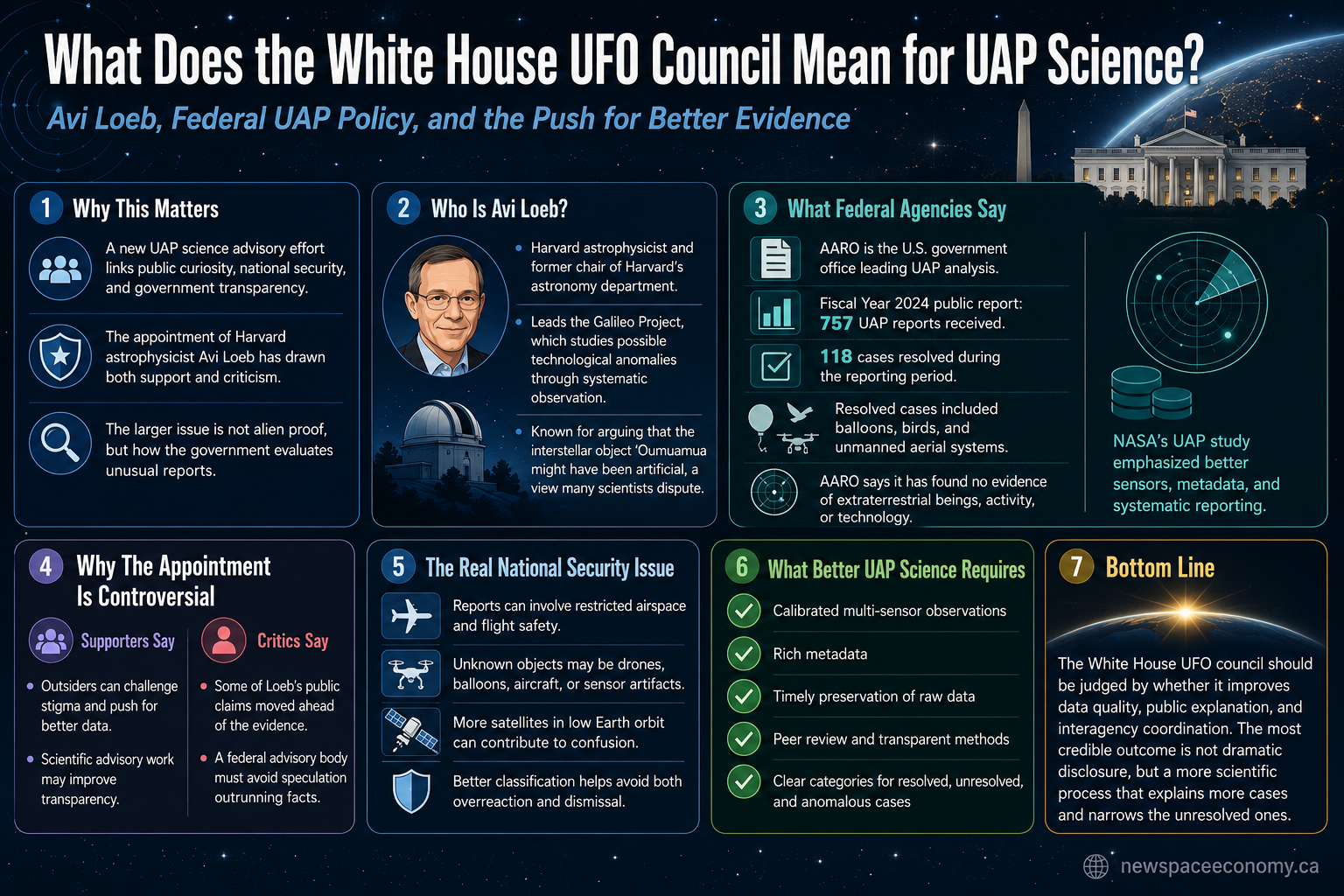
- Key Takeaways
- Why the White House UFO Council Became a Public Test of UAP Science
- How Avi Loeb’s Record Shapes the White House UFO Council Debate
- What Federal Agencies Already Say About UAP Evidence
- Why News Coverage Focuses on Aliens Even When Agencies Focus on Data
- The National Security Question Is Broader Than Alien Claims
- What Better UAP Science Would Actually Require
- Why Public Trust Depends on Disclosure Rules
- How the Space Economy Connects to UAP Reporting
- What the Council Should Be Judged On
- Summary
- Appendix: Useful Books Available on Amazon
- Appendix: Top Questions Answered in This Article
- Appendix: Glossary of Key Terms
Key Takeaways
- Avi Loeb’s appointment raises questions about evidence, transparency, and scientific trust.
- UAP work now sits between public curiosity, defense concerns, and data quality problems.
- Better sensors, open data, and careful review matter more than claims about alien origin.
Why the White House UFO Council Became a Public Test of UAP Science
On June 30, 2026, PBS NewsHour carried an Associated Press account reporting that Harvard astrophysicist Avi Loeb had been picked to lead a new scientific advisory council connected to White House work on unidentified anomalous phenomena, or UAP. The appointment placed a highly visible scientist, known for claims about possible extraterrestrial technology, into a federal advisory setting tied to national security, public transparency, and government declassification.
The timing matters because UAP policy has moved from folklore-adjacent debate into a bureaucratic process involving the Office of the Director of National Intelligence, the Department of Defense, the Federal Bureau of Investigation, and the All-domain Anomaly Resolution Office. DefenseScoop reported that the UAP Science Advisory Council would advise a higher-level UAP Governance Board established to improve interagency coordination, data collection, analysis, and declassification support.
Loeb is not entering the debate as a neutral public figure in the ordinary sense. He is a respected Harvard scientist with a long record in cosmology, black holes, and early galaxy formation, and Harvard identifies him as a former chair of its Department of Astronomy from 2011 to 2020. He also heads the Galileo Project, which seeks to move the search for extraterrestrial technological artifacts from anecdotal observation into systematic measurement.
The appointment is controversial because Loeb’s public profile changed after 2017, when he argued that the interstellar object ʻOumuamua might have been artificial. Many astronomers regard that claim as unsupported by the available evidence, and the Associated Press account quoted scientists who objected to Loeb’s methods, public style, and limited national security background. The issue is less whether a scientist may ask unconventional questions. Science depends on hard questions. The issue is whether a federal advisory process can keep firm boundaries between hypothesis, evidence, institutional trust, and public messaging.
The appointment also lands in a media environment where UAP stories quickly travel from defense reporting to alien speculation. New Space Economy has treated that tension in articles such as The New Era of Unidentified Anomalous Phenomena and What Are the Most Controversial Theories About Extraterrestrial Intelligence?. The appointment does not prove that the government has evidence of alien technology. It does show that federal UAP work now has to manage science, secrecy, public expectation, and political pressure at the same time.
How Avi Loeb’s Record Shapes the White House UFO Council Debate
Avi Loeb’s credentials give the council scientific visibility that a less famous chair would not bring. Harvard’s profile describes him as the Director of the Institute for Theory and Computation at the Harvard-Smithsonian Center for Astrophysics, the head of the Galileo Project, and a former astronomy department chair. That background gives him real standing in astrophysics, even among scientists who reject his more speculative claims.
The difficulty is that UAP work sits in a different evidentiary setting than theoretical cosmology. Black holes and early galaxies can be studied through observatories, models, and peer-reviewed data sets. Military UAP cases may involve incomplete sensor data, restricted locations, classified collection systems, redacted files, human perception, aircraft, drones, balloons, satellites, weather effects, and instrument artifacts. A scientist entering that space needs expertise from many fields, including aviation, intelligence analysis, sensor calibration, atmospheric science, orbital tracking, and data curation.
Loeb’s supporters can argue that he brings exactly the kind of outsider pressure that government agencies need. UAP investigations have often suffered from stigma, fragmented reporting, and poor data. NASA’s UAP Independent Study Team said in 2023 that the subject required better data acquisition, stronger analysis methods, systematic reporting, and reduced reporting stigma. That argument supports a science advisory role for external researchers, provided their work remains anchored in testable evidence.
His critics focus on method and inference. Loeb’s ʻOumuamua hypothesis moved public discussion toward alien technology before most astronomers saw enough evidence to justify that framing. Later work challenged the artificial-origin interpretation from several directions, including peer-reviewed and preprint work arguing that the alien-probe case lacked enough physical support. Such criticism does not make Loeb unqualified to serve on a council. It does mean the council’s credibility will depend on procedures that prevent any one worldview from shaping conclusions before data can support them.
The Galileo Project offers a useful test case. Its official description says it seeks transparent and systematic scientific research on extraterrestrial technological signatures, with emphasis on physical objects rather than electromagnetic signals. That mission could be relevant to UAP data standards, observatory design, and anomaly detection. Yet government UAP cases need a lower starting assumption: unresolved does not mean alien, and unusual does not mean impossible. Current Status of UFO/UAP Research and Theories makes that distinction useful for readers trying to separate unexplained cases from unsupported conclusions.
A credible council would treat Loeb’s unusual openness to extraterrestrial explanations as one viewpoint within a larger technical process. It would pair that openness with skeptical review, independent data access, adversarial testing, and publication standards that can survive scrutiny from scientists who have no personal stake in UAP disclosure.
What Federal Agencies Already Say About UAP Evidence
The federal baseline remains cautious. AARO says its team leads U.S. government UAP work using a scientific framework and data-driven approach, and its public website asks directly whether the Department has found evidence of extraterrestrial technology. AARO’s current public materials answer that no such evidence has been found.
The Fiscal Year 2024 Consolidated Annual Report on UAP gives the most useful public numbers. It covered reports from May 1, 2023, to June 1, 2024, plus older reports not captured earlier. AARO received 757 UAP reports during that period. It resolved 118 cases during the reporting period, and those resolved cases were attributed to prosaic objects such as balloons, birds, and unmanned aerial systems. AARO also stated that it had discovered no evidence of extraterrestrial beings, activity, or technology.
Those numbers do not make UAP unimportant. They make the problem more practical. Many unresolved cases stay unresolved because the data are too thin, not because the object has exotic origin. A short sensor clip without range, speed, altitude, metadata, and environmental context may look strange even when the underlying object is ordinary. A distant balloon, a satellite flare, a bird, a drone, or an aircraft can generate misleading impressions if the observer lacks enough reference information.
AARO’s public records also show how hard the work is. Its UAP records page links UAP records from the National Archives, NASA’s UAP study, material-analysis papers, and explanatory work on Starlink flaring, forced perspective, and parallax. That mix points to an investigation model grounded in case resolution rather than mystery amplification.
NASA reached a compatible view from the science side. Its UAP study page states that the agency commissioned a team to examine UAP from a scientific perspective, with attention to available data, future data collection, and how NASA could help improve understanding. The 2023 final report emphasized calibrated sensors, multiple measurements, metadata, baseline data, and open scientific practice.
That framework suggests the White House UFO council should be judged by its data practices, not by the fame of its chair. Does it improve reporting? Does it identify which cases deserve new collection? Does it reduce classification barriers without exposing sensitive capabilities? Does it distinguish between unresolved, anomalous, foreign, domestic, natural, sensor-related, and speculative categories? Those questions matter more than whether the council produces dramatic headlines.
Why News Coverage Focuses on Aliens Even When Agencies Focus on Data
News coverage of UAP often faces a structural problem: the scientifically accurate version of the story is slower and less dramatic than the alien version. A headline about “polarizing alien theories” attracts readers because it names a cultural argument already familiar from decades of UFO lore. A technical story about sensor metadata, parallax, calibration, declassification workflow, and reporting mechanisms is more accurate, but it needs more patience from the audience.
The PBS NewsHour article reflected that tension. It identified Loeb’s scientific standing, his controversial extraterrestrial hypotheses, the council’s national security setting, and the skepticism from scientists who doubt his approach. The article also included Loeb’s statement that he would begin with the assumption that UAP are human-made, not alien. That distinction is essential because a federal advisory council cannot begin from the conclusion that it is supposed to test.
DefenseScoop approached the story through defense and government technology coverage. It reported that the science council would advise a UAP Governance Board that connects intelligence, defense, law enforcement, and civilian agencies. That framing puts less emphasis on aliens and more emphasis on whether agencies can coordinate declassification, case analysis, and data collection.
Reuters and other major news organizations have previously stressed that the Pentagon’s historical review found no evidence that UAP represented extraterrestrial technology. Reuters reported in 2024 that most investigated sightings were identified as ordinary objects or phenomena, and that better data could resolve many unresolved cases. That type of coverage is useful because it keeps public attention on what the government has actually said, rather than what some advocates believe the government might be hiding.
The political setting also pulls coverage toward spectacle. The 2026 declassification push followed President Donald Trump’s February 2026 statement about releasing files related to alien life, UAP, and UFOs. The Defense Department’s public release page describes a presidential unsealing and reporting process and includes the president’s public language. A reader who encounters that wording may reasonably expect dramatic disclosures, even though AARO’s formal findings remain cautious.
New Space Economy’s How Could Governments Handle Extraterrestrial Intelligence Disclosure? separates disclosure planning from confirmed discovery. That distinction matters here. Governments may need procedures for rare, disruptive claims even when no confirmed evidence exists. Planning is not confirmation. Declassification is not proof. Advisory councils are not findings.
The National Security Question Is Broader Than Alien Claims
UAP became a government priority because some reports involve military personnel, restricted airspace, flight safety, and unknown objects near sensitive sites. Those concerns do not require extraterrestrial explanations. A drone, balloon, aircraft, satellite artifact, sensor error, atmospheric event, or foreign surveillance platform can still matter if it appears in the wrong place at the wrong time.
AARO’s Fiscal Year 2024 report said U.S. military aircrews supplied two reports identifying flight safety concerns, and three reports described pilots being trailed or shadowed by UAP. AARO stated that it had no indication or confirmation at that time that those activities came from foreign adversaries. That phrasing is careful. It avoids both dismissal and exaggeration.
The report also described cases near U.S. nuclear infrastructure and launch sites, identifying those incidents as unmanned aerial systems. For public debate, that is a useful reminder that “UAP” can describe unresolved or initially unidentified events that later fit ordinary categories. The label is a starting point for analysis, not a conclusion about origin.
National security analysis must address two different risks. One risk is overreaction, where ambiguous data leads officials or the public to jump toward exotic explanations. Another risk is underreaction, where unusual observations get dismissed because the subject carries stigma. A good UAP process reduces both errors by demanding better reporting, faster data preservation, and careful classification of what is known.
The space economy adds another layer. Low Earth orbit contains more satellites than earlier eras, and bright satellite trains or flaring can confuse observers. AARO’s records include material on Starlink satellite flaring, and its 2024 report said some cases increasingly resolve to satellite-related explanations. That makes UAP analysis partly a space traffic, remote sensing, and public education issue. New Space Economy’s Pentagon Releases Third Batch of Declassified UAP Files places that point in the context of drones, commercial aircraft, Starlink satellites, balloons, and atmospheric phenomena.
A council advising the UAP Governance Board should account for that wider environment. Satellite operators, aviation authorities, remote-sensing firms, defense agencies, astronomers, and data scientists all hold pieces of the puzzle. The challenge is institutional design. A process that relies too much on secrecy will lose public trust. A process that releases poorly explained files may fuel speculation rather than clarity.
What Better UAP Science Would Actually Require
Better UAP science starts before an unusual event occurs. It depends on sensors that record time, location, angle, range, altitude, spectrum, weather, calibration status, and observer context. It also depends on preserving raw data quickly, because compression, cropping, and delayed reporting can remove the details needed to identify an object.
NASA’s 2023 UAP study argued for multiple, well-calibrated sensors and richer metadata. That recommendation sounds technical, but it addresses the central problem. A single image or short clip may show a shape without enough information about distance or speed. A multi-sensor record can compare optical, infrared, radar, and environmental data. Good metadata can show whether an apparent acceleration is real motion, camera movement, parallax, or processing artifact.
AARO’s 2024 annual report made a similar point from government casework. It said case resolution remained constrained by a lack of timely and actionable sensor data, and that AARO was working with military and technical partners to improve sensor requirements, sharing processes, and report content. That is the language of an evidence problem, not a cover-up narrative.
The Galileo Project may contribute to this part of the debate. Its research model emphasizes systematic observation rather than witness testimony alone. A technical paper on multimodal ground-based observatories described work toward multi-sensor collection and data handling for UAP study. Such systems do not validate alien hypotheses by themselves. They can reduce false mystery by capturing the information needed for ordinary explanations or for stronger anomaly claims.
Peer review matters as much as instrumentation. UAP research has a credibility problem partly because claims often move into public debate before independent reviewers have tested the data. That does not mean scientists must avoid public communication. It means public claims should be clearly labeled as observations, hypotheses, preliminary assessments, or established findings. The council could help by publishing methods, uncertainty categories, and decision rules before it publishes conclusions.
New Space Economy’s The Evolution of UAP Investigations: From Project Sign to AARO shows that U.S. government inquiry has changed names and structures many times. The next improvement should not be another acronym. It should be a measurable increase in the quality of evidence available to investigators and the public.
Why Public Trust Depends on Disclosure Rules
UAP disclosure sits in a difficult zone. Some records can be released safely. Other records may reveal military sensor capabilities, collection locations, operational methods, or intelligence partnerships. The government cannot simply publish every raw file without review, yet heavy redaction creates suspicion. That tension gives advisory bodies a narrow path.
AARO’s UAP records page says the National Archives provides access to many historical UFO and UAP records and that digitized records are being released on a rolling basis. The same page describes AARO’s declassification information paper and public-facing records work. That approach gives the public more material, but declassification alone does not answer every case. Released records still need interpretation, context, and careful separation of old claims from current findings.
The White House-linked UAP Governance Board, as reported by DefenseScoop, appears designed to coordinate agencies whose responsibilities overlap. The Office of the Director of National Intelligence, the Federal Bureau of Investigation, and the Department of Defense bring different authorities and records. A council outside government can advise, but it cannot replace the agencies that hold classified data and operational responsibility.
Trust will depend on whether the process explains its categories. Public summaries should distinguish unresolved cases from anomalous cases, resolved cases from archived cases, and weak data from strong data. They should avoid treating “no explanation yet” as either proof of exotic origin or proof that nothing unusual happened. That middle category is where much of the real work sits.
The council’s membership also matters. DefenseScoop reported that Loeb’s early team included scientists, skeptics, data specialists, and public figures with different relationships to UAP debate. The Associated Press reported that the team included UFO activists and billionaire Ben Lamm. That mix can widen perspective, but it can also invite criticism if roles and standards are unclear.
A sound disclosure process should publish conflict-of-interest rules, data handling rules, peer review practices, and criteria for public statements. A council led by a scientist who has made controversial public claims can still do useful work if its procedures prevent personal theories from becoming institutional conclusions.
How the Space Economy Connects to UAP Reporting
The modern UAP problem partly reflects the growth of human activity in the sky and near space. More drones, more satellites, more commercial launches, more high-altitude platforms, and more imaging sensors create more chances for unusual sightings. Some are real objects. Some are sensor effects. Some are misidentified aircraft or satellites. A few may remain unresolved because the needed data never existed.
This matters for space economy coverage because commercial space infrastructure can both create and solve UAP confusion. Satellite constellations may generate sightings through visible passes, trains, and flaring. Remote-sensing firms may provide contextual imagery. Space situational awareness companies may help identify orbital objects. Aviation and launch operators may supply logs that connect sightings to known activity.
NASA’s UAP report stated that commercial remote-sensing satellites could complement UAP study when collection happens at the right time and place. The same report also warned that Earth-observing satellites often lack the spatial resolution to detect relatively small UAP directly. That balanced view is useful. Commercial space tools can help, but they are not magic evidence machines.
New Space Economy has covered adjacent themes through A History of US Government Engagement With UAP, The UAP Phenomenon: A Statistical Inquiry, and Strange Facts About UAP Controversies. Those topics fit the publication’s larger interest in how space technology, public belief, government action, and markets interact.
There is also a business-side caution. Companies should not exaggerate UAP links to sell products or services. Better tracking, imaging, analytics, and cataloging may support aviation safety and public understanding, but claims must match demonstrated capability. A sensor company that can identify satellites should not market itself as an alien detector. A data firm that can correlate records should not imply that correlation proves origin.
The best commercial contribution may be mundane and valuable: better catalogs, cleaner timestamps, cross-domain data fusion, and clearer public education about what satellites, drones, aircraft, balloons, meteors, sprites, and sensor effects can look like.
What the Council Should Be Judged On
The White House UFO council should be judged by outputs that can be tested. A useful council would publish a clear problem statement, define UAP categories, identify common causes of misidentification, recommend evidence thresholds, and explain how public data can be evaluated. It would also recommend ways to preserve sensitive information without making public summaries useless.
A poor council would drift toward personality, spectacle, and claims that outrun evidence. That risk is real because Loeb’s appointment guarantees intense public attention. Supporters may expect disclosure breakthroughs. Skeptics may expect weak science. The council can answer both groups only through disciplined procedures and transparent standards.
Several benchmarks would help. The council could publish a public methodology for classifying cases by data quality. It could recommend a minimum metadata package for civilian, aviation, military, and scientific reports. It could identify which cases need multi-sensor retesting. It could create a public taxonomy of ordinary explanations, including aircraft, balloons, drones, satellites, birds, atmospheric events, and sensor artifacts. It could suggest how to link public files to official case status without exposing sensitive details.
AARO already has a legal and operational role. NASA already has a scientific study record. The National Archives already holds historical records. The council’s value will depend on whether it strengthens those existing channels rather than competing with them.
Loeb’s involvement could help if it draws serious scientists toward a stigmatized problem and forces better data collection. It could hurt if public debate collapses into arguments about his past claims. The strongest path is neither reflexive belief nor reflexive dismissal. It is a public process where surprising claims must climb the same evidentiary ladder as every other scientific claim.
The most credible outcome may be less dramatic than many expect. Better UAP science may explain more cases as ordinary objects and leave a smaller set unresolved. That would still be progress. Reducing confusion is a public service, even when the result is not cosmic.
Summary
The appointment of Avi Loeb to lead a UAP Science Advisory Council gives the White House UFO council instant visibility and instant controversy. His scientific background is substantial, and his public reputation is inseparable from high-profile claims about possible extraterrestrial technology. That combination makes him a powerful public communicator and a risky institutional symbol.
Federal evidence remains cautious. AARO has reported many UAP cases, resolved many as ordinary objects, and stated that it has found no evidence of extraterrestrial beings, activity, or technology. NASA’s UAP study points toward better sensors, better metadata, and systematic reporting rather than dramatic claims.
The real test is institutional. If the council improves data quality, public explanation, and interagency coordination, it can help move UAP work into a more scientific frame. If it amplifies speculation faster than evidence, it will weaken the public trust it needs. The question is not whether UAP are interesting. The question is whether the new process can make them more knowable.
Appendix: Useful Books Available on Amazon
- Extraterrestrial: The First Sign of Intelligent Life Beyond Earth
- Interstellar: The Search for Extraterrestrial Life and Our Future in the Stars
- UFOs: Generals, Pilots, and Government Officials Go on the Record
- American Cosmic: UFOs, Religion, Technology
- The Eerie Silence: Searching for Ourselves in the Universe
- The UFO Experience: A Scientific Inquiry
- Searching for Extraterrestrial Intelligence: SETI Past, Present, and Future
- Life in the Universe: A Beginner’s Guide
Appendix: Top Questions Answered in This Article
Who Is Avi Loeb?
Avi Loeb is a Harvard astrophysicist known for work in cosmology, black holes, and early galaxies. He also heads the Galileo Project, which studies possible extraterrestrial technological artifacts through systematic observation. His public profile grew after he argued that ʻOumuamua might have had an artificial origin.
What Is the White House UFO Council?
The phrase refers to a new UAP governance and advisory structure tied to White House-backed transparency work. Reporting describes a UAP Governance Board supported by advisory groups, including a UAP Science Advisory Council led by Avi Loeb. Its stated purpose is to improve coordination, analysis, and declassification support.
Does Loeb’s Appointment Prove Alien Technology Exists?
No. The appointment does not prove any extraterrestrial origin for UAP. AARO’s public position remains that it has found no evidence of extraterrestrial beings, activity, or technology. The appointment shows that UAP work is receiving more advisory attention.
Why Is the Appointment Controversial?
Loeb is respected in astrophysics, but some scientists criticize his public claims about possible alien technology. Critics argue that some claims reached public debate before evidence became strong enough. Supporters argue that unconventional hypotheses deserve examination when tested against data.
What Does AARO Do?
AARO leads U.S. government work to receive, analyze, and resolve UAP reports. It coordinates with defense, intelligence, scientific, and law enforcement partners. Its public materials emphasize a scientific framework, case resolution, reporting mechanisms, and declassification where possible.
What Did NASA Recommend for UAP Study?
NASA’s 2023 UAP study recommended better data collection, calibrated sensors, richer metadata, standardized reporting, and reduced stigma. Its report did not confirm alien technology. It framed UAP as a data problem that science can help clarify.
Why Do Many UAP Cases Remain Unresolved?
Many cases remain unresolved because the available data are incomplete. A short clip, witness account, or sensor reading may lack distance, altitude, speed, calibration, and environmental context. Without those details, ordinary objects can remain unidentified.
How Do Satellites Affect UAP Reporting?
Satellites can produce visible passes, flares, trains, and other appearances that may confuse observers. AARO has identified satellite flaring as one explanation for some reports. Growth in low Earth orbit activity makes public education and orbital catalogs more useful.
What Would Make the Council Credible?
The council would gain credibility by publishing methods, evidence thresholds, data-quality categories, conflict rules, and public summaries that distinguish known facts from hypotheses. Its conclusions should be testable and open to independent scientific scrutiny where data can be released.
Why Does This Matter for the Space Economy?
UAP reporting intersects with satellites, remote sensing, aviation, drones, launch activity, data analytics, and public trust in space systems. Commercial space infrastructure can create sightings, help resolve sightings, and improve public understanding when companies make careful claims.
Appendix: Glossary of Key Terms
AARO
The All-domain Anomaly Resolution Office is the U.S. Department of Defense office responsible for coordinating UAP analysis across defense, intelligence, and other government partners. It receives reports, reviews cases, supports declassification, and publishes public records where possible.
Galileo Project
The Galileo Project is a Harvard-linked research effort led by Avi Loeb. It seeks systematic scientific study of possible extraterrestrial technological artifacts and UAP using observatories, sensors, and data analysis rather than anecdotal reports alone.
ʻOumuamua
ʻOumuamua is an interstellar object detected in 2017 as it passed through the solar system. Its unusual properties generated debate among astronomers. Avi Loeb argued that artificial origin should be considered, a claim many scientists viewed as unsupported.
Parallax
Parallax is an apparent shift in an object’s position caused by the observer’s viewpoint or motion. In UAP cases, parallax can make ordinary objects appear to move faster, farther, or more strangely than they actually do.
Sensor Metadata
Sensor metadata means information about how, when, and where data were collected. It can include time, location, angle, calibration, range, instrument settings, and environmental conditions. Without metadata, UAP analysis becomes much harder.
UAP
Unidentified anomalous phenomena are observations of objects or events that cannot be identified immediately. The term can apply to air, sea, space, or transmedium reports. It does not mean alien technology or proof of any specific origin.
UAP Governance Board
The UAP Governance Board is described in reporting as an interagency body intended to improve coordination among intelligence, defense, law enforcement, and civilian agencies. It is expected to receive advice from groups such as the UAP Science Advisory Council.