- Key Takeaways
- Why Satellite Mass Classification Matters to Space Markets
- The NASA Small Spacecraft Scheme
- The BryceTech and FAAet View
- Why CubeSats Need Their Own Category
- Why the Same Satellite Can Fit Different Labels
- How Mass Classes Shape Costs, Launch Choices, and Business Models
- How Satellite Mass Classification Affects Regulation and Sustainability
- How to Use Satellite Mass Classification Without Misleading Readers
- Which Reference Set Should Be Used in Practice
- Summary
- Appendix: Useful Books Available on Amazon
- Appendix: Top Questions Answered in This Article
- Appendix: Glossary of Key Terms
Key Takeaways
- Mass labels help compare spacecraft scale, launch needs, cost, and mission risk.
- NASA and BryceTech use different ranges because they answer different questions.
- CubeSat labels describe form factor, so they should not replace mass classes.
Why Satellite Mass Classification Matters to Space Markets
Satellite mass classification gives engineers, launch providers, insurers, investors, regulators, journalists, and policy analysts a common way to describe spacecraft scale. A satellite’s mass affects launch options, mission cost, power generation, propulsion choices, thermal control, redundancy, payload capacity, testing burden, orbital lifetime, and end-of-life disposal planning. The label attached to a spacecraft can also shape how outsiders understand its business model. A 6 kg nanosatellite built for a university demonstration belongs in a different market conversation than a 700 kg broadband satellite deployed as part of a commercial low Earth orbit constellation.
Mass categories look simple because they are usually expressed in kilograms. In practice, they compress many design decisions into a single shorthand. A heavier spacecraft can often carry larger solar arrays, bigger batteries, more fuel, larger antennas, more shielding, and redundant electronics. A lighter spacecraft can often launch at lower cost, use standardized dispensers, move faster through development, and support distributed mission designs. Neither direction is automatically better. The useful question is whether the mass class fits the mission, budget, launch path, operating environment, and required lifetime.
The strongest reference points come from three kinds of sources. NASA sources explain small spacecraft categories and CubeSat basics for engineering and mission design. BryceTech’s annual smallsat launch statistics, adapted from Federal Aviation Administration Office of Commercial Space Transportation categories, help market analysts compare spacecraft launched by mass class. Standards documents, particularly the Cal Poly CubeSat Design Specification, define form factors that sometimes overlap with mass classes but should not be treated as the same thing.
Space economy coverage benefits from this distinction because mass labels connect upstream manufacturing to launch services, ground systems, data markets, defense demand, and satellite applications. New Space Economy’s coverage of the space economy value chain frames satellites as part of a broader chain that links research, manufacturing, launch, operations, data delivery, and end-user outcomes. Mass classification fits into that chain as one practical tool for comparing spacecraft scale, not as a complete description of commercial value.
A reader can use mass classes for quick orientation. A mission designer must go deeper. Two satellites with the same mass can have different power budgets, pointing accuracy, communication capacity, reliability, licensing obligations, and debris-mitigation responsibilities. A 10 kg spacecraft and a 90 kg spacecraft may both sit inside common smallsat discussions, yet they occupy very different engineering and market positions. Mass is a starting point. Mission architecture supplies the full meaning.
The NASA Small Spacecraft Scheme
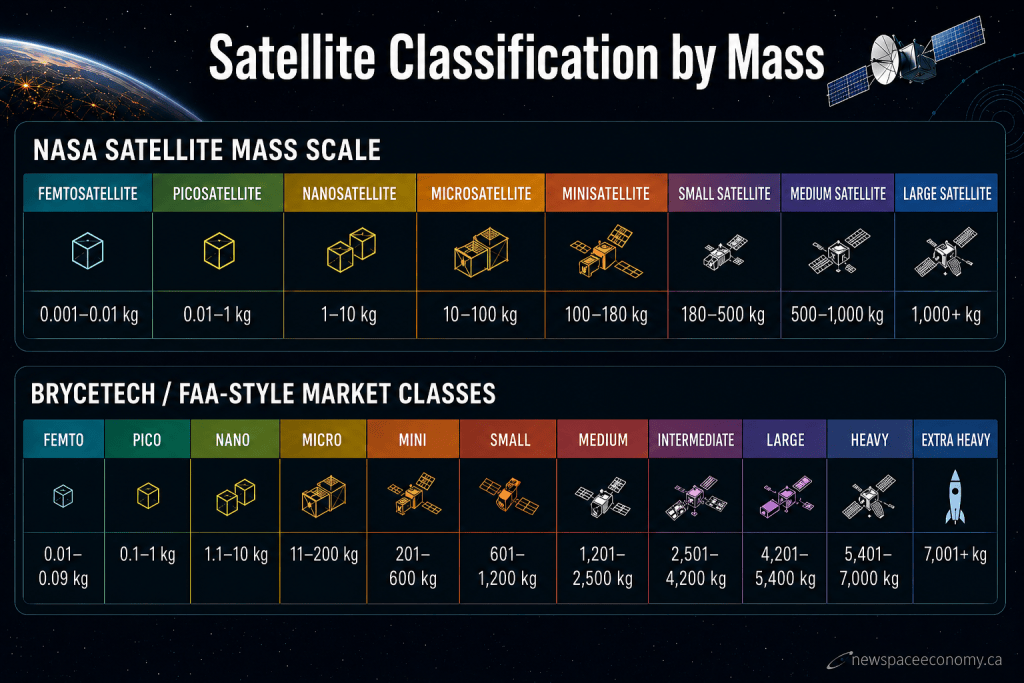
NASA’s public explainer, What Are SmallSats and CubeSats, defines SmallSats as spacecraft with a mass below 180 kg and gives five subcategories. The categories are minisatellite at 100 to 180 kg, microsatellite at 10 to 100 kg, nanosatellite at 1 to 10 kg, picosatellite at 0.01 to 1 kg, and femtosatellite at 0.001 to 0.01 kg. That scheme suits discussions focused on small spacecraft technology, NASA mission examples, and educational explanations.
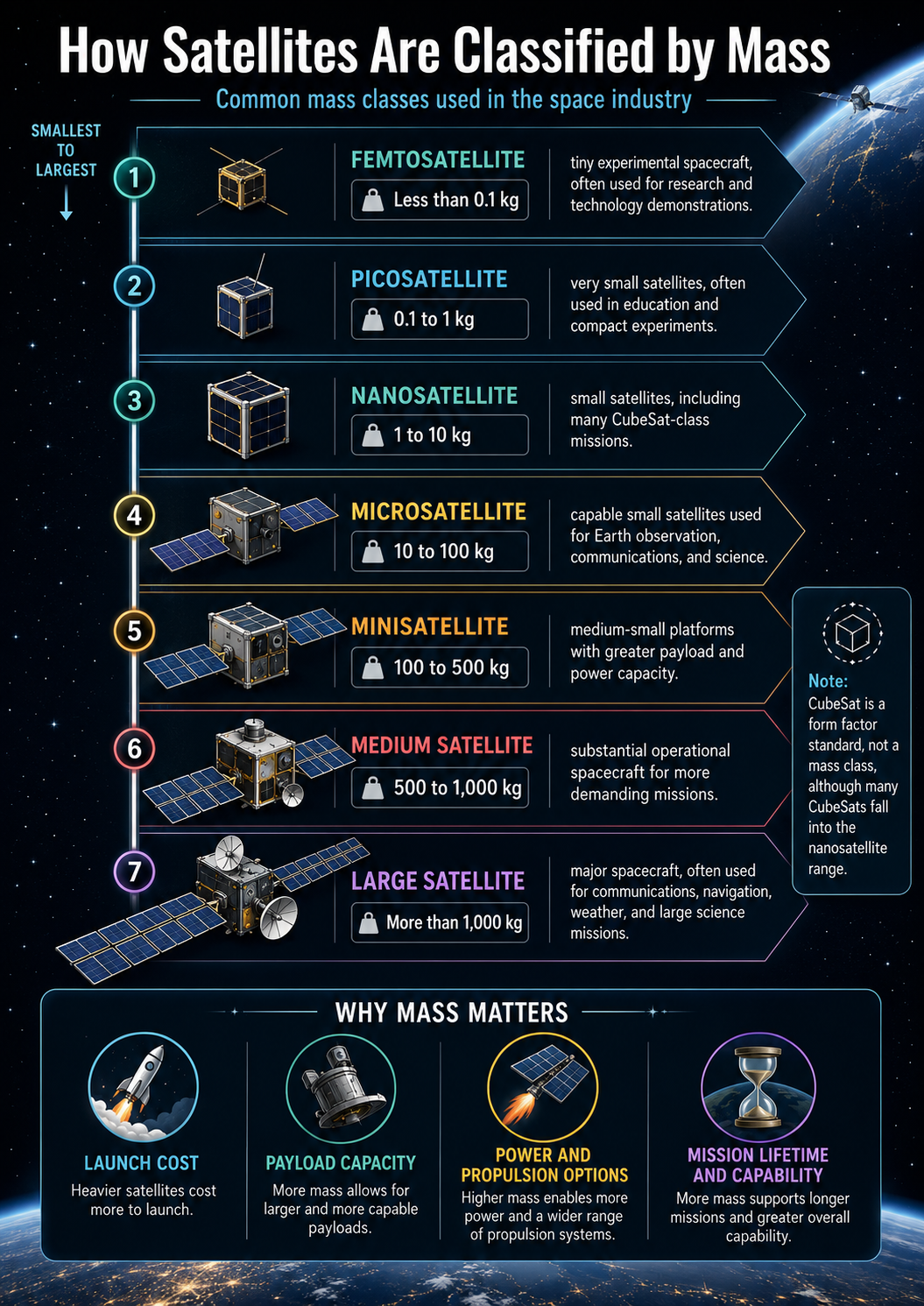
NASA’s 2026 small spacecraft technology survey also makes clear that small spacecraft have moved beyond simple mass labels. The survey points to larger mini-class constellations in the 201 to 600 kg range and larger small spacecraft constellations in the 600 to 1,200 kg range. That matters because the smallsat market no longer means only CubeSats, university demonstrators, or compact science payloads. Many operational commercial constellations now use spacecraft that weigh far more than older smallsat shorthand might suggest.
NASA’s definitions remain useful because they give a plain framework for readers who need to understand mini, micro, nano, pico, and femto labels. They work well when the subject is spacecraft technology scaling below 180 kg. They are less useful as the sole framework for broadband constellations, high-capacity Earth observation platforms, hosted payload services, or launch-market analysis. In those contexts, the market has stretched past the narrower NASA explainer categories.
New Space Economy’s discussion of NASA’s 2026 small spacecraft survey captures this shift. The technical issue is no longer whether a spacecraft is small in the old sense. The business issue is whether the platform can provide power, data throughput, maneuvering, payload support, cybersecurity, tracking, and regulatory compliance at scale.
The NASA scheme should be presented as a technology-oriented small spacecraft classification. It gives clean labels for compact satellites and helps readers understand why nanosatellites and microsatellites do not mean the same thing. For current market coverage, the NASA scheme should sit beside broader launch-market classes rather than replace them.
The table below organizes NASA’s public small spacecraft categories and shows the best editorial use for each label.
| NASA Category | Mass Range | Best Editorial Use |
|---|---|---|
| Minisatellite | 100 To 180 Kg | Larger NASA-style SmallSat missions |
| Microsatellite | 10 To 100 Kg | Compact science, technology, and commercial missions |
| Nanosatellite | 1 To 10 Kg | CubeSats and very compact spacecraft |
| Picosatellite | 0.01 To 1 Kg | Tiny experimental spacecraft |
| Femtosatellite | 0.001 To 0.01 Kg | Chip-scale and gram-scale concepts |
The BryceTech and FAAet View
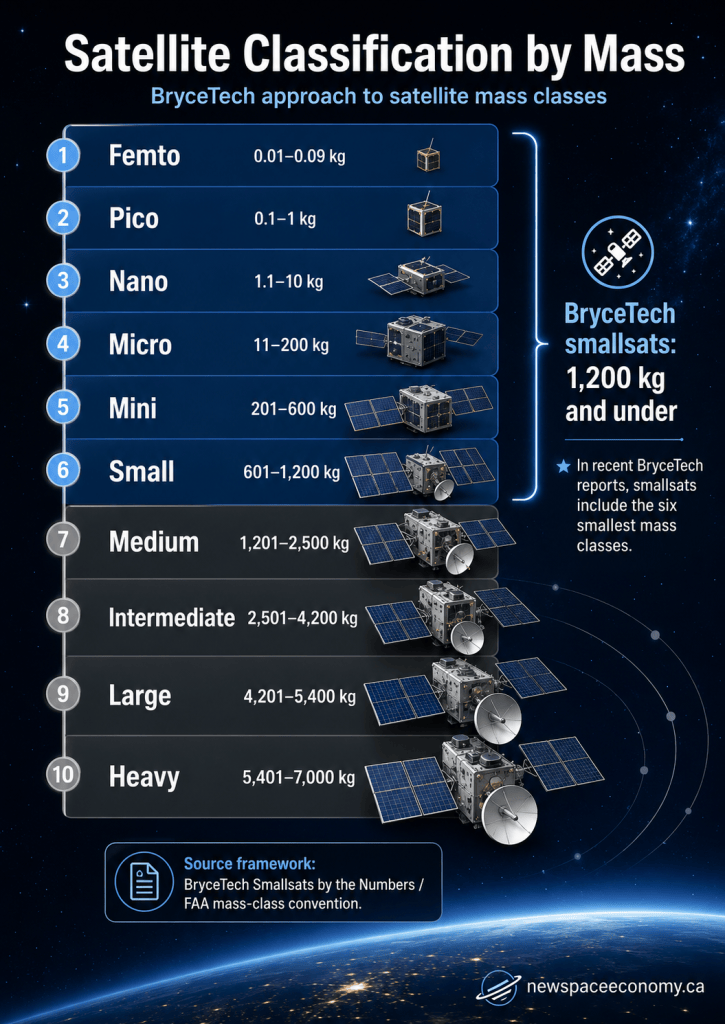
BryceTech’s Smallsats by the Numbers 2025 uses a broader mass classification adapted from Federal Aviation Administration Office of Commercial Space Transportation categories. This framework extends from femto spacecraft at 0.01 to 0.09 kg through extra-heavy spacecraft above 7,001 kg. For commercial launch-market analysis, this wider span is more useful than a small-spacecraft-only scheme because it lets analysts compare mass distribution across all launched spacecraft.
The BryceTech table uses femto at 0.01 to 0.09 kg, pico at 0.1 to 1 kg, nano at 1.1 to 10 kg, micro at 11 to 200 kg, mini at 201 to 600 kg, small at 601 to 1,200 kg, medium at 1,201 to 2,500 kg, intermediate at 2,501 to 4,200 kg, large at 4,201 to 5,400 kg, heavy at 5,401 to 7,000 kg, and extra-heavy above 7,001 kg. Those categories help explain why the phrase “small satellite” can seem to expand or shrink depending on the source.
BryceTech’s market view matters because modern constellation spacecraft have grown. A satellite can be small relative to legacy geostationary communications spacecraft but large relative to a CubeSat. Some low Earth orbit broadband satellites occupy mini or small mass classes in BryceTech’s framework, even though they might feel massive to a CubeSat developer. That does not make the terminology wrong. It means the classification was built for launch-market comparison rather than only compact spacecraft engineering.
The business impact appears in launch procurement. A 5 kg nanosatellite may reach orbit through a CubeSat deployer or rideshare program. A 300 kg mini-class spacecraft may need an adapter, a larger integration campaign, and a different rideshare slot. A 900 kg small-class spacecraft may begin to resemble a core payload rather than a secondary payload. That progression affects price, schedule control, insurance, payload accommodations, ground testing, and risk allocation.
New Space Economy’s global launch services market analysis explains why dedicated small-satellite launches can retain value even when larger reusable rockets offer lower prices per kilogram. Timing, orbital destination, integration control, and customer priority can justify higher per-kilogram launch costs for some spacecraft. Mass class helps identify which satellites can use which launch channels, but launch economics also depend on schedule, orbit, risk, and mission control.
A strong article, investor memo, or policy brief should name the mass scheme it uses. Using NASA categories for technical explanation and BryceTech or FAA-style categories for launch-market statistics avoids a common error: mixing a technology taxonomy with a market dataset as if they were the same instrument.
Why CubeSats Need Their Own Category
CubeSat is a form-factor standard, not simply a mass class. The CubeSat Design Specification maintained through the Cal Poly CubeSat program defines a 1U CubeSat as a 10 cm cube with a mass up to 2 kg. The same standard covers configurations from 1U to 12U. NASA’s CubeSat 101 explains that CubeSats must meet specific shape, size, and weight criteria, which separates them from the broader smallsat category.
That difference matters because CubeSats are often called nanosatellites, yet larger CubeSat configurations can move beyond the 1 to 10 kg nanosatellite range used by NASA. A 6U or 12U CubeSat can carry more mass than a simple nanosatellite definition permits. Larger CubeSat missions may still use standardized units, standardized dispensers, commercial off-the-shelf components, and modular mission architecture. Their form factor remains CubeSat-based, even when their mass no longer fits a strict nanosatellite box.
New Space Economy’s CubeSat overview explains how the 10 cm unit-based standard became a platform for education, science, commercial missions, and government technology demonstration. The standard lowered barriers by giving mission teams common mechanical and integration assumptions. That made component markets easier to build and launch interfaces easier to repeat.
The commercial effect was large. CubeSat standards helped vendors sell radios, batteries, solar panels, structures, flight computers, deployable antennas, propulsion modules, and ground support services to many buyers. The result was not just a smaller satellite. It was a repeatable product architecture. Mass classification alone cannot capture that shift because a form factor can influence supply chains, integration workflows, and launch contracts.
A precise sentence should read like this: “A CubeSat is a standardized small satellite form factor that often falls in the nanosatellite or microsatellite mass range.” That wording avoids two common mistakes. It does not define every nanosatellite as a CubeSat, and it does not force every CubeSat into a single mass class. It also leaves room for PocketQubes, ESPA-class platforms, hosted payload buses, and other spacecraft architectures that matter in the current market.
Why the Same Satellite Can Fit Different Labels
A satellite can carry more than one valid label because classification systems answer different questions. “Nanosatellite” answers a mass question. “CubeSat” answers a form-factor question. “Earth observation satellite” answers a mission question. “Rideshare payload” answers a launch-procurement question. “Commercial constellation spacecraft” answers a business-model question. Confusion begins when one label is asked to do all of that work.
The Italian Space Agency’s micro and nanosatellite explainer illustrates the problem. It describes satellites below 500 kg as small satellites and uses picosatellites below 1 kg, nanosatellites below 20 kg, microsatellites below 100 kg, and minisatellites below 500 kg. Those thresholds differ from NASA’s public SmallSat explainer. ASI also notes that the boundary between nano and micro categories has shifted in practice as small spacecraft capabilities have increased.
This is why a single universal table can mislead readers. A strict NASA table may classify a 150 kg spacecraft as a minisatellite. Another industry source may treat a spacecraft below 500 kg as a smallsat. BryceTech may place a 350 kg satellite in the mini class and a 900 kg satellite in the small class. Each framework can be valid inside its own context, provided the author identifies the framework.
A second source of ambiguity comes from wet mass and dry mass. Wet mass includes propellant. Dry mass usually excludes it. Published satellite masses may not always make this distinction clear. For a spacecraft with little or no propulsion, the gap may be modest. For a maneuvering spacecraft with significant propellant, the difference can affect classification. Writers should avoid overstating precision when the source does not say which mass basis it uses.
A third complication comes from hosted payloads and buses. A customer payload may be small, but the host spacecraft may be large. A compact instrument on a larger platform should not automatically be described as a small satellite. The mass class should apply to the spacecraft under discussion, not to one component unless the sentence makes that distinction.
The safest editorial practice is to define the scheme near the beginning of any article, chart, or report. A short note can prevent confusion: “Mass classes in this article follow NASA categories for sub-180 kg spacecraft and BryceTech categories for broader launch-market comparisons.” That sentence keeps the taxonomy honest.
The table below compares three common ways a satellite may be classified and explains why they should not be merged casually.
| Label Type | What It Describes | Example Use |
|---|---|---|
| Mass Class | Spacecraft weight in kilograms | Nano, micro, mini, small, medium |
| Form Factor | Shape, unit standard, and interface | CubeSat, PocketQube, ESPA-class bus |
| Mission Class | Operational purpose or service market | Communications, imaging, science, inspection |
| Launch Role | How the spacecraft reaches orbit | Primary payload, rideshare payload, deployed payload |
How Mass Classes Shape Costs, Launch Choices, and Business Models
Mass affects cost, but it does not control cost by itself. A 50 kg satellite with a demanding payload, precision pointing, high data volume, propulsion, and tight reliability requirements can cost far more than a heavier but simpler spacecraft. A 500 kg satellite built as part of a repeat production line may cost less per unit of capability than a bespoke microsatellite. Mass is best understood as one driver inside a larger system of mission requirements.
Launch is the most visible link. Smaller spacecraft can use standardized deployers, hosted services, and rideshare programs. Larger spacecraft need more structural support, larger adapters, more integration time, and more schedule coordination. A spacecraft’s class can affect whether it flies as a secondary payload, a rideshare payload, a dedicated small-launcher customer, or a primary payload on a larger rocket. These choices influence schedule confidence, orbital precision, insurance, and contract negotiation.
Manufacturing also changes by class. New Space Economy’s guide to small satellite components shows how structures, propulsion, avionics, power, and communications create distinct areas for innovation. A nanosatellite may depend on high integration density and miniature subsystems. A microsatellite may support more capable payloads and better pointing. Mini and small-class spacecraft can carry more power and communications capacity, but they require more capital, larger facilities, and longer test campaigns.
The market effect reaches downstream services. Earth observation businesses care about aperture, revisit time, spectral bands, latency, and processing, not mass alone. Communications businesses care about capacity, coverage, spectrum, terminals, network management, and ground infrastructure. Defense and security customers care about resilience, tasking, data protection, survivability, and procurement speed. Mass class may shape the platform, but the service customer buys the outcome.
New Space Economy’s global satellite industry guide describes commercial operators and startups through the services they provide rather than mass alone. That is the proper market framing. A satellite mass classification helps describe the hardware base, yet revenue usually comes from connectivity, imagery, analytics, positioning, timing, weather data, science services, or defense support.
Investors should treat mass labels as operational clues. A company building nanosatellites may have fast iteration cycles and lower unit costs, but it may face limits in power and payload capacity. A company building mini-class constellation satellites may need more capital but may deliver higher capacity per spacecraft. Neither model wins automatically. The correct comparison is cost per useful service delivered over the mission lifetime.
How Satellite Mass Classification Affects Regulation and Sustainability
Regulators do not exempt spacecraft from basic responsibilities because they are small. A nanosatellite still needs spectrum coordination, licensing where applicable, registration by a launching state, debris-mitigation planning, and safe operations. Smaller spacecraft may face distinct constraints because they have less power, less propulsion, less tracking margin, and less room for redundancy. That can make end-of-life planning harder for a very small mission than for a larger spacecraft with dedicated propulsion.
Orbital sustainability has become a major reason to handle mass labels carefully. A picosatellite or nanosatellite may sound harmless because it is light, but many small spacecraft in busy orbits can still add collision risk, tracking demand, and coordination burden. A larger spacecraft can carry more maneuvering capability, but it also brings more stored energy and more mass into the orbital environment. Risk depends on orbit, lifetime, maneuverability, tracking quality, operator behavior, and post-mission disposal plan.
The United Nations Office for Outer Space Affairs, the Inter-Agency Space Debris Coordination Committee, national regulators, and satellite operators all deal with debris mitigation in ways that do not reduce neatly to mass. A small spacecraft launched into a low orbit that naturally decays can present a different long-term profile than a heavier spacecraft deployed into a longer-lived orbit. A tiny satellite without propulsion may still need reliable tracking and deployment planning.
Mass classes also influence insurance and procurement language. An insurer may care about heritage, redundancy, launch integration, mission lifetime, and orbital risk. A government procurement office may care about schedule, compliance, data rights, cybersecurity, supply-chain assurance, and resilience. Mass labels can help screen proposals, but they cannot replace technical due diligence. A label that is precise in a table can still hide large differences in operational risk.
New Space Economy’s space economy taxonomy is useful here because it treats space activity as a layered system of infrastructure, services, applications, regulation, and end-user markets. Satellite mass classification belongs inside that system. It helps organize spacecraft hardware, but sustainability outcomes depend on behavior, orbit selection, debris mitigation, traffic coordination, and institutional capacity.
A defensible sustainability sentence should connect mass to capability without overstating it: “Small satellites can lower cost and support distributed architectures, but safe operation still depends on tracking, command authority, spectrum coordination, and end-of-life planning.” That framing respects the mass category without turning it into a regulatory shortcut.
How to Use Satellite Mass Classification Without Misleading Readers
Good usage starts with declaring the framework. If the subject is NASA small spacecraft technology, NASA’s sub-180 kg scheme is a strong choice. If the subject is annual launch statistics, BryceTech’s FAA-adapted mass categories are more appropriate. If the subject is CubeSat development, the Cal Poly CubeSat Design Specification should lead the discussion. If the subject is national or international policy, official regulatory sources should lead, with mass categories used only as descriptive support.
Terminology should stay stable within the same piece. An article should not call a 300 kg spacecraft a minisatellite in one paragraph, a small satellite in another, and a microsatellite later unless it explains that different schemes are being compared. Switching terms without explanation makes the spacecraft appear to change category. The more precise move is to state the mass and then assign the label under a named scheme.
Writers should avoid treating “small” as a single universal threshold. Some sources use below 180 kg. Some use below 500 kg. BryceTech’s launch-market framing includes a small class at 601 to 1,200 kg. Wikipedia’s small satellite article gives useful background, but current technical claims should still be checked against NASA, standards documents, agency sources, company data, or market reports. A reader needs to know which standard is active.
The same caution applies to CubeSat references. A CubeSat should not be described as a mass class when the intended meaning is a standardized unit-based spacecraft. A 1U CubeSat has defined dimensions and a mass limit under the Cal Poly specification, but larger CubeSats may sit outside a strict 1 to 10 kg nanosatellite definition. New Space Economy’s small satellite mission guide provides a useful bridge between the unit-based CubeSat standard and the practical issues of cost and schedule.
Commercial articles should connect mass to service outcomes. A broadband constellation, Earth observation network, internet-of-things service, on-orbit inspection mission, or science constellation should be described by what it does and how its architecture works. The mass class explains the hardware scale, not the whole business. New Space Economy’s guide to America’s satellite manufacturers makes that point indirectly by focusing on buses, payloads, and integrated spacecraft rather than mass labels alone.
A reliable editorial approach uses three layers. Start with the actual mass when available. Add the classification scheme. Then explain the mission or market role. For example: “The spacecraft is a 12 kg CubeSat-class mission, which places it near the boundary between nanosatellite and microsatellite categories under common mass schemes, and it is designed for Earth observation technology demonstration.” That sentence gives mass, scheme, and purpose without pretending that one label settles everything.
Which Reference Set Should Be Used in Practice
The best reference set depends on the publication need. NASA’s SmallSat and CubeSat pages work well for a general explanation. NASA’s annual small spacecraft technology survey works well for subsystem maturity, spacecraft platforms, and engineering context. BryceTech works well for market statistics and launch trends. Cal Poly works well for CubeSat form-factor definitions. ASI works well as a caution that alternate thresholds exist.
A publication should not try to impose one universal taxonomy unless the article itself is proposing a taxonomy. That can create false precision. Better practice is to say which taxonomy is being used and why. A sentence at the start can save many corrections later: “For small spacecraft below 180 kg, this article uses NASA’s public SmallSat categories; for launch-market comparisons, it uses BryceTech’s FAA-adapted mass classes.”
For broad space economy writing, the recommended approach is a two-track framework. Use NASA to explain the terms mini, micro, nano, pico, and femto in a reader-friendly way. Use BryceTech when comparing mass trends across launches. Treat CubeSat as a separate form-factor category. Mention ASI or another authority when the article needs to show that thresholds differ by source or jurisdiction.
This approach also helps readers understand why “smallsat” has become a flexible term. A smallsat article from the 2000s may emphasize university CubeSats and compact science missions. A 2026 market discussion may include hundreds of kilograms of spacecraft mass, commercial broadband constellations, hosted payload services, commercial deorbit products, autonomous operations, and higher data-throughput platforms. The label has grown because the market has grown.
New Space Economy’s architecture of the global space economy offers a useful reminder that satellites sit within public-sector procurement, private-sector manufacturing, downstream services, spectrum coordination, launch infrastructure, financing, and end-user adoption. Mass classes help organize the hardware layer. They do not replace market structure, legal status, or mission performance.
The simplest practical rule is this: state the mass, name the taxonomy, and avoid making the label do more than it can support. A spacecraft’s kilogram rating is valuable. It can guide comparison, procurement, launch planning, and market analysis. It becomes misleading only when it is treated as a substitute for payload capability, system design, operating model, or customer value.
Summary
Satellite mass classification is a compact vocabulary for describing spacecraft scale, but it is not a universal language with a single global dictionary. NASA’s public categories are strong for explaining SmallSats below 180 kg. BryceTech’s FAA-adapted categories are strong for launch-market analysis across the full spacecraft mass spectrum. Cal Poly’s CubeSat Design Specification defines a form factor that overlaps with mass classes but does not equal one.
The most accurate articles, charts, and market discussions identify the scheme they are using. A nanosatellite label should mean that the spacecraft fits a stated mass range. A CubeSat label should mean that the spacecraft follows a unit-based form factor. A smallsat label should be tied to a source because the threshold changes by context. The reader should never have to guess whether the author means NASA’s compact spacecraft scheme, ASI’s sub-500 kg convention, or BryceTech’s broader launch-market categories.
Mass affects launch options, production models, cost, risk, and sustainability planning. It also shapes how companies position themselves inside the space economy. Yet a satellite’s market value comes from the service it delivers: connectivity, imagery, weather data, navigation support, science, inspection, or defense-relevant information. Mass classification can help compare spacecraft. It cannot replace mission analysis.
Appendix: Useful Books Available on Amazon
- Handbook of Small Satellites
- CubeSat Handbook
- Satellite Technology
- Spacecraft Systems Engineering
- Introduction to Satellite Communication
- The Satellite Communication Applications Handbook
Appendix: Top Questions Answered in This Article
What Is Satellite Mass Classification?
Satellite mass classification is the practice of grouping satellites by weight, usually in kilograms. It helps readers compare spacecraft scale, launch requirements, payload capacity, and likely design constraints. The category is useful, but it should always be tied to a named framework because NASA, BryceTech, ASI, and other sources use different thresholds.
What Is the Best General Reference for SmallSat Mass Classes?
NASA’s public SmallSat and CubeSat explainer is a strong general reference for non-specialist readers. It defines SmallSats as spacecraft below 180 kg and breaks them into mini, micro, nano, pico, and femto categories. For market analysis, BryceTech’s annual smallsat reports are often more useful because they compare spacecraft launches across broader mass classes.
Why Do Different Sources Use Different Satellite Mass Ranges?
Different sources classify satellites for different purposes. NASA’s public categories are helpful for small spacecraft technology and educational explanations. BryceTech uses a broader launch-market framework adapted from FAA categories. ASI uses another sub-500 kg framework that reflects alternate smallsat conventions. The difference is not necessarily an error; it reflects the source’s purpose.
Is a CubeSat the Same Thing as a Nanosatellite?
A CubeSat is not exactly the same thing as a nanosatellite. Nanosatellite is a mass label, commonly tied to the 1 to 10 kg range. CubeSat is a standardized form factor based on modular units. Many CubeSats fit within nanosatellite or microsatellite ranges, but larger CubeSat configurations can exceed strict nanosatellite thresholds.
Why Does Mass Matter for Launch Planning?
Mass affects how a spacecraft is integrated, deployed, and priced for launch. Very small spacecraft may use CubeSat deployers or hosted mission services. Heavier spacecraft may require larger adapters, more testing, more schedule coordination, and different rideshare or dedicated launch options. Orbit, timing, and mission risk also influence launch decisions.
Are Small Satellites Always Cheaper Than Large Satellites?
Small satellites often cost less per unit, but they are not automatically cheaper per unit of useful service. A compact spacecraft with demanding performance requirements can become expensive. A larger spacecraft produced in quantity can deliver more capability per satellite. Cost depends on payload, reliability, production volume, ground systems, mission duration, and launch strategy.
Why Should Writers State the Classification Scheme?
A stated scheme prevents confusion. The word “small” can mean below 180 kg, below 500 kg, or a 601 to 1,200 kg class depending on the source. A clear sentence naming the framework lets readers know whether the article uses NASA’s technology-oriented categories, BryceTech’s launch-market categories, or another convention.
Do Mass Classes Affect Space Debris Risk?
Mass classes influence debris risk, but they do not determine it alone. A spacecraft’s orbit, tracking quality, maneuvering capability, mission duration, and end-of-life plan all matter. A tiny spacecraft without propulsion can still require responsible deployment and tracking. A larger spacecraft may have more maneuvering capacity but also places more mass in orbit.
What Is the Difference Between Wet Mass and Dry Mass?
Wet mass usually includes propellant, and dry mass usually excludes it. Satellite classification can change near category boundaries if the source does not specify which value it uses. Writers should use the published value cautiously and avoid excessive precision when the source does not clarify the mass basis.
What Is the Best Practical Rule for Using Satellite Mass Labels?
The best practical rule is to state the spacecraft mass, name the taxonomy, and describe the mission role. A sentence that includes all three gives readers scale, context, and purpose. This avoids treating mass classification as a substitute for payload performance, commercial strategy, or regulatory status.
Appendix: Glossary of Key Terms
Satellite Mass Classification
Satellite mass classification groups spacecraft by weight, usually in kilograms. It helps compare engineering scale, launch options, mission cost, and operational constraints. The label must be tied to a source because different organizations use different boundaries for small, mini, micro, nano, pico, and femto spacecraft.
SmallSat
SmallSat is a general term for small spacecraft, but its threshold changes by source. NASA’s public explainer focuses on spacecraft below 180 kg. Other industry and agency sources may use 500 kg or broader launch-market categories. The term should be defined when used in formal writing.
Minisatellite
Minisatellite usually refers to a spacecraft larger than a microsatellite but smaller than conventional large spacecraft. NASA’s public SmallSat scheme uses 100 to 180 kg. Other sources may extend the label to 500 kg or 600 kg, which makes source context essential.
Microsatellite
Microsatellite is a mass label often used for spacecraft in the 10 to 100 kg range under NASA-style categories. BryceTech uses 11 to 200 kg in its broader market table. Microsatellites can support more capable payloads than many nanosatellites, but mission design varies widely.
Nanosatellite
Nanosatellite commonly refers to a spacecraft around 1 to 10 kg. Many CubeSats fall in this class, although CubeSat is a form-factor standard rather than a mass label. Nanosatellites are common in education, science, technology demonstration, and commercial constellation experiments.
Picosatellite
Picosatellite describes a very small spacecraft below the nanosatellite range. NASA’s public SmallSat explainer uses 0.01 to 1 kg. Other sources may use 0.1 to 1 kg. Such spacecraft face tight limits in power, communications, payload size, and maneuvering capacity.
Femtosatellite
Femtosatellite describes extremely small spacecraft at gram-scale or near gram-scale mass. NASA’s public SmallSat explainer uses 0.001 to 0.01 kg. BryceTech’s launch-market table uses 0.01 to 0.09 kg. These spacecraft are often experimental and highly constrained.
CubeSat
CubeSat is a standardized small satellite form factor based on modular 10 cm units. A 1U CubeSat is a 10 cm cube with a mass limit defined by the Cal Poly specification. CubeSats often overlap with nanosatellite and microsatellite mass classes.
Form Factor
Form factor describes the physical packaging, dimensions, unit structure, and interface standard of a spacecraft. CubeSat and PocketQube are form-factor labels. A form factor can shape launch integration, component markets, and mission design even when mass labels differ.
Wet Mass
Wet mass is the spacecraft mass including propellant. It matters when classifying satellites near category boundaries or comparing spacecraft with different propulsion systems. If a source does not specify wet or dry mass, classification should be described carefully.
Dry Mass
Dry mass is the spacecraft mass excluding propellant. It can differ significantly from wet mass when a spacecraft carries fuel for orbit raising, station keeping, collision avoidance, or deorbit. Writers should avoid mixing dry mass and wet mass in one comparison.
Rideshare Launch
Rideshare launch places multiple payloads on the same rocket. Smaller satellites often use rideshare missions because they do not need the full launch capacity. Rideshare can lower cost, but it may reduce control over exact launch timing or orbital destination.
Hosted Payload
A hosted payload is an instrument or mission package carried on a spacecraft operated by another provider. The payload may be small even when the host satellite is not. Mass classification should refer clearly to the payload or the full spacecraft.