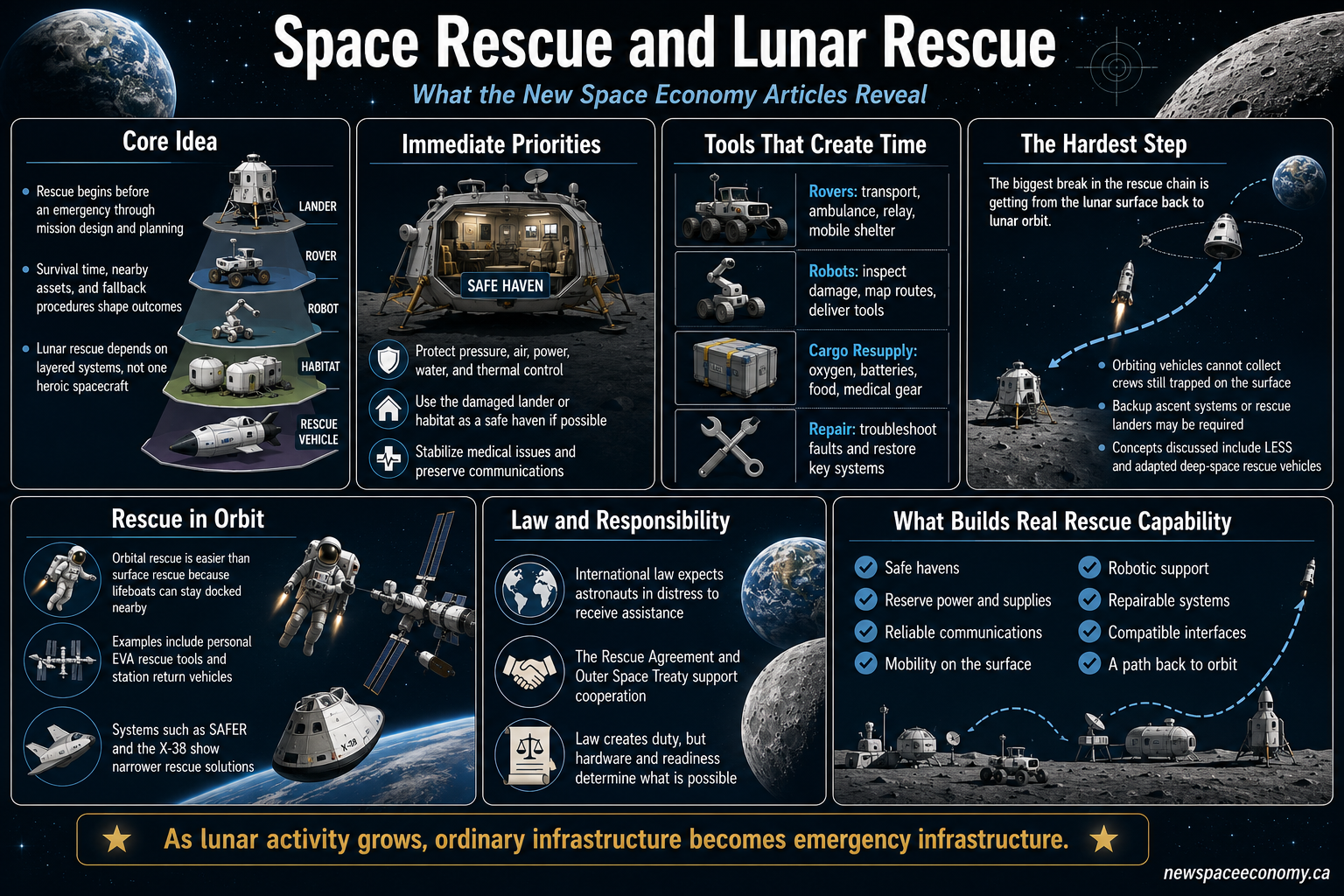
- Key Takeaways
- Why Space Rescue and Lunar Rescue Begin Before an Emergency
- Lunar Surface Survival Comes Before Evacuation
- Mobility, Robots, Supplies, and Repair Create Time
- Reaching Lunar Orbit Is the Hardest Break in the Chain
- Personal Rescue Devices and Orbital Lifeboats Solve Narrower Problems
- Apollo-Era Studies Still Expose Modern Design Questions
- Law Creates a Duty to Help but Cannot Supply a Vehicle
- Rescue Readiness Becomes Part of the Space Economy
- Summary
- Appendix: Useful Books Available on Amazon
- Appendix: Top Questions Answered in This Article
- Appendix: Glossary of Key Terms
Key Takeaways
- Space rescue depends on survival time, nearby assets, and tested fallback procedures.
- Lunar rescue works best when shelter, mobility, power, and communications are redundant.
- Treaties require assistance, but engineering and readiness determine whether help can arrive.
Why Space Rescue and Lunar Rescue Begin Before an Emergency
On March 10, 2026, the NASA oversight report stated that the agency lacked a capability to rescue astronauts stranded in space or on the lunar surface after a catastrophic event involving an early Artemis lander. That finding gives the New Space Economy collection a firm starting point. Space rescue and lunar rescue cannot be treated as services that begin after a distress call. They must exist inside mission architecture, spacecraft design, logistics planning, crew training, and operating rules long before launch.
The July 2026 feature on astronaut rescue options separates emergencies by location. Low Earth orbit offers relatively short return times, established tracking, mature communications, and inhabited spacecraft that may provide refuge. Cislunar space adds travel time, more demanding propulsion, harsher radiation exposure, and difficult rendezvous geometry. The lunar surface removes nearly every familiar form of emergency response. No aircraft, ship, ambulance, road network, hospital, or nearby launch facility can reach a stranded crew.
That geographic progression changes the meaning of rescue. Near Earth, evacuation may mean entering a docked spacecraft and returning within hours. Near the Moon, an emergency can require days of survival before another vehicle reaches the crew. On the surface, rescue may begin as sheltering inside the disabled lander, repairing the failed system, transferring supplies by rover, or reaching a separate ascent vehicle. A dramatic recovery mission launched from Earth sits near the end of the option set, not the beginning.
Rescuing Humans Stranded on the Moon develops this idea through survival time. Air, power, water, thermal control, medical stability, and communications determine how long the crew can remain alive and capable of acting. Every later option depends on those resources. A technically feasible rescue vehicle has no value if the crew loses cabin pressure in minutes or exhausts suit oxygen before reaching shelter.
The collection repeatedly replaces the image of one heroic rescue craft with a layered system. Abort modes prevent some accidents. Redundant systems contain others. Safe havens preserve life. Rovers move people and supplies. Robots inspect damage. Cargo vehicles extend consumables. Repair can restore the original mission vehicle. Orbital assets can receive a crew that retains an ascent capability. Dedicated rescue vehicles become useful only when earlier layers cannot resolve the emergency.
This framing is demanding because it assigns emergency value to ordinary infrastructure. A power unit must support routine work and degraded operations. Communications must survive local equipment loss. A rover becomes transport, ambulance, towing vehicle, relay station, and mobile shelter. The rescue architecture is the operating architecture under failure conditions.
Lunar Surface Survival Comes Before Evacuation
The stranded lunar surface analysis presents the lander as the crew’s most plausible safe haven when the ascent system fails but the cabin, power supply, thermal controls, and communications remain usable. This distinction matters. A lander that cannot launch is not automatically a destroyed lander. It may continue to protect the astronauts for days, giving ground teams time to diagnose the fault, develop repair procedures, or direct support assets.
The accident type controls the available response. An engine ignition fault may leave the pressure vessel untouched. A landing-leg failure could place the vehicle at an angle that blocks an elevator, hatch, antenna, or propellant system. A hard landing could damage batteries, tanks, radiators, avionics, or life-support equipment. Fire or toxic contamination could make the cabin unusable even when the vehicle remains structurally upright. Rescue plans must address these different states rather than use one generic “stranded crew” scenario.
Anatomy of a Lunar Rescue broadens the hazard set. Radiation, micrometeoroids, abrasive regolith, temperature extremes, medical emergencies, and limited mobility can turn a repairable hardware problem into a worsening survival problem. Surface crews also work inside spacesuits that impose their own time limits. Battery charge, cooling water, oxygen, carbon-dioxide removal, fatigue, visibility, and dust contamination constrain any attempt to walk or drive toward help.
The earlier Lunar Search and Rescue feature treats search, access, stabilization, extraction, transport, and recovery as separate functions. Finding a crew may sound easy when mission control already tracks the lander, but local terrain, blocked sight lines, failed radios, damaged navigation equipment, or an accident during a long traverse could complicate location and approach. A rescuer must reach the site without becoming another casualty.
Medical rescue creates another set of limits. Lunar gravity changes how crews move patients and perform procedures. A suit injury may require transfer through an airlock before treatment. A patient with limited mobility may be unable to climb ladders or enter a small ascent cabin. Delayed evacuation places more weight on onboard diagnosis, medical supplies, crew cross-training, remote consultation, and equipment that can function in a cramped pressure vessel.
The articles converge on shelter-in-place because it changes an immediate emergency into a managed endurance problem. Shelter protects the crew from vacuum, radiation, dust, and temperature swings. It supports communications and medical care. It also reduces the physical risk of an improvised traverse. Leaving a working pressure vessel can be the wrong choice unless the destination offers greater safety and the route has been verified.
This conclusion does not make shelter sufficient. A safe haven needs reserve consumables, independent power, fault isolation, fire response, carbon-dioxide removal, thermal control, communications, and a planned occupancy period. It must remain accessible after likely landing failures. Rescue engineering begins by asking how the crew survives where it already is.
Mobility, Robots, Supplies, and Repair Create Time
A lunar base or repeated landing zone can turn nearby assets into an emergency network. Rescuing Humans Stranded on the Moon describes a rover as a possible ambulance, cargo carrier, towing vehicle, communications relay, and mobile safe haven. An unpressurized rover may move suited astronauts over limited distances. A pressurized rover could carry an injured person, support longer travel, and provide protection during delays.
Range alone does not determine whether a rover can perform a rescue. The vehicle needs enough stored energy for the outbound trip, site operations, and return with reserve margin. Terrain data must identify slopes, craters, loose soil, boulders, and shadowed areas. Communications must reach the vehicle throughout the route. The crew also needs a way to transfer a disabled astronaut between the accident site, rover, and destination.
Robots reduce human exposure and can begin work before a crew leaves shelter. They can inspect a damaged lander, photograph leaks, carry radios, move oxygen bottles, deliver tools, deploy navigation markers, or check whether a route remains passable. A robotic arm may hold a light or camera during repair. Small autonomous vehicles can map hazards near a crash site without consuming suit time.
Robotic help has hard boundaries. A machine stored outdoors for months must survive radiation, thermal cycling, abrasive dust, connector contamination, battery aging, and software faults. Autonomy must be reliable enough for operations with limited supervision. Rescue equipment that depends on a single charging point, radio link, or proprietary control system can fail at the same moment it is needed.
Cargo delivery offers another route to survival. A robotic lander could bring oxygen, water, food, batteries, medical equipment, filters, tools, replacement electronics, or a portable shelter. Pre-positioned caches offer faster access because they remove launch and transit delay. Their usefulness depends on location, packaging, thermal protection, maintenance, inventory control, and the crew’s ability to reach them.
Repair receives less public attention than evacuation, yet it may resolve many emergencies faster. Ground teams can use telemetry to isolate faults, test software changes, and prepare step-by-step procedures. Robots can inspect areas that astronauts cannot safely approach. Crews may replace valves, reroute power, clean connectors, patch pressure leaks, free jammed mechanisms, or use spare components in unconventional ways.
Apollo 13 demonstrated the value of system knowledge, disciplined resource management, and improvised configuration, though that mission remained a self-recovery rather than an external rescue. Lunar operations can build on the same principle by designing hardware for diagnosis and repair. Accessible components, standardized connectors, isolation valves, cross-strapped power, interchangeable parts, and clear fault data can convert a mission-ending failure into recoverable damage.
Mobility, resupply, robotics, and repair share one purpose: they create time and options. They are also useful during normal operations, which strengthens their economic case. A rover purchased for science gains emergency value. A cargo service purchased for logistics can replenish a safe haven. A robot used for inspection can support damage assessment. Rescue capacity grows from systems that remain productive between emergencies.
Reaching Lunar Orbit Is the Hardest Break in the Chain
A crew on the lunar surface cannot return to Earth until it reaches lunar orbit or boards a vehicle capable of direct return. Loss of ascent capability creates the sharpest break in the rescue chain. Orion, Gateway, or another orbiting spacecraft may be ready to receive astronauts, yet none can collect people who remain on the ground without a lander or escape vehicle.
The Lunar Escape System article revisits a 1970 concept known as LESS. The proposed vehicle would have carried two suited astronauts from the surface to an orbit where the Apollo command and service module could complete rendezvous and recovery. Its open structure reduced mass, but offered limited protection from debris, radiation, thermal conditions, or injury.
LESS is useful as a design lesson rather than a ready blueprint. Emergency vehicles can shift work to other parts of the architecture. A small ascent craft does not need to duplicate every function of a lander if an orbiting vehicle can move toward it, perform rendezvous, and provide the cabin for return. That division can reduce mass, though it demands compatible tracking, communications, docking or transfer methods, pressure suits, and orbital geometry.
A dedicated rescue lander offers broader capability. It could wait in lunar orbit, descend near a stranded crew, accept the astronauts, and ascend to a return vehicle. Such readiness requires long-duration propellant storage, power, health monitoring, landing navigation, terrain data, docking compatibility, cabin capacity, and confidence that dormant systems will work on demand. Orbital plane differences may prevent rapid access to every surface location.
The Dragon rescue concept explores another boundary: adapting a proven low Earth orbit capsule for lunar rescue. Crew Dragon has operational human-spaceflight experience, but the standard spacecraft is not a complete lunar rescue system. A deep-space version would need propulsion for translunar flight and lunar operations, greater endurance, appropriate communications, thermal management, navigation, radiation planning, suit compatibility, and entry performance for a higher-energy return.
This distinction guards against a common assumption that a crew capsule becomes a rescue vehicle because it already carries astronauts. Rescue depends on the whole mission stack. Launch vehicle availability, upper-stage performance, transfer propulsion, docking interfaces, life support, crew composition, mission planning, tracking, recovery forces, and launch windows all matter. A capsule can be one component without being the complete answer.
Pre-positioning changes the response time. A vehicle already in cislunar space avoids Earth launch preparation and much of the transit delay. It still needs power, communications, consumables, propellant management, inspection, software maintenance, and an assigned operating authority. Readiness is an ongoing service, not a parked spacecraft.
The collection leaves one central design question: how much independent ascent capability should a lunar operating zone maintain? Full duplication adds mass and cost. Minimal redundancy leaves crews exposed to common-mode failures. The answer will change as activity grows, but reaching orbit remains the decisive step between surface survival and return to Earth.
Personal Rescue Devices and Orbital Lifeboats Solve Narrower Problems
Space rescue can also occur at human scale. The SAFER rescue aid feature explains the Simplified Aid for Extravehicular Activity Rescue (SAFER), a compact propulsion backpack attached to a U.S. spacesuit. An astronaut who becomes untethered during an extravehicular activity (EVA) can use nitrogen jets to stabilize motion and fly back toward the spacecraft.
NASA tested SAFER during STS-64 in September 1994. The device addresses a narrow failure mode: accidental separation during a spacewalk. It does not repair a damaged station, recover an unconscious astronaut, or return a crew from orbit. Its strength comes from being carried by the person who may need it, removing the delay associated with sending another vehicle.
The Personal Rescue Enclosure shows a different form of narrow rescue design. NASA studied a fabric pressure enclosure for moving or protecting a crew member who lacked a functioning pressure suit. The concept became known informally as the rescue ball. It never entered operational service, but it illustrates how an emergency device can preserve pressure and life support during transfer between vehicles.
Such concepts expose a recurring human-factors problem. Rescue equipment must work for injured, frightened, fatigued, or partially incapacitated people. Hatches, ladders, seats, suit interfaces, controls, and transfer paths that work during routine operations may become barriers during an emergency. A system designed around a healthy, mobile astronaut can fail when the person most in need of rescue cannot operate it.
The X-38 station lifeboat moves from personal equipment to crew evacuation. NASA developed the X-38 as a prototype for a Crew Return Vehicle intended to carry up to seven people away from the International Space Station. The lifting-body design used automated flight and a large parafoil for landing. NASA canceled the program in 2002, leaving Soyuz spacecraft and, later, U.S. commercial crew vehicles to support emergency return through docked transport vehicles.
The station model offers a strong operational principle: every person aboard should have an assigned seat in a healthy return spacecraft. That rule links occupancy to evacuation capacity. It also recognizes that a launch-on-demand rescue may arrive too late for fire, decompression, toxic contamination, collision damage, or medical decline.
Orbital lifeboats are more achievable than lunar surface rescue because they start near the crew and can descend directly to Earth. Even so, they require docking ports, maintenance, certified shelf life, compatible suits, landing support, and enough capacity for the full population. Rescue remains a continuous readiness obligation.
Apollo-Era Studies Still Expose Modern Design Questions
The 1971 rescue study examined advanced lunar missions that extended beyond short Apollo sorties. Its work covered hazards, escape, survival, rescue requirements, mission techniques, and more than 200 safety recommendations. The technologies are dated, but the analytical method remains useful.
The study treated rescue as a chain of functions rather than a single vehicle. Crews might need to escape a damaged element, survive until help arrived, transfer between systems, move across the surface, reach orbit, rendezvous, and return. Each step required assumptions about time, consumables, medical condition, vehicle status, and location. Breaking the problem into functions prevents mission planners from hiding a gap behind a broad promise of redundancy.
Apollo-era concepts also reveal the trade between simplicity and protection. LESS reduced mass by placing astronauts on an open ascent platform in pressure suits. A more enclosed vehicle would offer greater protection and support an injured crew member, but would weigh more and require additional systems. Modern electronics and materials improve the trade, yet they do not erase it.
Another lesson concerns common-mode failure. Two engines do not provide full independence if they share tanks, software, power, sensors, structures, or damage exposure. Two vehicles parked close together may both be affected by landing debris, dust, radiation, or a local power failure. Redundancy must separate failure paths rather than duplicate visible hardware.
Compatibility carries equal weight. A rescue vehicle must dock, communicate, exchange atmosphere safely, support the crew’s suits, and accommodate their physical condition. Ground controllers need shared data formats and authority to command assets. Surface equipment needs common charging, towing, lifting, and cargo interfaces. Without those links, nearby hardware may remain unusable during the emergency.
The historical articles also show why rescue proposals disappear. Emergency systems add cost, mass, testing, maintenance, and schedule pressure, yet missions may never use them. Program managers can see them as burdens on the primary mission. X-38 cancellation and the unbuilt LESS concept demonstrate how rescue capability can lose funding even when engineers consider it feasible.
Modern commercial procurement complicates that tension. NASA may buy landers, suits, rovers, cargo delivery, and communications from different providers. Each contract can meet its own requirements without producing an integrated rescue system. Government must define cross-program emergency functions, common interfaces, readiness standards, and responsibility for maintaining standby capability.
Historical studies supply no automatic solution for Artemis. They do offer a disciplined question set: what can fail, how quickly does it become fatal, what intact system remains, how does the crew reach it, and which organization has authority to act? Those questions are as relevant in July 2026 as they were during Apollo planning.
Law Creates a Duty to Help but Cannot Supply a Vehicle
Space Law: Rescue Agreement explains the humanitarian rules associated with astronauts in distress. The formal Rescue Agreement entered into force on December 3, 1968. It expands duties connected to rescue, assistance, safe return of spacecraft personnel, and recovery of space objects. Article V of the Outer Space Treaty also directs astronauts of one state to render all possible assistance to astronauts of other states in outer space.
Those rules establish cooperation as the expected conduct, but they do not create a funded rescue fleet. They do not specify a universal lunar distress frequency, docking standard, cost-sharing formula, command structure, medical protocol, or response-time guarantee. A state can possess a legal duty to help and still lack a vehicle capable of reaching the crew.
Commercial missions add questions that treaty language did not fully anticipate. States remain responsible for national space activities under the Outer Space Treaty, including activity by private companies. Yet an actual emergency could involve a commercial passenger, a privately operated lander, hardware owned by several companies, and rescue assets controlled by another state. Contracts, licenses, insurance, cross-waivers, export controls, intellectual property, and mission authority may affect how quickly assistance can be organized.
Space Rescue for Orbital Space Tourists brings that issue into low Earth orbit. Commercial passengers receive less training than career astronauts and may depend heavily on automated systems and operator support. No independent orbital emergency service waits to collect a disabled tourism spacecraft. The practical safety model remains prevention, onboard redundancy, abort capability, and a return vehicle that stays with the passengers.
A rescue service also raises a public-policy question. Governments maintain terrestrial emergency services because society accepts shared responsibility for life safety. Commercial spaceflight may eventually create pressure for comparable coordination, but the cost per mission would be high and the users few. Regulators would need to decide which capabilities operators must provide, which services governments should support, and how costs should be allocated.
The legal duty becomes harder to execute with distance. Mars emergency rescue planning describes a setting where Earth cannot provide timely physical rescue. Communication delay can reach many minutes each way, and launch opportunities depend on planetary geometry. A settlement or expedition must rely on local shelter, spare systems, medical capability, vehicles, supplies, and trained personnel.
Mars makes explicit what the lunar articles imply: rescue capability declines as distance grows, and local self-recovery takes its place. Law can organize cooperation, information sharing, and obligations. Survival still depends on hardware, people, and resources located close enough to act.
Rescue Readiness Becomes Part of the Space Economy
The article collection connects astronaut safety to procurement, infrastructure, insurance, standards, and market development. Rescue capability consumes real capacity. Standby vehicles occupy docking ports or orbital positions. Spare hardware needs launch mass. Consumables expire. Batteries age. Software requires maintenance. Crews and controllers need recurring training. None of those requirements disappear because an emergency never occurs.
A growing lunar operating zone could spread those costs across routine services. Commercial cargo landers can deliver emergency caches during scheduled missions. Communications networks can carry normal science and operational traffic, then provide distress coverage. Rovers can support exploration and serve as rescue transport. Inspection robots can maintain facilities and assess accident sites. Navigation beacons can guide ordinary travel and emergency response.
Shared infrastructure creates value only when users can connect to it. Common docking mechanisms, power connections, data formats, suit ports, cargo restraints, lifting points, towing interfaces, medical fittings, and distress protocols can determine whether one operator’s asset can help another operator’s crew. Standards development may appear less visible than vehicle construction, but incompatibility can turn physical proximity into operational isolation.
Insurance markets will also influence behavior. Underwriters may ask whether a mission has safe-haven capacity, independent communications, emergency power, medical supplies, repair tools, alternate transport, and agreements with nearby operators. Better preparedness could affect premiums, exclusions, financing terms, and investor confidence. A severe accident without a credible response could alter public acceptance and regulation across the human-spaceflight sector.
Government procurement remains central during early operations because commercial demand alone may not support standby rescue assets. Agencies can require fault tolerance, common interfaces, survival analysis, emergency exercises, and data sharing through contracts. They can also purchase services that have both routine and rescue functions, reducing the amount of hardware that sits unused.
The March 2026 NASA oversight finding does not mean every Artemis malfunction would be fatal or that lander providers have ignored crew safety. It identifies a gap between hazard mitigation and external recovery after a catastrophic event. Prevention, redundancy, aborts, and onboard survival can address many failures. A committed rescue capability addresses the smaller set that defeats those protections.
A mature rescue network would probably emerge in stages. Early sorties may depend mainly on the lander, suits, Orion, mission control, and limited pre-positioned supplies. Repeated missions can add rovers, cargo caches, surface power, relays, spare shelters, robots, and additional vehicles in lunar orbit. Permanent habitation could justify dedicated rescue staffing and assets.
The most valuable lesson from the New Space Economy series is that rescue cannot be purchased as one late program element. It arises from architecture choices made throughout the system. Every added shelter, interoperable vehicle, reserve power source, mapped route, trained crew, and reliable communications path widens the set of failures that people can survive.
Summary
Space rescue and lunar rescue cover distinct problems that share one rule: help must be close enough, compatible enough, and ready soon enough to matter. Low Earth orbit supports docked lifeboats and personal self-rescue devices. Cislunar missions need deep-space propulsion, longer endurance, radiation planning, and precise rendezvous. Lunar surface crews need shelter, power, communications, mobility, medical support, repair capability, and a path back to orbit.
The New Space Economy collection moves from compact devices such as SAFER and the Personal Rescue Enclosure to larger concepts such as X-38, LESS, adapted Dragon missions, standby landers, and lunar infrastructure. It also covers the Rescue Agreement, commercial passengers, and Mars expeditions. Together, these subjects show that the word “rescue” includes prevention, escape, survival, self-recovery, evacuation, and return.
NASA’s March 10, 2026 oversight finding places the issue inside current Artemis planning. Early missions lack a committed external capability for a crew stranded after a catastrophic event. The practical response is not one universal rescue ship. It is layered resilience built from safe havens, reserves, repairable equipment, mobile assets, robotic support, compatible interfaces, and rehearsed cooperation.
As lunar activity expands, ordinary infrastructure can become emergency infrastructure. That shift can make rescue more capable and economically supportable. A communications relay, cargo service, rover, robot, or habitat earns value every day and retains a defined emergency function. Human activity beyond Earth becomes safer when mission planners design the operating zone to recover from failure rather than assume failure will remain contained.
Appendix: Useful Books Available on Amazon
- Apollo 13
- Failure Is Not an Option
- Digital Apollo
- How Apollo Flew to the Moon
- A Man on the Moon
- The Value of the Moon
- Safe Is Not an Option
Appendix: Top Questions Answered in This Article
Does NASA currently have a lunar rescue capability?
A March 10, 2026 NASA Office of Inspector General assessment stated that NASA lacked a capability to rescue crew members stranded in space or on the lunar surface after a catastrophic event involving early Artemis landers. NASA and its providers continue hazard mitigation and survival analysis, but those measures are different from a committed external recovery service.
Could a rescue mission launch from Earth after astronauts become stranded?
A launch from Earth may help only when a suitable vehicle, launch system, transfer stage, crew, mission team, and launch opportunity are ready before survival time expires. Preparation and travel can take longer than available consumables. Pre-positioned shelter, supplies, vehicles, and repair capability offer more credible early responses.
What is the safest initial response to a lunar emergency?
The crew would normally stabilize pressure, air, power, thermal control, water, communications, and medical condition. An intact lander, habitat, or pressurized rover may serve as a safe haven. Movement becomes justified when remaining in place is more dangerous or when another shelter offers a verified path to longer survival.
Could Orion rescue astronauts from the lunar surface?
Orion can support return from lunar space, but it cannot land on the Moon to collect a surface crew. The astronauts must reach lunar orbit through their lander, a backup ascent vehicle, or a rescue lander. Orbital rescue assets have limited value when the surface-to-orbit link has failed.
Could Crew Dragon perform an Artemis rescue mission?
A standard Crew Dragon is designed for low Earth orbit operations and cannot perform a complete lunar rescue mission by itself. A proposed rescue configuration would require added propulsion, endurance, deep-space navigation, communications, thermal management, suit compatibility, radiation planning, and support from an appropriate launch and transfer architecture.
What role could lunar rovers have during rescue?
Rovers could move astronauts, medical equipment, batteries, oxygen, tools, and other supplies. A pressurized rover could serve as a mobile shelter and ambulance. Rescue value depends on range, terrain access, power reserves, communications, crew-transfer methods, and the vehicle’s ability to remain ready after long periods on the surface.
How could robots assist a stranded crew?
Robots can inspect damage, map routes, carry supplies, deploy radios, position cameras, move cables, and support repairs. They can act before astronauts leave shelter and reduce suit exposure. Their usefulness depends on autonomy, power, environmental tolerance, communications, and controls that the crew or mission center can access.
What does international space law require during an emergency?
The Rescue Agreement and Outer Space Treaty establish duties of assistance, cooperation, notification, and safe return in defined circumstances. They express a humanitarian expectation that astronauts in distress receive help. They do not provide vehicles, technical standards, command arrangements, funding, or a guaranteed response time.
Why is rescue on Mars harder than rescue on the Moon?
Mars is far enough from Earth that physical aid cannot arrive during many acute emergencies. Communication delay prevents immediate conversational support, and launch opportunities depend on planetary positions. Mars crews need local shelter, medical resources, spare systems, mobility, repair skills, and the authority to make decisions without direct Earth control.
What would improve lunar rescue capability most?
The strongest improvement would be a layered operating zone with independent shelter, reserve power, communications, mobility, supplies, repair tools, robotic help, compatible interfaces, and more than one path to orbit. Dedicated rescue vehicles may become justified as activity grows, but shared infrastructure can provide useful capability earlier.
Appendix: Glossary of Key Terms
Space Rescue
Actions that protect, stabilize, recover, evacuate, or return people facing danger beyond Earth. The term can include personal self-rescue, use of a docked lifeboat, repair of a disabled spacecraft, transfer to shelter, retrieval by another vehicle, and safe return to Earth.
Lunar Rescue
Emergency support for people in lunar orbit or on the Moon’s surface. It may involve shelter-in-place, surface transport, robotic assistance, cargo resupply, repair, ascent to orbit, rendezvous, medical stabilization, and return through Orion or another Earth-entry spacecraft.
Safe Haven
A pressurized vehicle or habitat that can protect a crew after its primary mission function fails. A safe haven must provide enough atmosphere, power, thermal control, communications, water, medical support, and fault isolation to preserve life until repair or evacuation becomes possible.
Extravehicular Activity
Work performed outside a pressurized spacecraft, habitat, or rover. Extravehicular activity requires a spacesuit with pressure, oxygen, cooling, communications, and power. Emergency time is limited by suit resources, crew condition, distance from shelter, and the ability to reenter a pressure vessel.
SAFER
The Simplified Aid for Extravehicular Activity Rescue is a small nitrogen-propelled backpack attached to a U.S. spacesuit. It allows a conscious astronaut who becomes untethered during a spacewalk to stabilize motion and maneuver back toward the spacecraft.
Crew Return Vehicle
A spacecraft maintained near an inhabited orbital facility so occupants can evacuate and return to Earth. The planned X-38 was designed for this function. Current station practice assigns crew members seats in docked transport spacecraft that can also support emergency departure.
Lunar Escape System
A lightweight Apollo-era concept for carrying two suited astronauts from the Moon’s surface to lunar orbit after loss of the main ascent vehicle. The concept shifted rendezvous and recovery work to the orbiting command spacecraft to reduce the escape vehicle’s mass.
Rescue Agreement
The 1968 international agreement covering rescue and assistance for spacecraft personnel and the return of space objects. It gives legal form to humanitarian cooperation, but does not establish a standing rescue organization, technical architecture, common equipment standard, or response-time commitment.