- Key Takeaways
- Government Is Still Central to Commercial Space
- Government as Customer Creates Space Revenue
- Government as Regulator Grants Permission and Protects Shared Resources
- Government as Investor Reduces Early Technical and Market Risk
- Government as Anchor Tenant Helps Infrastructure Become Financeable
- Government as Strategic Actor Uses Space for National Goals
- Government Data and Public Infrastructure Enable Private Markets
- Public Procurement Can Strengthen or Weaken Competition
- International Governance Shapes National Markets
- How Professionals Should Evaluate Government Space Policy
- Summary
- Appendix: Useful Books Available on Amazon
- Appendix: Top Questions Answered in This Article
- Appendix: Glossary of Key Terms
Key Takeaways
- Government shapes space as customer, regulator, investor, anchor tenant, and strategist.
- Public procurement can create markets, but weak subsidies can hide poor demand.
- Commercial space still depends on public rules, public missions, and public trust.
Government Is Still Central to Commercial Space
NASA’s Commercial Low Earth Orbit Program Office states that NASA wants a strong economy in low Earth orbit where the agency can purchase services as one customer among many. That sentence captures one of the most important changes in the modern space economy. Government is no longer the only builder and operator of many space systems, yet it remains a powerful buyer, regulator, funder, risk manager, standard setter, and strategic actor.
The idea that commercial space grows because government steps aside is misleading. Commercial space often grows because government changes how it participates. A public agency may stop owning every system directly and begin buying transportation, data, communications, cargo delivery, research access, or crew services from commercial providers. The ownership model changes. The public mission remains.
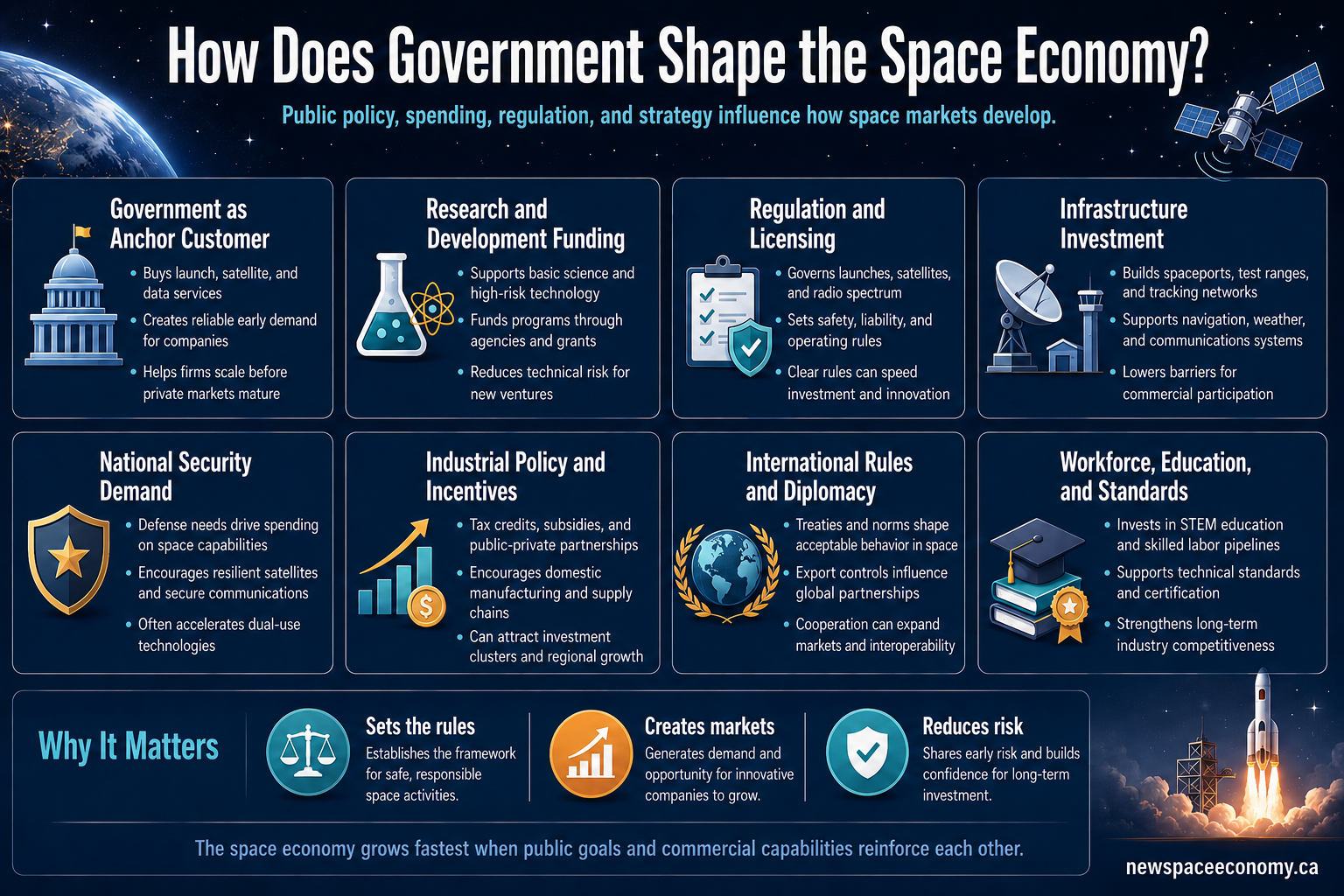
Government’s role in space economy development appears in five main forms. It acts as a customer by purchasing launch, communications, imagery, weather data, science missions, defense services, cargo transport, crew transport, and station access. It acts as a regulator by licensing launches, satellite operations, spectrum use, remote sensing, reentry, and orbital debris mitigation. It acts as an investor by funding research, infrastructure, demonstration missions, grants, and public-private partnerships. It acts as an anchor tenant by providing early reliable demand for services that may later serve broader markets. It acts as a strategic actor by using space for national security, economic development, diplomacy, science, climate monitoring, and civil protection.
This public role reaches every major space market. Launch companies need licenses and government customers. Satellite communications providers need spectrum rights and often sell to public agencies. Earth observation firms may rely on defense, civil, or intelligence contracts. Weather data companies can sell to public meteorological agencies. Commercial space station developers need NASA demand to support early low Earth orbit markets. Lunar lander firms depend on public exploration programs. Even consumer satellite broadband depends on regulators, landing rights, spectrum coordination, and public-safety rules.
New Space Economy’s article on government procurement of space products and services explains how public buyers use requests for proposals, competitive bidding, technical evaluation, and contract awards to acquire space capabilities. The procurement system is not a side issue. It is one of the main ways governments shape company revenue, technical standards, risk allocation, and industry structure.
Government also creates the legal permission structure. A launch provider cannot simply launch because it has a rocket. A satellite communications operator cannot simply transmit because it has antennas. A remote sensing firm cannot always sell imagery without license conditions. A commercial station cannot host people without safety review, customer approval, transportation, emergency planning, and mission integration. The space economy operates inside rules because orbital activity affects public safety, international obligations, spectrum sharing, national security, and the long-term usability of orbits.
The public role can support growth or create distortion. Smart procurement can create competition, reward performance, preserve public bargaining power, and move capability from government-owned systems toward service markets. Poor procurement can create dependency, protect weak companies, subsidize concepts without customers, or transfer public risk into private gain. New Space Economy’s article on public money and private gain frames the question well: taxpayer support works best when contracts include standards, competition, data rights, and a path away from permanent dependence.
A practical view of the space economy places government near the center, not at the edge. Space is a commercial frontier, but it is also a regulated environment, a strategic domain, a public-service tool, and a scientific platform. Private firms can build and operate many systems better or faster than traditional public programs in some settings. They still depend on public rules, public demand, public infrastructure, and public legitimacy.
The table below summarizes the main public roles in the space economy.
| Government Role | Main Tool | Market Effect | Main Risk |
|---|---|---|---|
| Customer | Contracts And Purchases | Creates Revenue | Supplier Dependence |
| Regulator | Licenses And Rules | Grants Market Access | Delay Or Uncertainty |
| Investor | Grants And Demonstrations | Reduces Early Risk | Weak Commercial Pull |
| Anchor Tenant | Early Service Demand | Helps Finance Infrastructure | Permanent Public Dependence |
| Strategic Actor | Policy And National Programs | Shapes Long-Term Direction | Political Overreach |
Commercial space is not a market that escaped government. It is a market being reshaped by government demand, government rules, and private execution. That mix defines the space economy as much as rockets and satellites do.
Government as Customer Creates Space Revenue
Government demand built many of the markets that commercial space now serves. Civil agencies, defense organizations, weather offices, intelligence agencies, communications authorities, environmental departments, and science programs buy space products and services because space supports public missions that private customers may not fund on their own. Public demand can give companies revenue, credibility, technical requirements, and financing support.
NASA’s commercial resupply missions show how a government customer can buy a recurring service rather than build every spacecraft itself. Commercial providers deliver cargo and supplies to the International Space Station under contracts that require mission performance. NASA defines the need. Companies provide transportation services. The model shifts part of delivery execution to commercial firms.
The same pattern appears in crew transport. NASA’s Commercial Crew Program purchases astronaut transportation from commercial providers that must meet NASA requirements. This is a major example of government demand creating a commercial service category. It does not mean NASA disappeared from human spaceflight. It means NASA changed from full system owner toward customer, certifier, mission planner, and safety authority.
Government demand also supports satellite communications. Defense agencies buy resilient communications, mobility links, broadband, protected systems, and backup networks. Civil agencies may buy satellite connectivity for remote sites, disaster response, research stations, ships, aircraft, or public broadband programs. Commercial satellite operators can use public customers to stabilize revenue and validate service performance.
Earth observation firms often depend on government buyers. Civil agencies buy imagery for mapping, disaster response, agriculture, environmental monitoring, and infrastructure. Defense and intelligence agencies buy imagery and analytics for awareness, planning, and verification. A commercial Earth observation company may advertise private-sector applications, but public contracts can provide a large share of early revenue.
Weather data purchasing shows another model. NOAA’s Commercial Data Program assesses and acquires space-based observational weather data from the private sector to improve forecasts and explore more efficient ways to meet mission requirements. This approach allows a public weather agency to test commercial data while retaining public responsibility for forecasting.
The customer role is not limited to the United States. The European Space Agency, European Commission, national space agencies, defense ministries, and civil departments across many countries buy space services, fund missions, and create demand. The European Space Agency supports commercialisation through programs, procurement, access to facilities, business incubation, and partnership structures. Public demand is a global feature of the space economy.
Government purchasing can create a reference customer. A startup that wins a contract from NASA, ESA, NOAA, the U.S. Space Force, the National Reconnaissance Office, or another high-standard public buyer can use that award to build investor confidence and approach private customers. The contract shows technical credibility, but it does not automatically prove a broad market. A public mission and private demand can be very different.
Public customers can also be demanding. Government contracts may require documentation, audits, cybersecurity, domestic sourcing, export-control compliance, safety review, data rights, cost reporting, and performance metrics. Those requirements can raise cost and slow delivery. A company that succeeds in consumer markets may struggle with government procurement. A company built around government work may struggle with fast commercial sales.
Government demand affects technical design. A defense buyer may require encryption, anti-jam features, secure facilities, domestic production, and resilience. A weather agency may require calibration, data continuity, and model impact. A civil science mission may require strict instrument performance. A public broadband program may require coverage of remote regions. The customer’s mission becomes part of the product.
Procurement can also preserve competition. Public buyers may fund multiple providers to avoid dependence on one firm. This can create redundancy and price discipline. It can also split demand among firms and make each provider’s business case harder. A government must balance competition, efficiency, safety, and program continuity.
New Space Economy’s article on commercial space services in defense architectures explains that commercial services can support military architectures, but mission sensitivity, availability, resilience, integration, and security shape adoption. Government customers buy more than capacity. They buy trust under operational stress.
A public contract should be read carefully. A funded service contract is stronger than a research grant. A competitive award with milestones differs from a broad partnership announcement. A data purchase differs from a development contract. A contract ceiling is not guaranteed revenue. A memorandum of understanding is not a sale. Professionals should examine the legal form, funding status, cancellation terms, and performance obligations.
Government as customer can make a market. It can also hide weak demand. If a company has only public customers, the business may still be viable if the public mission is large and recurring. Weather satellites, defense communications, launch services, and science missions can support long-term public demand. The problem appears when a company claims a broad commercial market but depends almost entirely on government grants or one-off demonstrations.
Public demand is strongest when it buys real service, preserves competition, and gives providers room to improve. It is weakest when it funds technology without a path to operational use. The customer role is powerful because revenue is the clearest market signal. The question is whether the signal points to a true service market or only to a public policy experiment.
Government as Regulator Grants Permission and Protects Shared Resources
Space activity requires regulation because launch, satellite operations, spectrum use, remote sensing, reentry, debris mitigation, and human spaceflight can affect public safety, international obligations, national security, other operators, and shared orbital resources. Regulation is not an outside layer placed on top of the space economy. It is one of the conditions that allows the market to operate.
The Federal Aviation Administration Office of Commercial Space Transportation manages U.S. commercial launch and reentry licensing and safety oversight. Its work includes licensing, environmental assessment, public safety standards, reusable and expendable vehicle inspection, and launch-site oversight. A company with a rocket still needs authorization before conducting many commercial launch or reentry activities from the United States or by U.S. persons abroad.
Launch regulation balances innovation and public risk. Rockets operate with high energy, hazardous propellants, falling hardware, airspace closures, maritime safety zones, environmental impacts, and potential debris. Regulators must protect public safety without freezing new vehicles and operations. Faster commercial cadence makes this task harder because more launches create more licensing work, range coordination, and public-safety planning.
Communications regulation is equally central. The FCC Space Bureau leads policy and licensing matters related to satellite and space-based communications in the United States. Satellite operators need permission to use frequencies and provide services. Ground stations need authorization. Constellations must avoid harmful interference and meet license conditions. Spectrum access can decide whether a communications business can operate.
At the international level, the International Telecommunication Union supports procedures for satellite network filings, radio-frequency use, and orbital coordination. Satellite communications is global by nature because signals cross borders and orbital slots matter. International coordination prevents destructive interference and supports predictable access.
Remote sensing regulation affects Earth observation companies. Governments may regulate high-resolution imagery, radar sensing, customer access, distribution rights, and security-related restrictions. A commercial imaging firm must know what it can collect, sell, store, and export. A powerful sensor without market permission is not a commercial product.
Orbital debris rules influence satellite design and operations. Operators may need disposal plans, passivation, tracking, maneuvering capability, and collision-risk management. The United Nations Office for Outer Space Affairs describes space debris mitigation as a long-running concern in international space governance. Debris risk is an economic issue because collisions can harm satellites, raise insurance costs, and reduce confidence in orbital services.
Regulators also protect the rights of other users. A satellite operator cannot be judged only by its own service. It must operate in a way that does not create unacceptable interference, collision risk, or public safety hazards for others. Space is a shared operating environment. Permission is tied to responsible behavior.
The table below shows how major regulatory areas connect to business risk.
| Regulatory Area | Business Affected | Main Permission | Failure Consequence |
|---|---|---|---|
| Launch And Reentry | Launch Providers | Flight Or Site License | Mission Delay Or Denial |
| Spectrum | Satellite Communications | Frequency Authorization | Interference Or Market Loss |
| Remote Sensing | Earth Observation | Imaging And Sales License | Restricted Product Access |
| Debris Mitigation | Satellite Operators | Disposal And Safety Plan | Higher Risk And Licensing Limits |
Regulatory predictability supports investment. A company can raise capital more easily when licensing rules, timelines, review standards, and compliance duties are understood. Unclear rules raise cost because investors cannot estimate whether a service will reach market. Overly slow approval can damage companies. Overly weak approval can damage public safety and orbital sustainability.
National regulators also implement international responsibility. Under the Outer Space Treaty, states bear international responsibility for national activities in outer space, including those carried out by non-governmental entities. That principle gives governments a reason to authorize and supervise private space actors. Commercial activity does not remove state responsibility.
Regulation creates winners and losers. A company with strong compliance capacity may enter markets that smaller rivals cannot. A firm with approved spectrum may gain advantage. A company with remote sensing permission can sell products others cannot. Rules must balance entry, safety, competition, and responsibility.
Regulatory arbitrage is a risk. Companies may seek jurisdictions with lighter rules. This can attract business, but it can also weaken safety and create diplomatic tension. Strong national frameworks can attract serious investment because responsible firms prefer clear rules and reputational safety.
New Space Economy’s article on national frameworks for space activities describes why states build policy, regulation, and administration around space activity. A national framework tells companies who approves activities, what standards apply, how liability is handled, and how public interests are protected.
A professional reading a space business plan should treat regulation as a product requirement. Does the company have launch approval, spectrum rights, remote sensing permission, export-control compliance, debris plans, and market access? If not, the technology may be interesting but the business remains incomplete.
Government as Investor Reduces Early Technical and Market Risk
Governments invest in space because many space capabilities produce public benefits, require long development cycles, or demand infrastructure that private capital may not fund alone. Public investment can take the form of research grants, demonstration missions, milestone payments, test facilities, incubators, prizes, procurement commitments, infrastructure support, and public-private partnerships.
Space technology often begins with high technical risk. New propulsion systems, sensors, materials, robotics, life-support systems, launch vehicles, in-space servicing, lunar systems, and commercial station components may require years of development before customers can use them. Public investment can reduce risk enough for private investors to follow. It can also fund missions whose benefits are scientific, environmental, or national rather than directly commercial.
NASA, ESA, national agencies, defense innovation organizations, weather agencies, and economic development departments all invest in space capability. ESA’s commercialisation activities support entrepreneurs, commercial partnerships, business incubation, technology transfer, and access to agency expertise. Public investment can help firms cross the gap between laboratory success and operational service.
Public-private partnerships are a common structure. Government may pay milestones, supply facilities, define requirements, share technical knowledge, or guarantee a service purchase. The private partner contributes capital, engineering, operations, and commercial execution. The goal is often to reduce cost, speed deployment, encourage competition, and shift some performance risk to industry.
NASA’s commercial cargo and crew programs show the investment logic. Public funding helped commercial systems develop. Contracts then created service demand. NASA gained transportation services. Companies gained capability that could support other customers. This model does not work automatically, but it changed the way many policymakers think about space procurement.
Commercial low Earth orbit stations are a harder test. NASA wants commercially owned and operated destinations that can serve NASA and other customers. The challenge is whether enough non-NASA demand develops to support stations after government support. New Space Economy’s article on NASA’s view of commercial space station viability examines how NASA’s 2026 low Earth orbit strategy shifted the debate toward procurement, budget, and market risk. The issue is not whether private stations can be built. The issue is whether the revenue base can support them.
Government investment can create spillovers. Public missions produce technology, workforce skills, suppliers, standards, data, and facilities that private firms later use. Weather satellites, navigation systems, Earth observation archives, and communications research have all supported commercial activity. Open public data can create private analytics markets. Public launch infrastructure can support private missions.
Investment can also distort markets. If grants flow to firms without customer pull, the result may be companies optimized for proposals rather than customers. If public funding selects a single favored provider too early, competition may weaken. If government absorbs too much risk and private firms capture most gain, taxpayers may get poor value. If public agencies demand too much control, commercial incentives weaken.
The quality of public investment depends on design. Milestone payments can reward progress. Competitive awards can preserve pressure. Matching funds can require private confidence. Open data rights can create public benefit. Clear termination rights can prevent endless support. Transparent selection criteria can reduce political favoritism. Strong technical review can prevent funding fashionable but weak ideas.
New Space Economy’s article on public-private partnerships presents PPPs as collaboration mechanisms that combine public goals and private execution. The strongest partnerships define deliverables, rights, risks, and public value clearly. Loose partnerships with vague promises should receive more caution.
Public investment is also strategic. Governments fund domestic launch capability, satellite manufacturing, robotics, Earth observation, secure communications, space-domain awareness, and lunar systems to support national goals. These investments may not be justified only through direct commercial return. They may support resilience, science, security, industrial capacity, and workforce development.
Public agencies must also decide where not to invest. A government cannot fund every space concept. It must judge maturity, public benefit, private co-investment, technical feasibility, market need, and national priority. Funding too many weak projects can scatter resources. Funding too few can leave strategic gaps.
A professional should ask what risk the public investment is reducing. Is it technical risk, market risk, infrastructure risk, first-customer risk, or national capability risk? Is the investment temporary, milestone-based, and tied to public benefit? Or does it become continuing subsidy without proof of demand?
Government as investor can accelerate the space economy when it turns uncertain capability into tested service. It can weaken the market when it replaces customer demand with grant dependence. The difference lies in contract design, competition, transparency, and follow-through.
Government as Anchor Tenant Helps Infrastructure Become Financeable
An anchor tenant is an early reliable customer whose demand helps finance infrastructure. In commercial real estate, an anchor tenant can support a shopping center or office development. In commercial space, a government anchor tenant can support launch services, satellite communications, Earth observation data, weather data, cargo transport, crew transport, low Earth orbit stations, lunar delivery, and space-domain awareness services.
The anchor-tenant model is different from a simple grant. A grant funds activity. An anchor tenancy buys use. The buyer gives the provider a predictable revenue stream or demand signal. Investors can then assess whether the infrastructure is financeable. The model works best when the public agency buys a real service that it needs and the provider can attract other customers over time.
NASA’s low Earth orbit strategy is the clearest example. The agency does not want to own and operate every future low Earth orbit destination. It wants to purchase services from commercially owned and operated destinations. NASA’s commercial space station page describes the transition to commercial stations as a way to continue research and activity in low Earth orbit through services NASA and others can buy.
The risk is that NASA may remain the main customer. If a commercial station depends mainly on NASA payments, the model is less a broad commercial market and more a different form of public infrastructure procurement. That may still be worthwhile if NASA’s mission requires it. The marketing language should match the revenue reality.
Commercial cargo and crew services show a stronger anchor-tenant path because the service need was clear. NASA needed cargo and crew transport to the International Space Station. Providers delivered those services under contracts. Other markets, such as private astronaut missions or future low Earth orbit research demand, can build from that base. The public customer created operational capability.
Weather data can also use anchor demand. NOAA’s Commercial Data Program buys commercial observations when they meet mission needs. The agency does not need to own every satellite collecting every possible atmospheric measurement. It can assess commercial data quality, buy operational data where useful, and maintain public forecasting responsibility. The commercial provider gains revenue and validation.
Defense can serve as an anchor tenant for commercial communications and imagery. A government buyer may purchase services that strengthen resilience, increase coverage, and support operations. Commercial providers can then serve allied, enterprise, and civil users. The risk is that security requirements can pull the product toward public missions and away from broad commercial usability.
Anchor tenancy can help infrastructure sectors with high upfront costs. A communications constellation, commercial station, ground network, or lunar delivery service may need large investment before private demand is proven. A reliable public customer can make financing easier. But anchor tenancy should not erase discipline. The provider still needs credible cost control, operations, and a plan for customer diversification where private demand is claimed.
New Space Economy’s article on space industry policy issues and best practices describes procurement and anchor tenancy as tools governments can use to shape national space industry. The best version creates stable demand, technical standards, and customer proof without locking the market into one provider.
Anchor-tenant policy can preserve competition by supporting multiple providers through early phases. This reduces dependence on one firm and creates pressure to perform. It can also raise public cost because demand is split. Policymakers must decide whether redundancy and competition justify higher early spending.
A weak anchor-tenant model becomes permanent dependence. A company markets itself as commercial, but the public buyer pays most revenue indefinitely. If private customers never appear, the government must either keep paying or let the infrastructure fail. That may be acceptable for public missions such as weather or defense, but it should be called public service procurement rather than broad commercial market formation.
A strong anchor-tenant model uses public demand to create a bridge. The government buys a service it needs. The firm uses that demand to build operational credibility. Other customers follow because the service solves their problems. Public demand declines as a share of revenue or remains one stable segment among several.
The table below separates stronger and weaker anchor-tenant structures.
| Model Feature | Stronger Form | Weaker Form | Policy Test |
|---|---|---|---|
| Demand | Real Service Purchase | Vague Market Signal | Is The Service Needed? |
| Competition | Multiple Capable Providers | Single Favored Firm | Can The Buyer Switch? |
| Private Demand | Customer Diversification | Permanent Public Dependence | Who Pays Later? |
| Public Value | Clear Mission Benefit | Unclear Subsidy Goal | What Does The Public Receive? |
Anchor tenancy works when it turns government need into service-market formation. It fails when public demand becomes a shield against market reality. Space professionals should treat anchor-tenancy claims with evidence: contract size, duration, performance terms, customer mix, private demand, and public mission value.
Government as Strategic Actor Uses Space for National Goals
Government uses space for goals that extend beyond individual contracts. Space supports national security, public safety, scientific leadership, climate monitoring, industrial policy, diplomacy, economic development, and strategic autonomy. These goals shape markets because they guide funding, regulation, procurement, export controls, alliances, and national programs.
National security is one of the largest strategic drivers. Governments rely on satellites for communications, positioning, navigation, timing, missile warning, intelligence, surveillance, reconnaissance, weather, and space-domain awareness. Commercial systems now supplement public systems. Defense agencies may buy commercial communications, imagery, analytics, launch, and resilience services because private firms can sometimes deploy faster or offer wider capacity.
The strategic shift is not simply commercial replacement of government systems. Defense users need assured access, protected communications, classified handling, operational security, resilience against interference, and integration with command systems. Commercial firms can supply useful capacity and data, but public systems remain needed for the most sensitive missions.
Space-domain awareness has become a strategic function because orbital assets support civil and military activity. Governments track satellites, debris, launches, maneuvers, and potential threats. Commercial data providers can support this work, but public authorities retain security responsibilities. As orbital traffic grows, awareness becomes both a safety tool and a national-security tool.
Sovereign launch capability is another strategic issue. A country may decide that depending entirely on foreign launch creates too much risk for defense, science, or civil missions. New Space Economy’s article on sovereign launch capability explains why national access to orbit may matter even when foreign launch is cheaper. The public value can include independence, industrial depth, workforce, and crisis readiness.
Navigation systems show strategic autonomy clearly. GPS, Galileo, BeiDou, GLONASS, QZSS, and NavIC are not only technical systems. They represent public control over positioning and timing services. The European Union’s Galileo program reflects the value of civilian-controlled navigation capability. Governments invest in navigation because timing and positioning support finance, telecom, transportation, defense, agriculture, and public safety.
Earth observation also serves strategic goals. Public satellite programs support environmental policy, disaster response, agriculture, mapping, treaty monitoring, climate science, and security. The European Union’s Copernicus program provides data and services for environmental and security applications. The value is public and commercial at the same time because open or accessible data can support private analytics and public missions.
Weather satellites are strategic public infrastructure. Forecasts protect life, property, aviation, energy, agriculture, water management, and emergency response. Governments fund weather systems because society benefits broadly. Commercial providers can add data and products, but public agencies retain responsibility for warnings and continuity.
Industrial policy is a strategic tool. Governments support domestic suppliers, launch sites, research centers, test facilities, workforce programs, robotics, sensors, manufacturing, and data companies. These investments can support jobs, exports, national security, and resilience. They can also become expensive if not tied to real demand and performance.
Diplomacy uses space through partnerships, data sharing, joint missions, training, capacity building, and international agreements. Countries build relationships through space science, Earth observation, satellite navigation, disaster data, and exploration. Space can signal technological capability and national prestige, but it can also create practical cooperation.
The strategic role can create tension with commercial freedom. A company may want to serve global customers, but export controls, sanctions, security reviews, or conflict conditions may restrict sales. A satellite communications service may become politically sensitive. A remote sensing company may face pressure over imagery distribution. A launch provider may be affected by national-security requirements. Commercial strategy cannot ignore geopolitics.
Public strategy can also shape regional space clusters. A government that funds a spaceport, robotics program, satellite-manufacturing base, or data platform may attract firms and workers. New Space Economy’s article on emerging states in the global space economy argues that emerging space nations can use procurement, niche specialization, regulation, and partnerships rather than trying to copy every large space power.
Governments must choose priorities because space strategy can become overextended. A country may want launch vehicles, satellites, exploration, defense systems, commercial stations, lunar missions, Earth observation, and data services. Budgets rarely support everything. Strategic choices should match national needs, industrial strengths, geography, alliances, and public missions.
Government as strategic actor explains why some space activities continue even when near-term commercial return is weak. Science, defense, weather, navigation, exploration, and resilience may justify public spending. The issue is not whether every public space activity becomes profitable. The issue is whether public goals are clear, spending is disciplined, and commercial claims are not overstated.
Government Data and Public Infrastructure Enable Private Markets
Many commercial space services rely on public infrastructure that is easy to overlook. Open satellite data, public navigation signals, weather systems, launch ranges, research laboratories, standards, databases, procurement records, and mission archives all support private activity. Government does not only buy from the market. It supplies inputs that markets use.
The Global Positioning System is one of the strongest examples. The GPS program is operated by the U.S. Space Force and provides positioning, navigation, and timing services used worldwide. Private companies create enormous value through receivers, phones, mapping apps, logistics systems, farm equipment, financial timing devices, and navigation services. Most of that value does not appear as GPS subscription revenue.
Public Earth observation data works similarly. Landsat and Copernicus data support research, environmental monitoring, agriculture, mapping, climate services, insurance tools, and commercial analytics. Private firms can build products on public baselines, then add proprietary data, algorithms, customer interfaces, and domain expertise. Open data can create markets by lowering input barriers.
Weather data is another public foundation. Government satellites, radars, stations, buoys, models, and warning systems provide information that private weather firms, airlines, energy companies, farmers, insurers, and emergency managers use. Commercial firms may add specialized forecasts, decision tools, or proprietary observations. The public base remains valuable because forecasts depend on broad data continuity.
New Space Economy’s article on public databases related to the space economy identifies launch records, satellite catalogs, regulatory filings, procurement databases, science archives, and market data as information infrastructure. Analysts, companies, journalists, researchers, and policymakers use these resources to understand activity and risk.
Public standards also support markets. Safety requirements, data formats, spectrum rules, debris guidelines, procurement rules, cybersecurity expectations, and interoperability standards reduce uncertainty. A market with no common rules can become expensive because every customer and provider must negotiate basic trust from scratch.
Public test facilities support development. Vacuum chambers, vibration tables, thermal test systems, propulsion test sites, robotics labs, antenna ranges, space-environment test facilities, and clean rooms can be expensive. Government or university access can help startups and suppliers test systems without building every facility themselves.
Launch ranges are public infrastructure in many countries. They include tracking, safety, airspace coordination, maritime notices, emergency support, and regulatory systems. Commercial providers may operate pads and vehicles, but they often rely on public range infrastructure or public approval. High launch cadence requires both company capacity and public-range capacity.
Public research creates long-term benefits. Many space technologies begin in agency laboratories, university programs, defense research, or international science missions. Commercial firms later adapt sensors, software, materials, robotics, and mission methods. The payoff can take years, making public research difficult to evaluate through short-term commercial revenue.
Education and workforce development are public contributions. Universities, technical colleges, apprenticeships, agency internships, research grants, and public training programs help produce engineers, technicians, data scientists, mission operators, lawyers, policy specialists, and program managers. A national space strategy without workforce capacity will struggle.
Public infrastructure can also crowd out private markets if poorly designed. Free public data may reduce the market for some commercial data. Public agencies may compete with firms in applications where private providers could serve users. The solution is not always to restrict public data. Open public data can create more private value than it displaces. Policymakers must distinguish public baseline infrastructure from commercial value-added products.
Data rights are central. If government buys commercial imagery or weather data, will the public receive open access, limited access, or no access? If public money funds a mission, who owns the data? If defense buys imagery, can civil users benefit? These choices affect both public value and commercial incentives.
Public infrastructure is strongest when it creates a stable base that private firms can build on. GPS, weather data, Earth observation archives, regulatory databases, and science missions show how public systems can support private services. The government does not need to commercialize every layer. Sometimes the best public role is to maintain an open infrastructure layer and let firms compete above it.
Public Procurement Can Strengthen or Weaken Competition
Public procurement is one of the most powerful market-design tools in the space economy. It can create competition, set standards, open markets, test commercial capability, and shift risk. It can also concentrate power, lock in weak designs, reward lobbying, or subsidize firms without real customers. Procurement quality matters.
A competitive procurement can reveal supplier capability. A government issues requirements. Firms submit proposals. Technical, price, schedule, risk, management, and past performance are evaluated. Awards create revenue and signal credibility. New Space Economy’s article on government space procurement describes competitive bidding as a common method for acquiring space products and services.
Competition is useful because it protects the public buyer. Multiple providers reduce dependence, create price pressure, and give agencies alternatives after technical setbacks. NASA’s commercial cargo and crew approaches used multiple companies at different stages. Defense agencies may purchase from multiple satellite communications and imagery vendors to increase resilience.
Too much competition can also weaken market formation. If public funding is spread across many firms with insufficient contract size, none may reach operational service. If the government funds too many demonstrations without buying operational capability, companies may survive through proposal cycles rather than customer use. Procurement must balance competition with enough demand to support delivery.
Contract type affects incentives. Fixed-price contracts can push providers to control cost and deliver agreed services. They are most suitable when requirements are clear and technology is mature enough. Cost-plus contracts can fit uncertain research or unique missions, where unknowns are large and government oversight is intense. Milestone-based contracts can reward progress and limit public exposure.
Public buyers must avoid transferring too much risk to firms that cannot carry it. A fixed-price contract for immature technology can cause financial strain or failure. A cost-plus contract for mature commercial service can weaken cost discipline. The right structure depends on maturity, safety, public need, and market readiness.
Data rights can affect competition. If the government pays for data but cannot share it across agencies, public value may shrink. If the government demands overly broad rights, commercial firms may avoid the market. If one provider receives exclusive access to government-funded data, rivals may be disadvantaged. Rights should match public mission and commercial viability.
Procurement can support small and medium-sized firms. Set-asides, phased awards, challenge programs, commercial data buys, and clear requirements can help newer entrants. Yet public buyers must still demand performance. Supporting small firms should not mean lowering safety or mission standards in ways that create public risk.
New Space Economy’s article on business models of the space economy describes the shift from government-owned hardware toward purchasing services from commercial providers. This shift can create stronger service markets when providers remain responsible for operations and improvement. It can fail if government requirements become so custom that the product no longer serves other customers.
Procurement can shape technical architecture. Buying commercial data encourages data markets. Buying services encourages operators to build reusable capability. Buying custom hardware may support manufacturing but can limit broader service use. Buying open public data supports downstream applications. Each procurement choice shapes the industry.
Public procurement should be transparent enough for market trust. Companies need to know how awards are evaluated. Investors need to know whether awards are funded. Citizens need to know what public value is being purchased. Excessive opacity can create suspicion of favoritism. Excessive disclosure can harm security or commercial confidentiality. The balance depends on mission type.
The table below shows procurement choices and their market effects.
| Procurement Choice | What It Encourages | Best Use | Main Risk |
|---|---|---|---|
| Fixed-Price Service | Cost Control | Mature Capabilities | Provider Overstretch |
| Cost-Plus Development | Technical Exploration | High Uncertainty | Cost Growth |
| Commercial Data Buy | Data Markets | Weather And Imagery | Continuity Risk |
| Multi-Provider Award | Redundancy And Competition | Strategic Services | Spread Too Thin |
Public procurement should be evaluated as market architecture. It decides who is eligible, what is rewarded, who owns data, how risk is shared, whether competition survives, and whether the public receives value. It is one of the strongest tools government has to shape the space economy.
International Governance Shapes National Markets
Space activity crosses borders because satellites orbit Earth, radio signals move across territories, debris risk affects all operators, and international law assigns responsibility to states. National space markets therefore sit inside international governance. Governments cannot shape domestic space economies without considering treaties, spectrum coordination, liability, export controls, alliances, and diplomatic relationships.
The Outer Space Treaty remains the base treaty for space activity. It states principles such as peaceful use, freedom of exploration and use, no national appropriation of outer space, and state responsibility for national activities. These principles affect commercial markets because governments must authorize and supervise private actors.
The Liability Convention addresses international liability for damage caused by space objects. This matters for launch, reentry, collision risk, and insurance. A private company may conduct an activity, but the launching state can face international consequences. This legal structure explains why governments regulate private missions.
The Registration Convention supports registration of space objects. Registration helps identify responsibility and track activity. Satellite catalogs and public records support transparency, insurance, research, and space-domain awareness. Markets function better when actors and objects can be identified.
Spectrum governance is another international layer. The International Telecommunication Union coordinates satellite frequency use and orbital resources. National regulators file, coordinate, and authorize systems through procedures tied to international rules. A communications constellation must navigate this process before delivering global service. Spectrum rights can become as valuable as hardware.
Export controls shape commercial relationships. Space hardware, software, sensors, propulsion, encryption, and technical data can be subject to national security rules. These rules can restrict foreign sales, partnerships, manufacturing locations, staff access, and data sharing. Export controls can protect strategic technology but also complicate supply chains and international expansion.
Sanctions and conflict conditions can alter markets quickly. A satellite communications provider, imagery firm, launch company, or component supplier may lose access to customers or suppliers due to geopolitical events. A commercial system may become strategically sensitive if used in conflict. Business planning in space must account for political risk.
International partnerships can support market growth. Joint missions, shared ground stations, data-sharing agreements, common standards, and exploration partnerships can reduce cost and widen participation. Smaller space nations may enter through specialized roles rather than full national programs. A country may contribute robotics, instruments, data processing, ground stations, legal expertise, or manufacturing components.
The Artemis Accords are one example of a political framework around lunar and exploration cooperation. They are not a substitute for treaties, but they show how governments use policy instruments to align expectations among partners. Lunar services, surface operations, safety zones, data sharing, and resource questions all carry commercial implications.
International governance can lag technology. Large LEO constellations, mega-constellation interference, direct-to-device services, commercial lunar missions, in-space servicing, private stations, and debris-removal concepts test older frameworks. Regulators must adapt without creating uncertainty that blocks useful services. This adaptation is now a major policy challenge.
New Space Economy’s article on the architecture of the global space economy describes public governance, private commercialization, and academic foundations as interacting parts of a global structure. That architecture is not one world government. It is a mix of treaties, national laws, markets, agencies, firms, universities, and standards.
International governance also shapes competition. A firm licensed in one country may face different rules from a rival licensed elsewhere. A government may support domestic firms through procurement, export finance, or regulatory timing. A country may restrict foreign ownership of sensitive space firms. Market access can depend on diplomacy.
For professionals, international governance should be treated as operating context. A satellite service that appears global may need country-by-country permissions. A remote sensing product may face export rules. A launch company may face treaty obligations through its licensing state. A lunar service may need clarity on property, resource, liability, and safety expectations. A business that ignores this layer is not fully planned.
How Professionals Should Evaluate Government Space Policy
Government space policy should be evaluated by asking what public problem it solves, what market behavior it changes, what public value it creates, what risks it transfers, and whether competition survives. Policy should be judged by outcomes, not by slogans about commercialization or national prestige.
A strong customer policy buys needed services. It defines the mission, sets performance standards, preserves competition where possible, manages data rights, and pays for delivery. A weak customer policy funds activity without service demand. The difference is visible in contract structure, operational use, and whether customers remain after demonstration.
A strong regulatory policy gives clear permissions and clear duties. It protects public safety, spectrum, orbital sustainability, national security, and international obligations without arbitrary delay. A weak regulatory policy is either too uncertain for investment or too loose to protect shared resources. The space economy needs rules that firms can plan around and users can trust.
A strong investment policy reduces risk that private capital cannot reasonably carry. It supports research, testing, infrastructure, demonstrations, and early demand with transparent goals. A weak investment policy spreads money across fashionable concepts without customer need, technical milestones, or public benefit. Space investment should not be treated as industrial theatre.
A strong anchor-tenant policy turns public demand into service formation. It buys real capability, supports multiple providers when feasible, and tests whether other customers can join. A weak version creates permanent dependence dressed as commercial growth. Commercial claims should be matched to customer mix and revenue evidence.
A strong strategic policy matches national goals to realistic capabilities. A country may choose launch, robotics, Earth observation, data analytics, ground systems, communications, navigation, or lunar participation. It does not need every capability to participate in the space economy. The best strategies build around strengths, public missions, and alliances.
Professionals should read policy through incentives. What behavior does the policy reward? Does it reward delivered service, proposal writing, domestic employment, private co-investment, technical performance, resilience, open data, or political visibility? Incentives shape markets. Poor incentives can create firms that chase grants rather than customers.
Budget realism matters. A policy can announce ambitious goals but fail if appropriations do not match. Programs need sustained funding across years. Space infrastructure cannot be planned on press releases. Professionals should compare strategy documents with budgets, contract awards, agency capacity, and schedule realism.
Data rights should be examined. Publicly funded data can support private markets and public services if access is designed well. Overly restrictive rights can waste public value. Overly broad public demands can weaken commercial incentives. The correct balance depends on mission, cost, security, and market role.
Competition policy matters because public markets can create dominant providers. A single contractor may become efficient and experienced. It may also gain too much bargaining power. Multi-provider strategies can reduce dependence but may cost more. Policymakers must choose consciously rather than drift into monopoly or fragmentation.
Resilience should be a policy metric. Space services now support communications, finance, transport, weather, emergency response, defense, agriculture, and energy. Governments should ask whether systems can survive jamming, cyber attack, launch delay, supplier failure, satellite loss, regulatory conflict, and orbital congestion. A cheap service that fails under stress may not satisfy public needs.
Public accountability is needed because taxpayers fund many space markets. Citizens should know what public money buys, how risks are allocated, what data rights exist, what safety rules apply, and whether private firms are meeting commitments. Transparency does not require disclosure of sensitive security details. It does require enough information to assess public value.
New Space Economy’s article on key space industry policy issues and best practices highlights procurement, anchor tenancy, downstream data use, national security, and allied partnerships as policy tools. A professional evaluation should translate those tools into evidence: contracts, standards, services, budgets, customers, and operational results.
Government space policy works best when it respects both public purpose and commercial discipline. Public purpose prevents space from becoming only a subsidy contest or speculative narrative. Commercial discipline prevents public programs from becoming slow, closed, and cost-insensitive. The space economy needs both.
Summary
Government shapes the space economy as customer, regulator, investor, anchor tenant, and strategic actor. It buys services, grants permissions, funds early risk reduction, supplies demand that can make infrastructure financeable, and uses space for public missions. Commercial space is not a market separate from government. It is a mixed public-private system.
The customer role creates revenue. Public agencies buy launch, communications, imagery, weather data, cargo delivery, crew transport, commercial station services, science missions, and defense services. These contracts can validate capability and support financing. They can also create dependence if private demand does not follow.
The regulator role grants market access and protects shared resources. Launch, spectrum, remote sensing, debris mitigation, reentry, and satellite operations all require rules. Regulation can slow activity if it is uncertain or inefficient. It can protect markets by supporting safety, trust, and responsible operations.
The investor and anchor-tenant roles can help markets form. Public funding can reduce technical risk. Public demand can give firms early revenue. The best models tie support to performance, competition, data rights, and public value. The weakest models subsidize companies without proof that customers need the service.
The strategic role gives space policy its larger meaning. Governments use space for national security, civil protection, science, climate monitoring, communications, navigation, industrial policy, and diplomacy. The space economy grows inside that public purpose. Any serious understanding of commercial space must begin with the fact that government remains one of its main architects.
Appendix: Useful Books Available on Amazon
- The Space Economy
- Space Is Open for Business
- Space 2.0
- The Case for Space
- The Politics of Space Security
Appendix: Top Questions Answered in This Article
Why Is Government Still Central to the Space Economy?
Government remains central because space activity serves public missions and uses shared resources. Public agencies buy services, regulate safety, manage spectrum, fund research, support national security, and help create markets. Commercial firms may own and operate more systems, but they still depend on public rules and public demand.
How Does Government Act as a Space Customer?
Government acts as a customer by buying launch, communications, imagery, weather data, science missions, cargo transport, crew transport, space-domain awareness, defense services, and commercial station access. These purchases create revenue for companies and can validate new business models. Public demand can also become a source of dependency.
What Does Government Regulate in Space?
Government regulates launch, reentry, satellite communications, spectrum use, remote sensing, orbital debris mitigation, export controls, spaceports, and some human spaceflight activities. Regulation protects public safety, national security, international obligations, other operators, and the long-term usability of shared orbital environments.
Why Does Government Fund Commercial Space Companies?
Government funds commercial space companies to reduce technical risk, support public missions, build industrial capability, encourage competition, and create services it can later buy. Public funding works best when tied to milestones, performance, competition, data rights, and a clear public benefit.
What Is an Anchor Tenant in Commercial Space?
An anchor tenant is an early reliable customer whose demand helps finance infrastructure. In commercial space, government can act as an anchor tenant for launch, cargo delivery, weather data, satellite communications, commercial stations, lunar services, or Earth observation. The model works best when other customers later join.
How Can Public Procurement Shape Space Markets?
Public procurement shapes space markets by deciding what government buys, how risk is shared, who owns data, how competition is preserved, and which capabilities receive revenue. Buying services can create commercial operating models. Buying custom hardware can support manufacturing but may limit broader market growth.
What Is the Risk of Government Subsidies in Space?
The main risk is that subsidies may support companies without customer demand or operational performance. Poorly designed subsidies can weaken competition, transfer public risk to taxpayers, or create permanent dependence. Stronger programs tie funding to public value, performance, competition, and measurable progress.
Why Does Regulation Help Commercial Space Rather Than Only Limit It?
Regulation can help commercial space by creating clear market access, protecting public safety, preventing interference, reducing debris risk, and supporting customer trust. Investors and customers need predictable rules. A market with no credible rules would be risky for operators, users, and the public.
How Does Space Policy Support National Strategy?
Space policy supports national strategy through defense, communications, navigation, weather forecasting, Earth observation, industrial development, science, exploration, and diplomacy. Governments invest in space because it supports national resilience and public services, not only because it creates commercial revenue.
How Should Professionals Evaluate Government Space Policy?
Professionals should ask what public problem the policy solves, what incentives it creates, how risks are shared, whether competition survives, what data rights apply, and how success will be measured. Good policy creates useful services and public value. Weak policy funds activity without clear outcomes.
Appendix: Glossary of Key Terms
Anchor Tenant
An early reliable customer whose demand helps finance infrastructure or validate a service. In the space economy, governments can act as anchor tenants for commercial stations, cargo transport, weather data, launch services, satellite communications, Earth observation, and lunar delivery.
Commercial Space
Space activity involving private-sector participation, market-oriented services, commercial contracting, private capital, or profit-seeking firms. Commercial space can still depend heavily on government customers, government rules, public funding, and public missions.
Public Procurement
The process by which government buys goods or services. In space, procurement can cover launch, spacecraft, data, communications, research, cargo transport, crew transport, weather data, defense services, and station access. Procurement choices shape markets and competition.
Fixed-Price Contract
A contract in which the provider agrees to deliver a service or product for a set price. It can encourage cost control when requirements are clear and technology is mature enough. It can create financial stress if risk is underestimated.
Cost-Plus Contract
A contract in which government reimburses allowable costs and pays a fee. It can suit uncertain development or unique missions. It may reduce cost discipline compared with fixed-price service contracts if not managed carefully.
Public-Private Partnership
A collaboration in which government and private firms share roles, risks, funding, or delivery duties. Space public-private partnerships can support cargo transport, crew transport, station development, lunar services, technology demonstrations, and data markets.
Regulatory Authorization
Permission from a public authority to conduct a space activity. This may include launch licensing, satellite communications approval, remote sensing permission, reentry authorization, spectrum access, or spaceport licensing.
Spectrum Coordination
The process of managing radio-frequency use to prevent harmful interference among satellite and terrestrial systems. Spectrum coordination involves national regulators and international procedures. It is essential for satellite communications, navigation, telemetry, and remote sensing.
Remote Sensing Regulation
Rules governing the collection and distribution of Earth observation data. These rules can affect imagery resolution, customer access, security restrictions, foreign sales, data storage, and product distribution.
Orbital Debris Mitigation
Practices designed to reduce the creation of debris and limit collision risk. They can include disposal plans, passivation, maneuvering capability, tracking, and mission design choices. Debris mitigation protects operators and the shared orbital environment.
Space-Domain Awareness
The ability to track and understand objects and activity in space. It supports collision avoidance, debris monitoring, satellite safety, national security, and responsible operations.
Sovereign Launch Capability
A nation’s ability to launch payloads to orbit under domestic control. It can support defense, science, civil missions, industrial policy, and strategic autonomy. It may be valued even when foreign launch options are cheaper.
Open Data
Publicly accessible data made available for broad use. In space, open data from Earth observation, weather, and navigation systems can support research, private services, public agencies, and civil society.
International Space Law
The treaties, principles, and agreements that govern state activity in outer space. These rules affect commercial markets because governments remain responsible for national space activities, including activities conducted by private firms.
Commercial Data Purchase
A public procurement model in which government buys data from private providers rather than building every observing system itself. It can support weather, Earth observation, defense, and environmental missions when data quality and continuity meet public needs.