- Key Takeaways
- Esrange Secures Two Contracted Alpha Missions
- A Spaceport Must Deliver an Integrated Operating Service
- Buying Full Launch Capacity Gives SSC a Commercial Intermediary Function
- European Infrastructure and an American Rocket Create Selective Autonomy
- Mission Fit Matters More Than Geographic Branding
- Repeat Operations Will Determine the Long-Term Value
- Summary
Key Takeaways
- SSC Space has contracted two Firefly Alpha launches from Esrange, with missions targeted for 2028.
- The agreement combines Swedish launch infrastructure with an American vehicle and shared regulatory work.
- Spaceport readiness and customer demand must be demonstrated through complete mission execution.
Esrange Secures Two Contracted Alpha Missions
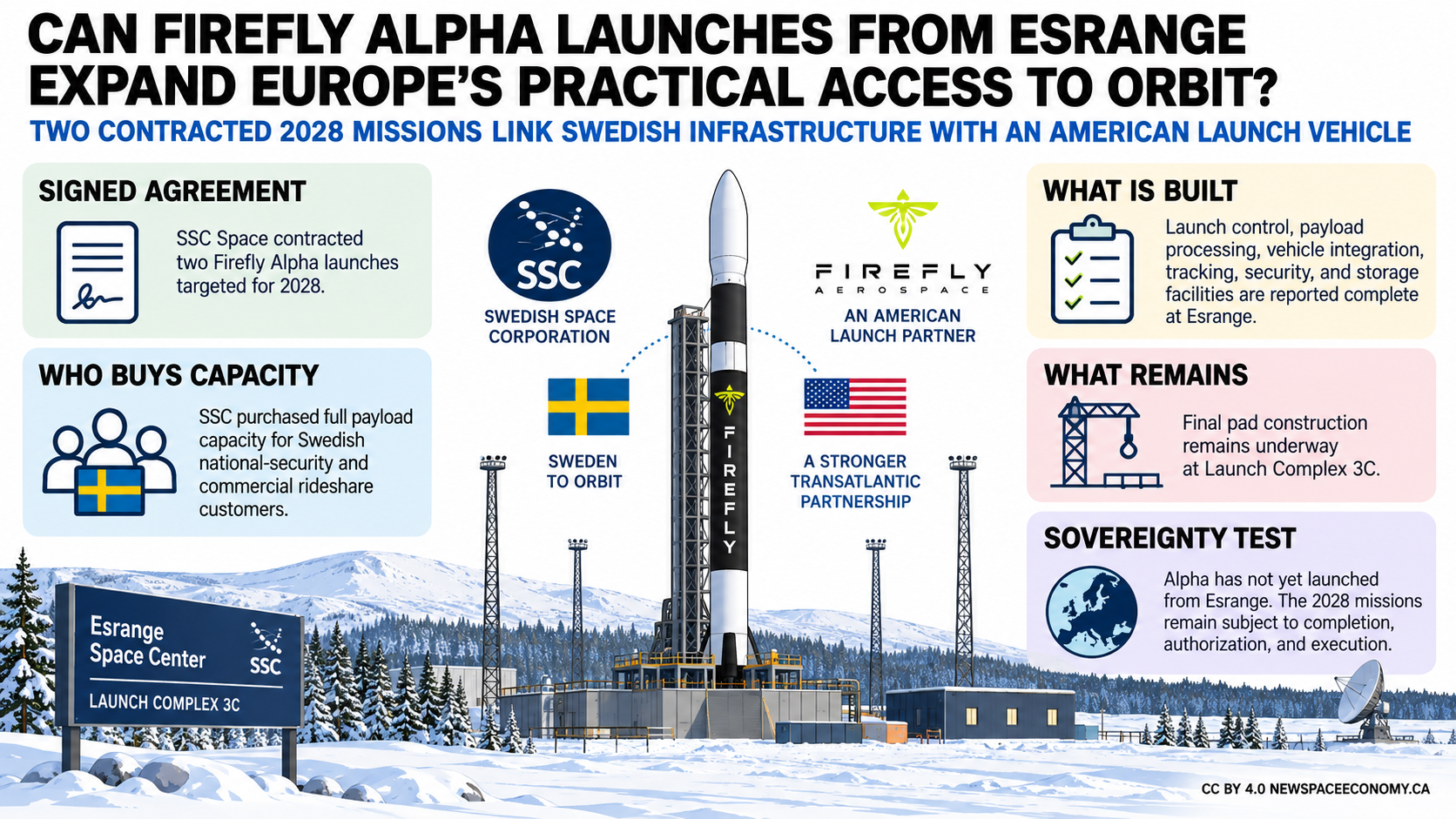
SSC Space and Firefly Aerospace announced a contract on September 9, 2026, for two Alpha rocket launches from Esrange Space Center in Sweden. The missions are targeted for 2028 and would serve Swedish national-security requirements alongside commercial customers sharing the flights.
The multi-launch agreement gives SSC Space the full payload capacity of both missions. SSC can allocate that capacity among its customers, making it a purchaser of complete launches as well as the operator of the host spaceport.
The companies report completed supporting facilities, with final launchpad construction continuing. The contract does not establish that Alpha has flown from Esrange or that all mission-specific preparations have been completed.
A target year also differs from an achieved operating capability. The missions remain dependent on the completion of site work and the readiness of the vehicle and payloads.
The agreement is nevertheless more concrete than an expression of interest in a new launch location. A named customer has purchased capacity on a named vehicle at a specified site, providing a clearer basis for coordinating infrastructure and mission preparation.
The economic question now concerns execution. Esrange must provide a working service around the launch vehicle, and SSC must assemble customer payloads that fit the missions. Success would demonstrate a functioning transatlantic delivery arrangement rather than simply another European location with launch ambitions.
A Spaceport Must Deliver an Integrated Operating Service
A launchpad is only one part of a spaceport’s capability. Payloads need facilities for preparation, and launch vehicles need buildings and equipment suited to their integration.
SSC’s June infrastructure update provides earlier context for the work supporting Alpha at Esrange. The program combines physical construction with the arrangements required to operate across Swedish and American organizations.
The value of those facilities depends on how effectively they function together during a mission. A completed building may be ready for occupancy without the full launch process having been demonstrated.
Operational rehearsals and interface checks help establish whether people and equipment can perform the required sequence. They also reveal where responsibilities overlap or where a task has no clear owner.
New Space Economy’s analysis of spaceport financial models explains the continuing costs behind launch infrastructure. Facilities require maintenance and staffing even when no rocket is on the pad.
For Esrange, that creates an incentive to develop a dependable flow of activity. A small number of launches can establish capability, but sustained use is needed to support continuing operations unless public funding explicitly covers the difference.
The September contract helps connect construction with customer demand. It does not reveal the complete financial model or establish that launch revenue alone will cover the site’s costs.
A meaningful readiness assessment should follow the entire customer process. The test begins when hardware arrives and continues through launch and post-mission work, rather than ending when the pad is physically complete.
Buying Full Launch Capacity Gives SSC a Commercial Intermediary Function
SSC’s purchase of complete payload capacity creates a different arrangement from a spaceport charging only for facility use. The company can assemble missions for customers that do not need or cannot fill an entire rocket.
That can simplify access for smaller payload owners. Instead of arranging every element of a dedicated launch, a customer can purchase a share of a mission coordinated by SSC.
The arrangement also gives SSC responsibility for matching customer requirements. Payloads sharing a flight need compatible destinations and schedules, with integration arrangements that fit the vehicle’s capabilities.
Commercial risk depends on the terms of SSC’s purchase and resale agreements. If customer demand or readiness changes, the company may need to find replacement payloads or manage unused capacity. The public announcement does not disclose how those risks are allocated.
Government demand can help establish an initial manifest. Swedish national-security requirements are identified in the announcement, but customer identities and payload details have not been fully disclosed.
New Space Economy’s discussion of space-service procurement provides context for purchasing complete services through an intermediary. The end customer needs clear responsibility for the outcome even when several companies contribute to delivery.
A well-structured arrangement would define what happens if a payload misses its readiness date or a launch changes schedule. Those provisions matter because one customer’s delay can affect others sharing the mission.
SSC’s role could create value by handling that coordination effectively. The commercial evidence will come from completed missions and customer willingness to purchase the service again.
European Infrastructure and an American Rocket Create Selective Autonomy
Launching from Sweden would give European customers another geographic option, but the vehicle remains American. The arrangement should be assessed as international cooperation with identifiable dependencies, rather than complete domestic self-sufficiency.
The distinction is important for sovereignty claims. Control over the launch site can improve access to facilities and local scheduling, but it does not automatically provide independent access to the rocket or all the technology needed to operate it.
New Space Economy’s examination of sovereign capability choices explains why countries may accept shared industrial arrangements. The relevant question is which functions must remain available and how external dependencies are managed.
For Esrange, an American vehicle can provide a route toward operating capability without requiring Sweden to develop an entirely separate launcher. That may reduce some development burdens, although it preserves dependence on Firefly’s production and continued participation.
The companies report progress on transatlantic regulatory arrangements. Such progress supports implementation but should not be treated as a blanket guarantee that every future payload or mission is automatically authorized.
Government customers may also require particular security and handling arrangements. Those needs must fit the shared operating model without disrupting the commercial customers on the same flight.
The practical measure of autonomy is whether the arrangement supplies dependable access under the conditions that matter to its customers. A European launch location can strengthen that access even when the complete industrial chain crosses the Atlantic, provided the remaining dependencies are understood.
Mission Fit Matters More Than Geographic Branding
A launch location is useful when it can serve the destination and operating requirements of its customers. Its value cannot be established solely by being closer to the spacecraft manufacturer or inside a preferred jurisdiction.
For Esrange’s proposed Alpha service, payload owners need confirmation that the mission can deliver them to acceptable orbital conditions. The detailed flight plan and vehicle performance matter more than a general claim of European access.
Customer scheduling also affects mission fit. A spacecraft ready before the contracted flight may need storage and continued support. One that is late may lose its place or require changes to the shared manifest.
A spaceport must therefore offer more than a nominal opportunity to launch. It needs preparation processes and reliable information that allow customers to plan their own work.
Transport and integration costs should be included when comparing options. A launch price alone can omit expenses that materially affect the complete mission budget. The September announcement does not disclose enough commercial detail to make that comparison.
The same care applies to responsiveness. A location that can theoretically host a mission does not automatically provide rapid access when a customer needs it. Vehicle availability and completed approvals influence the actual response time.
Esrange’s contracted flights provides an opportunity to test these factors together. Successful delivery would show that the site and vehicle can serve real customer requirements, supplying evidence more useful than comparisons based only on geography or promotional descriptions.
Repeat Operations Will Determine the Long-Term Value
Two contracted missions can establish an operating relationship, but a long-term spaceport business requires continuing activity. Facilities and personnel must remain available between flights, creating costs that outlast any individual launch campaign.
The next commercial test will be whether the initial missions lead to repeat demand. Customers who complete the full service can judge its reliability and integration burden more accurately than prospective buyers reviewing a proposed capability.
For SSC and Firefly, that makes execution commercially important beyond the immediate contract value. A dependable experience could support further purchases, whereas avoidable delays could make customers reluctant to build future plans around the site.
The program should also distinguish local operating readiness from vehicle performance. Problems originating in the rocket would have different remedies from problems in the ground infrastructure. Clear reporting would help establish where improvements are needed without treating every delay as a failure of the entire model.
Workforce development can become an additional benefit if repeated campaigns retain skills at Esrange. That effect depends on continuing work and meaningful participation, rather than the presence of facilities alone.
Public support, if part of the wider infrastructure model, should be assessed against its stated purposes. Strategic access and regional industrial benefits may justify expenditure that launch fees do not fully recover, but those purposes should remain visible.
The strongest evidence would be a sequence of completed missions followed by renewed customer commitments. That would show that the Swedish infrastructure and American vehicle can function as a repeatable service rather than a one-time demonstration.
Summary
The SSC–Firefly agreement gives Esrange two concrete Alpha missions targeted for 2028. It connects infrastructure development with purchased launch capacity and establishes a transatlantic model for serving European customers.
The remaining work involves complete operational readiness and mission execution. Final pad construction is one milestone among several, and neither the contract nor the supporting buildings establish a successful launch service by themselves.
A further test will concern flexibility after the initial flights. If SSC can accommodate changing customer requirements without repeatedly rebuilding the mission process, Esrange could become a useful addition to European access to orbit. That would be demonstrated through repeat operations and dependable delivery, rather than the nationality of any single component.