- Key Takeaways
- The UK Space Strategy Reorders British Space Priorities
- £7.8 Billion Creates Scale but Not Automatically Growth
- Defense Procurement Becomes the Main Market-Shaping Instrument
- Sovereign Capability Must Be Defined Selectively
- Satellite Communications Expose the Dependency Problem
- Access to Space Faces a Difficult Commercial Record
- Space Domain Awareness and Servicing Could Reinforce Each Other
- ESA, NATO, and Allied Partnerships Multiply British Capacity
- Research Strength Must Convert Into Scalable Companies
- Delivery Measures Will Determine Whether the Strategy Works
- Summary
Key Takeaways
- The United Kingdom will concentrate £7.8 billion on security, sovereign capacity, and growth.
- Government purchasing could give British space companies dependable demand and room to scale.
- Selective sovereignty will require domestic assets, commercial services, and allied partnerships.
The UK Space Strategy Reorders British Space Priorities
On September 8, 2026, the British government released a UK Space Strategy backed by more than £7.8 billion in planned investment through the 2029/30 financial year. The document places defense, national security, and economic growth at the center of British space policy.
That order matters. Earlier British policy often presented space through a broad combination of science, innovation, regional development, and participation in European programs. Those activities remain, but the 2026 strategy treats space capabilities more directly as national infrastructure. Satellites support communications, navigation, financial transactions, weather forecasting, intelligence, military operations, and public services. The strategy says satellite services support activity associated with 18% of British gross domestic product.
The government has selected four subsectors for concentrated support: satellite communications, space domain awareness, in-orbit servicing, assembly and manufacturing, and access to space. Each has both commercial and security applications. Secure communications serve military units and civilian users. Space domain awareness helps operators track satellites and debris. Servicing technologies can extend spacecraft life or remove hazardous objects. Launch facilities can support commercial missions and government access requirements.
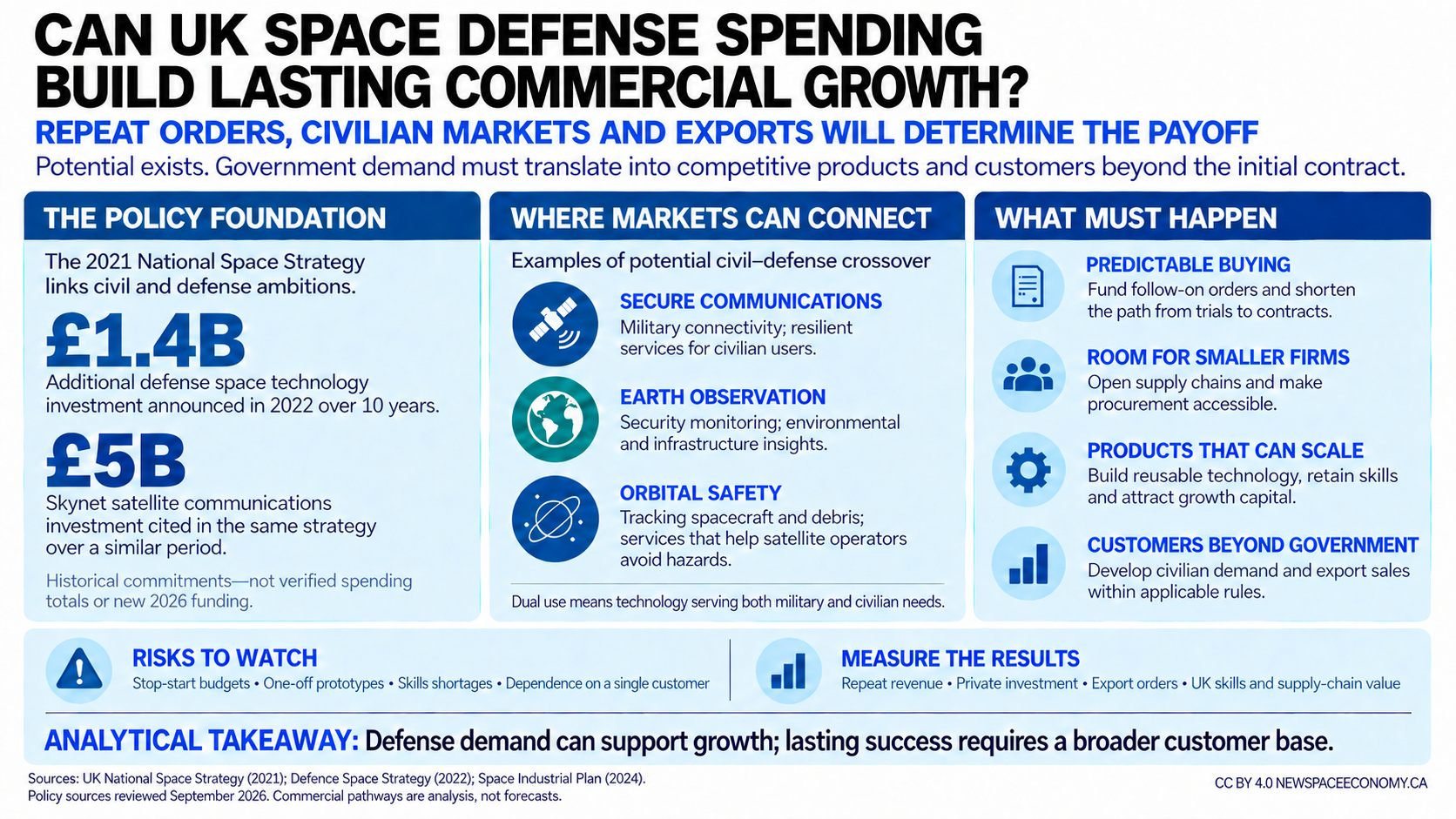
New Space Economy’s examination of the UK strategy and commercial growth identifies the central policy test. Public investment can create technical capacity, yet lasting economic value requires repeat customers, export sales, production knowledge, and companies able to survive after individual programs end.
The strategy responds to that problem by moving government purchasing closer to industrial policy. British departments will be expected to consider how their demand for communications, observation, security, and scientific services can support domestic suppliers. The government also intends to intervene selectively where a capability has high commercial potential or contributes to national autonomy.
Selective intervention is more credible than attempting to build every part of the space value chain at home. Britain has considerable strengths in satellite payloads, communications, propulsion, research, insurance, regulation, and scientific instrumentation. It has less scale in orbital launch, mass spacecraft production, and large sovereign constellations. The strategy recognizes that public resources must be concentrated rather than spread evenly across every promising technology.
The question is whether the government can maintain that focus once departments, regions, established contractors, and startups compete for the same funding. A strategy becomes economically useful when it changes purchasing decisions, contract structures, and investment behavior. Publication alone does not accomplish those tasks.
£7.8 Billion Creates Scale but Not Automatically Growth
The £7.8 billion commitment gives the strategy financial weight. It covers defense and civil programs through 2030, including satellite communications, scientific missions, space surveillance, launch infrastructure, Earth observation, and positioning services. The total is large enough to shape company decisions if departments translate it into visible procurement schedules.
British space companies need more than grants. A grant can fund research, a prototype, or a demonstration mission. It rarely creates the predictable revenue needed to build a factory, recruit production staff, qualify multiple suppliers, or negotiate long-term financing. Companies make those investments when they can see a credible sequence of purchases.
Defense procurement may provide that visibility. Military communications, orbital monitoring, intelligence services, and resilient navigation require continued operation rather than one-time demonstrations. A department buying an operational service over several years gives a supplier stronger evidence of commercial demand than a short development award.
This relationship explains how defense spending expands the space economy. Government customers can absorb early development costs, establish demanding performance requirements, and purchase capacity before civilian markets reach comparable scale. Suppliers can then adapt the resulting technology for civil agencies or private customers.
The economic result depends on contract design. Large cost-reimbursement programs tend to favor established contractors with extensive compliance departments. Smaller companies often benefit more from fixed-price milestones, paid demonstrations, framework agreements, and contracts for defined service outcomes. These structures allow new suppliers to compete without reproducing the administrative machinery of a traditional defense prime.
Procurement timing also matters. A company cannot plan production efficiently when it receives several small grants separated by long periods of uncertainty. Irregular awards encourage firms to retain engineering teams but postpone investments in repeat manufacturing. Britain would gain more industrial capacity from a published purchasing pipeline covering several years than from a collection of disconnected competitions.
The strategy’s value should therefore be measured through the behavior it produces. Relevant indicators include the percentage of spending awarded through competitive procurement, the number of suppliers receiving follow-on contracts, export revenue generated by supported technologies, and private capital invested after government validation. Employment numbers alone would provide an incomplete picture because temporary project work does not necessarily create a self-supporting business.
A separate concern involves the distribution of spending between domestic firms and foreign-owned suppliers. Britain participates in an international space industry, and excluding capable foreign companies would raise costs and reduce access to technology. Yet a program described as sovereign industrial policy must retain intellectual property, engineering knowledge, operational control, or production capacity inside the country.
The government will need to explain which benefits it expects from each large purchase. Some contracts may prioritize immediate operational performance. Others may develop domestic skills or establish a new supplier. Trying to satisfy every objective with every contract could produce expensive programs with unclear results.
Defense Procurement Becomes the Main Market-Shaping Instrument
Defense agencies purchase space services because military operations increasingly depend on them. Secure communications connect ships, aircraft, deployed units, and command centers. Earth observation supports intelligence and damage assessment. Navigation and timing data guide vehicles, synchronize networks, and support weapons systems. Orbital monitoring helps governments understand what other spacecraft are doing.
The British strategy places these operational requirements beside commercial policy. That combination gives the Ministry of Defence greater influence over which technologies receive sustained support. A company able to satisfy defense security, availability, and resilience standards may gain a reference customer that improves its standing in allied markets.
The opportunity extends beyond spacecraft manufacturers. A defense space contract can generate demand for antennas, terminals, encryption, ground stations, data processing, cyber protection, component testing, software, maintenance, and training. The economic reach of a program depends on how much of this work remains open to competitive suppliers.
Commercial services have also changed military procurement. Governments once acquired most sensitive space capacity by owning complete systems. Military users now purchase bandwidth, imagery, analytics, and network access from commercial operators. New Space Economy’s review of satellite services for military organizations describes a mixed architecture in which sovereign satellites, allied systems, and commercial networks serve different security requirements.
Britain can use that model to avoid the cost of owning every asset. The government may reserve sovereign systems for protected communications or intelligence missions and purchase commercial capacity for routine traffic, surge demand, or less sensitive operations. Such an arrangement broadens the supplier base and lets departments adopt newer services without waiting for a complete government spacecraft program.
Commercial purchasing introduces its own risks. A supplier may change ownership, suffer financial distress, or redirect capacity toward a larger customer. Foreign law may affect access to data or equipment. A service that performs well during peacetime may face congestion, interference, or political restrictions during a conflict.
Contracts must address those conditions before a crisis. Buyers need defined availability levels, priority rules, cyber requirements, replacement provisions, and access to technical information. Government users also need terminals and software capable of moving between networks when one service fails.
Industrial policy can distort competition if officials repeatedly select suppliers based on national symbolism rather than operational performance. Protection from competition may preserve employment for a period, but it can weaken incentives to improve cost, reliability, and delivery. The stronger model gives domestic companies a credible path into government procurement and still requires them to meet measurable standards.
Classification presents another obstacle. Smaller firms cannot sell a dual-use service broadly if defense rules place too much of the underlying technology behind security restrictions. British departments will need to separate sensitive mission information from commercial technology that can support export growth.
A successful defense-commercial relationship gives companies an early customer without making them permanently dependent on one ministry. Companies should be expected to develop civil applications, allied sales, and private customers as their products mature.
Sovereign Capability Must Be Defined Selectively
“Sovereign capability” can mean ownership, control, domestic production, guaranteed access, or freedom from foreign political interference. Those are different conditions, and each carries a different cost.
Britain could own a satellite built largely with imported components. It could purchase a service from a British company that relies on foreign launch vehicles and cloud infrastructure. It could operate a system developed through the European Space Agency. Each arrangement provides a degree of national control, but none represents complete independence.
Complete self-sufficiency would be financially unrealistic. Spacecraft incorporate electronics, sensors, materials, software, propulsion systems, and ground equipment drawn from international supply chains. Launch vehicles depend on specialized components and test facilities. Even the United States relies on foreign materials and allied suppliers in selected areas.
The British government therefore needs a tiered definition of sovereignty. Missions connected to nuclear command, protected military communications, or independent intelligence may require national operational control and tightly managed supply chains. Less sensitive services can rely on allied or commercial providers if contracts guarantee access and permit replacement.
This selective model fits the wider structure of the space economy. Space activity connects manufacturing, launch, data services, insurance, finance, communications, agriculture, transportation, defense, and public administration. No country needs to dominate every layer to retain strategic influence.
The strategy’s four selected subsectors offer different forms of sovereignty. Space domain awareness gives Britain independent information about orbital activity. Secure satellite communications provide control over sensitive traffic. In-orbit servicing could help maintain or inspect national spacecraft. Domestic launch infrastructure offers an option for placing selected payloads into orbit from British territory.
Even these capabilities depend on external relationships. A British launch site may host a foreign-designed rocket. A domestically built satellite may use an American launch service. Space surveillance data becomes more accurate when combined with information from allies. Communications resilience increases when users can move between British and allied networks.
The government should identify the exact dependency it wants to reduce in each program. Without that clarity, sovereignty can become a flexible justification for high spending. A domestic system may cost more than a commercial alternative without providing meaningful additional control.
Ownership also matters less than operational authority in some circumstances. A government may obtain assured service from a privately owned system through contractual priority and technical access. Conversely, owning hardware provides limited security if foreign suppliers control essential software updates or replacement components.
Britain’s practical objective should be freedom of action rather than isolation. That means maintaining enough domestic knowledge to evaluate systems, negotiate from an informed position, integrate services, and replace a supplier when necessary. Strategic autonomy comes from options.
Satellite Communications Expose the Dependency Problem
Satellite communications receive strong attention because they support government, military, maritime, aviation, emergency, and commercial users. Britain already possesses substantial experience through companies such as Inmarsat, now part of Viasat, and Eutelsat OneWeb. It also operates the Skynet military communications program.
These assets do not eliminate dependence on overseas suppliers. Commercial low Earth orbit services have demonstrated their value during disasters and armed conflict, but their operation remains subject to corporate decisions, licensing conditions, ground infrastructure, and foreign jurisdictions. Governments cannot assume that commercial capacity will always be available on preferred terms.
The issue became more visible as the British government expanded its use of services connected with SpaceX. Reuters reported in September 2026 that British departments had spent nearly $40 million on Starlink and Starshield-related equipment and services, including terminals intended for government and defense use. Such purchases can provide fast deployment and extensive coverage, but they also concentrate dependency on one American company.
A rational response is not to reject foreign commercial services. Building an equivalent sovereign constellation solely to avoid dependency could cost billions of pounds and take years. Britain can instead combine domestic military satellites, Eutelsat OneWeb capacity, other commercial networks, and allied arrangements.
Technical interoperability will determine whether that combination works. Terminals designed for one constellation may not connect to another. Security approvals can limit network switching. Data formats, encryption systems, and user equipment may create hidden forms of vendor dependence even when multiple satellite operators exist.
Government procurement should reward portability. Departments could require open interfaces, defined data-export rights, multi-network terminals, and tested procedures for transferring traffic between providers. Resilience must exist in operational practice rather than in a list of contracted suppliers.
The commercial opportunity is substantial. British companies can develop antennas, network-management software, encryption, gateways, optical communications, and service integration. These products may be easier to export than an entire sovereign constellation because allied governments face similar dependency concerns.
Satellite communications also demonstrate why national security purchasing can support civilian markets. Technologies developed for secure military connectivity can serve remote industries, shipping, aviation, emergency response, and infrastructure operators. Civil buyers may value reliability and network diversity even when they do not require military protection levels.
The economic test remains customer breadth. A communications supplier dependent almost entirely on British defense contracts may have stable revenue but limited commercial reach. A company that converts defense-funded engineering into products sold across several sectors creates a stronger industrial return.
Access to Space Faces a Difficult Commercial Record
Britain has invested political attention and public money in becoming a launching state. Spaceports in Scotland and Cornwall have pursued different combinations of vertical and horizontal launch. The results have shown how difficult it is to turn geographic access into a sustainable launch business.
Virgin Orbit’s January 2023 mission from Spaceport Cornwall failed to place its payloads into orbit. The company later entered bankruptcy. Orbex encountered financial difficulties after years of work on a Scottish launch vehicle. Other prospective operators changed schedules, financing plans, or technical partnerships.
These outcomes do not prove that British launch is impossible. They do show that launch infrastructure cannot survive on national ambition alone. A spaceport needs vehicles, payload customers, regulatory approvals, range services, insurance, trained personnel, and enough missions to distribute fixed costs.
The 2026 strategy adopts a more selective approach, with particular attention to SaxaVord Spaceport in Shetland. SaxaVord offers northern launch trajectories suited to polar and sun-synchronous orbits, which are commonly used by Earth observation and surveillance satellites. Its commercial prospects depend on attracting reliable launch operators with funded vehicles and credible manifests.
European demand could help. Governments want more launch options after delays, vehicle retirements, and dependence on non-European providers restricted access to orbit. New Space Economy’s analysis of European launch competition shows that emerging providers must prove reliability and cadence before policy support becomes a stable market.
Britain should avoid treating every launch from domestic soil as an economic success. A mission using a foreign vehicle, imported equipment, and a foreign payload may produce some local revenue but little lasting industrial capacity. The value increases when British suppliers provide components, mission software, range services, testing, insurance, or payload integration.
Government missions can support an early launch schedule, though they should not conceal weak commercial economics. Purchasing several demonstration launches may help a provider qualify its system. Continuing to buy expensive missions after the service fails to attract other customers would preserve activity without creating a viable market.
Launch policy also needs an exit discipline. Projects that repeatedly miss technical and financial milestones should not receive indefinite support because officials fear admitting failure. Redirecting funds toward stronger suppliers or adjacent services can preserve the wider industrial objective.
Britain may gain more from specialized access than from attempting to compete directly with high-cadence American launch providers. Responsive missions, polar trajectories, small government payloads, and tightly integrated services could offer defensible market positions. Even there, cost and schedule performance will decide whether customers return.
Space Domain Awareness and Servicing Could Reinforce Each Other
Space domain awareness refers to the ability to detect, track, identify, and assess objects and activity in orbit. The service draws on radar, optical telescopes, satellite sensors, databases, and analytical software. Demand is rising because orbital congestion, debris, military activity, and large constellations make reliable information more valuable.
Britain already contributes to international surveillance and tracking efforts. The UK Space Agency has supported sensor development, debris monitoring, and data analysis. British military facilities also participate in allied space monitoring.
Independent awareness provides several benefits. Operators can receive warnings about possible collisions. Regulators can evaluate whether license holders follow operational commitments. Defense officials can assess unusual spacecraft behavior. Insurers and investors can use better information to understand risk.
Commercialization will require products that customers can purchase and use without building their own analysis teams. Raw observations have limited value if operators cannot convert them into maneuver recommendations, risk assessments, or operational alerts. British companies have room to compete in software and integrated services even when sensor data comes from several countries.
The connection with in-orbit servicing is direct. A servicing spacecraft needs accurate information about its target, surrounding objects, and approach path. Inspection missions may contribute new observations. Debris-removal systems require trusted tracking data before they can rendezvous with an object safely.
Britain has supported missions and companies working on debris removal, inspection, refueling, and spacecraft life extension. These technologies could serve government customers that want to protect expensive assets and commercial operators seeking longer satellite lifetimes. They also carry security concerns because a spacecraft capable of approaching and manipulating debris may be able to approach an active satellite.
Regulation and transparency will shape market acceptance. Operators need licensing rules for rendezvous, liability arrangements, data-sharing procedures, and evidence that a service mission will not create more debris. International customers will also want assurance that servicing technology will not be used for unauthorized interference.
Government can accelerate this market by purchasing defined services. A contract to inspect a satellite or remove a specific debris object provides a clearer commercial test than a grant to demonstrate general technology. Performance-based missions force providers to integrate spacecraft, sensors, software, insurance, and operations into something a customer can buy.
The strongest British position may come from combining awareness, regulation, insurance knowledge, and servicing expertise. Each capability reinforces the others. Better tracking reduces operational risk. Clear licensing improves customer confidence. Insurance can price the residual exposure. Servicing provides a practical response when monitoring identifies a problem.
ESA, NATO, and Allied Partnerships Multiply British Capacity
Britain’s space strategy depends on international cooperation even as it emphasizes national capability. The country remains a member of the European Space Agency (ESA), participates in the North Atlantic Treaty Organization (NATO), works closely with the United States, and maintains bilateral relationships with other spacefaring states.
ESA membership gives British researchers and companies access to missions that would be too expensive for Britain to fund alone. Contributions support scientific spacecraft, Earth observation, telecommunications research, navigation, exploration, and technology demonstrations. British firms compete for contracts funded through those programs.
The economic return depends on what companies learn and retain. A contract that develops reusable engineering knowledge can lead to later commercial sales. A narrowly defined contribution may generate revenue for one mission without creating a product that can be sold again. Government should evaluate international program participation through both scientific value and industrial development.
NATO creates a separate demand channel. The alliance increasingly relies on commercial communications, Earth observation, and data services. British suppliers that satisfy national security requirements may compete for allied contracts, expanding their customer base beyond the Ministry of Defence.
Allied purchasing can also reduce duplication. Several governments may share communications capacity, surveillance data, or common standards rather than building separate systems. Britain gains resilience through access to partner capabilities and contributes assets in areas where it has comparative strength.
Dependence on partnerships still requires management. Allies may assign different priorities during a crisis. Export controls can delay the transfer of components or software. Shared programs can suffer from complex governance and slow decisions. National capabilities remain valuable where Britain needs immediate authority.
Standards offer a quieter source of influence. British participation in technical, safety, debris-mitigation, and service standards can help domestic firms enter international markets. A company familiar with emerging rules may design compliant products earlier than competitors. Regulators can also encourage responsible conduct without requiring Britain to own every relevant spacecraft.
The strategy should treat international partnerships as part of industrial planning rather than as diplomatic decoration. Each program should specify which British capabilities it will strengthen, what contracts domestic suppliers can pursue, and how the resulting technology can reach additional customers.
Britain occupies a useful middle position. It cannot match American space spending, but it has more technical depth and diplomatic reach than many smaller states. It can assemble coalitions, contribute specialized systems, and help connect commercial services with government requirements.
That position is valuable only if British companies remain capable suppliers. Partnerships cannot compensate for weak delivery, high costs, or technologies that never leave demonstration status.
Research Strength Must Convert Into Scalable Companies
The British space sector generates approximately £18.9 billion in annual income and supports more than 55,000 direct jobs, according to figures used by the UK Space Agency. Universities, research institutes, established contractors, and young companies give the country considerable technical breadth.
Britain has often found it harder to scale technology companies than to create them. Space businesses face long development periods, expensive testing, limited early revenue, and demanding regulatory requirements. Investors may support initial research yet hesitate when a company needs much larger sums for manufacturing and commercial deployment.
Government procurement can close part of that gap. A contract from a recognized public customer validates performance and provides revenue. It may also help a company obtain private financing because investors can see a defined market.
Procurement alone cannot repair every weakness. Companies need experienced managers, manufacturing knowledge, patient capital, export support, and access to facilities. The transition from building one spacecraft to producing 20 requires different systems, suppliers, and quality controls.
The strategy’s selective approach should favor companies capable of repeat delivery. Technical novelty matters less if the supplier cannot produce units on schedule or support customers after deployment. Funding decisions should examine management, manufacturing plans, supplier concentration, and commercial demand beside scientific performance.
Britain also needs a path for firms that do not become large prime contractors. Specialized component makers, software suppliers, test providers, and engineering companies can build profitable businesses by serving several programs. Industrial success does not require every startup to operate a constellation.
Foreign investment creates another policy tension. International capital can help British companies grow, enter new markets, and survive expensive development cycles. Acquisition by an overseas buyer may also move intellectual property, decision-making, or production outside Britain.
Blanket restrictions would reduce financing options. The government can instead attach conditions to support where national capability matters. These might cover domestic facilities, access to intellectual property, continuity of supply, or notification before ownership changes.
Regional development deserves similar discipline. Space clusters can support skilled employment in Scotland, Cornwall, Harwell, Leicester, Belfast, and other locations. Funding should follow credible concentrations of capability rather than an obligation to distribute every program geographically.
Successful clusters contain customers, suppliers, research institutions, and experienced workers. A launch pad without a dependable operator is infrastructure, not an industry. A research center without commercial customers may produce knowledge without producing scale.
Delivery Measures Will Determine Whether the Strategy Works
The 2026 strategy sets a direction through 2030 and identifies longer-term ambitions for 2035. Delivery will span several departments, procurement systems, regulators, and international partnerships. That complexity makes measurement necessary.
Spending totals are easy to publish but reveal little about outcomes. The government should report how much committed funding has been contracted, how much has reached suppliers, and whether programs remain on schedule. Large announcements followed by delayed competitions do not give companies dependable demand.
Commercial measures should include follow-on sales, export revenue, private investment, customer concentration, and production growth. A firm receiving repeated grants without attracting paying customers should not be treated as equivalent to one that has converted government support into a marketable service.
Security measures require different indicators. Britain can assess whether communications remain available during disruption, whether surveillance systems detect relevant orbital events, and whether departments can switch between suppliers. Some results will remain classified, but public reporting can still describe progress without exposing sensitive details.
Supplier diversity also matters. If most spending flows to a small group of established contractors, the strategy may preserve existing capacity without developing new competition. If contracts go mainly to young companies lacking delivery experience, programs may accumulate schedule and technical risk. A balanced portfolio needs both.
The government should distinguish between funded, contracted, demonstrated, and operational capability. Space policy often compresses those stages into a single announcement. A concept receiving development money is not yet an available service. A satellite awaiting launch is not operational. A demonstration does not prove that a company can deliver repeatedly.
Independent review could help maintain that distinction. Parliament, the National Audit Office, and sector bodies can compare spending with schedules, contracts, and operational results. Regular public reporting would also give investors a clearer view of the market the government intends to create.
Policy stability remains another test. Space programs extend beyond electoral cycles and departmental budget reviews. Suppliers cannot build manufacturing capacity when priorities change every two years. Stability does not mean protecting unsuccessful projects. It means preserving long-term objectives and using transparent evidence when programs change.
The strategy will have succeeded if Britain reaches 2030 with more than new spacecraft and launch sites. The stronger outcome would include companies with repeat customers, skilled production teams, exportable products, multiple suppliers, and government users able to purchase services quickly.
Failure would look different. Britain could spend £7.8 billion, complete several demonstrations, and still rely on foreign suppliers for most operational capacity. It could maintain respected research programs without producing companies able to scale. It could own infrastructure that lacks enough customers to cover operating costs.
The difference lies in procurement, delivery, and the willingness to stop supporting programs that do not work. Strategy provides permission to concentrate resources. Execution determines whether that concentration produces lasting capability.
Summary
The UK Space Strategy published in September 2026 marks a stronger connection between national security policy and commercial space development. More than £7.8 billion in planned investment through 2030 gives the government enough purchasing power to influence which technologies mature, which firms expand, and which capabilities remain available under British control.
Four priority subsectors provide the center of that effort: satellite communications, space domain awareness, in-orbit servicing and manufacturing, and access to space. Each can support defense missions and commercial customers. Each also faces a different path to market, from purchasing communications capacity to funding debris-removal missions or supporting launch operations.
Defense procurement can provide dependable early demand, but public spending does not automatically produce a competitive industry. Contracts must create repeat delivery, supplier depth, transferable knowledge, and products that can reach allied or civilian customers. Grants and demonstrations have value, though they cannot substitute for operational purchasing.
Sovereignty will need a selective definition. Britain cannot produce every component or own every service. It can retain freedom of action by controlling sensitive missions, maintaining domestic technical knowledge, diversifying suppliers, and preserving access through commercial and allied arrangements.
The strategy’s most demanding work begins after publication. Departments must turn spending plans into procurement schedules, define measurable outcomes, and distinguish operational capability from funded concepts. Companies must prove that government support can lead to production, exports, and customers beyond a single program.
Britain has scientific strength, established satellite businesses, respected regulators, allied relationships, and a growing security requirement. Converting those assets into lasting commercial growth will depend less on the size of the headline commitment than on what the government buys, how consistently it buys it, and whether suppliers can sell the resulting capabilities elsewhere.