- Key Takeaways
- Space Pharmaceuticals Move Beyond the ISS Test Phase
- Why Microgravity Can Change Biological Production
- Evidence From Merck, LambdaVision, and Auxilium
- The Infrastructure Split Between Stations and Capsules
- The Economics of High-Value, Low-Mass Products
- Regulation Must Follow the Entire Orbital Production Chain
- Supply Chains, Workforce, and Public Procurement
- Commercial Readiness Requires Proof Beyond Flight Success
- Summary
Key Takeaways
- Microgravity can improve selected biological processes, but scientific value alone does not establish a market.
- Reliable launch, orbital processing, sample return, and quality control must function as one production chain.
- Commercial growth depends on repeat customers, regulatory clarity, and products valuable enough to absorb space costs.
Space Pharmaceuticals Move Beyond the ISS Test Phase
On September 17, 2026, Reuters reported that drugmakers and biotechnology companies were preparing for pharmaceutical research and manufacturing after the International Space Station. The date matters because the station remains the main orbital laboratory for life-science work, yet NASA plans to end ISS operations around 2030 and shift low-Earth-orbit services to private providers. Space pharmaceuticals now face a demanding transition: years of government-supported experiments must become repeatable commercial work before the platform that enabled much of that research disappears.
The sector includes several distinct activities. Drug discovery uses microgravity to study proteins, cells, disease models, and chemical behavior. Product development applies those observations to formulations or medical devices intended for use on Earth. Manufacturing goes further by producing a material, dosage form, tissue construct, or device in orbit and returning it under controlled conditions. Those activities share hardware and transport needs, but their economics and regulatory burdens differ greatly.
NASA describes the ISS as a laboratory where investigators have conducted more than 500 protein-crystal-growth experiments through 2021. A NASA review of in-space production identifies drug development, crystallization, tissue engineering, and advanced materials as promising uses of microgravity. The record establishes scientific credibility. It does not prove that routine orbital production can compete with mature terrestrial factories.
Commercialization requires a shift in the question being asked. An experiment asks whether microgravity produces a useful effect. A commercial process asks whether that effect can be reproduced, measured, approved, insured, financed, and delivered on schedule. It also asks whether the resulting product gains enough value to cover launch, spacecraft, integration, orbital operations, reentry, recovery, testing, and regulatory compliance.
That distinction explains why the approaching ISS retirement is both a constraint and a forcing mechanism. Research teams can no longer treat access to orbit as an occasional scientific opportunity. They need production plans that work across private stations, autonomous capsules, or both. New Space Economy coverage of the ISS transition risk shows how schedule uncertainty could interrupt research continuity. Pharmaceutical developers may need to qualify more than one orbital platform so a delay at one provider does not stop an entire development program.
Why Microgravity Can Change Biological Production
Microgravity does not remove gravity completely. Spacecraft in low Earth orbit continually fall around Earth, creating a near-weightless environment for their contents. Under those conditions, buoyancy-driven convection and sedimentation become much weaker. Fluids still move because of surface tension, diffusion, vibration, and other forces, but they behave differently from fluids in a terrestrial laboratory.
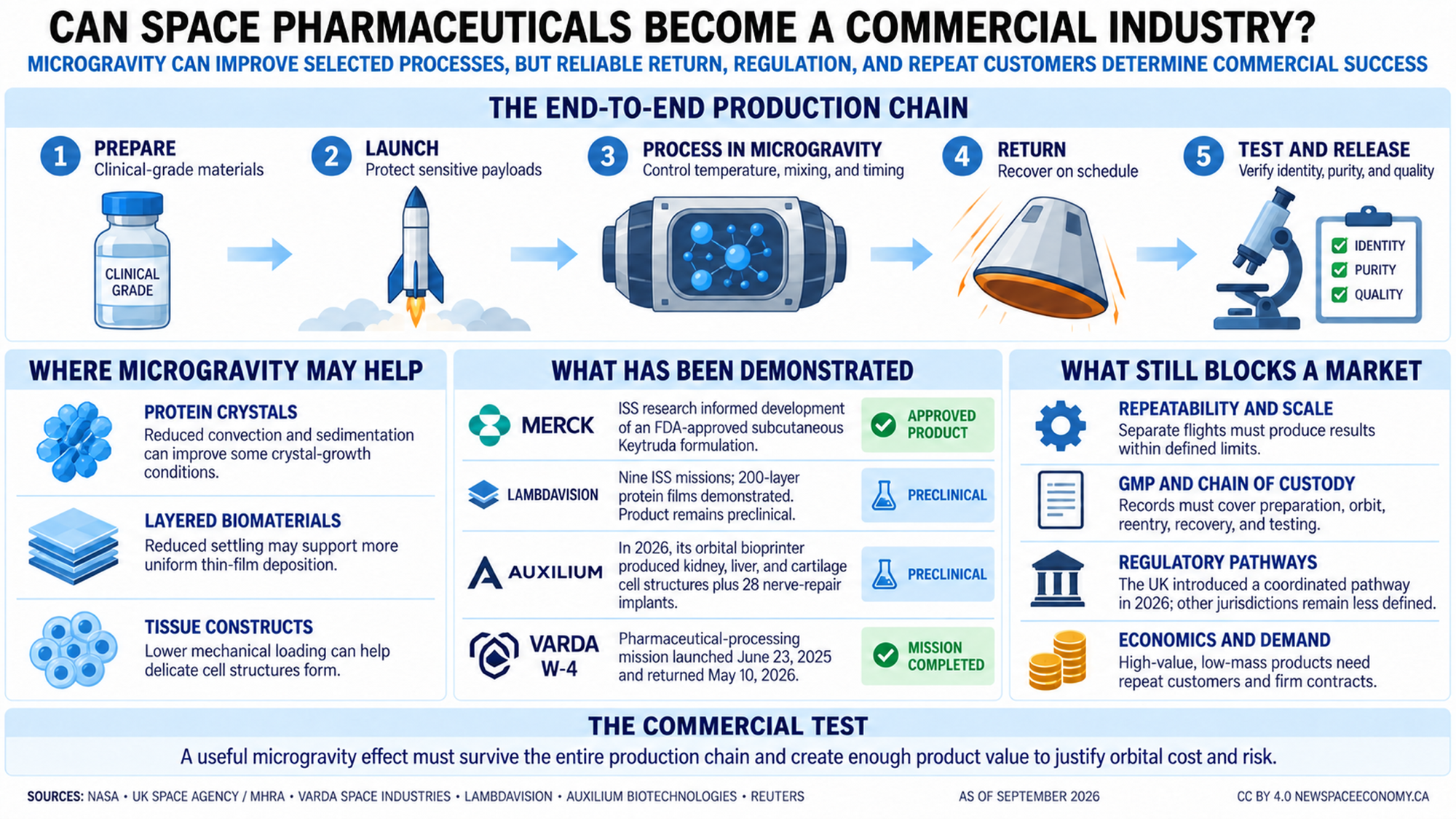
Protein crystallization illustrates the possible benefit. On Earth, gravity can drive fluid circulation and cause particles to settle, disrupting crystal growth. In orbit, some proteins can form larger or more uniform crystals. Better crystals can reveal molecular structures more clearly and can also help researchers study particle size, stability, and formulation behavior. NASA’s account of protein crystal research describes decades of work across shuttle missions, Mir, and the ISS.
Biological tissues present another use. Soft cell structures can sag or collapse under their own weight during terrestrial fabrication. Reduced gravitational loading can let cells assemble or be printed with less need for rigid support material. Researchers can also observe how cells behave when mechanical cues from gravity change. Those conditions may help create disease models, tissue samples, or implants, though an orbital demonstration remains far from an approved transplantable organ.
Layered biomaterials offer a related case. LambdaVision is developing a protein-based artificial retina by depositing many thin layers onto a scaffold. The company says its nine ISS missions helped refine the process and demonstrated 200-layer protein films. Microgravity may improve layer uniformity by reducing settling and fluid disturbances. The company remains in the preclinical stage, and its expected clinical-trial schedule is a plan rather than a completed milestone.
Microgravity does not improve every process. Some formulations gain little from it. Others encounter harder fluid-management problems because liquids do not settle at the bottom of a vessel. Radiation, vibration during launch, limited power, thermal cycling, and reentry loads can damage sensitive material. An orbital method deserves commercial investment only when its advantage survives the complete journey and cannot be reproduced more cheaply on Earth.
The relevant comparison is not space against an ordinary laboratory. It is space against the best terrestrial alternative available when a product reaches the market. Ground-based manufacturing keeps improving through automation, continuous processing, advanced bioreactors, and better analytical tools. Space pharmaceuticals must deliver a measurable property that remains valuable after terrestrial competitors respond.
Evidence From Merck, LambdaVision, and Auxilium
Merck provides the strongest example of orbital research informing an approved medicine. Experiments aboard the ISS examined pembrolizumab, the active ingredient in Keytruda, and produced insights into highly concentrated crystalline suspensions. NASA reported in January 2026 that the research helped inform development of a subcutaneous cancer therapy approved by the U.S. Food and Drug Administration in September 2025. The formulation can be administered under the skin rather than through a longer intravenous infusion for eligible patients.
The Merck case requires careful interpretation. The commercial medicine is manufactured on Earth. Orbital experiments contributed knowledge about particle structure and formulation behavior; the ISS did not serve as a production plant supplying doses to hospitals. That pathway may prove more common than bulk orbital manufacturing. A small quantity of research material can generate information worth far more than its mass, allowing space access to influence a large terrestrial product line without returning tons of output.
LambdaVision represents a different model. Its product concept combines a light-sensitive protein with a layered implant intended to replace some function of damaged retinal cells. NASA documented the company’s early artificial-retina investigation, which began with an ISS experiment in 2018. By September 2026, LambdaVision had completed nine station missions and announced work beyond the ISS. The value proposition rests on producing highly consistent thin films that may be difficult to fabricate under gravity. Clinical evidence, regulatory approval, manufacturing validation, and patient outcomes remain ahead.
Auxilium Biotechnologies adds tissue printing and medical-device production. The company reported that its AMP-1 orbital bioprinter produced structures containing human liver, kidney, and cartilage cells, along with 28 nerve-repair implants, during a 2026 ISS mission. Its company materials describe the platform as an automated manufacturing system rather than a single-purpose experiment. These results indicate that one compact machine can process more than one biological product type. They do not establish that the tissues are transplant-ready or that the implants have completed clinical testing.
Together, the cases reveal three commercial routes. Orbital research can improve a product manufactured on Earth. Microgravity can become part of the fabrication method for a returned medical device. Automated systems can produce biological constructs for research, testing, or eventual therapy. Each route has a different revenue timetable and approval burden.
This differentiation matters for investment. A pharmaceutical company may pay for one high-value experiment if the resulting data improves a blockbuster drug. A medical-device developer may need dozens of flights to validate a repeatable production process. A tissue manufacturer could require sustained access, cold-chain handling, rapid return, and clinical-grade facilities. Treating all three as one market can conceal the operational demands that determine commercial viability.
The Infrastructure Split Between Stations and Capsules
The post-ISS market is dividing into crewed stations and uncrewed return capsules. Crewed stations offer astronaut support, larger laboratories, maintenance, and the ability to host many investigations. Autonomous capsules offer dedicated hardware, fewer crew-safety restrictions, and direct return of processed material. Pharmaceutical customers may use both, depending on product volume and the amount of human intervention required.
NASA’s commercial-station program includes work with Axiom Space, Starlab, and other providers. These stations remain under development as of September 2026. Their business plans combine government demand with private research, national astronaut missions, media activity, manufacturing, and other services. Pharmaceutical demand can strengthen those plans, but it cannot carry a station by itself unless customers commit to regular, high-value use.
Axiom Space promotes in-space manufacturing in advanced materials and biomedical products. Starlab has announced reservation agreements with life-science companies, including a July 2026 arrangement for pharmaceutical research. Vast describes Haven-1 Lab as a research and manufacturing facility with capacity for small-batch biotechnology work. These announcements establish customer interest and planned capability. They do not equal an operational production service until hardware reaches orbit, completes commissioning, and performs to specification.
Autonomous spacecraft follow a different commercial logic. Varda Space Industries combines an orbital processing module with a reentry capsule. Its W-4 mission, launched June 23, 2025, returned on May 10, 2026 after conducting pharmaceutical processing. The company’s platform avoids dependence on station crew time and lets a customer design a mission around a dedicated process. New Space Economy’s Varda company profile explains how pharmaceutical work and government reentry testing support the same vehicle architecture.
Capsules face their own constraints. Payload volume is small, thermal control must survive every mission phase, and landing authorization can shape the schedule. A returned batch also needs prompt recovery and controlled transport to a qualified laboratory. Reentry vehicles may create revenue from government testing before pharmaceutical manufacturing reaches scale, giving operators a way to fund vehicle development without relying solely on biotechnology customers.
Stations favor flexible, multi-user laboratories. Capsules favor dedicated, automated runs. A plausible production network could use stations for exploratory research and process development, then move stable recipes to autonomous vehicles for repeated batches. That model reduces astronaut labor but demands compatible hardware standards, shared data formats, and validated handoffs between providers.
The Economics of High-Value, Low-Mass Products
Space manufacturing favors products whose value is high relative to mass. Launch and return expenses punish bulk commodities. Pharmaceuticals appear attractive because a small amount of active material can carry substantial economic value. Yet price per kilogram is an incomplete measure. A drug also carries development risk, regulatory costs, quality-control obligations, and a finite patent life.
The strongest candidate begins with a biological or physical process that improves in microgravity. The improvement must affect a property that patients, clinicians, or drug developers value, such as stability, delivery method, purity, crystal form, or predictive power in disease modeling. The product must tolerate launch and return, fit within automated hardware, and retain enough margin to pay for repeated missions.
New Space Economy has described in-space manufacturing’s business-model problem as a gap between persuasive science and reliable demand. That gap appears in customer behavior. Pharmaceutical companies may sponsor experiments, but a production market needs multiyear purchase commitments, reserved capacity, or contracts tied to verified performance. Public grants can finance demonstrations; they do not guarantee repeat orders.
Cadence affects cost as much as rocket price. A company that flies once every 18 months learns slowly and carries staff and facilities between missions. Monthly or quarterly service creates more data, faster process refinement, and better use of fixed assets. It also requires enough customers to fill flights. Empty capacity can erase savings gained from reusable launch vehicles.
Return is often harder than launch. Biological samples may require a narrow temperature range, a rapid handoff, and chain-of-custody records from orbit to the testing laboratory. A delayed reentry can alter material properties or invalidate a batch. Customers will judge a provider by end-to-end reliability rather than the cost of reaching orbit alone. New Space Economy’s review of the commercial return market shows why landing sites and recovery networks are becoming commercial infrastructure.
Insurance presents another complication. Launch insurance can cover loss of a spacecraft, but a pharmaceutical batch may have uncertain replacement value because its worth includes time, data, and a place in a clinical program. Contracts must define whether the operator, customer, launch provider, or insurer bears losses caused by launch failure, hardware malfunction, contamination, reentry delay, or recovery damage.
The market may develop through services before products. Companies can sell experiment design, payload integration, analytical data, process-development campaigns, and regulatory support. Those services generate revenue without claiming that hospitals will soon receive large volumes of medicine manufactured in orbit. They also create the operational record needed to support later production claims.
Regulation Must Follow the Entire Orbital Production Chain
A medicine made partly in orbit must still meet terrestrial standards for identity, strength, quality, purity, and safety. Regulators need evidence that the process remains controlled from material preparation through launch, orbital processing, reentry, recovery, transport, and final release. Space adds locations and hazards, but it does not lower the evidence required for patients.
Good manufacturing practice, commonly abbreviated as GMP, governs how medicines are produced and tested. An orbital process would need qualified equipment, documented procedures, calibrated sensors, contamination controls, secure records, deviation handling, and validated analytical methods. Automation must record what happened inside the payload, including temperatures, pressures, mixing conditions, timing, and any interruption in power or communications.
The United Kingdom moved early. In March 2026, the UK Space Agency, the Medicines and Healthcare products Regulatory Agency, the Regulatory Innovation Office, and the Civil Aviation Authority announced a coordinated space-medicines pathway. The package includes guidance, case studies, a regulatory sandbox, and supply-chain work. A June 2026 government explanation described it as the initial dedicated pathway for space-manufactured medicines.
The UK approach addresses a basic problem: several regulatory systems touch one mission. Spaceflight authorities license launch and return. Medicines regulators oversee product quality and clinical use. Customs agencies govern cross-border movement. Environmental and workplace rules can apply to hazardous materials. Export controls may cover spacecraft hardware or biological technology. A company needs these systems to align closely enough that one approval does not conflict with another.
The United States had no comparable dedicated pathway described by Reuters as of September 17, 2026. Existing Food and Drug Administration requirements still apply, and NASA maintains safety reviews for ISS payloads, but neither arrangement alone supplies a complete commercial route for orbital manufacturing. Early engagement with regulators can help companies define what evidence will be required before they lock in hardware that cannot collect it.
Jurisdiction becomes complex when raw material starts in one country, launches from another, processes on a spacecraft registered elsewhere, lands at a foreign range, and enters a pharmaceutical facility in a fourth nation. Regulators will need confidence in data integrity and chain of custody across every boundary. Companies may respond by keeping early missions within one regulatory network, even if a more distributed supply chain offers lower costs.
Standards can reduce duplication. Shared interfaces for payload power, data, temperature logging, sample containment, and recovery documentation would let customers move between platforms without redesigning every experiment. Common standards cannot replace product-specific validation, but they can prevent the transport system from becoming a bespoke obstacle for each medicine.
Supply Chains, Workforce, and Public Procurement
Orbital pharmaceutical production joins two heavily regulated industries with different working cultures. Aerospace teams design for launch loads, radiation, vacuum, limited repair, and mission safety. Pharmaceutical teams design for sterility, batch traceability, validated cleaning, controlled materials, and patient protection. Commercial programs need specialists who can translate requirements in both directions.
Payload integration begins months before launch. Biological material may have a short usable life, so teams must coordinate preparation, transport to the launch site, loading, launch windows, and contingency storage. A scrubbed launch can force a batch to be replaced. Once in orbit, communications outages or power limits may restrict intervention. Recovery teams then need suitable laboratories and cold-chain logistics near the landing location.
The workforce extends beyond scientists and spacecraft engineers. Programs need quality-assurance personnel, regulatory strategists, biostatisticians, mission operators, recovery technicians, customs specialists, and contract managers. Universities can supply research talent, but commercial scale requires training in documented production systems. A brilliant experiment can fail regulatory review if the team cannot prove how every step was controlled.
Government procurement may shape the market during its early commercial period. NASA purchases research services and seeks continued access to low Earth orbit. Defense agencies buy reentry data and flight testing. Health agencies can fund enabling science. These customers can support infrastructure that later serves pharmaceutical companies, though public contracts can also pull providers toward government requirements that differ from clinical manufacturing.
Dual-use revenue is visible in Varda’s model. The same reentry expertise that returns processed material can support government tests of thermal protection and high-speed flight. This does not make a pharmaceutical product commercially proven. It can keep vehicles flying often enough to build an operational record. More flights produce performance data that insurers, regulators, and private customers can evaluate.
National policy will influence where facilities cluster. Countries with launch sites, licensed return ranges, medicines regulators, research universities, and life-science manufacturing may capture more of the value chain. The UK’s regulatory initiative seeks to connect those pieces before the market matures. Australia’s Koonibba Test Range has already supported Varda returns, illustrating how a landing site can become part of an international production network.
Supply security also matters. Pharmaceutical customers will resist dependence on one rocket, one station, or one recovery range. Providers that offer compatible backup routes can reduce schedule risk. The commercial network may resemble contract manufacturing on Earth, with several qualified sites operating under shared specifications and audited quality systems. Space adds orbital transport to that model, making redundancy expensive but commercially valuable.
Commercial Readiness Requires Proof Beyond Flight Success
A successful launch and landing show that hardware can survive a mission. Commercial readiness demands more. The process must create a product with a repeatable advantage, and the evidence must survive scrutiny from customers and regulators. A returned sample that looks promising can justify another experiment; it cannot by itself support routine sales.
Process repeatability is an early test. A provider should be able to run the same recipe on separate flights and obtain results within defined limits. The company must explain how launch vibration, orbital duration, spacecraft orientation, radiation exposure, and reentry conditions affected each batch. If performance changes from mission to mission, the operator needs enough sensor data to identify the cause.
Scale is another test. Increasing production may alter heat transfer, mixing, crystal growth, or cell behavior. Hardware that works for milligrams may not work for grams. Crewed stations can add equipment and human attention; capsules have fixed volume and power. Scaling might mean flying more small units rather than building one large reactor. The right choice depends on product value, failure risk, and quality-control strategy.
Demand must become visible through contracts. Reservation agreements show interest, but firm orders with payment schedules and performance terms provide stronger evidence. Pharmaceutical partners also need to reveal enough about program objectives for investors to judge the opportunity. Confidentiality protects intellectual property, yet excessive secrecy makes it hard to separate paid customer work from provider-funded demonstrations.
Regulatory engagement must start before commercial batches fly. Companies should identify the intended product category, manufacturing jurisdiction, release-testing plan, and evidence needed for clinical or market approval. The UK pathway gives firms a structured place to test assumptions. Other countries may develop their own approaches, creating competition among jurisdictions as well as a need for mutual recognition.
The ISS transition adds a deadline but should not lower standards. Commercial stations and capsules must prove that they can deliver predictable access, controlled processing, and timely return. NASA’s experience can transfer procedures and knowledge, yet private providers will carry more schedule and market risk. New Space Economy’s account of growth in the in-space economy places manufacturing within a broader service network that includes transport, communications, robotics, and data.
The sector will look commercially mature when customers choose orbit because measured product performance warrants the cost, rather than because a flight offers publicity or subsidized research. That point may arrive product by product. One formulation, implant, or research service can succeed without proving that every medicine benefits from space.
Summary
Space pharmaceuticals have moved beyond isolated experiments, but the industry remains in a transition between scientific validation and commercial production. Merck’s pembrolizumab research shows how orbital data can inform an approved terrestrial medicine. LambdaVision and Auxilium are testing manufacturing methods for layered biomaterials and printed biological structures. Varda has demonstrated autonomous processing and return, and developers including Axiom Space, Vast, and Starlab are building platforms intended to continue microgravity work after the ISS.
The commercial test is stricter than the scientific test. A useful microgravity effect must become a controlled process with reliable transport, repeatable output, documented quality, regulatory acceptance, and enough customer value to cover the complete orbital supply chain. Launch price matters, but cadence, return timing, recovery, insurance, and batch integrity can matter more.
Regulation is beginning to catch up. The United Kingdom established a coordinated pathway in 2026, giving companies a route to discuss manufacturing and spaceflight requirements together. Other jurisdictions still rely on existing medicines and space rules that were not designed as one system. International operations will intensify questions about jurisdiction, data integrity, and chain of custody.
Commercial success is likely to emerge through narrow, high-value applications rather than mass production. Research services may mature before finished medicines. Orbital data may improve Earth-based manufacturing more often than orbit supplies final doses. Returned implants, crystals, or biological materials could support specific products whose benefits justify the expense.
ISS retirement raises the cost of delay. It also forces companies to decide which experiments can become businesses. The strongest programs will pair measurable biological advantage with flight cadence, regulatory planning, and a credible customer. Space pharmaceuticals will become an industry when orbit functions as a dependable part of pharmaceutical production, not as a special event.