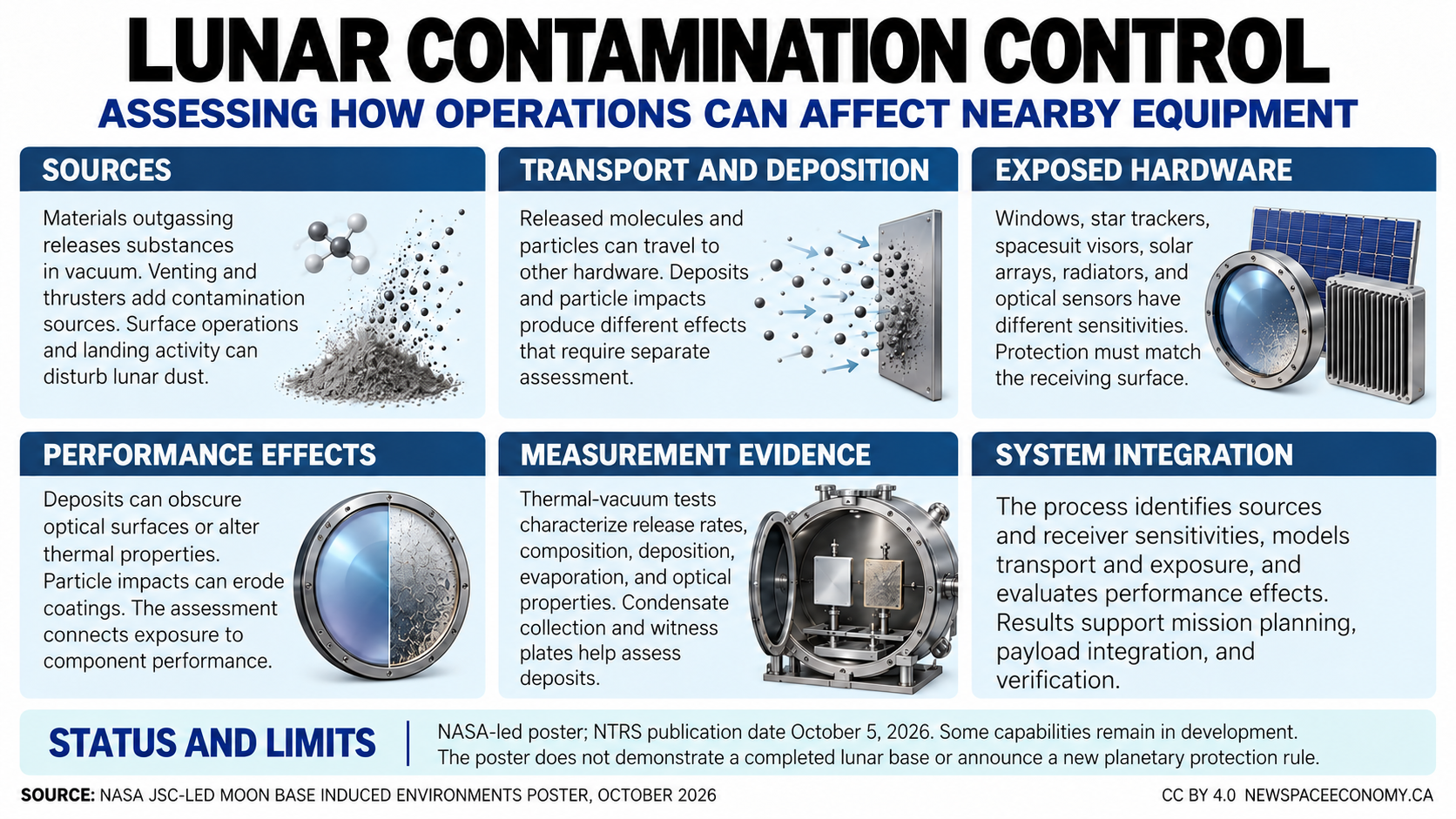
A NASA Johnson Space Center-led poster describes how lunar equipment can create environmental conditions that affect neighboring systems. Moon Base Lunar Surface Operations Induced Environments and Integration, listed with an October 5, 2026 publication date in the NASA Technical Reports Server, addresses lunar contamination from materials, venting, thrusters, and disturbed surface dust. The technical conference poster presents an integration approach for identifying sources, modeling transport, and assessing effects on equipment. It identifies some capability development as still in progress.
The authors include researchers from NASA, Amentum, and The Aerospace Corporation. Their subject is the environment generated by operations and hardware, in addition to the natural conditions on the Moon. This distinction matters when several systems share an operating area. A lander, rover, spacesuit, or scientific instrument can meet its individual requirements and still expose another system to material that reduces performance.
The poster divides the problem into molecular and particulate contamination, together with erosion and deposition of lunar surface material. Molecular contamination can originate when materials release gases or other substances in vacuum, a process called outgassing. Venting and thruster operation provide additional sources. Particulate contamination involves solid particles, including dust moved by surface activity or a landing system’s descent, landing, and ascent.
Contamination control begins by identifying what is being released. A general statement that a material outgasses is insufficient to estimate its effect on a specific instrument. Engineers need information about composition, release rate, and the conditions under which release occurs. These source characteristics provide inputs for calculations of how material travels and where it may accumulate.
The receiving hardware must also be characterized. The poster identifies windows, star trackers, spacesuit visors, solar arrays, radiators, and optical sensors among the systems exposed to contamination effects. Different components have different sensitivities. A deposit that changes optical transmission can affect an observation or a view through a window. A deposit that changes a surface’s thermal properties can affect temperature control.
A star tracker determines spacecraft orientation by observing stars. Contamination on its optical surfaces can interfere with the light reaching its detector. Solar arrays depend on incident sunlight to generate electricity, and radiators release heat to their surroundings. The poster’s integration framework links contaminant transport and deposition to these kinds of system effects, helping engineering teams evaluate which surfaces need protection.
Dust introduces mechanical effects as well as optical obscuration. Particles striking a surface can erode coatings or remove material. Deposited particles can cover sensitive areas without removing the underlying material. The poster treats erosion and deposition separately because they produce different consequences and require different evidence. New Space Economy’s coverage of Moon dust hazards provides additional background on the material and equipment issues associated with disturbed lunar soil.
The integration process follows the relationship between a source and a receiver. Engineers assess the receiver’s sensitivity, characterize the source, estimate transport, evaluate deposition or impacts, and determine the resulting performance change. That sequence makes contamination a system interaction rather than an isolated material property. It also identifies where incomplete measurements or models could limit confidence in the assessment.
The authors describe an approach based on International Space Station integration practices, with improvements informed by Mars 2020 and Europa Clipper. These references identify experience used to develop the process. They do not establish that the operating environments are identical. Lunar applications must account for the conditions and geometry of the particular mission, including local sources and surfaces that may receive contaminants.
Thermal-vacuum testing provides one means of obtaining evidence. Such tests expose hardware to controlled temperature and vacuum conditions. The poster describes measurements on flight articles to characterize outgassing rates, contaminant composition, deposition and evaporation rates, and optical properties. Testing complete hardware can reveal contributions from assemblies that are not fully represented by individual material measurements.
The measurement approach includes collecting condensate and examining deposits on witness plates. A witness plate is a test surface used to collect material for subsequent assessment. Other instruments measure gases in the chamber or the accumulation of condensable material. The aim is to connect the amount and type of released material with the effects expected at receiving surfaces.
Ground measurements still require interpretation before they can support a lunar operating decision. A chamber test does not reproduce every possible arrangement of equipment on the Moon. Engineers must connect measured source behavior to the modeled transport and exposure conditions for the intended application. The poster presents this connection as part of integration and verification, and it does not provide universal numerical exposure limits for every component.
For commercial lunar systems, the engineering implication is that interface information may need to include environmental effects. Payload accommodation normally addresses matters such as attachment, electrical power, and data exchange. Contamination analysis adds information about material release, plume exposure, sensitive surfaces, and operational timing. These considerations could influence equipment placement or the sequence of activities, depending on the demonstrated interaction.
The same information supports scientific interpretation. Material deposited by operations can affect a sensor’s performance or alter conditions near a measurement site. The poster connects induced-environment work to science payload integration and planetary protection, including landing-site alteration. It does not announce a new planetary protection rule. Its stated application is to provide technical information for mission planning and assessment.
The poster does not demonstrate a completed contamination-control system for an operating lunar base. It describes a cross-disciplinary process and identifies development work still underway. Its contribution is to define the evidence needed to evaluate interactions between systems before those interactions affect crew equipment, science measurements, or infrastructure performance.
A shared lunar operating area will require assessments that connect the releasing hardware to the exposed hardware. Material testing alone cannot answer every integration question, and a transport calculation needs representative source data. The practical requirement is a traceable relationship between measured releases, predicted exposure, and acceptable component performance. That relationship allows contamination concerns to inform design and operations without treating an untested assumption as verified protection.
Useful Books Available on Amazon