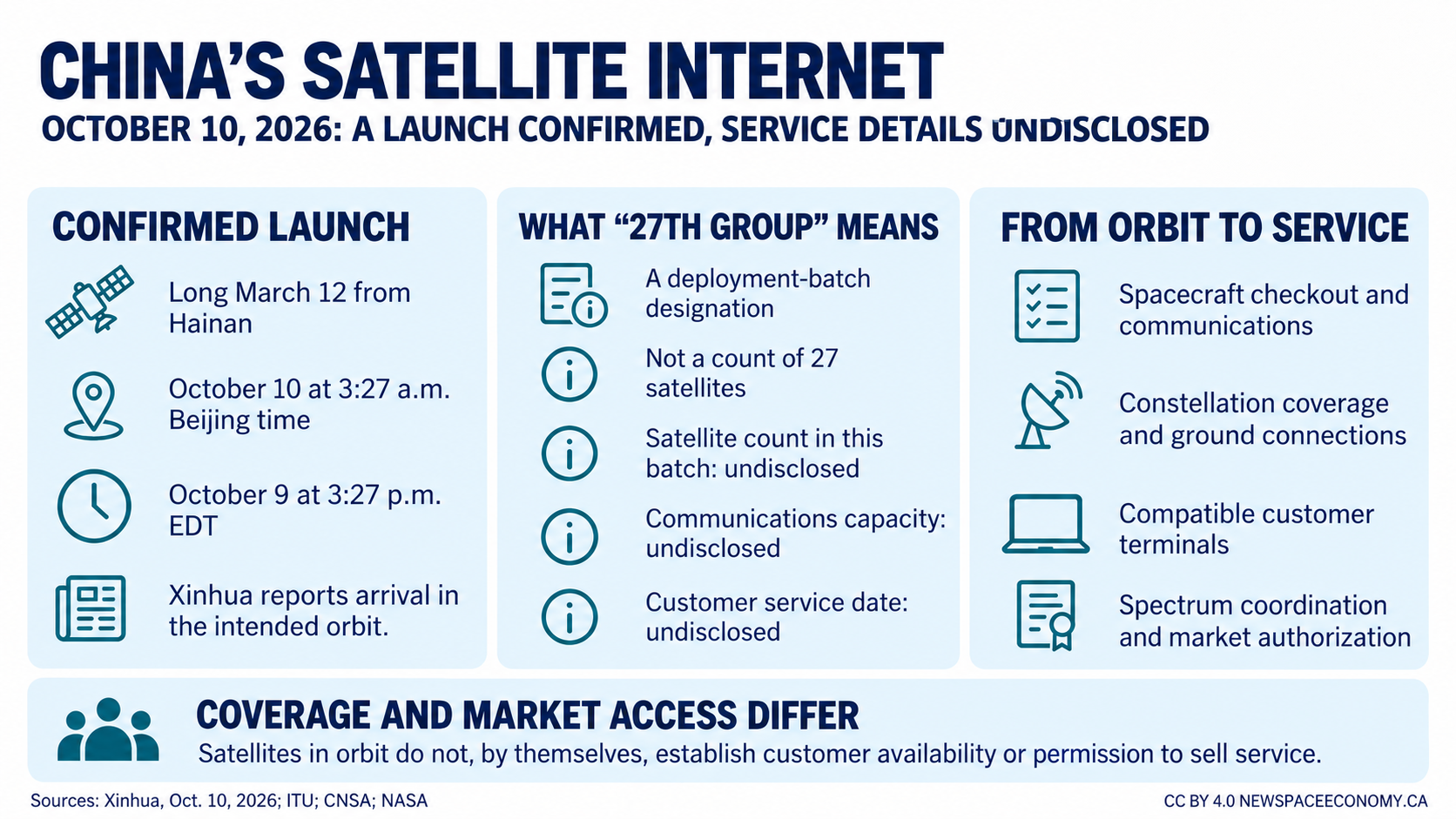
China launched its 27th group of low-orbit internet satellites from Hainan on October 10, 2026, using a Long March 12 rocket. Xinhua’s launch report states that the payload reached its intended orbit after liftoff at 3:27 a.m. Beijing time. That corresponds to 3:27 p.m. Eastern Daylight Time on October 9.
The announcement establishes another deployment in China’s satellite internet program. It does not give the number of spacecraft in the batch, their communications capacity, or a date for customer service. The phrase “27th group” identifies the sequence of launches or deployment groups, not a count of 27 satellites. The distinction matters when assessing how much usable communications infrastructure a launch has added.
Satellite internet requires a system that connects an orbiting fleet with equipment and users on Earth. A launch supplies spacecraft to that system, but does not measure the service it can deliver. Coverage, traffic capacity, user equipment, ground connections, and operating permissions all affect whether a deployed satellite becomes part of a practical broadband offering.
Low Earth orbit offers a shorter communications path than geostationary orbit. The International Telecommunication Union’s non-geostationary systems explanation describes why lower-orbit satellites operate as constellations: they move across the sky rather than remaining above a fixed point. Multiple spacecraft are needed to maintain service as individual satellites pass beyond a user’s view.
Lower altitude can reduce the delay associated with the signal’s journey through space. It also reduces the geographic area visible to each satellite. An ITU-published technical discussion by an SES spectrum specialist explains this relationship between shorter signal paths and smaller coverage areas. The resulting need for many spacecraft helps explain repeated batch launches, without establishing the performance of this particular Chinese deployment.
The total number of satellites alone cannot settle the coverage question. Their distribution across orbital planes and their positions within those planes affect where service can be provided over time. A batch can contribute to a constellation without immediately providing continuous coverage over every intended market. The October announcement does not supply enough orbital or service information to calculate that contribution.
Hainan’s launch infrastructure is part of the program’s physical capacity to place spacecraft in orbit. The China National Space Administration’s account of the site’s debut records a Long March 12 launch on November 30, 2024, carrying two experimental satellites. It describes the commercial launch site as infrastructure intended to support civilian and commercial low-orbit constellation deployment.
That earlier mission provides context for the October 2026 launch without proving a particular annual launch rate or production cost. A functioning launch site and a rocket that has completed missions are concrete infrastructure assets. Their economic contribution depends on how frequently they can support launches, how many suitable spacecraft are available, and how efficiently launch and satellite schedules can be coordinated.
The word “commercial” also requires care. It can describe the organization of a launch service or the intended sale of satellite services. It does not, by itself, establish private ownership of every participating organization. New Space Economy’s Chinese space-sector profile describes a sector containing state-directed programs and commercially organized activities. That broader context should not be used to infer undisclosed contract terms for the latest mission.
After deployment, operators must establish that spacecraft can perform their assigned functions. NASA’s commissioning guidance identifies early operational concerns such as power balance, communications, and recovery from unexpected conditions. These are general engineering requirements. They are not evidence that the Chinese satellites experienced any anomaly, and they do not establish how long this batch will require before entering service.
For a broadband operator, successful spacecraft checkout is followed by service-level questions. User equipment must connect reliably, and information must reach the terrestrial networks or destinations that customers need. Published service availability and measured performance would provide stronger evidence of that result than an orbital-insertion announcement. None of those customer-facing results is included in the short launch report.
Regulation is another separate requirement. The ITU’s satellite coordination overview explains that national administrations license satellite systems within an international framework for spectrum and associated orbital resources. International coordination helps manage interference between authorized systems. Placing a satellite above a country does not establish permission to sell service there.
This distinction is relevant to any claim of global reach. Technical coverage and legal market access answer different questions. A spacecraft may be capable of communicating over a region, but the availability of a lawful service depends on the applicable authorizations. The launch report does not identify new market approvals, and it should not be read as announcing them.
The ITU’s 2026 licensing toolkit separately considers market access, spectrum use, Earth stations, user terminals, and services. It also addresses consumer protection and cross-border terminal enforcement. Those categories show why satellite broadband development involves more than manufacturing and launches. They do not establish which approvals this particular system has obtained.
Operating the fleet also entails managing close approaches and eventual disposal. ESA’s space-debris guidance describes collision assessment, avoidance planning, and measures to limit debris generation. These responsibilities continue after a successful launch. The latest announcement provides no basis for evaluating the new batch’s maneuvering capability or end-of-life arrangements.
Commercial assessment also needs evidence of demand and delivery costs. A successful flight confirms a deployment event, not subscriber growth, affordable terminal prices, or profitable operations. Without disclosed capacity and customer information, comparisons with another constellation risk treating different services and development stages as equivalent. A defensible comparison would use matching measures, such as coverage in the same market or measured performance under similar conditions.
The October 10 mission is a confirmed addition to China’s low-orbit internet deployment activity. Its service contribution will become clearer when operators disclose spacecraft counts, commissioning outcomes, coverage, and customer availability. Those results would connect the launch record to the practical question of where the network works and what communications service it can provide.
Useful Books Available on Amazon