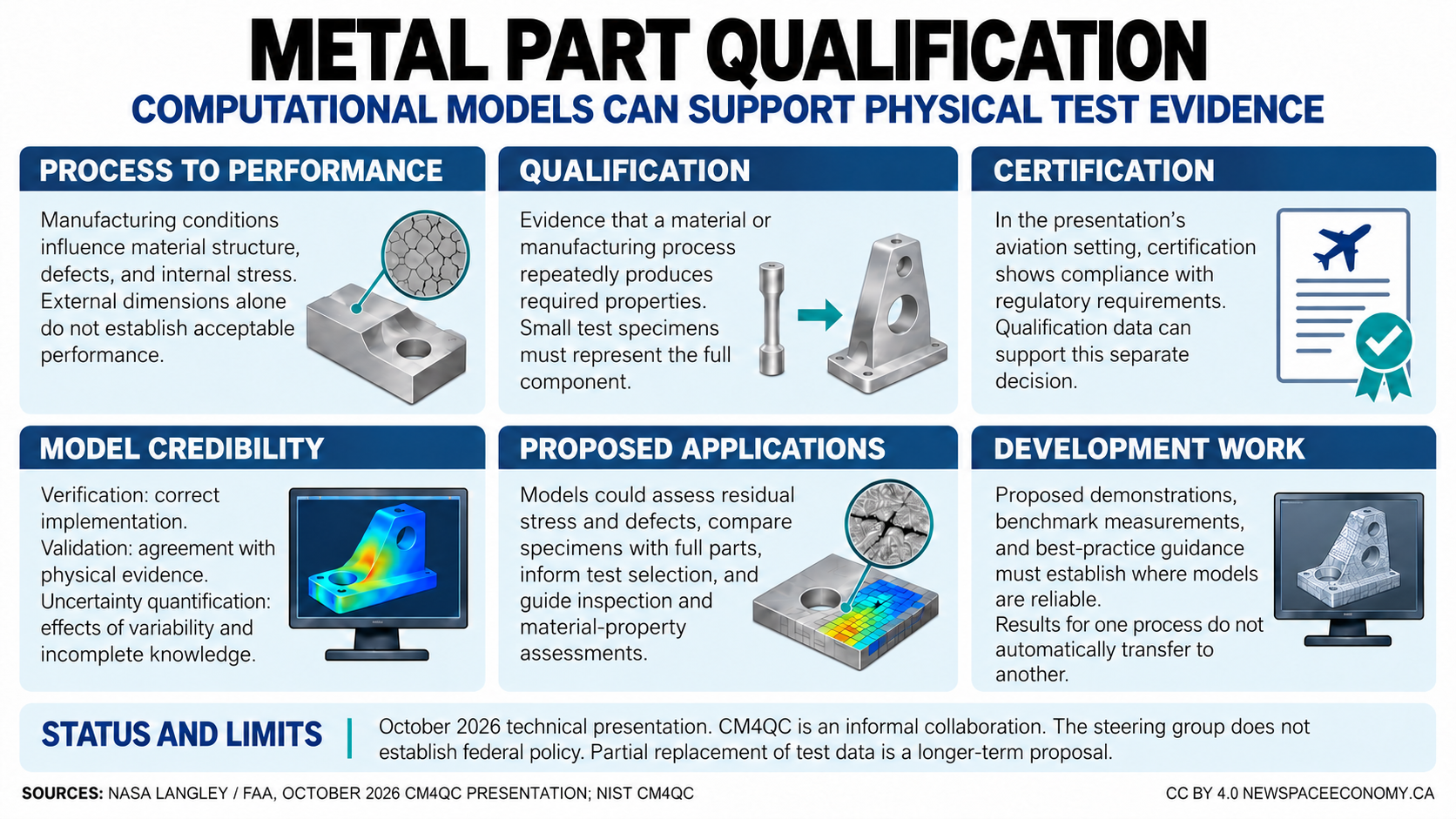
NASA Langley Research Center technologist Edward H. Glaessgen and Federal Aviation Administration specialist Michael Gorelik describe a proposed role for computational materials in a presentation prepared for the October 5–7, 2026 Materials Science and Technology conference. Their qualification and certification presentation, listed with an October 7 publication date by NASA, examines how models could improve the evidence used to accept manufactured metal parts. It focuses on materials whose properties depend strongly on the manufacturing process, including metal additive manufacturing.
The practical issue is the relationship between manufacturing conditions and performance. A finished component must meet requirements for its intended use, even when its geometry or production method differs from a previously accepted design. The presentation proposes computational tools that help engineers choose tests, interpret results, and assess whether small specimens represent full components. It explicitly states that the steering group does not establish federal policy and that the authors’ views do not necessarily represent their institutions.
Additive manufacturing builds parts by adding material, commonly in successive layers. In metal processes, the thermal conditions experienced during production influence the structure of the material. Changing the process can change defects, internal stresses, and the properties that determine how a part responds to loading. A component’s external dimensions alone do not establish whether it will resist repeated loads, elevated temperatures, or crack growth.
Computational materials methods seek to explain these relationships through linked models of processing, material structure, and performance. A process model may estimate how a region heats and cools. Other models may estimate the resulting material structure or its mechanical behavior. The presentation treats these connected calculations as potential contributors to an evidence package, with their usefulness depending on the accuracy and limitations of each model.
Qualification and certification have different meanings in the presentation’s aviation setting. Qualification demonstrates that a manufacturing process or material repeatedly produces the required properties. Certification establishes compliance with regulatory requirements for a product or structure. Qualification data can support certification, but the two activities are not interchangeable. The aviation examples do not establish a universal approval procedure for rocket or spacecraft hardware.
The CM4QC collaboration includes companies, government research and regulatory organizations, and universities. Its work addresses a gap between advances in materials modeling and accepted qualification practices. The National Institute of Standards and Technology describes tools at different readiness levels and identifies verification, validation, and uncertainty quantification as necessary investments. The October presentation develops those issues through specific proposed applications.
Verification checks whether a computational method is implemented correctly. Validation examines whether its predictions agree sufficiently with physical evidence for an intended use. Uncertainty quantification examines how incomplete knowledge and variability affect a prediction. These activities address different questions. A model can be implemented correctly and still fail to represent a physical process accurately enough for a qualification decision.
The presentation calls for objective, quantitative validation measures. It also separates a measure of agreement between predictions and experiments from a decision about whether that agreement is acceptable. Experimental measurements have uncertainty as well, so a comparison must account for limitations in both the calculation and the test. Confidence should reflect the evidence available within the conditions where the model will be used.
One proposed application concerns the relationship between a test coupon and a complete component. A coupon is a small specimen used to measure material behavior. Its production history may differ from that of a larger part with thicker sections, complex internal passages, or changing geometry. Modeling thermal history, material structure, and defects could help establish whether the coupon provides representative evidence or whether additional testing is needed.
Residual stress provides another application. These internal stresses can remain after manufacturing, even when no external force acts on a part. The presentation proposes modeling them to support assessments of damage tolerance and manufacturing feasibility. Such calculations would need validation before they could justify a consequential decision. The proposal does not show that every printed metal component has an accurately characterized residual-stress field.
Engineers also need material allowables, the property values used in design assessments. Generating the supporting data can involve substantial testing across production conditions. The roadmap proposes using models first to select test combinations that provide useful information about variability. Partial substitution of test data with modeling results appears as a longer-term possibility, rather than an established general practice.
Defect assessment could connect models to inspection requirements. The effect of a flaw depends on its location, size, surrounding material, and the loads experienced by the component. A validated model might help identify where inspection should concentrate or which flaw sizes affect acceptable performance. The presentation describes this as a potential application, without announcing a new acceptance limit for flight hardware.
The space-sector relevance is concrete: the presentation illustrates increasingly complex manufactured parts with rocket engine nozzles and turbopump housings. New Space Economy’s coverage of advanced manufacturing in space explains related production methods. Applying computational qualification methods to such components would still require evidence appropriate to their materials, manufacturing routes, operating conditions, and responsible approving organizations.
The proposed next phase includes demonstration exercises, outreach, and best-practice guidance. Controlled benchmark measurements, including the additive manufacturing benchmark work described in the presentation, can help researchers compare calculations with repeatable physical observations. Demonstrations would need to reveal capability gaps as well as successful predictions; a method that works for one part or process cannot automatically be generalized.
The supported near-term direction is to improve the relationship between models and experiments. Better calculations could guide testing and clarify what a specimen result means for a complete part. Any reduction in testing would have to preserve adequate evidence of performance and repeatability. The remaining issue is the validated scope of each method, rather than a general choice between computer simulation and physical tests.
Useful Books Available on Amazon