
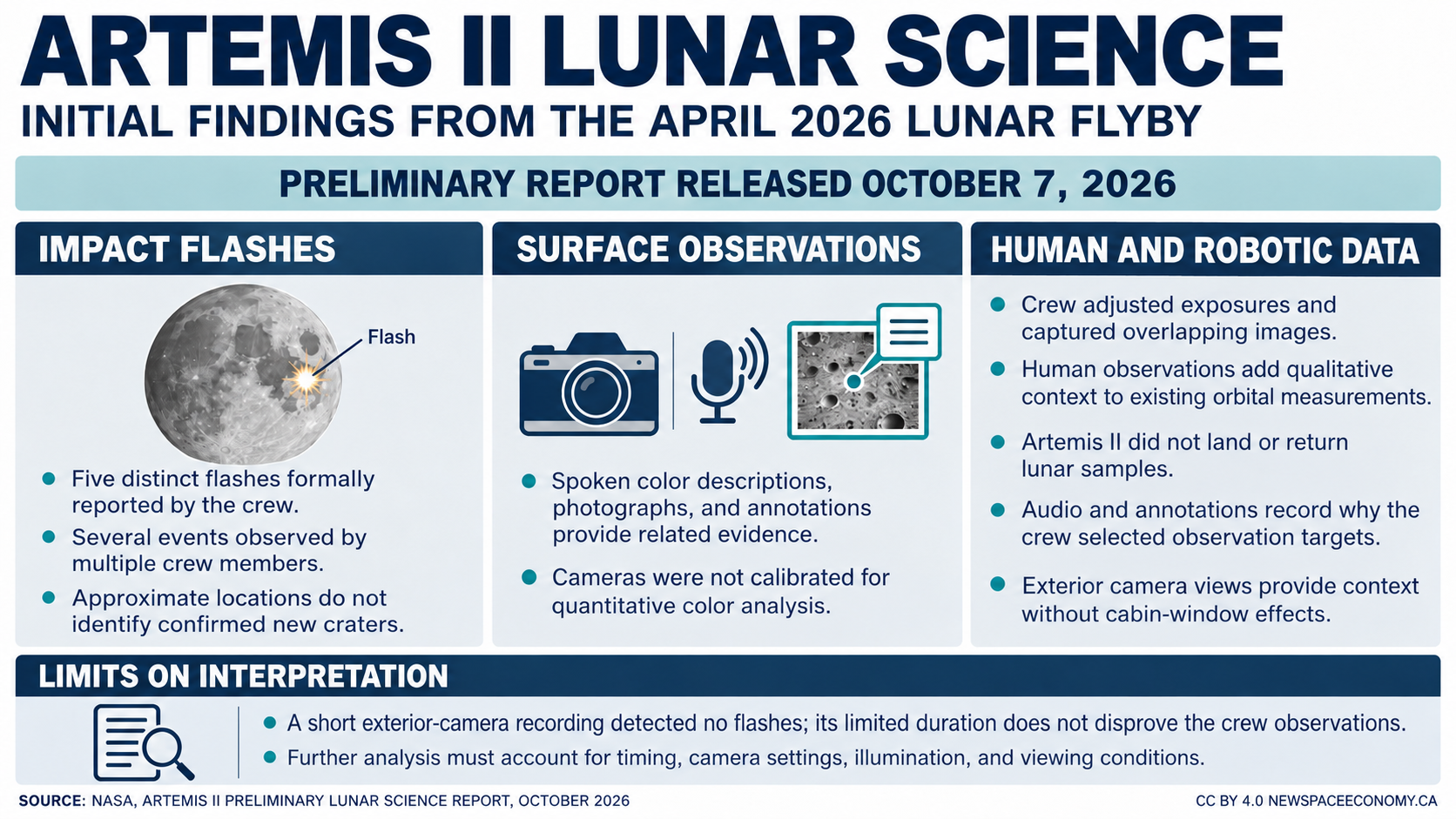
NASA released the Artemis II Preliminary Lunar Science Report on October 7, 2026, documenting observations made during the crew’s April flight around the Moon. The Artemis II science report describes five formally reported impact flashes, differences in perceived surface color, and the combination of photographs, spoken observations, and annotations. Its findings are preliminary. The report supplies an initial assessment of the observations and identifies limitations that affect further analysis.
The science campaign took place within a mission whose primary purpose was to test the Orion spacecraft with astronauts aboard and return them safely. NASA astronauts Reid Wiseman, Victor Glover, and Christina Koch flew with Canadian Space Agency astronaut Jeremy Hansen. Their lunar observations supplemented those engineering objectives. The resulting evidence offers a documented example of how trained human observers can add qualitative information to photographs and existing robotic measurements without replacing calibrated instruments.
The preliminary science report organizes the campaign around 10 science themes. The team developed observations within the available trajectory, spacecraft hardware, and crew schedule. The lunar science team joined mission planning approximately two and a half years before launch, after much of the mission organization was established. Those circumstances matter when assessing the results: the flight was not designed as a dedicated, fully instrumented lunar survey.
One reported result concerns brief flashes on the dark lunar surface. Five distinct events were formally reported during the period when the Moon obscured the Sun from Orion’s viewpoint. Several were seen simultaneously by more than one crew member. The team treated those overlapping observations as evidence that the events were impact-flash detections. The crew also described possible additional flashes but excluded ambiguous events from the formal record.
The evidence consists of recorded descriptions, communications with Earth, and a crew-annotated image showing approximate locations. During a subsequent conference, the astronauts explained that the flashes differed from spacecraft reflections and the visual effects of cosmic rays striking the eye. That distinction supports the team’s interpretation, but the observations do not establish precise impact coordinates, crater dimensions, or the composition of the impacting objects.
An Orion exterior camera recorded approximately two minutes of video during the same eclipse period at 30 frames per second. Researchers found no impact flashes in that recording. The report notes the limited duration, which prevents the absence of a camera detection from disproving the crew’s longer observations. Different observation intervals and instrument capabilities must be considered before comparing the two records.
Follow-up imaging also faces restrictions. The science team consulted the Lunar Reconnaissance Orbiter team and concluded that locating new craters from these events was probably infeasible. The expected craters could be too small for the orbiter’s camera to resolve, and the crew’s approximate locations were insufficient for targeted observations. The flashes provide evidence of transient events, rather than a confirmed inventory of newly mapped craters.
Surface color is another subject for which the report defines a specific evidentiary limit. The handheld and spacecraft cameras were not calibrated for quantitative color and brightness measurements during this mission. Exposure settings, white balance, compression, and viewing through cabin windows can change an image’s appearance. The team consequently treats color and photometric interpretations as qualitative, using the crew’s verbal descriptions as the primary observations for this theme.
Koch’s observations of the Aristarchus Plateau illustrate how the records can be combined. She described a boundary between brownish and grayish areas, photographed it, and added an annotation identifying the feature. The photograph supplies geographic context, the annotation identifies the intended boundary, and the audio records the perceived difference. These are related descriptions of an observation, rather than three independent measurements proving a particular mineral composition.
The report also explains how humans adjusted their imaging during the flyby. Crew members changed camera settings, recorded overlapping images for mosaics, and captured bracketed exposures, meaning several photographs taken with different exposure levels. Such adjustments respond to bright and dark features or changing views. These records preserve how the crew responded to the changing view during the encounter. Their scientific value depends on preserving the settings and the observer’s intent so that later analysts can understand what each image represents.
Matching the records requires care. Camera and audio timing can connect photographs with spoken descriptions, and audible shutter clicks provide additional clues. An audio file’s timestamp may identify when recording ended rather than the moment a statement was spoken. Annotations can be associated with observation blocks and checked against the recordings. These details affect whether a later interpretation refers to the correct feature and viewing conditions.
The observations extend a record assembled by earlier lunar missions, including robotic imaging and Apollo fieldwork. Artemis II did not land or collect lunar samples. Its contribution is a flyby dataset produced by trained observers using available spacecraft equipment. Comparisons with previous data can help frame research questions, but differences in resolution, illumination, instrumentation, and observation methods prevent simple claims that one mission’s evidence is universally better.
NASA’s accompanying public data release gives researchers access to more than 800 gigabytes of material, including more than 11,000 full-resolution images and video, 8.5 hours of science audio, and annotated images. Making the underlying records available allows investigators outside the mission team to examine interpretations and develop additional analyses. The volume alone does not establish the accuracy or scientific significance of every observation.
For future crewed missions, the report supports attention to camera capabilities, annotation methods, timing, and coordination between astronauts and ground scientists. It does not demonstrate commercial demand for particular equipment or establish that recommended changes have been funded. The direct operational implication is narrower: observations become more useful when the mission preserves both the recorded scene and enough context to evaluate how it was observed. Further work must determine which preliminary interpretations remain supported after detailed analysis.
