- Key Takeaways
- How Emerging Space Markets Should Be Classified
- Emerging Launch and Space-Transportation Markets
- Emerging Satellite and Spacecraft Manufacturing Markets
- Emerging Satellite-Communications Markets
- Emerging Earth-Observation and Geospatial Markets
- Emerging Positioning, Navigation and Timing Markets
- Emerging Space-Domain Awareness and Safety Markets
- Emerging In-Orbit Servicing and Debris Markets
- Emerging In-Space Manufacturing and Microgravity Markets
- Emerging Commercial Space-Station Markets
- Emerging Space-Tourism and Human-Spaceflight Markets
- Emerging Lunar-Economy Markets
- Emerging Space-Resource Markets
- Emerging Defense and Security Markets
- Emerging Space-Finance and Insurance Markets
- Emerging Regulatory and Legal Markets
- Emerging Ground-Infrastructure Markets
- Emerging Climate, Environmental, and Sustainability Markets
- Emerging Workforce, Education, and Support Markets
- Geographic Markets With Expanding Space Demand
- Which Emerging Markets Are Closest to Commercial Scale?
- What Determines Whether an Emerging Space Market Succeeds?
- The Commercial Shape of the Space Economy in 2026
- Summary
Key Takeaways
- Emerging space markets now extend from satellite data to lunar infrastructure.
- Earth-based services will generate revenue sooner than deep-space industries.
- Government procurement remains important for many early commercial markets.
A market becomes “emerging” when commercial demand is developing, business models are still being tested, or new technology is creating customers who did not previously exist. In the space economy, the term applies to both new orbital industries and expanding terrestrial services that depend on satellites, spacecraft, launch systems, ground infrastructure, or space-derived data.
The distinction matters because the space economy is often discussed as if it were a single industry. It is better understood as a collection of connected markets. Satellite communications, launch services, Earth observation, navigation, space manufacturing, insurance, cybersecurity, lunar logistics, and space tourism have different customers, costs, regulations, technical risks, and timelines.
The OECD’s space-economy framework defines the sector as the full set of activities and resources involved in exploring, researching, understanding, managing, and using space. Its measurements show that almost 100 countries had operated a satellite by late 2023, including a growing number of lower-income countries.
The World Economic Forum and McKinsey space-economy analysis projects that the global space economy could grow from approximately $630 billion in 2023 to $1.8 trillion by 2035. Much of that increase is expected to come from satellite communications, positioning, navigation, timing, Earth observation, and data services rather than from rockets alone.
How Emerging Space Markets Should Be Classified
Emerging space markets can be grouped into four broad layers.
The first layer consists of infrastructure used to reach, operate in, and communicate with space. This includes launch vehicles, satellites, ground stations, spacecraft manufacturing, spectrum, spaceports, and mission-control systems.
The second layer consists of services delivered from space to customers on Earth. These include broadband, navigation, weather information, imagery, climate monitoring, agriculture data, maritime surveillance, and financial timing.
The third layer consists of services performed in orbit or on other celestial bodies. These include satellite servicing, debris removal, in-space manufacturing, lunar delivery, lunar communications, and resource prospecting.
The fourth layer includes supporting markets. Finance, insurance, regulation, cybersecurity, workforce development, testing, standards, and government procurement influence whether space technologies become sustainable businesses.
New Space Economy uses a related classification that separates the space economy into “backbone,” “reach,” and “emerging” markets. Its space-economy taxonomy helps distinguish established infrastructure from newer activities that depend on that infrastructure.
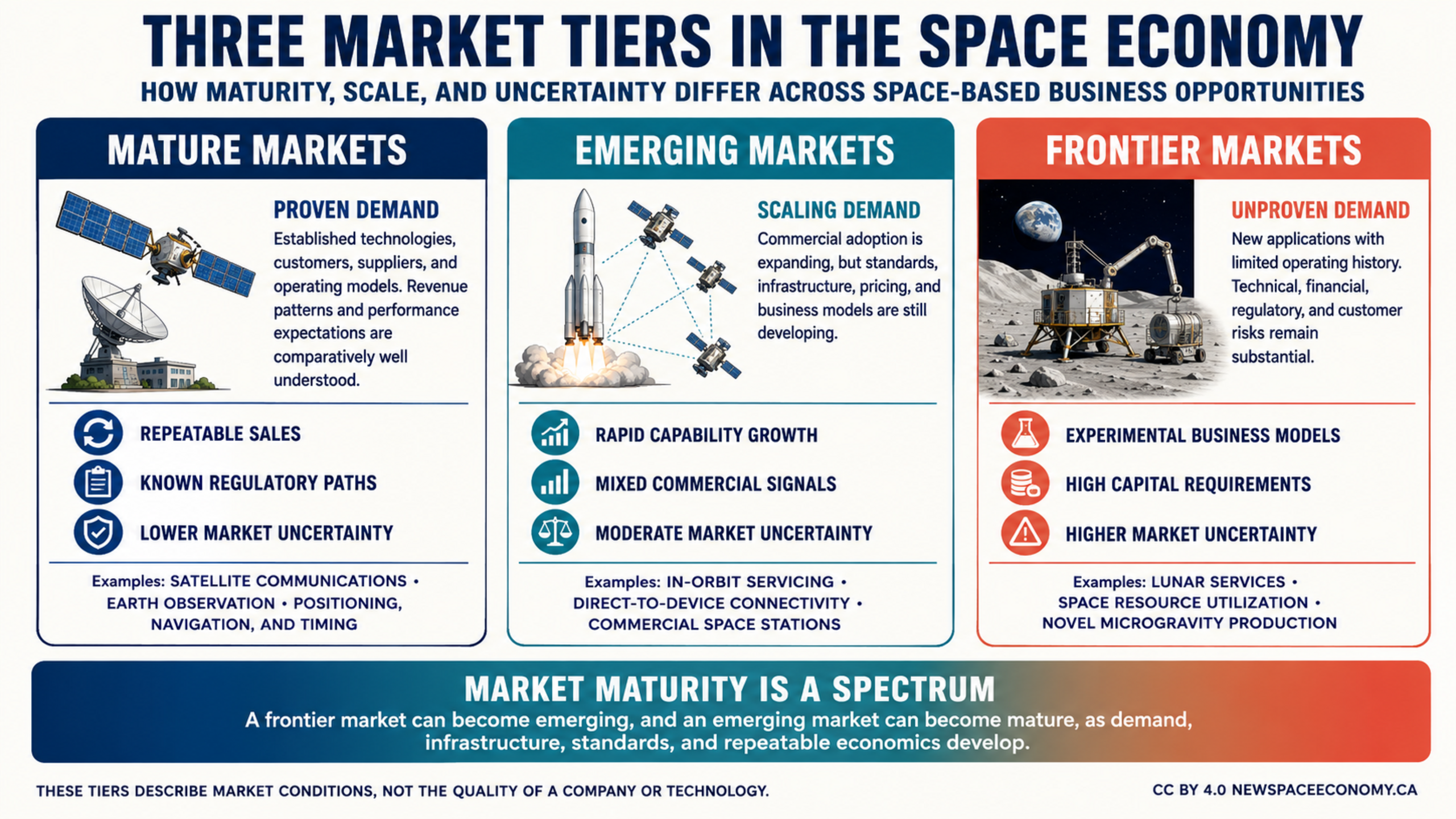
An emerging market does not always mean a speculative market. Satellite-to-phone communications, commercial Earth-observation analytics, space-domain awareness, and satellite servicing have identifiable customers and active demonstrations. Asteroid mining, large-scale space settlements, and orbital data centers have much less commercial certainty.
Emerging Launch and Space-Transportation Markets
Launch remains one of the most visible parts of the space economy, but the market is expanding beyond traditional government launch contracts.
Reusable Orbital Launch
Reusable launch vehicles are designed to return some hardware for another flight. Reuse can reduce manufacturing demand, shorten turnaround times, and support higher launch frequency. The commercial value depends on reliability, refurbishment cost, range access, insurance, and the number of missions available.
Reusable launch is developing through several business models:
- Heavy-lift reusable rockets
- Medium-lift reusable rockets
- Small reusable launch vehicles
- Reusable upper stages
- Recoverable orbital transfer stages
- Reusable spacecraft
- Reusable lunar-landing systems
- Reusable atmospheric-entry vehicles
The market is likely to remain concentrated among companies with access to substantial capital, testing facilities, launch ranges, and government customers. Smaller firms may succeed in specialized missions, responsive launch, or regional services.
Small-Launch Services
Small satellites created demand for launch vehicles capable of carrying payloads into specialized orbits. Dedicated small-launch services offer customers more control over timing, orbital altitude, inclination, and mission scheduling than rideshare launches.
Potential customers include:
- Earth-observation companies
- Defense organizations
- Universities
- National space agencies
- Satellite operators replacing failed spacecraft
- Technology-demonstration programs
- Companies requiring unusual orbital destinations
The business faces strong price pressure from rideshare missions. A dedicated launch provider must offer advantages that justify a higher price, such as schedule control, orbital precision, rapid deployment, or national access.
Rideshare and Mission Integration
Rideshare services place several spacecraft on one launch vehicle. Mission integrators manage payload interfaces, regulatory paperwork, orbital deployment, testing, and launch coordination.
This market is producing demand for:
- Payload adapters
- Deployment systems
- Mission-planning software
- Satellite testing
- Launch brokerage
- Regulatory services
- Orbital deployment
- Payload insurance
- Post-launch operations
New Space Economy’s satellite rideshare guide examines how rideshare services lower launch barriers for smaller spacecraft operators.
Responsive Launch
Responsive launch refers to the ability to place a payload into orbit quickly after a customer request. Defense agencies may need rapid replacement satellites, emergency imagery, or new communications capacity after a conflict or natural disaster.
The market requires:
- Ready-to-launch vehicles
- Stored spacecraft
- Flexible launch licenses
- Mobile ground systems
- Rapid payload integration
- Pre-approved mission designs
- Reliable launch-range access
Responsive launch has a military connection, but civilian customers could also need urgent replacement or observation services.
Orbital Transfer and Space Tugs
An orbital transfer vehicle moves a spacecraft from its initial deployment orbit to another location. Space tugs may use electric propulsion, chemical propulsion, or a combination of both.
Potential services include:
- Last-mile delivery to specialized orbits
- Constellation deployment
- Satellite relocation
- Orbit raising
- Deorbiting
- Mission extension
- Lunar transfer
- Deep-space transfer
- Payload release
As satellite fleets grow, customers may increasingly purchase transportation as a service rather than designing every spacecraft around its final orbit.
Commercial Reentry and Cargo Return
Cargo-return services bring materials, experiments, manufactured products, or equipment back to Earth. The market depends on controlled reentry, heat-shield technology, landing systems, recovery operations, regulatory approval, product demand, and acceptable return costs.
Pharmaceutical samples, biological materials, research hardware, and high-value microgravity products are possible early customers.
Emerging Satellite and Spacecraft Manufacturing Markets
Spacecraft production is moving toward greater standardization, modularity, software control, and production volume. This change creates opportunities for companies that supply components rather than complete satellites.
CubeSats and Small Spacecraft
Small spacecraft can carry communications, imaging, scientific, navigation, or technology-demonstration payloads. Their lower construction cost has allowed universities, startups, defense organizations, and developing countries to enter the market.
Emerging product areas include:
- CubeSat buses
- Small satellite platforms
- Hosted payloads
- Small radar satellites
- Small communications satellites
- Pocket satellites
- Educational spacecraft
- Technology demonstrators
- Rapidly manufactured spacecraft
- Modular satellite structures
Small spacecraft do not eliminate the need for larger satellites. High-power communications, crewed missions, radar imaging, and some defense missions still require substantial platforms.
Mass-Produced Satellite Constellations
Large constellations require repeatable production, automated testing, software updates, supply-chain coordination, and fleet management.
The market includes:
- Satellite assembly lines
- Automated testing
- High-volume solar arrays
- Satellite batteries
- Electric propulsion
- Inter-satellite links
- Onboard processors
- Flight software
- Antenna systems
- Radiation-resistant electronics
- Constellation-control systems
A constellation manufacturer must manage production reliability as carefully as individual spacecraft performance. A defect repeated across hundreds of satellites can create financial and operational problems.
Software-Defined Satellites
Software-defined satellites can change frequencies, beams, coverage areas, or payload functions through software updates. This provides operators with greater flexibility than hardware designed for one fixed configuration.
Commercial demand may come from communications operators, defense agencies, disaster-response organizations, maritime users, aviation users, national governments, and mobile-network operators.
The market depends on secure software architectures, radiation-tolerant processors, reliable update procedures, and protection against unauthorized control.
Hosted Payloads
A hosted payload uses spare capacity on another spacecraft. The arrangement can reduce launch costs and shorten development schedules.
Potential hosted payloads include:
- Communications equipment
- Earth-observation instruments
- Weather sensors
- Navigation experiments
- Scientific instruments
- Defense sensors
- Space-weather monitors
- Technology demonstrations
Hosted payloads create revenue for satellite operators and provide lower-cost access for institutions that cannot finance an independent spacecraft.
Space-Qualified Components
Specialized suppliers can serve multiple spacecraft manufacturers by producing radiation-tolerant processors, flight computers, star trackers, reaction wheels, electric thrusters, solar cells, batteries, valves, sensors, optical terminals, deployable antennas, thermal-control systems, propulsion tanks, and docking fixtures.
This market may expand as spacecraft production becomes more standardized and manufacturers seek multiple suppliers.
Emerging Satellite-Communications Markets
Satellite communications already generate substantial revenue, but several newer segments are expanding quickly.
Low-Earth-Orbit Broadband
Low-Earth-orbit broadband constellations use large fleets of satellites to reduce signal delay and provide coverage across remote regions. Customers include households, businesses, ships, aircraft, governments, and emergency responders.
The principal markets are:
- Rural broadband
- Remote industrial connectivity
- Maritime broadband
- Aviation connectivity
- Government communications
- Emergency connectivity
- Connectivity for military units
- Backhaul for mobile networks
- Connectivity in areas without terrestrial infrastructure
The commercial challenge is balancing satellite replacement costs, ground infrastructure, spectrum, customer equipment, regulatory approval, and competition from fiber, cellular networks, fixed wireless, and other satellite systems.
Direct-to-Device Connectivity
Direct-to-device services connect ordinary smartphones or other consumer devices to satellites. Initial services may focus on text messaging, emergency communication, location sharing, and low-bandwidth data.
Future services could include voice communication, Internet access, machine-to-machine messaging, agricultural sensors, maritime sensors, remote asset tracking, disaster response, and government field operations.
The business model often depends on partnerships between satellite operators and mobile-network companies.
Satellite Internet of Things
Satellite Internet of Things services connect sensors and machines in regions without terrestrial networks. Potential users include mining companies, oil and gas operators, shipping firms, agriculture companies, utility providers, railways, environmental agencies, and emergency services.
Devices may transmit only small amounts of data, allowing low-power terminals and smaller antennas.
Hybrid Satellite-Terrestrial Networks
Hybrid networks combine satellites with fiber, cellular networks, fixed wireless, aircraft systems, and other communications infrastructure. Software can select the best available connection based on location, cost, bandwidth, or urgency.
The market includes:
- Network orchestration
- Satellite backhaul
- Cellular offload
- Emergency failover
- Remote network extension
- Multi-orbit connectivity
- Government communications
- Enterprise continuity services
New Space Economy’s satellite applications coverage examines how satellite connectivity is entering agriculture, transportation, telecommunications, and financial services.
Optical Satellite Communications
Laser communications can transfer large volumes of data between spacecraft and between satellites and specialized ground stations. The technology faces pointing, atmospheric, cloud, weather, and terminal-cost challenges.
Potential markets include high-capacity satellite networks, secure government communication, deep-space communication, data relay, Earth-observation image transfer, inter-satellite networking, and space-based computing.
Emerging Earth-Observation and Geospatial Markets
Earth observation is among the largest families of emerging downstream markets because satellite data can serve industries that previously relied on surveys, aircraft, field inspections, or incomplete records.
Commercial Satellite Imaging
Commercial imaging companies sell raw imagery, processed data, subscriptions, APIs, and analytical services. New capabilities include:
- High-resolution optical imaging
- Radar imaging
- Thermal imaging
- Hyperspectral imaging
- Radio-frequency monitoring
- Satellite video
- Rapid-revisit imaging
- Night-time imaging
- Three-dimensional mapping
- Change detection
Customers may purchase information about land, infrastructure, weather, oceans, agriculture, commodities, security, or environmental conditions.
Geospatial Data Analysis
Geospatial software processes satellite imagery and other location-based data to identify changes or patterns. Applications include crop health, construction activity, deforestation, flooding, wildfires, mining activity, infrastructure damage, urban expansion, port activity, vehicle movements, vessel movements, energy facilities, and climate risks.
The commercial opportunity is larger than selling images because customers often want a decision, alert, forecast, or measurement rather than a picture.
Agricultural Intelligence
Satellite data can help farmers, lenders, governments, and insurers monitor land and crops. Services include:
- Crop identification
- Crop-health monitoring
- Yield forecasting
- Irrigation planning
- Soil-moisture analysis
- Drought assessment
- Pest monitoring
- Farm-boundary mapping
- Agricultural credit assessment
- Parametric crop insurance
- Carbon measurement
The market depends on local data quality, cloud cover, crop diversity, farm size, broadband access, and the ability of farmers to use the resulting information.
Forestry and Carbon Markets
Satellite data support forest monitoring and carbon-accounting systems. Potential customers include governments, forestry companies, carbon-credit developers, conservation organizations, lenders, and insurance firms.
Services include deforestation detection, forest-degradation monitoring, reforestation measurement, biomass estimation, carbon-stock assessment, illegal-logging detection, fire-risk analysis, protected-area monitoring, and carbon-credit verification.
The commercial value depends on measurement standards, customer trust, regulatory acceptance, and the quality of ground-based validation.
Water and Coastal Monitoring
Earth observation can support water-management decisions in regions where ground measurements are incomplete.
Markets include reservoir monitoring, groundwater assessment, flood mapping, irrigation management, river-basin planning, coastal erosion, wetland monitoring, sea-level observation, fisheries management, aquaculture monitoring, harmful-algal-bloom detection, and illegal-fishing detection.
Infrastructure and Construction Monitoring
Satellite images can monitor large projects, transportation networks, power facilities, pipelines, ports, mines, and urban growth.
Potential services include:
- Construction progress
- Structural movement
- Road development
- Rail monitoring
- Pipeline surveillance
- Power-line monitoring
- Bridge and dam inspection
- Mining expansion
- Port activity
- Building changes
- Land subsidence
These services may reduce the need for frequent physical inspections, although high-value infrastructure still requires onsite engineering work.
Climate and Disaster Services
Satellite information supports emergency planning, response, insurance, and recovery. Commercial products include flood-risk maps, wildfire detection, drought alerts, storm-impact assessment, earthquake-damage mapping, landslide monitoring, volcanic-activity monitoring, heat-risk mapping, disaster-response coordination, climate-risk analytics, and disaster-risk financing.
The World Bank’s Earth-observation work describes the use of satellite data in agriculture, infrastructure planning, energy, climate resilience, and development finance.
Maritime and Aviation Intelligence
Satellite imagery, automatic identification systems, radar, and radio-frequency data can be combined to monitor ships and aircraft.
Commercial customers include shipping companies, port operators, fisheries agencies, insurers, customs authorities, naval organizations, offshore-energy companies, search-and-rescue agencies, and aviation authorities.
Services may identify vessel activity, route changes, illegal fishing, port congestion, offshore construction, or hazardous conditions.
Emerging Positioning, Navigation and Timing Markets
Satellite navigation has become ordinary infrastructure, but new markets are forming around greater precision, resilience, integrity, and specialized applications.
High-Precision Positioning
High-precision positioning services support autonomous vehicles, surveying, construction, agriculture, mining, drone operations, port management, rail systems, aircraft operations, maritime navigation, and machine control.
These services use correction data, regional networks, ground stations, or multiple satellite systems to provide accuracy beyond ordinary consumer navigation.
Navigation for Autonomous Systems
Autonomous vehicles, drones, robots, ships, and agricultural machinery need reliable position information. Commercial services may combine satellite navigation with cameras, radar, inertial sensors, maps, and terrestrial signals.
The market includes navigation-integrity monitoring, anti-jamming systems, anti-spoofing systems, terrain-referenced navigation, indoor-outdoor positioning, drone navigation, autonomous shipping, robotic mining, and precision agriculture.
Timing Services
Precise satellite timing supports telecommunications, electrical grids, financial transactions, data centers, broadcast networks, transportation systems, industrial automation, and scientific facilities.
Commercial providers may sell timing resilience, backup timing, monitoring, and synchronization services to organizations that cannot tolerate a prolonged timing outage.
Resilient Positioning, Navigation and Timing
Resilient positioning, navigation and timing services provide alternatives when satellite signals are jammed, spoofed, obstructed, or unavailable.
Potential technologies include signals of opportunity, terrestrial transmitters, inertial systems, celestial navigation, quantum sensors, regional augmentation, multiple satellite constellations, and integrated navigation software.
The market has both civilian and defense customers.
Lunar Navigation
Future lunar operations may require local communications and navigation services. Possible customers include landers, rovers, cargo vehicles, astronauts, scientific instruments, and construction systems.
ESA’s Moonlight initiative illustrates the development of dedicated lunar communications and navigation services.
Emerging Space-Domain Awareness and Safety Markets
As the number of spacecraft increases, operators require better information about objects, trajectories, interference, and environmental conditions.
Space Situational Awareness
Space situational awareness involves tracking objects and understanding the conditions that affect spacecraft operations.
Commercial services include satellite tracking, debris tracking, collision warnings, conjunction analysis, orbit prediction, maneuver planning, reentry prediction, rocket-body identification, launch support, and mission planning.
Space-Domain Awareness
Space-domain awareness extends beyond tracking. It can include the condition, behavior, ownership, purpose, and possible threat associated with space objects.
Customers may include satellite operators, defense agencies, insurers, regulators, launch providers, intelligence organizations, financial institutions, and telecommunications companies.
Space Weather Services
Solar activity can affect communications, navigation, spacecraft electronics, aviation, electrical grids, and human operations. Commercial services may provide solar-flare alerts, radiation forecasts, geomagnetic-storm warnings, satellite-anomaly support, aviation-radiation information, power-grid risk information, navigation-accuracy forecasts, and mission planning.
Space-Traffic Coordination
Space-traffic coordination services can help operators plan maneuvers and share information. The market may include conjunction screening, maneuver coordination, data standards, operator notifications, regulatory reporting, spaceport scheduling, launch collision assessment, and debris-risk monitoring.
The commercial model remains unsettled because some information may be treated as a public-safety function rather than a private product.
Emerging In-Orbit Servicing and Debris Markets
The orbital economy is moving toward services that extend, inspect, move, repair, or remove spacecraft.
Satellite Inspection
Inspection spacecraft can approach another spacecraft and collect images or sensor data. Customers may include satellite operators, insurers, governments, and defense organizations.
Uses include damage assessment, anomaly investigation, insurance claims, end-of-life evaluation, security monitoring, docking preparation, and mission-extension planning.
Inspection missions raise security questions because the same technologies can support maintenance or intelligence gathering.
Satellite Life Extension
A servicing spacecraft may attach to a satellite and provide propulsion, attitude control, or other support. Life extension can delay replacement and preserve revenue from an otherwise useful satellite.
The business case depends on satellite value, remaining payload life, docking compatibility, servicing price, insurance, operator trust, regulatory approval, and mission risk.
New Space Economy’s in-orbit servicing analysis examines the relationship between satellite life extension, inspection, docking standards, regulation, and repeat customers.
Refueling and Repair
Refueling could extend the life of satellites designed with compatible connections. Repair could involve robotic replacement of components or the installation of new modules.
These services need standardized interfaces, grappling fixtures, safe rendezvous procedures, reliable robotics, propellant-transfer systems, legal agreements, insurance products, and operator cooperation.
Active Debris Removal
Active debris removal involves deliberately approaching an existing object and causing it to leave orbit in a controlled manner. Targets could include spent rocket stages, defunct satellites, or other large objects.
Possible business models include government contracts, operator-funded removal, insurance-backed removal, subscription-based orbital protection, mission-specific removal, end-of-life removal packages, and deorbit hardware installed before launch.
The NASA guidance on debris-removal systems describes active debris removal and spacecraft reentry as service areas involving rendezvous, capture, controlled disposal, and autonomous operations.
A central commercial difficulty is determining who pays for the removal of objects that may have no current owner willing to finance the mission. New Space Economy has examined both the commercial case for active debris removal and the argument that some cleanup functions may resemble a public obligation.
End-of-Life Compliance
Satellite operators increasingly face requirements concerning disposal, passivation, collision avoidance, and debris prevention. Companies can sell disposal planning, deorbit systems, compliance assessments, mission-end calculations, tracking and reporting, design-for-removal hardware, reentry-risk analysis, and space-sustainability certification.
This market is likely to expand as regulators and customers place greater emphasis on responsible orbital operations.
Emerging In-Space Manufacturing and Microgravity Markets
Microgravity changes how fluids, crystals, biological materials, combustion, and manufacturing processes behave. Commercial companies are testing whether those differences can produce products with greater value than the cost of sending materials into orbit and returning them.
Microgravity Research as a Service
Organizations may purchase access to orbital laboratories rather than operate spacecraft themselves. Customers can include pharmaceutical companies, universities, materials companies, medical-device firms, biotechnology companies, government research agencies, and agricultural companies.
Services may include payload preparation, launch, experiment operation, data collection, sample return, and data analysis.
New Space Economy’s microgravity-as-a-service article describes a model in which microgravity is treated as a research utility rather than only as a destination.
Pharmaceutical and Biological Research
Potential applications include protein crystallization, drug formulation, cell research, tissue engineering, stem-cell research, cancer research, aging research, regenerative medicine, bioprinting, microbial research, vaccine development, and biological manufacturing.
The commercial test is whether a product made or improved in microgravity provides a measurable advantage after all launch, operations, processing, and return costs are included.
Advanced Materials
Possible microgravity products include specialty fibers, advanced alloys, thin films, semiconductor materials, high-performance glass, ceramic materials, pharmaceutical crystals, and optical materials.
New Space Economy’s advanced-manufacturing analysis examines the possibility that microgravity could support physical processes that are difficult to reproduce on Earth.
In-Space Additive Manufacturing
Three-dimensional printing in orbit could produce tools, replacement parts, structural components, and eventually larger systems.
Potential customers include space stations, lunar missions, deep-space missions, satellite-servicing companies, defense organizations, commercial laboratories, and exploration programs.
The business case is strongest when sending a printer and feedstock costs less than launching every required part from Earth.
In-Space Assembly
Large structures can be difficult to launch in a single piece. Orbital assembly could support large telescopes, communications antennas, solar-power systems, space stations, fuel depots, deep-space vehicles, research platforms, and large sensor systems.
NASA’s In-Space Servicing, Assembly, and Manufacturing program identifies servicing, assembly, manufacturing, robotics, orbital depots, and large structures as related parts of this market.
In-Space Recycling
Recycling could convert used structures, packaging, propellant tanks, or failed spacecraft into feedstock or construction material. The market remains at an early stage because collection, sorting, processing, contamination, and ownership rules have not been fully resolved.
Emerging Commercial Space-Station Markets
Commercial space stations could become platforms for research, tourism, manufacturing, observation, training, and technology demonstrations.
Commercial Space Stations
Potential station revenues include research time, laboratory leases, cargo delivery, crew accommodation, government missions, private astronaut missions, manufacturing, media production, spacecraft testing, docking services, data services, and education programs.
The market must overcome high development costs, human-safety requirements, transportation dependence, life-support complexity, and uncertain demand.
Private Astronaut Missions
Private astronaut missions can carry individuals who are not government astronauts. Customers may include private individuals, researchers, company-sponsored participants, artists, filmmakers, and national astronauts from countries without independent crewed launch systems.
Associated services include training, medical screening, mission planning, insurance, crew health, communications, public relations, research integration, transportation, and post-flight medical care.
Orbital Laboratories
Orbital laboratories can support experiments in biology, materials, fluid dynamics, combustion, medicine, and human physiology.
The commercial model may combine experiment hardware, crew time, robotic operations, automated laboratories, sample return, data analysis, regulatory support, and intellectual-property management.
Orbital Data Centers and Computing
Companies have proposed placing computing infrastructure in orbit to take advantage of solar energy, reduced terrestrial land demand, or direct processing of satellite data.
Potential applications include Earth-observation processing, large-scale data analysis, secure government computing, scientific data processing, inter-satellite networking, and storage of space-generated data.
The concept faces substantial challenges involving power, thermal control, radiation, launch cost, maintenance, networking, and data retrieval. It is an emerging concept rather than an established commercial industry.
Emerging Space-Tourism and Human-Spaceflight Markets
Suborbital Tourism
Suborbital flights provide several minutes of weightlessness and a view of Earth without completing a full orbital mission. Revenue may come from passenger seats, research payloads, sponsorships, media rights, training, hospitality, insurance, and corporate programs.
Orbital Tourism
Orbital tourism requires longer missions, higher launch energy, life-support systems, crew training, insurance, and transportation to an orbital destination. Possible customers include private individuals, researchers, national astronauts, and corporate sponsors.
High-Altitude Experiences
High-altitude balloons and other stratospheric platforms may offer lower-cost alternatives to rocket-based tourism. Services could include tourism, research, photography, communications, education, advertising, and media production.
Spaceport Tourism
Spaceports may produce revenue from visitor centers, museums, hotels, training facilities, retail, conferences, and launch-viewing experiences. Communities near launch sites may pursue tourism as a regional-development strategy.
Emerging Lunar-Economy Markets
The lunar economy includes services that support missions to the Moon, operate on the lunar surface, or use lunar infrastructure.
Commercial Lunar Delivery
Commercial lunar-delivery companies transport scientific instruments, technology demonstrations, communications hardware, navigation equipment, and other payloads.
Potential customers include space agencies, universities, defense organizations, telecommunications companies, mining companies, technology firms, scientific institutions, and commercial station developers.
Lunar Communications
Lunar missions need communications with Earth and with other spacecraft. A dedicated lunar communications network could reduce the need for every mission to develop independent equipment.
Potential services include:
- Lunar relay satellites
- Surface communications
- Data relay
- Mission-control support
- Emergency communications
- Commercial bandwidth
- Communications for rovers
- Communications for cargo vehicles
Lunar Navigation and Positioning
Rovers, landers, cargo vehicles, astronauts, and construction equipment may require navigation services distinct from Earth-based satellite navigation.
Possible components include lunar navigation satellites, surface beacons, orbital mapping, terrain databases, landing-site analysis, navigation software, positioning services, and timing services.
Lunar Surface Power
Sustained lunar operations require reliable power during long nights, shadowed regions, and periods of limited sunlight.
Potential markets include solar arrays, batteries, nuclear power, power distribution, energy storage, power-beaming systems, surface electrical grids, mobile power units, and power-system maintenance.
Lunar Mobility
Lunar mobility markets may include robotic rovers, cargo transporters, crew mobility systems, autonomous excavation vehicles, surface-transport networks, rover maintenance, navigation software, and fleet management.
Lunar Construction
Construction systems could create landing pads, roads, shelters, radiation protection, equipment foundations, and storage facilities.
Possible technologies include regolith-based construction, robotic excavation, additive construction, inflatable habitats, modular structures, dust-control systems, surface anchoring, and thermal protection.
Lunar Resource Prospecting
Before extraction can occur, companies and governments need information about the location, concentration, accessibility, and quality of lunar resources.
Services may include orbital mapping, polar-water surveys, regolith analysis, thermal mapping, geological interpretation, landing-site selection, resource databases, and prospecting missions.
Lunar Water, Oxygen, and Propellant
Water may be useful for life support, radiation shielding, hydrogen production, and oxygen production. Lunar regolith may contain oxygen and other useful materials.
Potential commercial activities include water extraction, oxygen production, hydrogen production, propellant storage, resource processing, surface transport, resource measurement, and storage infrastructure.
These markets remain dependent on successful robotic demonstrations, reliable power, transportation, legal arrangements, and customers willing to purchase lunar-derived products.
Emerging Space-Resource Markets
Asteroid Prospecting
Asteroid-prospecting companies could sell information about the composition, orbit, accessibility, and economic potential of near-Earth objects.
The market could include telescope observations, radar observations, spectral analysis, reconnaissance missions, resource databases, mission design, orbital-risk assessment, and legal and insurance services.
Asteroid Water and Metals
Water could theoretically support propellant production in space. Metals could have value for in-space construction if they can be extracted and processed economically.
Commercial obstacles include long mission durations, high capital requirements, navigation risk, robotic reliability, processing technology, product transportation, legal uncertainty, and limited early customers.
Asteroid mining is a frontier market and should not be treated as a near-term revenue source comparable to satellite communications or Earth observation.
Space-Resource Law and Property Services
As lunar and asteroid missions progress, demand may grow for resource-rights advice, mission licensing, international agreements, environmental standards, contract drafting, ownership analysis, dispute resolution, insurance, and resource verification.
Emerging Defense and Security Markets
Commercial companies increasingly sell space-enabled services to defense and security organizations.
Commercial Intelligence and Surveillance
Services may include high-resolution imagery, radar imagery, radio-frequency monitoring, satellite video, persistent surveillance, change detection, maritime monitoring, missile-warning support, border monitoring, and infrastructure intelligence.
Resilient Military Communications
Defense customers may purchase multi-orbit communications, protected satellite links, direct-to-device services, tactical terminals, anti-jamming systems, network management, rapid replacement capacity, hosted payloads, and optical communications.
Proliferated Satellite Architectures
A proliferated architecture uses many smaller spacecraft rather than relying on a few large satellites. Such systems may improve resilience through distribution, although they increase fleet-management demands.
Markets include small-satellite production, constellation operations, launch capacity, autonomous control, inter-satellite links, ground infrastructure, debris mitigation, and cybersecurity.
Commercial Space Cybersecurity
Space cybersecurity protects satellites, ground stations, mission-control systems, supply chains, data links, and software.
Commercial services include penetration testing, secure command systems, encryption, intrusion detection, supply-chain audits, incident response, software assurance, ground-station protection, spacecraft anomaly analysis, and cyber insurance.
Emerging Space-Finance and Insurance Markets
Space companies require capital before they generate revenue, and many missions carry risks that ordinary insurance products do not cover.
Space Venture Capital
Investment funds may target launch companies, satellite operators, Earth-observation firms, space-data companies, space cybersecurity, satellite servicing, lunar systems, microgravity research, space manufacturing, and space infrastructure.
Capital intensity differs sharply between software firms and launch or station developers. Investors therefore need to distinguish technology development from recurring commercial revenue.
Launch Insurance
Launch insurance covers loss or damage during launch and initial orbital deployment. Pricing depends on vehicle reliability, mission history, payload value, orbit, satellite design, launch provider, coverage terms, and replacement schedules.
In-Orbit Insurance
In-orbit policies may cover spacecraft failure, partial loss of service, collision, or other operational risks.
New products may emerge for satellite servicing, debris removal, inspection, lunar missions, space tourism, commercial stations, hosted payloads, and cyber incidents.
Satellite-Data Insurance
Satellite data can support insurance products on Earth. Examples include parametric flood insurance, crop insurance, drought insurance, hurricane insurance, wildfire insurance, infrastructure-risk insurance, and climate-risk insurance.
A parametric policy pays when a defined measured condition reaches a threshold, such as rainfall, wind speed, water level, or temperature.
Space-Infrastructure Finance
Large projects may require project finance, public-private partnerships, export finance, government guarantees, satellite leasing, hosted-payload financing, constellation financing, spaceport financing, revenue-backed debt, and infrastructure funds.
Emerging Regulatory and Legal Markets
Launch and Spaceport Licensing
Spaceport operators and launch companies need legal support for licensing, environmental assessment, safety, airspace coordination, liability, insurance, and international obligations.
Spectrum and Orbital Coordination
Satellite operators require radio-frequency coordination and orbital filings. Commercial services may support spectrum applications, interference analysis, frequency coordination, regulatory filings, orbital deployment planning, ground-station licensing, and international consultations.
Space-Traffic Regulation
Governments are developing rules concerning collision avoidance, debris mitigation, satellite registration, and end-of-life disposal. Companies may sell compliance systems that track obligations throughout a mission.
Lunar and Space-Resource Law
Legal services may cover lunar resource activity, international agreements, licensing, liability, environmental protection, mission contracts, data ownership, commercial disputes, resource verification, and export controls.
Emerging Ground-Infrastructure Markets
Space activity depends on Earth-based facilities, many of which are becoming commercial services.
Ground Stations as a Service
A ground-station operator can provide antennas, telemetry, tracking, command, data reception, and communications without requiring each satellite company to build its own facilities.
Cloud-Connected Ground Systems
Cloud integration can support mission control, data processing, fleet management, automated scheduling, cybersecurity, user access, and data distribution.
Optical Ground Stations
Optical communications require specialized ground stations capable of receiving laser signals. Atmospheric conditions and cloud cover require networks of geographically distributed sites.
Spacecraft Testing and Integration
New companies can provide thermal-vacuum testing, vibration testing, acoustic testing, electromagnetic testing, propulsion testing, payload integration, clean-room access, launch-site preparation, and spacecraft inspection.
Spaceport Services
Spaceports may earn revenue through launch support, vehicle processing, payload integration, propellant handling, range services, recovery operations, tourism, training, research, and regional logistics.
Emerging Climate, Environmental, and Sustainability Markets
Satellite-Based Climate Measurement
Commercial services may monitor greenhouse gases, methane, carbon stocks, sea level, ice sheets, glaciers, forests, oceans, soil moisture, urban heat, and air quality.
Space Sustainability Services
Space sustainability companies may provide debris-risk assessments, mission-end planning, design-for-demise analysis, disposal systems, lifecycle assessments, space-traffic data, environmental reporting, sustainability certification, dark-sky assessments, and collision-avoidance planning.
ESA’s Clean Space work includes ecodesign, deorbiting, design for removal, in-orbit servicing, and related measures intended to reduce the environmental burden of space activity.
Space-Derived Renewable-Energy Services
Satellite data can support solar-resource mapping, wind-resource mapping, hydropower planning, grid development, renewable-energy forecasting, and extreme-weather planning.
Space-based solar power is a separate frontier market involving the generation and transmission of power from orbit. Technical and financial barriers remain substantial.
Emerging Workforce, Education, and Support Markets
Space commercialization creates demand outside engineering and manufacturing.
Space-Education Services
Potential offerings include satellite-operations training, space-law education, geospatial-analysis courses, mission-management programs, astronaut training, space cybersecurity, space entrepreneurship, regulatory education, and space-policy programs.
Incubators and Accelerators
Organizations may support new firms through laboratory access, mentoring, investor introductions, mission design, regulatory support, testing, procurement assistance, and international partnerships.
Standards and Certification
As markets grow, customers need common standards for docking, refueling, cybersecurity, data quality, satellite interfaces, debris mitigation, navigation integrity, lunar communications, mission assurance, and spacecraft testing.
Technical and Commercial Advisory Services
Specialist firms can assist with business planning, market research, government procurement, export controls, supply-chain management, mission economics, insurance, regulatory strategy, technology transfer, and international cooperation.
Geographic Markets With Expanding Space Demand
Emerging geographic markets are countries or regions increasing their demand for satellites, launch services, Earth observation, communications, navigation, space education, or national space infrastructure.
South Asia
South Asia has strong demand for agriculture monitoring, flood and disaster services, broadband, weather information, navigation, urban planning, fisheries monitoring, resource mapping, and national satellite systems.
India has moved from a government-dominated model toward a larger commercial sector involving launch services, spacecraft, Earth observation, satellite communications, and exports. Bangladesh, Sri Lanka, Nepal, Bhutan, and Pakistan remain important markets for satellite-enabled services and national capacity development.
Southeast Asia
Indonesia, Vietnam, Thailand, Malaysia, the Philippines, Singapore, Cambodia, Laos, Myanmar, and Brunei have opportunities in maritime surveillance, fisheries, disaster response, agriculture, forestry, urban development, broadband, logistics, navigation, and climate monitoring.
The region’s geography creates demand for communications and monitoring services across islands, coastlines, forests, shipping routes, and remote communities.
Middle East and North Africa
The United Arab Emirates, Saudi Arabia, Qatar, Bahrain, Oman, Kuwait, Jordan, Egypt, Morocco, Algeria, Tunisia, and Türkiye are developing markets in satellite communications, Earth observation, launch services, space science, defense and security, climate monitoring, lunar missions, space education, space tourism, and satellite manufacturing.
The Gulf states are using space programs as part of broader economic-diversification strategies. Egypt, Morocco, Algeria, and Türkiye have opportunities in national satellite production, remote sensing, communications, agricultural monitoring, and regional services.
Sub-Saharan Africa
South Africa, Nigeria, Kenya, Ethiopia, Rwanda, Ghana, Senegal, Uganda, Tanzania, Angola, Namibia, Botswana, Zambia, Zimbabwe, Mauritius, Djibouti, the Democratic Republic of the Congo, and Côte d’Ivoire have demand for digital connectivity, agricultural monitoring, disaster management, climate services, mineral-resource mapping, maritime surveillance, border monitoring, weather information, urban planning, education, and health logistics.
Many African countries can enter space-enabled markets without developing complete launch or spacecraft industries. Buying imagery, communications, navigation, or data-analysis services may deliver economic value sooner than building national launch systems.
The UNOOSA Space Economy Initiative describes space-economy development in emerging nations as a route to employment, innovation, productivity, resilience, and social development.
Latin America and the Caribbean
Brazil, Mexico, Argentina, Chile, Colombia, Peru, Ecuador, Bolivia, Paraguay, Uruguay, Costa Rica, Panama, Guatemala, the Dominican Republic, Jamaica, Cuba, and Trinidad and Tobago have opportunities in agriculture, forestry, mining, climate monitoring, disaster response, maritime services, broadband, navigation, environmental compliance, national satellite systems, launch services, and geospatial analytics.
Brazil has particular potential because of its agricultural sector, Amazon-monitoring requirements, large territory, industrial base, and existing space institutions. Argentina has capabilities in radar satellites and communications spacecraft. Chile, Mexico, Colombia, and Peru have strong demand for mining, agriculture, maritime, climate, and disaster services.
Central Asia and the Caucasus
Kazakhstan, Uzbekistan, Azerbaijan, Georgia, Armenia, Kyrgyzstan, Tajikistan, and Turkmenistan have emerging demand for agriculture, mining, border monitoring, disaster management, communications, transport, water management, regional navigation, launch infrastructure, and Earth observation.
Kazakhstan also has strategic importance because of its association with the Baikonur launch complex, although ownership, governance, and commercial access involve complex arrangements.
Eastern and Southeastern Europe
Poland, Czechia, Romania, Hungary, Bulgaria, Greece, Croatia, Serbia, Slovenia, Slovakia, Ukraine, Lithuania, Latvia, Estonia, and Portugal are developing commercial capabilities in satellite manufacturing, Earth observation, launch systems, space cybersecurity, defense and security, space-domain awareness, communications, navigation, robotics, and data analytics.
Several of these countries benefit from European procurement, research funding, industrial partnerships, and demand for resilient infrastructure.
Oceania and the Pacific
Australia and New Zealand have developing commercial markets in launch, Earth observation, mining, agriculture, climate monitoring, robotics, space communications, lunar systems, and defense and security.
Fiji, Papua New Guinea, Samoa, Tonga, Vanuatu, and the Solomon Islands have more immediate demand for connectivity, disaster response, climate monitoring, coastal surveillance, fisheries management, weather services, and maritime safety.
Arctic and Northern Markets
Canada, Iceland, Norway, Sweden, Finland, and Greenland have opportunities in Arctic communications, navigation, climate monitoring, sea-ice observation, resource operations, maritime surveillance, space weather, remote logistics, launch services, and robotics.
Canada has particular demand for satellite communications and Earth observation because of its northern geography, remote communities, maritime routes, and resource areas.
Which Emerging Markets Are Closest to Commercial Scale?
Markets differ greatly in maturity. A company selling agricultural imagery faces a different level of uncertainty from a company planning asteroid mining.
Near-Term Commercial Markets
These markets already have identifiable customers and operating examples:
- Satellite broadband
- Direct-to-device communications
- Satellite Internet of Things
- Earth-observation analytics
- Agricultural intelligence
- Climate-risk services
- Maritime monitoring
- Space-domain awareness
- Space cybersecurity
- High-precision navigation
- Satellite ground stations
- Small-satellite manufacturing
- Launch integration
- Space insurance
- Disaster-risk services
Developing Markets
These markets have demonstrations, contracts, or early commercial services, but recurring demand is still being established:
- Satellite servicing
- Satellite inspection
- Life extension
- Active debris removal
- Orbital transfer vehicles
- Commercial space stations
- Private astronaut missions
- Microgravity research
- In-space manufacturing
- Commercial lunar delivery
- Lunar communications
- Lunar navigation
- Responsive launch
- Optical communications
- Hosted defense payloads
Frontier Markets
These markets remain technically or financially uncertain:
- Asteroid mining
- Large-scale lunar mining
- Mars logistics
- Space settlements
- Space-based solar power
- Orbital data centers
- Large-scale orbital construction
- Industrial-scale in-space recycling
- Interplanetary freight
- Human hibernation
- Planetary engineering
The difference between developing and frontier markets is often customer certainty. A lunar communications company may have identifiable future users among lander and rover operators. An asteroid-mining company must still establish the technology, economics, legal structure, processing method, and market for its products.
What Determines Whether an Emerging Space Market Succeeds?
Customer Demand
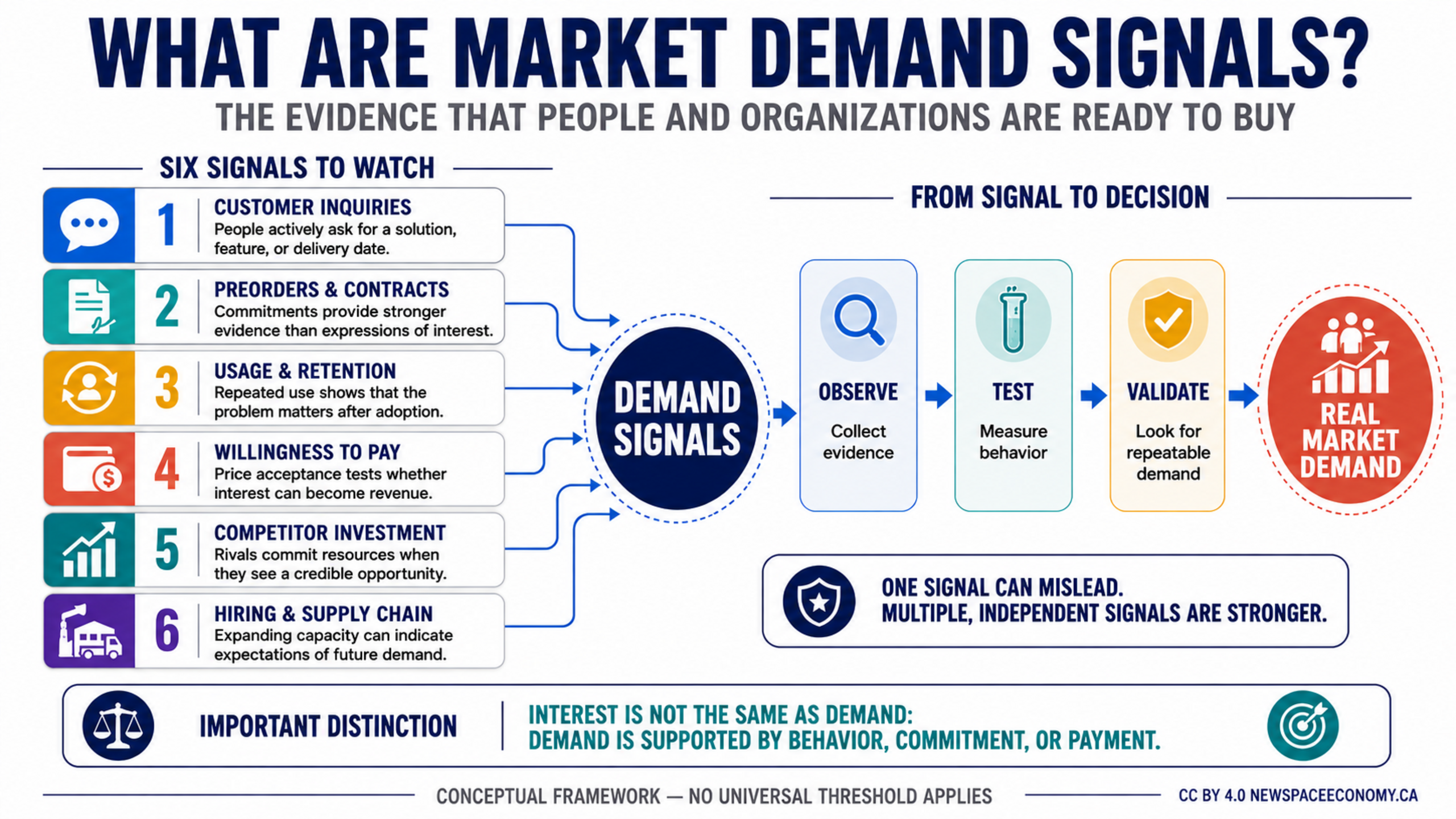
A technically impressive service can fail if customers do not face a problem large enough to justify its price. Commercial companies must identify who pays, how often they pay, and what alternative they currently use.
Government Procurement
Governments remain important early customers for launch, Earth observation, communications, defense, space weather, debris removal, and lunar delivery. Public contracts can help companies demonstrate capability and attract private capital.
Government procurement can also distort markets if companies depend on one customer, one program, or one political decision.
Launch Cost and Reliability
Lower launch prices can create new businesses, but price alone does not guarantee success. Customers also need reliable schedules, suitable orbits, insurance, regulatory certainty, and predictable spacecraft delivery.
Regulation
Space companies operate under national licensing, spectrum coordination, export rules, safety standards, environmental requirements, liability rules, and international obligations. Unclear regulation can delay investment. Excessively rigid rules can prevent small companies from entering.
Infrastructure
New services require ground stations, data networks, testing facilities, launch ranges, trained personnel, insurance, financing, and reliable supply chains. A company may have a viable product but still struggle because supporting infrastructure is unavailable.
Recurring Revenue
One-off missions can demonstrate technology but do not necessarily create a stable market. Stronger commercial prospects exist when customers require recurring imagery, connectivity, navigation, inspection, maintenance, data analysis, or transportation.
Standards and Compatibility
Servicing, docking, refueling, lunar operations, data exchange, cybersecurity, and navigation require agreed interfaces and procedures. Standards can reduce customer risk and allow multiple companies to participate.
Security and Trust
Spacecraft may carry sensitive data, provide defense services, or approach other spacecraft. Operators need confidence in ownership, command authority, cybersecurity, mission intent, and legal accountability.
The Commercial Shape of the Space Economy in 2026
The space economy in August 2026 includes established markets, expanding services, early commercial industries, and long-term concepts.
Established revenue remains concentrated in satellite communications, satellite television, navigation equipment, ground systems, spacecraft manufacturing, government programs, launch, and defense services. These markets support the infrastructure needed by newer industries.
The most promising emerging markets are closer to Earth and linked to clear terrestrial demand. Earth-observation analytics, direct-to-device communications, climate services, navigation resilience, satellite cybersecurity, and space-domain awareness can serve customers before large-scale lunar or orbital industry becomes practical.
In-space markets are developing in parallel. Satellite inspection, life extension, debris removal, orbital transportation, microgravity research, commercial stations, and lunar delivery have identifiable use cases, but each requires a combination of government demand and private investment.
Deep-space resource extraction remains further away. Its development will depend on transportation costs, robotic reliability, power systems, legal rules, resource verification, and the creation of customers for materials produced away from Earth.
Summary
The emerging markets of the space economy include far more than rockets and satellites. They cover commercial launch, reusable transportation, satellite manufacturing, broadband, direct-to-device connectivity, Earth-observation analytics, navigation, timing, climate services, space-domain awareness, cybersecurity, in-orbit servicing, debris removal, microgravity research, commercial stations, space tourism, lunar infrastructure, space resources, finance, insurance, regulation, ground systems, education, and workforce development.
The strongest near-term markets are those that solve existing problems on Earth. Satellite connectivity, geospatial analytics, climate monitoring, navigation resilience, defense services, cybersecurity, and space safety already have customers and operating use cases.
The most ambitious markets, including lunar resource use, asteroid mining, orbital manufacturing, space-based energy, and Mars logistics, remain dependent on technical and financial advances. Their long-term value may be substantial, but their commercial status should be described as developing, proposed, or speculative rather than established.