- Key Takeaways
- Vast Expands Beyond Its Initial Space Station
- Haven Demo Provides Evidence With Defined Limits
- Haven-1 Offers a Limited, Deliberate Starting Point
- NASA Offers Experience and Potential Demand
- National Astronaut Missions Build a Customer Base
- Research Revenue Depends on More Than Scientific Interest
- Private Capital Buys Development Time
- Satellite Sales Create Another Route to Revenue
- Haven-2 Raises the Operating Standard
- Summary
Key Takeaways
- Haven-1 targets a 2027 launch, with larger stations planned to support longer stays.
- Government astronaut missions offer early demand, but recurring station revenue remains unproven.
- Vast is expanding into satellites and lunar infrastructure before its crewed station begins operating.
Vast Expands Beyond Its Initial Space Station
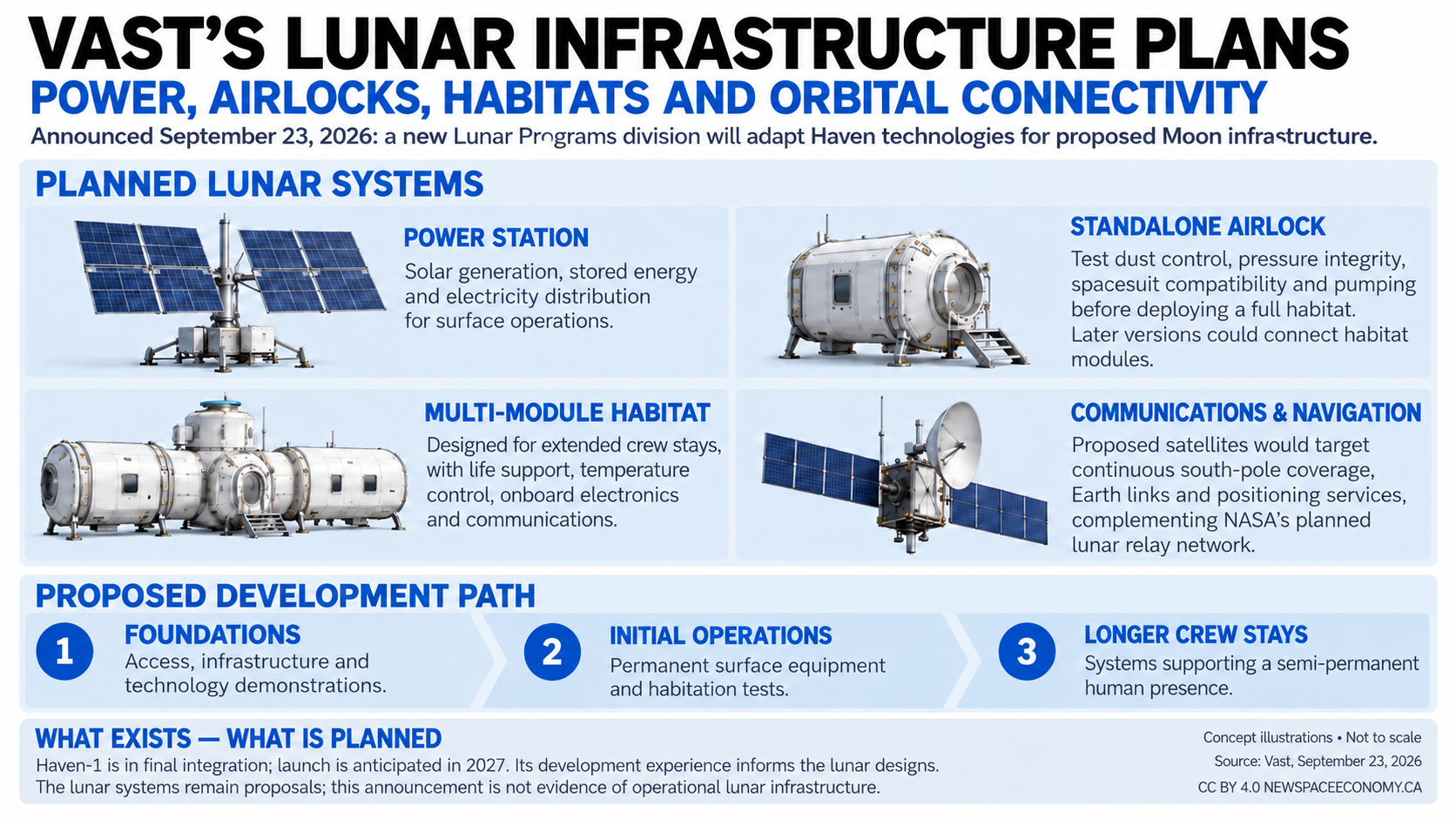
On September 23, 2026, Vast announced a Lunar Programs division, extending its business plans from Earth-orbiting stations to infrastructure on the Moon. The same announcement described Haven-1, its commercial space station under development in Long Beach, California, as being in final integration, with launch anticipated in 2027. Vast is pursuing new markets before completing the crewed orbital platform that remains central to its strategy.
The company’s lunar infrastructure proposal includes power equipment and a separate airlock. Larger habitats would follow, supported by proposed lunar communications and positioning satellites. These are development plans, rather than operational services or evidence of an awarded lunar habitat contract.
Vast’s expansion reflects a broader commercial calculation. A company developing equipment for human spaceflight acquires capabilities that may serve customers beyond astronaut missions. Manufacturing pressure vessels, controlling spacecraft temperatures, and operating flight software can create products for other missions. Whether those products generate attractive returns depends on the additional engineering required and the customers willing to purchase them.
Founded in 2021 by Jed McCaleb, Vast is led by chief executive Max Haot. Its business combines the Haven station program with astronaut mission services. Satellite manufacturing provides another potential revenue stream, and the lunar division extends its proposed product range farther from Earth.
The evidence supports a distinction between progress and commercial maturity. Vast has flown an uncrewed demonstration spacecraft, raised substantial financing, and announced customer agreements. It has not yet demonstrated that a company-owned crewed station can operate repeatedly at a price customers will pay and a cost the company can sustain.
That distinction shapes the commercial station investment debate. Hardware development can proceed well before a market becomes self-supporting. Conversely, prospective customers may hesitate to commit until they can inspect credible hardware and plan around a realistic flight schedule.
For Vast, the immediate task is to connect those two processes. Engineering must produce a dependable destination, and business development must produce enough funded activity to use it. Announcements about new markets expand the potential customer base, but they also increase the number of programs competing for management attention and investment.
Haven Demo Provides Evidence With Defined Limits
Vast’s completed orbital milestone is Haven Demo, an uncrewed spacecraft deployed on November 2, 2025. It flew aboard SpaceX’s Bandwagon-4 rideshare mission and underwent a controlled deorbit on February 4, 2026. Vast used the mission to test equipment intended to inform its larger spacecraft programs.
The demonstration carried flight computers and communications equipment. It also tested power and propulsion hardware. Operating those systems together in orbit provides evidence that ground testing alone cannot supply, including how spacecraft hardware and control software behave during an actual mission.
However, Haven Demo was not a habitable station. Its success does not establish that Haven-1’s complete life-support system can sustain people or that a visiting crew can safely occupy the station. The relevant achievement is narrower: Vast has operated its own spacecraft and can use the resulting experience when qualifying later designs.
Haven-1 moved into integration in January 2026. Vast’s integration announcement described installation of fluid systems and associated equipment, followed by additional electronics and air-processing hardware. Integration means assembling the vehicle’s systems and checking their interactions, rather than testing each component only in isolation.
That stage can reveal problems absent from individual component tests. A system may work correctly by itself but interfere with another system through electrical demand, heat, or software behavior. Finding such interactions before launch is part of the purpose of integrated testing.
Schedules have changed as this work progressed. In January 2026, Vast shifted its public readiness target from 2026 to the opening quarter of 2027. Its September 23 announcement uses the broader 2027 launch window. Neither statement establishes a confirmed launch date or a date for crew arrival.
Independent reporting has examined the distinction between launching a station and beginning crewed operations. Eric Berger’s January interview with Max Haot explored the schedule change and the work preceding astronaut arrival. Vast’s June mission announcement subsequently described an expectation that a crew could arrive within weeks of launch, but that remains a company plan dependent on readiness.
The strongest assessment of Vast’s progress consequently follows completed tests and demonstrated operations. A published launch target helps customers plan, but passing the remaining readiness gates will determine when those plans become executable.
Haven-1 Offers a Limited, Deliberate Starting Point
Haven-1 is designed for four occupants and visits lasting approximately two weeks. Vast lists 45 cubic meters of habitable volume within 80 cubic meters of pressurized volume. The distinction matters because equipment occupies part of a spacecraft’s enclosed interior, leaving less space available for daily crew activities.
The station’s published dimensions are 4.4 meters in diameter and 10.1 meters in height. Its listed mass is 14,600 kilograms, and its planned orbit is approximately 425 kilometers above Earth. Vast has contracted for launch aboard a SpaceX Falcon 9, with Dragon spacecraft providing crew transportation.
These specifications describe a compact facility built around short visits. Haven-1 should not be treated as a complete replacement for the International Space Station (ISS), which supports a much broader operational program. Vast’s larger Haven-2 proposal addresses its ambition for sustained human presence.
A smaller starting platform creates a manageable setting for learning, although it does not remove the demands of human safety. Vast can test its mission procedures and customer services without immediately deploying the full station architecture it proposes for later years. Each successful visit could produce operating experience relevant to subsequent hardware.
The interior includes private crew quarters and a communal table, together with a 1.1-meter domed window. These features form part of the station’s advertised design, alongside research facilities and communications through SpaceX’s Starlink network. Their commercial value will depend on how effectively the completed vehicle supports both work and daily life.
Habitability deserves attention beyond its visual appeal. Crew members need to find equipment, perform procedures, and move through confined spaces without unnecessary interference. A station can offer attractive accommodation yet still impose time costs if routine activities compete with research for space or attention.
Vast’s short-visit model also places pressure on preparation. A two-week mission offers limited time to recover from poorly defined experiment procedures or equipment problems. Customers need their research hardware tested and their operating instructions settled before departure, with clear responsibilities for handling unexpected results.
For prospective buyers, the useful measure is the service available during a mission. Interior volume alone says little about the amount of research completed, the quality of returned samples, or the reliability of communications. Those outcomes will determine whether Haven-1 generates repeat business after the novelty of an initial flight.
NASA Offers Experience and Potential Demand
The National Aeronautics and Space Administration (NASA) selected Vast in February 2026 to conduct the sixth private astronaut mission to the ISS. The mission order targets launch no earlier than summer 2027 and anticipates a stay of up to 14 days. Its actual timing depends on station traffic and other operational considerations.
This mission is separate from Haven-1. Vast will organize a flight to the existing international station using transportation purchased from SpaceX. The selection provides a route into crewed mission operations, but it does not constitute NASA approval of Haven-1 as a replacement destination.
The financial arrangements also require careful interpretation. Vast will purchase station services from NASA, including resources needed for daily operations. NASA will purchase the capability to return scientific samples requiring cold storage during transportation to Earth.
Those reciprocal purchases show how commercial human spaceflight can involve several transactions within one mission. The private operator sells access to customers, buys transportation, and purchases support at the destination. Government agencies may simultaneously act as facility providers and service buyers.
Longer-term station procurement presents a larger potential market. On July 6, 2026, NASA released a draft commercial station solicitation describing a competitive approach covering development, certification, and services. The agency proposed supporting two or more contractors during early development, followed by competition for later work involving one or more providers.
The July announcement also stated that NASA would proceed with its original commercial services approach following industry feedback. This updates the policy debate surrounding an alternative ISS-attached government core module discussed earlier in 2026. Earlier commentary should consequently be read in its chronological setting rather than assumed to describe the agency’s subsequent procurement position.
For Vast, an eventual station services contract could provide predictable demand and help attract additional private investment. It would also bring requirements that affect design, certification costs, and operating procedures. A company pursuing that market must finance work before knowing the full extent of future government purchases.
The discussion of NASA’s station viability concerns remains useful for understanding this tension, provided its May 2026 policy discussion is distinguished from NASA’s July announcement. Government demand can support a commercial operator without proving that the operator has developed a large nongovernment market. NASA’s procurement decisions and Vast’s customer development will need to be assessed separately, even when they influence each other.
National Astronaut Missions Build a Customer Base
Vast’s international agreements provide evidence of demand more specific than general expressions of interest in space tourism. On June 1, 2026, the company announced a two-mission agreement with France. The agreement covers an ISS mission and a Haven-1 crewed test mission, connecting access to the existing international station with a proposed commercial destination.
The European Space Agency (ESA), acting on behalf of the Czech Republic, also signed an astronaut mission agreement through Vast. Aleš Svoboda was proposed as pilot, subject to the relevant international crew approval process. The June 8 announcement described a planned 2027 mission using SpaceX transportation.
A September 9 agreement added Greece to the planned mission. Vast named Adrianos Golemis as a proposed mission specialist, subject to review and approval, joining Thomas Pesquet of France and Svoboda. These announcements identify prospective participants, but they do not mean that the mission has flown or that every remaining approval has been completed.
National astronaut missions have a different purchasing rationale from leisure travel. Governments may pay for research opportunities or domestic industrial participation. Education and national space capability can also influence spending decisions, making mission value broader than the individual astronaut’s experience.
That can create a customer base for an operator selling access without requiring each country to develop its own spacecraft. It also means demand depends partly on public budgets and national priorities. A successful mission does not automatically produce a commitment to buy another one at a fixed interval.
Other announcements remain more exploratory. Vast’s June agreement with the UK Space Agency concerns possible cooperation and commercial sponsorship for a Haven-1 flight involving astronaut John McFall. The wording describes an opportunity under consideration, rather than a funded mission with a confirmed departure date.
This difference matters when judging commercial traction. A memorandum of understanding records an intention to explore cooperation; a mission agreement can establish a more concrete relationship. Neither should be converted into an assumed revenue figure without disclosed financial terms.
The next business test is repeat purchasing. Vast will need to establish whether national customers return after an initial mission, expand their research programs, or reserve access to later stations. Public announcements establish a developing customer pipeline, but they do not yet reveal the frequency or profitability of future flights.
Research Revenue Depends on More Than Scientific Interest
Vast plans to sell access to the Haven-1 Lab, a research facility designed around eight standardized payload positions. Each position is advertised with 100 watts of continuous electrical power. The planned service includes remote monitoring and the delivery and return of products or samples through Dragon spacecraft.
Microgravity, the near-weightless condition experienced during orbital free fall, allows researchers to study processes differently from ground laboratories. The commercial question is whether access produces results valuable enough to justify the full mission cost. Scientific interest and an economically repeatable service are related, but they are different tests.
Vast has announced named institutional partners. Its April 2026 collaboration with Cedars-Sinai includes biomedical research and astronaut medical support. A planned Haven-1 experiment with Exobiosphere would investigate organoids, small cell structures used to reproduce selected characteristics of human organs.
In June 2026, Vast announced additional research memorandums with the University of California San Diego’s Sanford Stem Cell Institute and Auxilium Biotechnologies. LambdaVision and BioOrbit also joined the announced network. The agreements extend the group of organizations considering work on Vast platforms, but the announcement does not establish a disclosed revenue backlog for those activities.
Research purchasing can follow several paths. A university may fund an experiment through a grant, and a company may purchase access as part of product development. Those customers assess value differently, so an operator needs services that accommodate distinct funding schedules and standards of evidence.
The station’s responsibilities also extend beyond providing a payload slot. Customers need to know whether an experiment can operate unattended and how much crew time it requires. They need confidence in sample handling and in the integrity of data returned to Earth.
For biomedical work, results must survive scrutiny after the mission ends. A promising observation requires appropriate controls and reproducible methods before it can support a product-development decision. Spaceflight can provide a research environment, but it does not substitute for the later validation required by the intended application.
Manufacturing introduces an additional economic test. Producing a material in orbit is different from producing it consistently at a commercially acceptable delivered cost. Transportation, quality control, and postflight processing all affect that calculation.
Vast could earn useful revenue from experiments well before any customer develops a large manufacturing business. That would be a legitimate service market. The unresolved issue is whether the volume and pricing of those services can contribute enough to support station operations over repeated missions.
Private Capital Buys Development Time
Vast announced US$500 million in financing on March 5, 2026, consisting of US$300 million in Series A equity and US$200 million in debt. Balerion Space Ventures led the round, with McCaleb participating alongside additional institutional investors. The company said more than US$1 billion had been invested in its station technology and facilities.
The distinction between equity and debt is important. Equity supplies capital in exchange for ownership, accepting uncertainty over future returns. Debt carries repayment obligations whose consequences depend on terms that cannot be inferred from the headline financing amount.
Neither category represents customer revenue. Financing gives a company resources to complete development and pursue contracts. It does not establish the price customers will accept, the cost of operating a station, or the margin remaining after a mission.
Vast’s approach includes extensive internal engineering and manufacturing. Building more equipment internally can give a company greater control over design changes and production schedules. It can also require substantial spending on facilities and specialized staff before customers begin paying for completed services.
This creates a sensitivity to delays. If revenue-generating missions move later, the business may continue paying development and staffing costs for longer than planned. A large financing round can absorb some disruption, but the public total alone does not reveal how much schedule flexibility remains.
Public announcements also leave important commercial information undisclosed. Without complete debt terms or detailed operating costs, outside assessments cannot reliably calculate how long existing funds will last. Likewise, an undisclosed mission price prevents a defensible estimate of revenue from counting announced astronaut seats.
Staffing is another area where interpretation requires restraint. Business Insider’s August 2026 staffing report stated that Vast dismissed 46 employees, approximately 4% of its workforce, in what the company described as performance-related decisions. The report also noted continued recruiting and disagreements from affected employees about the explanation. That evidence does not by itself establish a financing crisis or a broad withdrawal from development.
The useful financial measures will become clearer as operations begin. Completed missions can reveal delivery costs, and repeat contracts can show whether prices support continued service. Until then, investment commitments demonstrate backing for the business plan, with future cash generation still to be established.
Satellite Sales Create Another Route to Revenue
On May 19, 2026, Vast announced Vast Satellite, a product line beginning with a 15-kilowatt-class satellite bus. A satellite bus is the supporting spacecraft platform that supplies services to a customer’s payload. The payload performs the mission, and the bus provides the equipment needed to keep it operating.
Vast said a confidential customer had signed an agreement for four satellites, with an option for up to 200 additional spacecraft. An option permits possible future purchases; it should not be counted as an order for all 200. The announcement did not disclose enough financial information to calculate the agreement’s contribution to the company’s business.
The product uses technology developed through the Haven programs. This gives Vast a potential way to sell equipment before a large crewed station market develops. Satellite customers may purchase platforms for communications or Earth observation without buying any astronaut services.
The satellite infrastructure expansion also changes how the company should be assessed. Station development and spacecraft manufacturing have different customer requirements. Success in one product line would not automatically demonstrate the profitability of the other.
Shared equipment could spread development spending over more units, which is a plausible economic benefit. However, that benefit depends on actual commonality. Extensive customization for individual customers can add engineering work and weaken the savings expected from repeated production.
Vast added a Special Programs division in July 2026 under Melanie Stricklan, formerly chief executive of Slingshot Aerospace. The company described the division as serving United States defense and intelligence customers through classified and unclassified work. The announcement establishes an organizational direction, rather than proving the existence or value of particular undisclosed contracts.
Diversification can reduce dependence on a single government procurement or one type of customer. It can also place additional demands on the same engineering workforce. For Vast, the practical issue is whether satellite and national security work can contribute resources to the station business without delaying the hardware needed to begin crewed operations.
Haven-2 Raises the Operating Standard
Vast’s proposed Haven-2 station is designed to expand through successive modules rather than remain a single short-stay habitat. Its published plan identifies an initial module in 2028 and a completed configuration in 2032. Vast’s broader roadmap targets the capability for continuous crew presence by 2030.
These dates describe company plans available as of September 23, 2026. They should not be interpreted as completed procurement decisions or guaranteed operational milestones. Funding, vehicle readiness, and customer requirements can all affect the schedule.
Continuous habitation changes the operating problem. A short visit uses a bounded supply of consumables and ends with crew departure. Sustained occupancy requires arrangements for replenishment and maintenance, with procedures that remain effective as equipment ages and crews change.
A larger station also needs to preserve useful customer capacity as its own support requirements grow. More internal space does not automatically mean proportionally more research revenue. Equipment, storage, and routine operations consume resources that cannot simultaneously be sold for other work.
Haven-1 could provide evidence relevant to that progression. Crew feedback could inform later interior designs, and actual maintenance experience could reveal which systems need easier access. Customer experiments could show whether advertised services match the work researchers most frequently request.
Vast’s long-term corporate roadmap also retains an ambition for artificial gravity. That concept involves producing gravity-like effects through rotation. It should remain separate from descriptions of Haven-1’s near-term microgravity service, rather than being presented as a capability already offered to customers.
The lunar program introduces a further change in environment. Vast proposes transferring Haven-derived technology into surface systems, but its announced plan includes a separate airlock demonstration to address lunar operating problems before deploying a complete habitat. Reusing designs may reduce some development effort; it does not establish that equipment is ready for every new mission environment.
Vast’s position will become easier to judge as these programs produce measurable outcomes. A safely occupied Haven-1 would strengthen confidence in its station operations. Repeat missions and funded research would provide commercial evidence, and subsequent modules would test whether that experience can support longer stays at greater scale.
Summary
Vast has assembled more than a station concept. Its record includes a completed demonstration flight, hardware progressing toward launch, and agreements associated with future astronaut missions. Financing and additional spacecraft products give the company several possible routes to support development, but its crewed station service remains ahead of it.
The business case will depend partly on how customers experience uncertainty. Researchers and national mission planners need dependable scheduling as much as they need an orbital destination. If Vast can make preparation requirements, costs, and delivery dates sufficiently predictable, customers may find it easier to fund recurring programs instead of isolated flights.
That purchasing behavior would provide evidence beyond publicity or occupancy during an inaugural mission. Repeated use would show that customers value the service enough to plan around it and pay again. Until such a pattern emerges, Vast’s progress is best understood as a substantial infrastructure development effort with identifiable customers, expanding ambitions, and commercial performance still to be demonstrated.