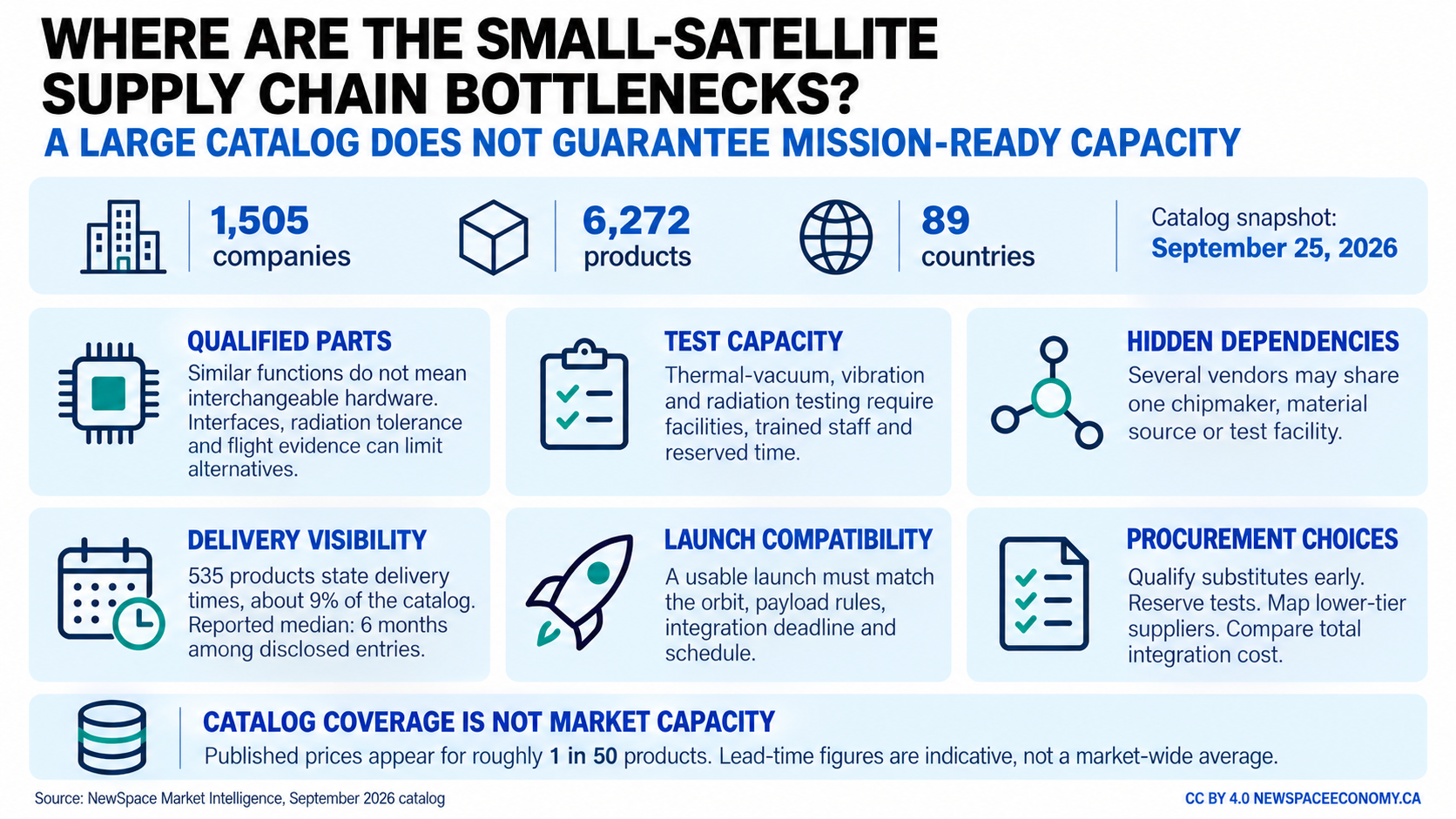
- Key Takeaways
- The Database Changes the Supply-Chain Question
- Where Supply Meets Hidden Constraint
- Qualification and Testing Can Limit Production
- Launch Availability Is More Than a Price per Kilogram
- Pricing Opacity Distorts Procurement Decisions
- Sovereign Capacity Changes Supplier Choices
- How Buyers Can Measure Resilience
- Small-Satellite Supply Chain Bottlenecks Will Move
- Summary
- Appendix: Top Questions Answered in This Article
- Appendix: Glossary of Key Terms
Key Takeaways
- Catalog depth can conceal shortages in qualified parts, test capacity, and production slots.
- Published lead times and prices remain too scarce for dependable procurement planning.
- Resilience depends on verified alternatives, shared standards, and earlier supplier commitments.
The Database Changes the Supply-Chain Question
The 2026 small-satellite supply-chain report from NewSpace Market Intelligence tracks 1,505 companies, 6,272 products, 372 launch windows, and 391 university programs across 89 countries. Those totals describe a sector with substantial commercial breadth, yet they do not prove that every mission can obtain qualified hardware at the needed time, price, and production volume.
A catalog counts products, not interchangeable choices. Two reaction wheels may perform similar functions but differ in radiation tolerance, vibration limits, software interfaces, export restrictions, flight heritage, or integration requirements. A spacecraft manufacturer cannot switch between them as easily as a consumer changes brands of electronics.
This distinction matters because the satellite manufacturing supply chain includes much more than visible spacecraft factories. It reaches semiconductor fabrication, specialty materials, machine tools, environmental testing, firmware, ground equipment, logistics, licensing, and insurance. A shortage in one narrow segment can delay hardware assembled from hundreds of otherwise available items.
Product totals also concentrate unevenly. The 2026 database lists 1,025 ground-segment products, 734 satellite platforms, 689 communications products, 501 software and service offerings, and 483 propulsion products. Other categories include attitude determination and control, payloads, structures, microelectronics, power systems, avionics, and launch vehicles.
The largest category is not automatically the least constrained. Ground systems include many software configurations and antenna offerings that serve different missions. Propulsion includes chemical, electric, cold-gas, and alternative systems that cannot be substituted without changing spacecraft mass, power, thermal design, and mission duration. Numerical abundance can coexist with operational scarcity.
Only about 535 products, roughly 9% of the catalog, state delivery times. Published pricing appears for approximately one product in 50. That missing information prevents buyers from converting a product directory into a dependable production plan. The real bottleneck often appears after a buyer requests a quotation, submits technical requirements, and learns that an advertised component has a long queue or an unfinished qualification campaign.
Where Supply Meets Hidden Constraint
The phrase “supply-chain bottleneck” often suggests an empty warehouse. Space manufacturing creates a more complicated form of scarcity. Hardware may exist but remain unavailable for a specific mission because the available unit lacks the required documentation, radiation performance, reliability evidence, or export authorization.
Supplier-stated lead times in the NewSpace Market Intelligence dataset extend from stocked inventory to five years, with a reported median of six months among products that disclose the information. That median cannot describe the whole market because most entries do not publish lead times. It still shows how procurement conditions can differ between catalog neighbors.
A six-month component order can fit a development schedule if engineering teams select it early. The same order becomes a mission delay when designers discover the need after completing a preliminary design. Redesigning the spacecraft around another supplier may affect connectors, software, thermal interfaces, structural mounts, power budgets, and environmental testing.
The cost of just-in-time manufacturing grows when launch dates are fixed and component schedules are uncertain. A delayed part can leave labor, cleanrooms, test equipment, and launch reservations unused. Buying early reduces schedule exposure but locks capital into inventory and increases the chance that requirements will change before integration.
Small companies face another constraint: order priority. A supplier with limited production capacity may favor a customer buying hundreds of units over a university mission buying two. Large constellation operators can fund tooling, negotiate reserved capacity, or develop components internally. Smaller manufacturers often accept standard product configurations and less favorable delivery terms.
The greatest exposure can sit below the named vendor. A spacecraft integrator may have two suppliers for a power module, yet both may depend on the same semiconductor foundry, connector manufacturer, radiation test facility, or specialty alloy. Visible supplier diversity then rests on a shared lower-tier dependency.
The fragile architecture of the space economy is shaped by these concentrated dependencies. Procurement teams need to map sub-tier sources, production locations, tooling, test facilities, and replacement times. Counting prime contractors cannot reveal whether several products rely on one industrial chokepoint.
Qualification and Testing Can Limit Production
Environmental qualification separates flight-ready hardware from equipment that appears suitable on paper. Components must survive combinations of vibration, shock, vacuum, radiation, temperature cycling, electromagnetic interference, and mission-specific operating conditions. The required campaign depends on the orbit, mission lifetime, spacecraft design, and customer.
Testing capacity is finite. Thermal-vacuum chambers, vibration tables, acoustic facilities, radiation sources, and electromagnetic compatibility laboratories require specialized staff and scheduled access. A component may leave the factory on time yet wait weeks or months for an available facility.
The U.S. space industrial base faces this problem at both supplier and infrastructure levels. An Aerospace Industries Association assessment identified constrained access to certified test facilities alongside component shortages and demand uncertainty. Its findings point toward a production system limited by verification capacity as well as factory output.
Flight heritage creates another barrier. Customers may prefer equipment that has already operated in orbit, but new products cannot acquire flight history without an initial buyer. Established suppliers gain an advantage even when newer entrants offer lower prices or improved performance. Government demonstration missions and hosted payloads can reduce this commercial adoption barrier.
Qualification is also configuration-specific. Changing a processor, coating, adhesive, or manufacturing location can require new analysis or testing. Suppliers facing shortages may find technically acceptable substitutes, yet customers still need evidence that the altered product meets mission requirements.
Standard interfaces can reduce redesign work, but standards do not remove qualification obligations. A mechanically compatible component may introduce different software behavior, electromagnetic noise, or heat rejection. Procurement resilience depends on maintaining verified engineering packages for alternatives before a disruption occurs.
The bottleneck sits at the boundary between industrial capacity and accepted evidence. Expanding factories without expanding test access may move queues from assembly to certification. Funding additional laboratories without producing trained operators creates a similar mismatch. Capacity plans need to connect manufacturing, testing, documentation, and customer acceptance.
Launch Availability Is More Than a Price per Kilogram
Launch supply appears broad when measured by the number of vehicles under development or the number of announced missions. Operational access depends on vehicles with completed flights, available manifests, suitable inclinations, compatible deployment systems, and regulatory approval.
The 2026 supply-chain database lists 193 launch vehicles and 372 launch windows. Many vehicles remain under development, serve restricted customers, or target different payload classes. A small satellite needing a sun-synchronous orbit cannot treat every geostationary, equatorial, or lunar launch as an alternative.
SpaceX’s published rideshare pricing has helped establish a visible benchmark for small-satellite launch costs. Price alone does not provide schedule control. A rideshare customer may need to accept the primary mission’s orbit, integration deadline, safety requirements, and deployment sequence.
The shortage of practical launch options becomes apparent when buyers filter available services by readiness, jurisdiction, destination, payload constraints, and timing. Dedicated small launch vehicles can offer more mission control, but many have struggled to reach dependable flight rates or sustainable economics.
Integration creates its own queue. Payload processing facilities, dispensers, range resources, licensing teams, and mission-assurance staff must all be available. Launch cadence can rise without giving every satellite operator a proportionate increase in usable capacity.
A spacecraft delayed by components may lose its reserved launch slot and wait for another compatible mission. Conversely, a launch delay can leave completed hardware in storage, requiring battery maintenance, software updates, repeated testing, and insurance adjustments. Supply-chain and launch schedules amplify each other.
Responsive launch programs seek shorter planning cycles, particularly for defense missions. Those services require prequalified spacecraft, standardized interfaces, available vehicles, prepared ranges, and regulatory coordination. A rocket held in reserve does not create responsive access if its payload or launch site cannot meet the same timetable.
Buyers should assess launch availability through probability-adjusted schedules rather than advertised cadence. Useful measures include the operator’s completed flight rate, manifest congestion, average delay, orbit compatibility, integration deadlines, replacement options, and financial capacity to continue service.
Pricing Opacity Distorts Procurement Decisions
Published prices appear for approximately 2% of products in the NewSpace Market Intelligence catalog. Most space hardware still requires a request for quotation, technical exchange, export review, and negotiation. That process protects customized pricing but prevents buyers from comparing total acquisition costs early.
A component’s purchase price represents one part of its economic effect. Integration labor, software adaptation, testing, documentation, shipping, customs, insurance, spare units, and schedule risk can exceed the initial price difference between suppliers. A cheaper unit with uncertain delivery may carry a higher expected mission cost.
Small organizations bear more of this information burden because they conduct fewer transactions. Large constellation manufacturers collect internal data across repeated purchases and can negotiate volume terms. Universities and new entrants may encounter the market only once per mission.
The space value chain distributes cost and risk across suppliers, integrators, operators, data processors, and customers. Limited price visibility makes it difficult to identify which stage captures value and which stage absorbs delays.
Framework agreements can improve visibility by setting price bands, delivery commitments, escalation rules, and options for additional units. Governments can publish aggregated procurement data without exposing sensitive technical information. Industry databases can separate list prices from verified transaction ranges.
Transparent capacity information may matter more than transparent unit prices. A supplier may quote an affordable component that cannot enter production for 18 months. Buyers need to know available monthly output, queue position, material dependencies, and recovery plans.
Suppliers have reasons to avoid fixed public pricing. Low production volumes, changing requirements, inflation, and export compliance can alter costs. Greater transparency need not mean a universal price tag. Standardized quotation fields could still expose assumptions, lead-time ranges, nonrecurring engineering charges, minimum orders, and validity periods.
Better information would help capital markets as well. Investors could distinguish companies with recurring production from firms selling prototypes into irregular programs. Insurers could price delay exposure with stronger evidence. Policymakers could direct industrial support toward demonstrated constraints instead of the most visible complaints.
Sovereign Capacity Changes Supplier Choices
Governments increasingly view space systems as communications, navigation, climate, defense, and emergency infrastructure. That status changes procurement. Price and performance remain relevant, but customers also examine ownership, jurisdiction, export controls, cybersecurity, political relations, and continuity during conflict.
The debate over space supply-chain resilience does not require every country to manufacture every component. Complete national self-sufficiency would be costly and technically unrealistic for most states. Governments can instead identify functions that must remain accessible during disruption and build domestic, allied, or contractually protected capacity around them.
Semiconductors, optical detectors, radiation-tolerant electronics, precision timing devices, propulsion materials, and secure communications components deserve close examination. Countries may accept foreign supply when inventories, licensing arrangements, shared production, or allied agreements reduce interruption risk.
Export controls can limit substitution. A buyer may identify a technically suitable replacement but lack permission to obtain it, transfer technical data, or integrate it with another controlled system. Compliance schedules need to enter procurement plans at the same stage as engineering schedules.
Foreign suppliers also face market-access risk. Changes in sanctions, investment screening, security rules, or licensing policies can affect contracts after design work begins. Multinational missions need clear allocation of legal responsibility and contingency plans for regulatory changes.
The question of whether space sovereignty requires domestic production is better reframed around assured access. A country can retain operational authority without owning every factory if contracts preserve data access, repair rights, alternative suppliers, and control over mission decisions.
Sovereign procurement can strengthen smaller suppliers through predictable demand. It can also fragment markets if national rules create incompatible standards and duplicate low-volume factories. Allied qualification recognition, common interfaces, and reciprocal market access can preserve resilience without dividing the industry into isolated blocs.
How Buyers Can Measure Resilience
Resilience requires evidence that a mission can continue after a supplier delay, test failure, regulatory interruption, or launch change. A second company name on a spreadsheet does not meet that standard unless the alternative has been technically and contractually prepared.
Procurement teams can begin with five practical measures:
- Identify sole-source components and shared lower-tier dependencies.
- Record verified lead times, production capacity, and queue positions.
- Maintain qualified substitutes for hardware with long replacement cycles.
- Reserve test and launch capacity before final integration.
- Track supplier finances, ownership changes, and regulatory exposure.
Digital engineering can reduce the cost of alternatives. Accurate interface models, test data, software documentation, and configuration control make it easier to evaluate substitutions. Buyers need contractual rights to the information required for continuity.
The products and services supporting space operations include many overlooked providers. Calibration laboratories, logistics firms, software verification teams, cybersecurity specialists, ground-station operators, and insurers can become schedule constraints even when spacecraft hardware remains available.
Governments can improve resilience through multi-year procurement, shared testing facilities, loan guarantees, advance purchase commitments, and demonstration opportunities. Such support should follow measured demand. Subsidizing capacity without credible customers can produce idle facilities rather than dependable supply.
Manufacturers can design resilience into product families by using common interfaces and controlled component substitutions. They can also publish clearer production information, including typical lead-time ranges and qualification status. Customers should reward disclosure instead of treating every schedule estimate as a binding promise.
Insurance markets could encourage stronger practices by requesting supply-chain maps and recovery plans. Lenders and investors can examine customer concentration, inventory policy, supplier deposits, and exposure to single facilities. These measures connect technical continuity with financial continuity.
The 2026 database provides a valuable map of commercial offerings. Its largest contribution may be showing what remains unreported. Markets function better when buyers can see prices, delivery ranges, qualification status, production maturity, and substitution limits.
Small-Satellite Supply Chain Bottlenecks Will Move
Capacity expansions can solve one constraint and expose another. More satellite factories increase demand for components, testing, operators, spectrum coordination, ground services, and launch. A sector that measures only spacecraft output may repeatedly discover its limiting resource downstream.
Automation may raise production rates for standardized buses and electronics. It will have less effect on long-duration radiation testing, specialized optical fabrication, regulatory review, or scarce engineering judgment. Workforce planning needs to distinguish tasks that can scale through machinery from those requiring experienced personnel.
Consolidation may provide capital for expansion but reduce supplier diversity. Vertical integration can protect one constellation and make independent customers more dependent on fewer merchant suppliers. Public procurement should examine market structure alongside unit cost.
Demand volatility remains a central problem. Suppliers hesitate to finance new facilities when orders depend on one constellation, one defense program, or one budget cycle. Customers then encounter constrained capacity when several programs accelerate together. Longer commitments can justify investment, but they can also lock buyers into outdated designs.
International coordination offers another route. Shared standards, reciprocal qualification, distributed production, and allied inventories can increase accessible capacity. These arrangements require rules for data, export control, cybersecurity, and emergency allocation.
The next version of a supply-chain map should connect products with maturity, lead time, pricing method, production location, qualification evidence, and sub-tier concentration. That data would reveal where abundance is real and where several apparent choices rest on one constrained input.
Small-satellite manufacturing no longer lacks suppliers in the aggregate. It lacks consistent visibility into which suppliers can deliver qualified products at mission speed. That is the distinction procurement teams, investors, and governments need to measure.
Summary
The small-satellite market contains thousands of products, yet operational choice is narrower than catalog totals suggest. Qualification status, test access, hidden sub-tier concentration, export rules, launch compatibility, and undisclosed production queues determine whether a listed product can support a real mission.
Supply-chain policy should move beyond counting firms. Buyers need verified lead times, prepared alternatives, capacity reservations, interface documentation, and continuity rights. Governments can support shared infrastructure and predictable demand without requiring complete domestic production.
The most useful future datasets will connect commercial breadth with delivery evidence. Once prices, queues, qualification, and dependencies become easier to compare, the industry can direct capital toward measured constraints rather than visible symptoms.
Appendix: Top Questions Answered in This Article
Why Can a Market With Thousands of Products Still Have Bottlenecks?
Products that perform similar functions may differ in interfaces, radiation tolerance, software, export status, and qualification evidence. A mission cannot substitute them without engineering work. Several vendors may also depend on the same lower-tier manufacturer or test facility.
What Is the Most Commonly Hidden Space-Supply Constraint?
Lower-tier concentration is often difficult to see. Two prime suppliers may use the same semiconductor foundry, specialty material, connector source, or testing laboratory. A disruption at that shared source can affect several apparent alternatives.
Why Does Testing Capacity Matter So Much?
Space hardware must demonstrate that it can survive launch and its intended operating environment. Limited access to thermal-vacuum chambers, vibration facilities, radiation testing, and qualified staff can delay otherwise completed equipment.
Does Rideshare Launch Solve Small-Satellite Access?
Rideshare reduces price for many missions, but it does not guarantee a preferred orbit or launch date. Customers must accept compatibility rules, integration deadlines, and schedule decisions shaped by the launch provider and primary mission.
Why Do So Few Suppliers Publish Prices?
Many products require customization, export review, nonrecurring engineering, and mission-specific testing. Suppliers often cannot quote one universal price. Standardized quotation fields could still make assumptions and additional charges easier to compare.
Is Domestic Manufacturing Necessary for Space Sovereignty?
Assured access matters more than manufacturing every item nationally. Governments can combine domestic production, allied supply, inventories, licensing rights, and qualified alternatives. Operational authority and access to data also affect sovereignty.
How Can Small Companies Reduce Supplier Risk?
They can select long-lead items early, reserve testing capacity, document interfaces, and maintain qualified alternatives for high-consequence components. Framework agreements may improve access to production slots and replacement units.
What Should Investors Examine in a Space Manufacturer?
Useful indicators include production throughput, supplier concentration, qualification status, recurring orders, inventory policy, and access to testing. A large contract backlog offers limited protection if the company cannot obtain essential parts or complete acceptance testing.
Can Standardization Eliminate Supply-Chain Delays?
Standards can reduce mechanical and software integration work. They cannot remove differences in performance, radiation behavior, cybersecurity, or mission assurance. Substitutes still need technical evaluation and acceptance.
What Data Would Improve the Market Most?
Verified lead-time ranges, production capacity, qualification status, pricing methods, manufacturing locations, and lower-tier dependencies would improve procurement decisions. These fields would make product catalogs more useful for schedule and continuity planning.
Appendix: Glossary of Key Terms
Small Satellite
A spacecraft with comparatively low mass, commonly used for Earth observation, communications, scientific research, technology demonstrations, or navigation. Definitions vary among organizations, so procurement decisions rely on specific mass, power, volume, and mission requirements.
Flight Heritage
Evidence that a component or spacecraft design has operated in space. Customers use flight heritage as one indicator of reliability, although prior performance does not guarantee success under a different mission environment or configuration.
Thermal-Vacuum Testing
Environmental testing that exposes equipment to vacuum and controlled temperature cycles. It helps determine whether hardware can operate under the heating, cooling, and pressure conditions expected during a space mission.
Lower-Tier Supplier
A company that provides materials, components, processing, or services to another supplier rather than directly to the spacecraft customer. Lower-tier dependencies may remain invisible until a disruption reaches several higher-level vendors.
Assured Access
A procurement and policy condition in which an organization expects continued access to an essential product or service during disruption. It may rely on domestic production, allied sources, inventories, contracts, licensing rights, or qualified alternatives.