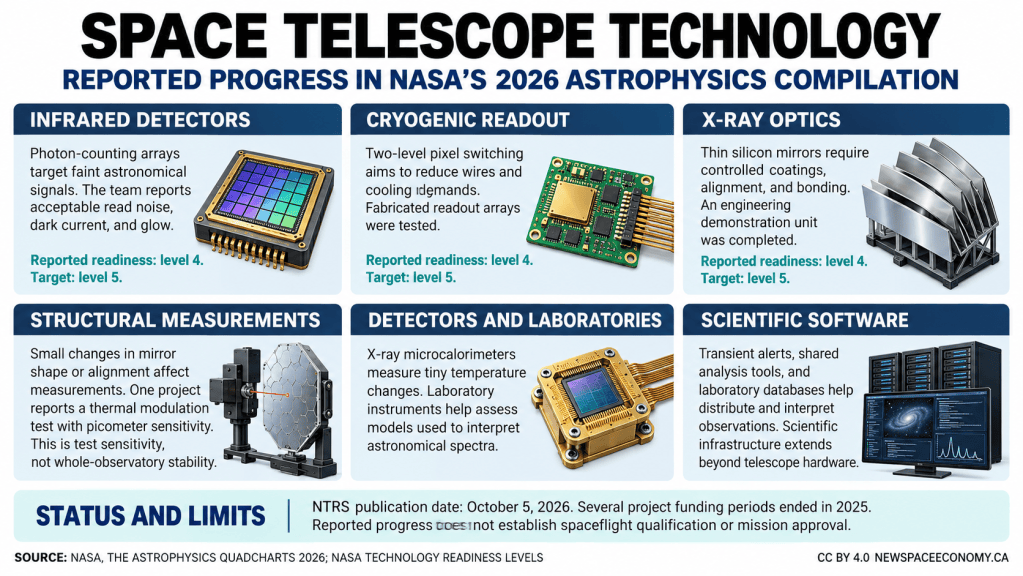
NASA’s The Astrophysics QuadCharts 2026, listed with an October 5, 2026 publication date in the NASA Technical Reports Server, documents work on detectors, optics, telescope structures, and scientific software. The technology compilation provides a specific account of space telescope technology development: what project teams attempted, what they report accomplishing, and which capabilities still require additional work. Several projects cover funding periods ending in 2025, so the publication date does not mean that every result was obtained in October 2026.
The report matters because a telescope’s scientific performance depends on more than its mirror diameter. Detectors must distinguish faint astronomical signals from instrument noise, structures must maintain the required optical alignment, and electronics must collect measurements without exceeding power or cooling limits. The compilation connects these engineering requirements to proposed and existing scientific applications. Its project summaries describe development progress, rather than announcing approval of the mission concepts mentioned in them.
One example concerns near-infrared detectors designed to measure very weak light. The project led by Michael Bottom at the University of California, Berkeley, studies linear-mode avalanche photodiode arrays. These semiconductor detectors amplify the electrical signal generated when light arrives. The intended applications include imaging and analyzing the light of planets outside the Solar System, as well as observing faint distant galaxies.
The team reports that detector read noise, dark current, and glow were within its acceptable limits. Read noise is introduced when electronics measure a detector’s signal. Dark current produces electrical charge even without the intended light, and glow is unwanted light generated within the instrument. These effects can interfere with measurements of faint objects. New Space Economy’s explanation of optical detector performance provides related context for these measurement constraints.
The detector chart reports that observations using a telescope raised the project’s technology readiness level to four, against a target of five. NASA’s technology readiness scale describes level four as component validation in a laboratory environment and level five as validation in a relevant environment. The distinction prevents a successful experiment from being interpreted as completed qualification for spaceflight. A detector can demonstrate useful performance and still need testing appropriate to its intended mission.
Another project addresses the electronics needed to read large arrays of far-infrared sensors. These sensors operate at very low temperatures, where cooling capacity is limited. Each additional electrical connection can complicate the design and introduce a thermal burden. The team’s approach uses two levels of pixel-address switching to reduce the number of cryogenic wires needed to collect measurements from a large array.
That chart reports fabricated and tested readout arrays, characterized performance, and an end-to-end noise test involving updated amplifiers. Its stated readiness remains at level four, with level five as the target. This result illustrates the difference between demonstrating a working component and establishing that it meets the conditions required for a particular instrument. The chart also identifies possible far-infrared applications without establishing a flight assignment.
X-ray optics introduce a different set of manufacturing problems. A project led at NASA’s Goddard Space Flight Center aims to combine fine angular resolution with lower mass and production cost. Its methods include thin silicon mirror substrates, reflective coatings, precise alignment, and bonding that preserves mirror shape. Small distortions introduced during coating or assembly can affect the image that the completed mirror system produces.
The team reports validating a coating stress-reduction method and completing an engineering demonstration unit based on an X-ray mission design. The reported current readiness level is four, against a target of five. The compilation separates these accomplishments from its performance objectives. Goals for lower cost, reduced mass, or improved resolution should remain goals unless the reported evidence establishes that the finished system achieved them.
Structural stability receives attention because changes in temperature or mechanical loading can alter optical alignment. The compilation describes methods for measuring small changes in structures and testing the response of mirror systems. A project associated with future ultraviolet, optical, and infrared telescopes reports a thermal modulation test with picometer sensitivity. A picometer is one trillionth of a meter; the claim concerns measurement sensitivity in the reported test, rather than the stability of an entire operating observatory.
The report also covers X-ray microcalorimeters, which measure the small temperature change produced when an X-ray is absorbed. Different projects examine large detector arrays, compact readout arrangements, and laboratory instruments used to evaluate models of astronomical spectra. Their readiness levels differ. A single maturity label for the entire portfolio would obscure differences between technologies and between their proposed applications.
Scientific infrastructure extends beyond instruments. The General Coordinates Network distributes alerts that help observatories coordinate measurements of transient events, including brief astronomical bursts. Its chart describes software modernization, searchable archives, identity management, and updated notices. Other entries discuss shared analysis tools and laboratory databases used to interpret observations. These capabilities affect whether measurements can be distributed, combined, and understood.
The maturity statements also require attention to their attribution. A Marshall Space Flight Center X-ray optics chart identifies a level-four assessment as asserted by the principal investigator. That wording makes the origin of the assessment explicit. The compilation records the teams’ descriptions of progress; a mission considering the hardware would still need evidence that the particular design meets its own requirements.
For suppliers and research organizations, the portfolio identifies areas where specialized fabrication, measurement, electronics, software, and testing contribute to astronomy programs. It does not establish an available procurement opportunity for every listed capability. Funding periods, reported maturity, collaborators, and intended applications must be evaluated separately before drawing conclusions about demand or a possible contract.
The compilation’s practical value is its separation of demonstrated results from development targets. It provides evidence for assessing individual technologies and the work still required to integrate them into scientific instruments. Decisions about future observatories will require that component evidence to be connected to system performance, mission conditions, cost, and verification requirements.
Useful Books Available on Amazon