As an Amazon Associate we earn from qualifying purchases.
Source: NASA
Key Takeaways
- NASA prepared a five-person Apollo return capability, but the Skylab rescue mission never launched.
- Thruster leaks prompted rescue preparations before engineers established a safe return procedure.
- Rescue depended on a habitable station, trained crews, docking access, and sufficient launch readiness.
A Spacecraft Failure Raised the Possibility of Stranded Astronauts
On August 2, 1973, a second thruster-system leak aboard the Apollo spacecraft attached to Skylab raised concern about whether three astronauts could return safely to Earth. Commander Alan Bean, science pilot Owen Garriott, and pilot Jack Lousma remained aboard the station as engineers investigated their spacecraft. NASA accelerated preparations for a separate flight that could retrieve them. The Skylab rescue mission would have launched two astronauts and returned with five.
The distinction between the station and its return vehicle explains the situation. Skylab provided living space, scientific equipment, electrical power, and supplies for extended stays in Earth orbit. An Apollo Command and Service Module (CSM) carried each crew to the station, remained docked throughout its expedition, and provided transportation home. A failure in that spacecraft could threaten the return journey without immediately making Skylab uninhabitable.
NASA’s rescue preparations addressed this particular combination of circumstances: astronauts could remain alive aboard an orbital station, but their assigned transportation might no longer provide a sufficiently reliable departure and landing. A replacement spacecraft could restore the missing return capability. The station’s ability to support its occupants gave ground teams time to prepare that replacement.
Skylab was launched without a crew on May 14, 1973. Its three occupied expeditions were designated Skylab 2, Skylab 3, and Skylab 4, making Skylab 3 the second crewed visit rather than the third. That numbering sometimes complicates accounts of the program. The rescue contingency, designated SL-R in NASA documentation, was separate from the scheduled expeditions.
It was also separate from the repairs undertaken by the first Skylab crew. Charles “Pete” Conrad, Joseph Kerwin, and Paul Weitz restored the station’s usefulness after damage during launch. Their work is often described as saving or rescuing Skylab. The unflown SL-R plan concerned retrieving people whose Apollo spacecraft could no longer bring them home.
New Space Economy’s coverage of the Skylab program provides the broader setting for these events. The rescue contingency deserves its own treatment because it involved a different objective, a modified spacecraft, additional crew assignments, and a defined launch preparation process.
Skylab Rescue Was Planned Before the 1973 Emergency
NASA did not begin designing the rescue mission after the second thruster leak. The program already contained a formal contingency for a disabled return spacecraft. The change record in its rescue mission requirements identifies May 17, 1972, as the original issue date. The August 24, 1973, revision incorporated further operational requirements during the period of actual Skylab flights.
The plan used hardware already associated with the program. For the first two occupied expeditions, the next scheduled Apollo spacecraft and Saturn IB rocket could be diverted to rescue duty. For the final expedition, a separate backup combination would provide the contingency. This arrangement linked emergency readiness to the preparation of the remaining scheduled flights.
That approach had practical advantages. NASA could use familiar spacecraft, existing launch infrastructure, and astronauts trained for Skylab operations. It did not require the development of a completely new rescue vehicle. The additional work centered on adapting an Apollo spacecraft to carry a larger returning crew and preparing the supporting mission procedures.
The first expedition illustrates how the arrangement worked. NASA’s account of Skylab 2’s return records that the next mission’s Saturn IB and Apollo spacecraft reached Launch Pad 39B on June 11, 1973, before the resident crew departed. If rescue had become necessary, Alan Bean and Jack Lousma would have flown to retrieve Conrad, Kerwin, and Weitz.
The identities of the potential rescuers depended on the expedition being supported. Brand and Lind became the designated rescue crew associated with the later Skylab missions. Describing them as the only astronauts ever considered for Skylab rescue would overlook the first expedition’s arrangement.
These preparations established more than an alternative spacecraft assignment. They required decisions about cabin equipment, crew transfer, flight control, return cargo, launch schedules, and recovery. Each decision had to be made before an emergency could demand its execution.
The planning also created a limit that remained important throughout the program. A rescue capability could exist without being immediately ready to launch. The available response time depended on how far the spacecraft, rocket, launch equipment, and personnel had progressed through their preparation schedules. Formal approval of the concept did not eliminate the physical work needed to make the mission flyable.
Apollo’s Cabin Could Be Modified to Return Five People
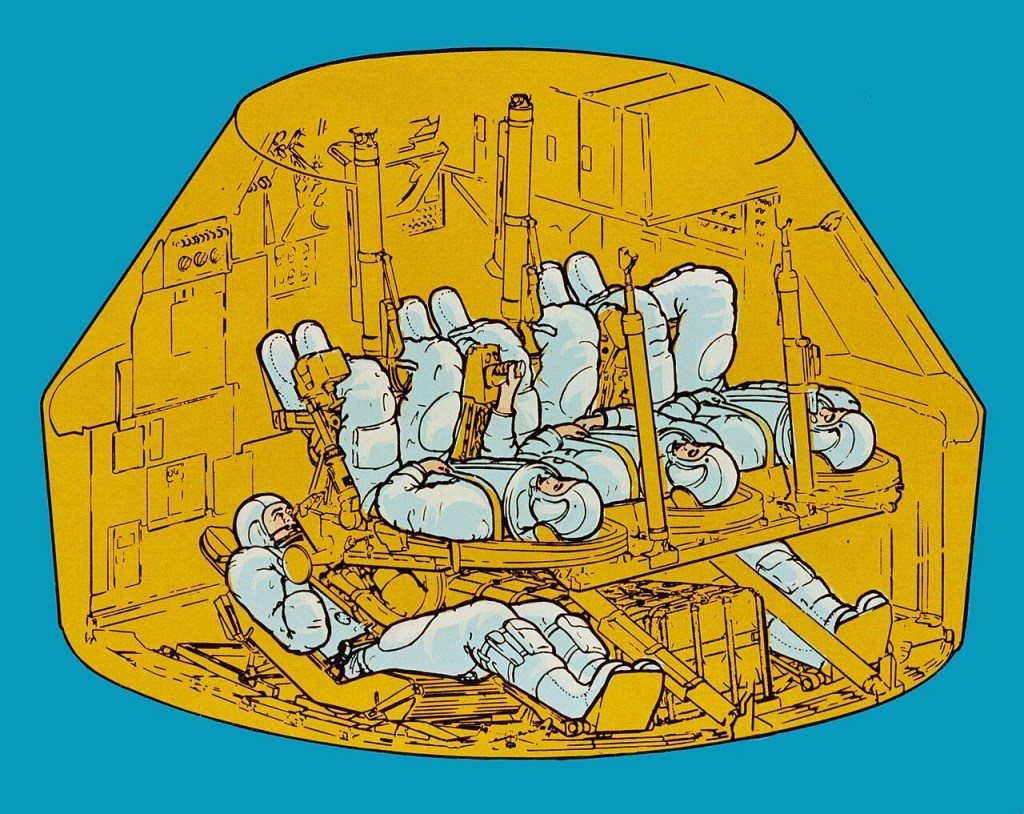
A standard Apollo command module carried three astronauts. Skylab rescue required a different configuration: two rescuers would launch, collect the station’s three occupants, and bring all five people back in the same capsule. NASA provided a modification kit that added two crew couches beneath the standard seating arrangement.
The additional couches occupied space otherwise used for stowage. That exchange was central to the design. A rescue flight needed capacity for people who had not been aboard during launch, and the command module’s available internal volume could not increase. Equipment placement and returning cargo had to accommodate the expanded crew.
The kit involved more than seats. NASA’s spacecraft safety review lists oxygen connections, masks, communications connections, additional crew equipment, ballast, postlanding ventilation equipment, and an experiment return pallet. It also identifies changes associated with the docking hardware. These items supported the complete rescue sequence rather than merely allowing five people to fit inside the cabin.
The equipment list shows why passenger capacity is an engineering requirement. Each added person needs support during the journey, a restraint arrangement for entry and landing, access to necessary equipment, and a workable procedure for leaving the spacecraft after recovery. Space available for a person’s body does not establish that the vehicle can safely transport that person.
Ballast addressed another consequence of the changing cabin configuration. A spacecraft’s mass distribution affects its behavior. The rescue vehicle would leave Earth with two occupants and return with five, together with selected equipment and scientific material. Planning had to account for the different conditions rather than assuming that additional seats were the only relevant modification.
The arrangement was intended for a short rescue flight. It did not convert Apollo into a spacious five-person orbital laboratory. Skylab would continue to provide the working and living environment until departure, and the command module would perform the transportation function.
The design distinguished between the duration of the rescue mission and the duration of the stranded crew’s wait. The replacement capsule needed to support the retrieval and return. The station needed to sustain its occupants until that capsule arrived.
This distinction helps explain the broader issue covered in New Space Economy’s discussion of spacecraft docking and rescue. Rescue requires compatible interfaces and sufficient capacity throughout the mission. A spacecraft that can reach another vehicle still needs a demonstrated way to accommodate its occupants and bring them home.
Two Thruster Leaks Triggered Accelerated Preparations
The problem began during Skylab 3’s flight to the station on July 28, 1973. One of the Apollo service module’s four thruster groups developed a leak. The crew isolated the affected group and completed its approach and docking using the remaining three.
Each group, or quad, contained four small rocket engines. They formed part of the reaction control system (RCS), which controlled spacecraft orientation and supported maneuvering. Orientation, often called attitude, describes which direction the spacecraft points. It is distinct from its position along an orbit.
A second leak occurred on August 2. NASA’s 1973 chronology identifies the affected groups as Quad B during the launch-day incident and Quad D during the later event. After the second group was isolated, Quads A and C remained operational. The immediate engineering question concerned whether the remaining capability was sufficient and whether further failures might follow.
Two apparently related problems justified investigation beyond the condition of the individual thruster groups. Engineers needed to determine whether the failures reflected separate defects or a common problem that could affect other parts of the spacecraft. That distinction would influence confidence in any return procedure.
The station supplied an important advantage during the investigation. Bean, Garriott, and Lousma were not dependent on their Apollo cabin for their daily living environment. They could remain aboard Skylab as ground specialists assessed the return vehicle and prepared alternatives.
Kennedy Space Center’s August 3 announcement described accelerated work on the Skylab 4 launch vehicle and spacecraft. Launch and checkout crews adopted a 24-hour, seven-day schedule. The announcement also stated that the astronauts were in no immediate danger and were continuing experimental assignments aboard the station.
Those circumstances matter when assessing the event. Rescue preparations did not establish that the crew had already become permanently stranded. NASA was responding to uncertainty about the transportation system and preserving another way to return the astronauts if the investigation produced an unfavorable result.
The sequence also demonstrates that emergency planning and diagnosis can proceed together. Preparing a replacement vehicle did not require abandoning analysis of the original spacecraft. Conversely, evidence that a return might remain possible did not immediately remove the value of continuing contingency preparations. The two activities addressed different parts of the same unresolved problem.
Brand and Lind Helped Establish a Safe Return Procedure
Vance Brand and Don Lind were assigned to fly the rescue mission if the later Skylab crews required retrieval. Their work also contributed to avoiding the flight. Ground simulations helped establish procedures that the Skylab 3 astronauts could use with the remaining service module thruster groups.
NASA’s account of the second expedition’s arrival explains that managers accepted workarounds developed by Brand and Lind in simulators. Those procedures supported returning in the original Apollo spacecraft despite the loss of half its service module thruster groups. The need for an actual rescue launch consequently diminished.
Simulation served a specific purpose. A crew could not safely establish every degraded operating procedure through trial and error in orbit. Ground facilities allowed astronauts and flight specialists to examine the available controls, sequence required actions, and assess the consequences of operating with reduced capability.
The work did not mean that the failed hardware had been restored. It meant that the remaining hardware, together with revised procedures, could support an acceptable return. That is an important distinction in accounts of spacecraft troubleshooting. A mission can recover an essential function without recovering every original component.
NASA’s contemporary chronology records growing confidence that the two failures did not indicate a general problem affecting all four quads. As the investigation progressed, the agency slowed the emergency preparation schedule. The operational decision reflected the combined evidence from troubleshooting and analysis of return options.
Bean, Garriott, and Lousma then continued their expedition. They installed an improved sunshade, maintained the solar observation equipment, and carried out biomedical and Earth observation research. NASA’s account of the 59-day mission describes scientific work that exceeded the planned research time.
The crew splashed down on September 25, 1973, aboard its original command module. NASA’s return account documents recovery by the USS New Orleans and the medical assessments that followed. No separate spacecraft had launched to collect the astronauts.
The outcome supports a measured assessment of the rescue preparations. They provided an alternative during a period of uncertainty, and the assigned rescuers helped evaluate a workable return in the existing vehicle. The contingency’s contribution cannot be judged solely by whether its rocket left the launch pad. Its personnel and preparation also supported the decision that an additional flight was unnecessary.
Launch Readiness Depended on Work Already Completed
The phrase “standby rescue vehicle” can suggest a rocket waiting to launch immediately. Skylab’s readiness arrangements were more conditional. Response time changed with the progress of assembly, spacecraft testing, launch equipment refurbishment, and pad operations.
The August 1973 mission requirements included a planning schedule showing approximately 48.5 days to rescue launch readiness at the beginning of certain expeditions. The interval shortened as preparations advanced, reaching nine days for the later portion of the Skylab 3 readiness schedule. These were planning values tied to a particular preparation state, not a universal promise of response time.
The initial period after a scheduled launch posed a substantial ground infrastructure problem. Launch equipment had just supported the departing expedition and needed to be made available again. The next rocket and spacecraft also had to complete work that ordinarily belonged to their scheduled mission preparation.
That dependency explains why a healthy station was essential to the rescue concept. A wait measured in days or weeks could be compatible with a supplied orbital laboratory. It would offer little protection against an emergency that made the station uninhabitable within minutes or hours.
During the actual Skylab 3 concern, NASA accelerated the next scheduled vehicle. The combination was Saturn IB SA-208 and Apollo spacecraft CSM-118. NASA’s Skylab 4 preparation history records that workers mated the spacecraft to the rocket on August 10 and rolled the stack to Pad 39B on August 14.
This identifies an important hardware distinction. CSM-118, intended for Skylab 4, entered the accelerated preparation process during the August emergency. CSM-119 was the dedicated backup spacecraft associated with rescue support for the final expedition. Treating both phases as a single CSM-119 operation obscures how the program used its next scheduled vehicle.
Readiness also required verification. A NASA flight readiness test described simulated launch functions and checks of compatibility between the rescue vehicle and its ground support equipment. Emergency scheduling could accelerate work, but the mission still depended on the interacting systems functioning correctly.
New Space Economy’s review of space rescue literature places this distinction in a broader setting. Rescue readiness includes the spacecraft, trained personnel, procedures, ground equipment, and time required to bring them together. A spare vehicle addresses only part of that requirement.
The Rescue Flight Needed a Usable Docking Route
A rescue mission would have launched from Kennedy Space Center’s Launch Complex 39B on a Saturn IB. Its two astronauts would enter Earth orbit, approach Skylab, and establish a connection through which the station’s occupants could transfer into the replacement Apollo spacecraft.
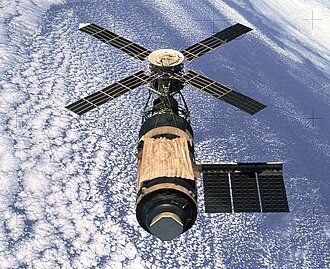
Skylab had two docking ports: an axial port at the end of its docking adapter and a radial port on the side. The second port made it possible for another Apollo spacecraft to reach the station even if the resident crew’s vehicle remained attached.
The mission requirements allowed two principal configurations. If circumstances permitted the disabled spacecraft to be jettisoned, the rescue vehicle could use the axial port. If the original spacecraft remained attached, the rescue vehicle could use the radial port. The document identified the axial port as the preferred rescue connection and the radial port as the backup.
The docking decision would affect more than the route through the hatch. Attaching another spacecraft changed the mass and geometry of the combined assembly. The approach, lighting, orientation, and control requirements consequently needed to match the selected configuration.
This is a useful example of the engineering discussed in New Space Economy’s history of rendezvous and docking. Rendezvous brings spacecraft into a suitable relative position and motion. Docking establishes the mechanical connection needed for subsequent operations. Successful completion of the first activity does not automatically establish the second.
For Skylab rescue, an internal transfer offered a defined route between the station and the replacement capsule. It avoided making every retrieved astronaut perform an independent transfer through open space. The arrangement still depended on accessible hatches, a functioning connection, and sufficient control of the vehicles.
The station itself remained part of the rescue system. Its docking adapter, attitude control, communications, and internal passageways contributed to the mission. A rescue vehicle could not compensate for every possible failure elsewhere in that system.
The implications follow directly from these dependencies. A plan that retrieves people from a stable, habitable station has a narrower operating envelope than a general capability to recover occupants from any damaged spacecraft. Skylab rescue was designed around a known destination and known interfaces. That specificity made the preparations practical, but it also defined which emergencies the mission could address.
Recovery Had to Account for People and Scientific Material
The rescue objective was the safe return of the Skylab crew. NASA also planned to recover selected experiment data, investigate the disabled spacecraft, and prepare the station for a later visit when circumstances permitted. Those additional activities were subordinate to bringing the astronauts home.
Scientific recovery mattered because much of Skylab’s research produced physical material. Film, magnetic tapes, biological specimens, and other samples needed transportation to Earth. Some observations could be transmitted, but a transmission could not replace every item collected during an expedition.
The five-person cabin configuration reduced the space available for returning equipment. Rescue planning required selection rather than the assumption that everything from the normal mission could be brought back. Returning people and preserving scientific results competed for finite cabin volume and allowable mass.
The proper interpretation of this planning is conditional. It did not mean that astronauts would be required to delay departure to recover every experiment. It established priorities and procedures for retaining useful material when the crew’s condition and the spacecraft’s capabilities allowed it.
The same reasoning applied to preparing Skylab for another expedition. Leaving systems in a suitable condition could preserve the possibility of continued research. That work was valuable only if it remained compatible with the rescue’s primary purpose and available time.
Recovery on Earth also needed to match the larger crew. The plan ended with water landing and recovery of all five astronauts, rather than ending at the moment they entered the replacement capsule. Flight duration, landing conditions, medical support, and removal from the cabin belonged to the complete mission.
Experience from the actual expeditions demonstrated why the final stage deserved attention. NASA’s Skylab 3 recovery account describes the capsule initially floating upside down, being righted by its inflatable bags, and being hoisted aboard the recovery ship with the crew still inside. Medical teams then assisted the astronauts from the capsule and assessed their condition.
These operations were particularly relevant after an extended stay in weightlessness. The returning crew’s needs could differ from those of the two rescuers, whose flight would have been much shorter. A workable retrieval mission had to account for those different experiences without assuming that every occupant could perform the same tasks after landing.
The mission’s requirements consequently extended through orbital transfer, atmospheric entry, splashdown, and medical recovery. Adding return seats was necessary, but safe delivery of the additional occupants required attention to every subsequent stage.
A Dedicated Vehicle Supported the Final Expedition
Skylab 4 launched on November 16, 1973, carrying Gerald Carr, Edward Gibson, and William Pogue. Because it was the final scheduled expedition, NASA could no longer rely on another routine Skylab flight being prepared behind it. The separate rescue combination consisted of Saturn IB SA-209 and Apollo spacecraft CSM-119.
Preparing that combination still depended on ground equipment availability. NASA had one mobile launcher equipped with the elevated platform used for Saturn IB launches from the Saturn V launch facilities. Assembly of the dedicated rescue vehicle followed the launcher’s return after Skylab 4 departed.
The rescue stack reached Pad 39B on December 3, 1973. NASA’s launch history states that, after December 20, its preparation state supported a launch within nine days if required. The vehicle remained available during the final expedition, but no emergency required it to fly.
Carr, Gibson, and Pogue returned on February 8, 1974, after an approximately 84-day mission. The rescue vehicle returned to the Vehicle Assembly Building on February 14 and was dismantled for storage. NASA later designated SA-209 and CSM-119 as backup hardware for the Apollo-Soyuz Test Project.
The conclusion of crewed Skylab operations ended the contingency’s original purpose. All nine astronauts who visited the station returned in the command modules that had carried them into orbit. The five-person rescue configuration never completed an operational rescue flight, so its history should not be presented as a demonstrated five-person landing.
Later programs faced related planning questions. For the 2009 Hubble servicing mission, NASA prepared the unflown STS-400 contingency with Endeavour available to retrieve Atlantis’s crew if needed. NASA’s Hubble servicing history explains that access to a second shuttle addressed the absence of an International Space Station safe haven for that mission.
That later arrangement did not duplicate Skylab’s hardware or transfer procedures. It repeated the operational decision to support a scheduled flight with a separately prepared rescue option. The relevant comparison concerns advance preparation, launch timing, crew survival, and retrieval capacity.
For the space economy, these arrangements identify concrete operational obligations. Emergency support requires personnel, testing, ground infrastructure, available transportation, and recovery services. New Space Economy’s coverage of the in-space rescue capability gap examines the broader question of converting rescue concepts into usable capabilities.
Skylab’s experience supports a specific lesson: a rescue plan becomes operationally meaningful when its equipment, interfaces, procedures, people, and response time are defined together. Its value also depends on whether the distressed crew can survive long enough for that system to reach them.
Summary
NASA’s Skylab rescue mission was a prepared contingency for retrieving astronauts whose docked Apollo spacecraft could no longer provide a safe return. It would have used a Saturn IB to launch two rescuers in a modified Apollo capsule, collect the station’s three occupants, and bring five people back to Earth.
The plan came closest to use during Skylab 3, when two service module thruster groups developed leaks. Investigation and simulator work established an acceptable return using the original spacecraft, and the crew completed its expedition. A dedicated rescue vehicle subsequently supported Skylab 4 without launching.
The program’s significance rests in its preparation and its limits. Skylab supplied a habitable place to wait, Apollo supplied adaptable transportation, and NASA organized the supporting launch and recovery operations. The arrangement addressed a disabled return vehicle at a functioning station. It did not provide an immediate response to every possible orbital emergency.
Appendix: Top Questions Answered in This Article
What Was the Skylab Rescue Mission?
The Skylab rescue mission was an unflown NASA contingency for returning astronauts whose Apollo spacecraft had become unsuitable for a safe journey home. A modified Apollo capsule would launch with two rescuers, dock with Skylab, and return with the station’s three occupants, producing a total landing crew of five.
Did NASA Ever Launch a Skylab Rescue Flight?
NASA never launched the Skylab rescue mission. Preparations accelerated during the second occupied expedition, and a dedicated vehicle supported the final expedition. All three Skylab crews ultimately returned aboard the command modules that had transported them to the station, so no separate retrieval flight became necessary.
Why Did Skylab 3 Nearly Require Rescue?
Two service module reaction control system thruster groups developed leaks, leaving two of the four groups operational. NASA investigated whether further failures could occur and whether the remaining systems could support a safe return. Engineers and astronauts established suitable procedures, allowing the expedition to continue without a rescue launch.
Who Would Have Flown the Rescue Spacecraft?
Vance Brand and Don Lind were assigned to the rescue contingency associated with the later Skylab expeditions. The arrangement for the first occupied expedition was different: Alan Bean and Jack Lousma would have flown the next scheduled spacecraft to retrieve Conrad, Kerwin, and Weitz if their return vehicle had become unusable.
How Could an Apollo Capsule Carry Five Astronauts?
NASA developed a modification kit that installed two additional crew couches beneath the normal three-person seating arrangement. The configuration used space otherwise allocated to stowage. Supporting equipment included oxygen and communications connections, additional crew supplies, ballast, and ventilation provisions, making the modification more extensive than simply adding seats.
Could the Rescue Rocket Have Launched Immediately?
The rescue vehicle could not launch immediately throughout an expedition. Readiness depended on assembly, testing, pad operations, and launch equipment availability. Early planning intervals could extend for weeks, shortening as preparation advanced. Skylab’s ability to sustain its occupants during that wait was an essential part of the contingency.
Which Spacecraft Was Prepared During the August Emergency?
NASA accelerated preparations for CSM-118 and Saturn IB SA-208, the combination intended for Skylab 4. This followed the plan to use the next scheduled mission’s vehicle for rescue if needed. CSM-119 and SA-209 subsequently provided the dedicated rescue backup for the final occupied expedition.
How Would the Rescue Spacecraft Have Docked?
The rescue plan allowed use of Skylab’s axial or radial docking port. If the disabled Apollo spacecraft could be removed, the replacement could use the axial port. If it remained attached, the second port offered another connection. The chosen arrangement would determine the applicable approach and control procedures.
Was Crew Rescue the Same as Repairing Skylab?
Crew rescue and station repair had different objectives. The first expedition repaired launch damage that had left Skylab overheated and short of electrical power. The SL-R contingency would retrieve astronauts if their transportation home became unusable. Both activities concerned mission safety, but they involved different operations and spacecraft requirements.
What Was the Main Limitation of the Rescue Plan?
The plan depended on astronauts retaining access to a habitable station until the replacement spacecraft arrived. It could address a disabled return vehicle under those circumstances, but it could not guarantee timely assistance after rapid loss of station pressure, a severe fire, or another emergency that removed the crew’s ability to wait.
Appendix: Glossary of Key Terms
Command and Service Module
The Apollo spacecraft combination used to transport Skylab crews. The command module contained the astronauts and returned through the atmosphere. The attached service module supplied propulsion and supporting systems during flight, then separated before the command module’s atmospheric entry.
Reaction Control System
A set of small rocket engines used to control a spacecraft’s orientation and support maneuvering. Skylab’s Apollo service modules carried thruster groups arranged around their exterior. Isolating a leaking group reduced the available control capability without necessarily disabling the entire spacecraft.
Crew Couch
A shaped seat and restraint assembly that supports an astronaut during launch, entry, and landing. Its function includes managing the loads experienced by the occupant. The Skylab rescue modification added two couches to the command module’s normal three-person arrangement.
Rendezvous
The process of bringing two spacecraft into a suitable relative position and motion for close operations. It requires control of their paths and approach speed. Rendezvous precedes docking, which establishes the physical connection through which people or equipment may subsequently transfer.
Axial Docking Port
A spacecraft connection positioned along the main lengthwise axis of Skylab’s docking adapter. It served as the normal arrival point for occupied expeditions. Rescue planning treated it as the preferred connection when circumstances allowed the disabled return spacecraft to be removed.
Radial Docking Port
A spacecraft connection positioned on the side of Skylab’s docking adapter. It provided a second access point when another Apollo spacecraft occupied the axial port. Using it required approach and control procedures appropriate to the resulting spacecraft arrangement.
Launch Readiness
The condition of a launch vehicle, spacecraft, supporting equipment, personnel, and procedures required for a mission to proceed. Readiness develops through preparation and testing. A vehicle assigned to standby duty may still require additional work before it can launch.
Safe Haven
A location that can sustain astronauts after another part of their mission system becomes unavailable or unsafe. Its usefulness depends on life support, supplies, access, and the duration of the wait. Skylab could provide this function if its return spacecraft failed.